

table of contents
A lot of practice administrators reach the same point at the same time. Visits are up, providers are busy, payer rules keep changing, and the billing team is spending more of its day reacting instead of controlling the process. Claims are sitting in A/R longer than they should. Denials are coming back for reasons that look preventable. Leadership wants cleaner reporting, faster cash, and fewer surprises.
That's usually when claims management stops looking like a back-office task and starts looking like a strategic operating decision.
For health systems, urgent care groups, specialty clinics, and growing independent practices, claims management companies can fill a real gap. But not every vendor solves the right problem. Some submit claims quickly and little else. Others bring stronger workflows, better denial follow-up, tighter documentation controls, and reporting that helps leaders make decisions before cash flow slips.
The difference matters because a claims partner touches the part of your business where clinical work turns into revenue. If that handoff is weak, the rest of the revenue cycle stays under pressure no matter how hard your front desk, coders, or finance team work. Strong revenue cycle management support doesn't just move claims out the door. It helps practices recover control over denials, reimbursement timing, and payer communication.
The Growing Need For Claims Management Partners
A familiar pattern plays out in growing practices. A multi-site clinic adds providers, opens another location, and keeps the schedule full, but cash does not keep pace with volume. Claims start breaking in more places at once. Eligibility errors increase, coding habits vary by site, payer edits pile up, and staff spend more time correcting work than preventing problems upstream.
The billing team usually sees the strain first. One person is fixing registration errors from yesterday. Another is chasing claims that should have been touched two weeks ago. Leadership gets reports at month end, but the numbers often show the result, not the cause.
That is the point where many organizations reassess whether their current model can still support growth.
In healthcare, claims management is no longer just about getting submissions out the door. The harder question is whether your operation can consistently keep denials low, move clean claims through quickly, and identify where revenue is leaking before A/R stretches out. Practices that invest in stronger revenue cycle management support usually do it because internal effort alone is no longer enough. The process has become too fragmented, too payer-specific, and too dependent on timely follow-up.
Why Healthcare Leaders Are Reassessing The Model
The strongest claims management companies stand out in two areas. First, they can show a track record of reducing denial rates, not just working denials after the fact. Second, they combine technology with specialized human judgment. Software can scrub claims, route work queues, and flag patterns. It cannot replace an experienced team that knows which denial codes point to front-end training issues, which ones require coding review, and which payers need a different follow-up approach.
That distinction matters because average vendors often create the appearance of activity. They submit claims, post updates, and send reports. High-performing RCM partners improve the underlying process. They tighten registration controls, standardize claim logic across locations, assign accountability for unresolved balances, and give leaders reporting they can effectively use to intervene.
A practice should expect structure in four areas:
- Front-end accuracy: finding registration, authorization, and eligibility issues before they become preventable denials.
- Submission consistency: applying the same billing rules across sites, providers, and specialties to reduce avoidable rework.
- Focused payer follow-up: keeping unpaid claims from aging in work queues with no clear owner.
- Operational reporting: showing where denials start, how long claims sit, and which payer or workflow changes are affecting cash.
If internal conversations keep returning to “we need to work denials harder,” the underlying issue is usually broader than denials. It is workflow design, ownership, and visibility across the revenue cycle.
Healthcare leaders are not just buying extra labor. They are looking for a partner that can handle complexity, reduce preventable write-offs, and give the organization better control over revenue performance.
What Claims Management Companies Actually Do
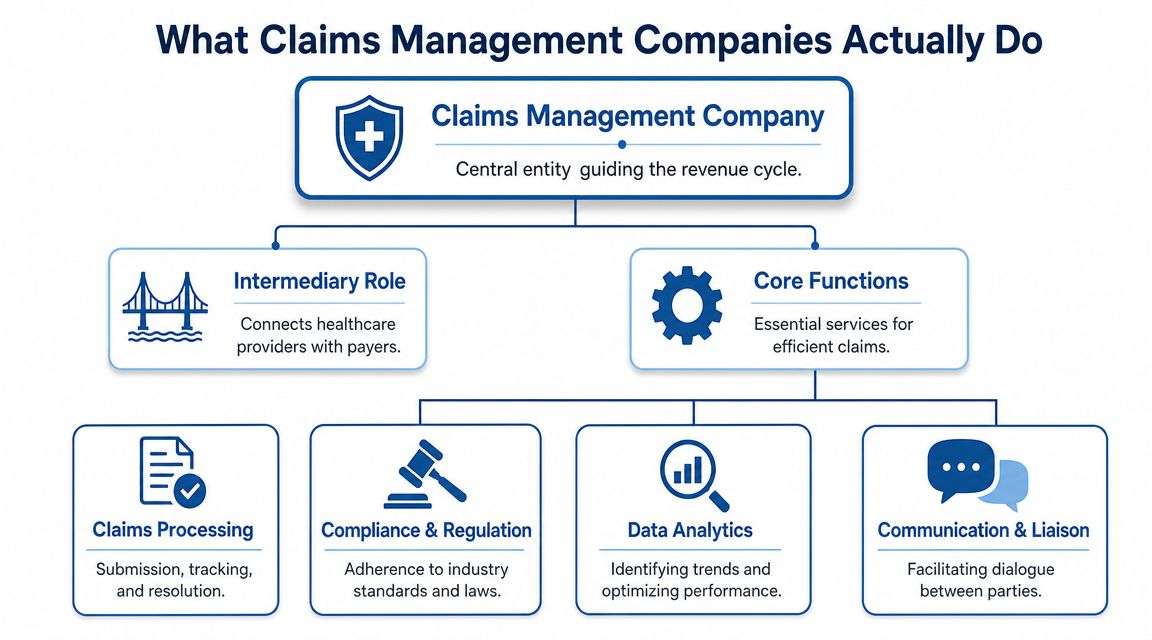
A claims management company sits in the middle of one of the highest-risk transitions in healthcare operations: the point where clinical documentation has to become a clean, payable claim. If that conversion is weak, revenue slows down fast. If it is managed well, cash moves predictably and denial volume stays under control.
That role has become more specialized as the market has grown. Mordor Intelligence projects the healthcare claims management market will grow from USD 32.17 billion in 2026 to USD 67.78 billion by 2031, with software and cloud-based solutions leading that expansion (Mordor Intelligence healthcare claims market projection).
Here's the operating model at a glance.
They Manage The Transition From Encounter Data To Reimbursed Claim
The visible work is straightforward. Claims are prepared, submitted, tracked, corrected, appealed, and posted. The harder part is controlling failure points before they turn into rework.
High-performing firms do more than move claims through a queue. They check whether documentation supports the code set submitted, whether modifiers match payer expectations, whether attachments are required, and whether a claim is likely to hit an edit before it ever leaves the system. For teams that want a clearer view of where each task fits, this outline of the medical billing process steps is a useful reference.
A key distinction arises between average vendors and strong RCM partners. Average vendors process volume. Strong partners reduce preventable denials because they know which edits can be automated, which payer rules need specialty-specific review, and which exceptions require an experienced biller or coder to intervene.
They Combine Technology With Human Judgment
Software matters, but software alone does not fix claims. Work queues, claim scrubbing, status automation, and reporting tools can remove manual effort and catch common errors early. They are part of the answer, not the whole answer.
Healthcare claims break in ways that require context. A modifier may be technically valid but still inconsistent with the payer's reimbursement pattern. A denial may look like a coding problem when the underlying issue is authorization timing or registration quality. This is why the better companies blend workflow technology with experienced staff who know payer behavior, specialty billing rules, and escalation paths. Simbie AI's revenue cycle insights reflect the same point. Revenue cycle improvement comes from pairing automation with informed operational follow-through.
They Create A Single Operating Process Across Teams, Locations, And Payers
Many organizations do not have one claims process. They have several versions of one. Each location handles edits a little differently. Each biller documents follow-up in a different format. Each payer issue gets worked according to whoever touched it last.
A capable claims management company standardizes that environment. It creates common work queues, shared documentation rules, defined escalation steps, and reporting that leadership can use without translating ten different local habits into one story. Guidewire describes the broader model as a connected system that centralizes notes, documents, financials, and workflow status, then adds automation and analytics on top (Guidewire on modern claims management practices).
That consistency has direct financial value. Clean claims go out faster. Follow-up does not disappear into personal inboxes or old notes. Denials get classified the same way across the organization, which makes root-cause analysis much more reliable.
They Turn Claim Activity Into Management Information
A practice does not need another monthly spreadsheet full of touches, submissions, and open balances. It needs to know whether the partner is reducing denial rates, shortening time to resolution, and stopping repeat issues from coming back.
The better firms translate claim activity into decisions. They show whether a payer edit changed, whether one specialty is driving avoidable denials, whether underpayments are increasing, and whether the source problem sits in registration, coding, documentation, or follow-up. That is operational support, not clerical support.
The right partner does not just report what was denied. They identify why it happened, who should fix it, and what process change will keep it from hitting the same work queue next month.
The Core Services That Drive Your Revenue Cycle
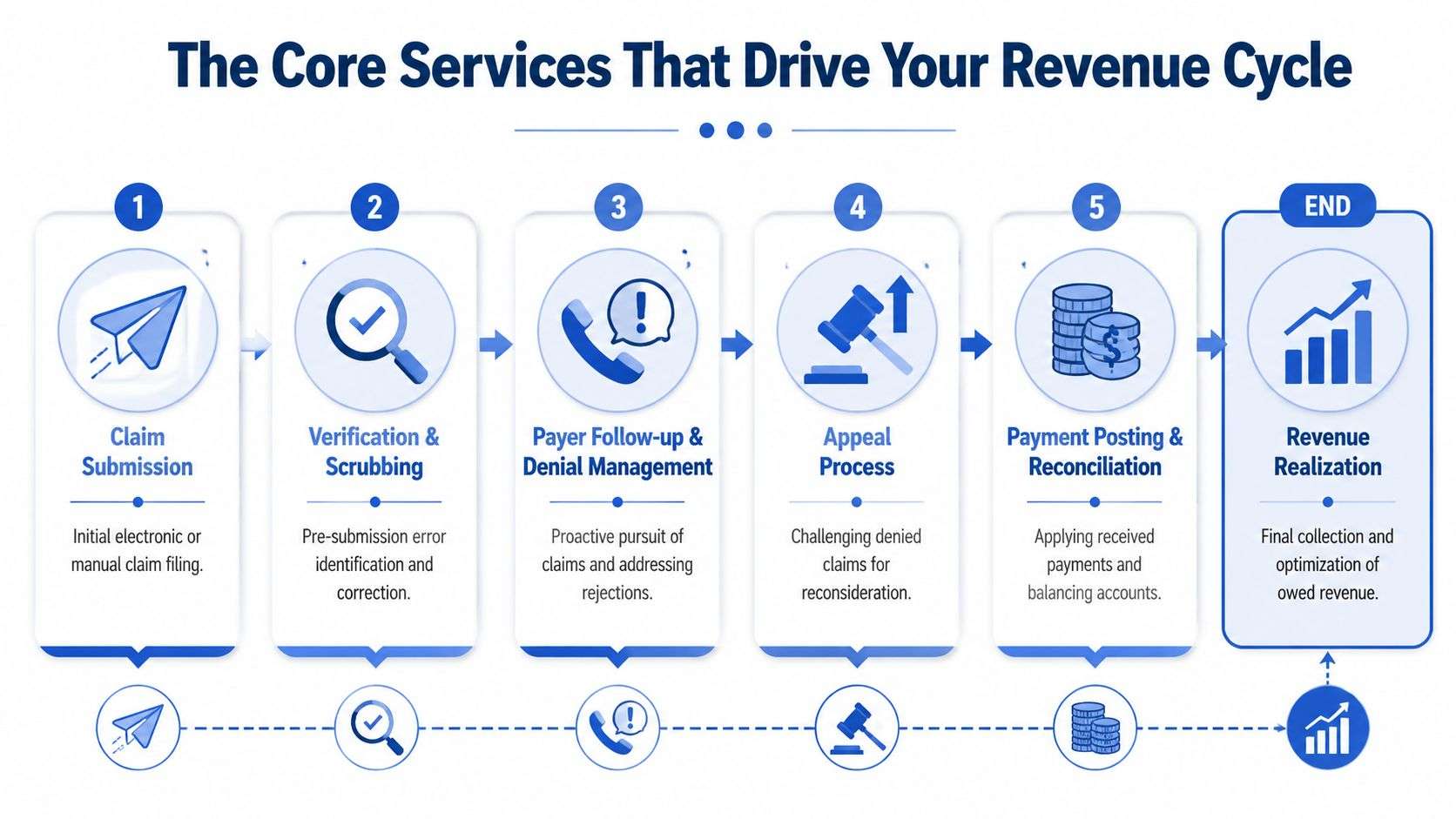
The day-to-day value of claims management companies shows up in the lifecycle details. Revenue doesn't improve because claims are “handled.” It improves because specific points of failure are managed in a disciplined order.
Eligibility And Front-End Review
Many denials start before the patient is seen. Coverage isn't active, authorization isn't in place, demographic data is off, or the visit type doesn't match payer requirements. A claims partner should help tighten these front-end controls, even if the practice still owns registration.
This part matters because bad front-end data creates downstream waste. Staff end up touching the same claim multiple times when they could have resolved the issue once before the encounter.
Coding Support And Claim Preparation
Coding is where clinical documentation gets translated into billable language. In simple primary care settings, that may look routine. In urgent care, behavioral health, infusion, pain management, or rheumatology, it rarely is.
A useful partner doesn't treat coding as isolated keystrokes. They connect coding decisions to payer edits, modifier usage, documentation sufficiency, and specialty patterns. That's one reason medical billing remains such a large part of the health claims management market. One industry report cited in the verified data notes that medical billing accounted for about 58% of total revenues in the health claims management market in 2023 (Grand View Research healthcare claims management overview).
Claim Submission And Scrubbing
Submission should be fast, but speed alone isn't the goal. Claims need to be scrubbed for missing fields, coding conflicts, payer-specific edits, and supporting documentation requirements. Otherwise, the claim leaves your system quickly and returns just as quickly.
Technology provides a solution here. Rules engines, work queues, and automated edits can catch recurring issues early. If you want a broader strategic view of where automation fits into performance, Simbie AI's revenue cycle insights offer a helpful perspective on how healthcare organizations are thinking about optimization across the revenue cycle.
Payer Follow-Up And Denial Management
This is the service line most buyers ask about, and for good reason. Denials are where average vendors and high-performing RCM partners separate. Anyone can say they “work denials.” The important question is how.
A serious denial workflow includes:
- Root-cause grouping: separating registration errors from coding issues, medical necessity denials, timely filing problems, and payer processing mistakes.
- Ownership rules: deciding which denials belong to the practice, the coder, the claims team, or a payer escalation path.
- Appeal discipline: sending complete, timely, well-supported appeals instead of generic resubmissions.
- Prevention loops: feeding recurring denial reasons back to front desk, clinical, and coding teams.
For practices comparing operating models, this overview of medical billing denial management is useful because it shows why appeals alone won't solve a denial problem that starts upstream.
Payment Posting, Reconciliation, And A/R Recovery
Payment posting sounds routine until it isn't. If remits are posted inconsistently, underpayments get missed, contractual adjustments are misapplied, and balances move into A/R without a clear path to resolution. Strong claims management companies treat posting as a control point, not just an administrative task.
A/R follow-up is where persistence matters. Some claims need status checks. Others need corrected submissions, documentation, rebilling, or escalation. Cycle time is a core performance metric here. VCA Software notes that cycle time is measured from claim creation to final resolution, and timeline analysis helps identify handoff delays and idle time that slow reimbursement and keep A/R high (VCA Software on claims data analysis and cycle time).
If a partner can't show where claims stall between submission and payment, they can't improve cash flow in a reliable way.
Key Benefits And Common Pitfalls Of Outsourcing
Outsourcing claims work can improve revenue operations, but it isn't automatically a win. The upside is real. So are the failure modes.

Where Outsourcing Helps
The clearest benefit is access to a team that lives in payer workflow every day. That often means stronger denial handling, better process consistency, and less dependence on one or two internal employees who carry too much institutional knowledge.
It can also reduce internal administrative strain. That doesn't mean your practice stops owning the revenue cycle. It means your staff can shift more attention to registration quality, patient communication, documentation support, and exception management instead of chasing every unpaid claim by hand.
For organizations thinking more broadly about support functions, the operational logic is similar to the case for benefits of call center outsourcing. The value usually comes from specialization, staffing consistency, and the ability to standardize work that internal teams struggle to scale.
Where Outsourcing Fails
The biggest pitfall is choosing a vendor that talks about process efficiency but can't prove it knows how to manage denials. That gap gets expensive quickly. Transcure cites an average denied-claim appeal cost ranging from $25 to $118, and says more than 65% of denied claims are never resubmitted because organizations lack the time, staffing, or tracking to pursue them consistently (Transcure on denial management economics).
If your partner submits clean-looking dashboards but can't explain appeal turnaround, payer escalation routines, or denial categories by specialty, you may be outsourcing lost revenue.
Common warning signs include:
- Weak reporting: monthly summaries without actionable denial categories or aging detail.
- Slow communication: issues sit in email chains instead of defined workflows.
- Generic staffing: the same team handles every specialty with no evidence of payer-specific expertise.
- No prevention mindset: denials are “worked,” but root causes keep repeating.
Outsourcing works when the partner takes ownership of process discipline. It fails when the partner only takes ownership of task volume.
The Real Trade-Off
You give up some direct control. In return, you should gain stronger process consistency, broader expertise, and better visibility. If you lose control and don't gain those things, the model isn't working.
How To Evaluate And Select The Right Partner
Most vendor reviews start too high level. Buyers ask about dashboards, software integrations, and staffing models, but skip the harder operational questions. That's where mistakes happen.
Claims are getting more complex, and vendor selection has to reflect that reality. Riskonnect notes that claims leaders are under pressure to manage speed, compliance, reporting, and cost containment at the same time, while analytics and predictive modeling are used to flag higher-risk claims for earlier intervention (Riskonnect on claims pain points and vendor evaluation). In healthcare terms, that means you should ask how a vendor uses automation without letting important claims slip through without human review.
Start With The Operating Questions
Before software demos, ask how the partner runs the work.
- Specialty fit: Have they worked your visit types, coding patterns, and payer mix before?
- Denial workflow: Who reviews denials first, and what determines whether a claim is corrected, appealed, or escalated?
- Communication: How often will your team receive updates, and who owns unresolved issues?
- System access: Will you have visibility into work queues, claim status, and notes?
- Implementation: What data, templates, payer enrollments, and workflow changes are required before go-live?
One practical reference point is reviewing firms that offer full-cycle support. For example, revenue cycle management company options can help administrators compare the kinds of services and operating models available in the market.
Vendor Evaluation Checklist
| Evaluation Area | What To Look For | Key Question To Ask |
|---|---|---|
| Specialty Expertise | Experience with your specialty, payer mix, and documentation patterns | How do you handle denials and coding issues that are common in our specialty? |
| Denial Management | A defined process for triage, correction, appeal, and prevention | What happens after a claim is denied, step by step? |
| Reporting Transparency | Clear aging, denial, and payer trend reporting that leaders can act on | What reports will we receive, and how often? |
| Technology And Workflow | Integration with EHR or PM tools, task visibility, and claim status tracking | How will our team see claim notes, open issues, and payer follow-up activity? |
| Compliance And Security | HIPAA-aligned workflows, access controls, audit readiness, and secure data handling | How do you protect PHI and document compliance controls? |
| Human Oversight | Experienced staff reviewing exceptions, appeals, and edge cases | Which claims are handled automatically, and which are reviewed by specialists? |
| Onboarding Process | A realistic transition plan with milestones and responsibilities | What has to happen in the first month for implementation to stay on track? |
Look Beyond The Sales Language
A polished presentation can hide weak execution. Ask for concrete examples of how the partner handles payer edits, missing authorizations, modifier disputes, underpayments, and aging claims that require repeated follow-up. Don't accept “we customize our process” as a complete answer.
Security also needs more than a verbal assurance. If a vendor handles protected health information, administrators should expect real controls around access, testing, and remediation. For teams reviewing their broader vendor risk posture, HIPAA penetration testing services can help frame what meaningful security validation looks like.
The Best Buyers Test For Accountability
Good questions include:
- What does your denial escalation path look like when a payer gives conflicting responses?
- How do you identify recurring root causes across locations or providers?
- What work stays automated, and where do trained billers or coders step in?
- How will you show us whether performance is improving or just being maintained?
- Who on your side owns implementation, and who owns ongoing account performance?
One option in this market is One For All Medical Billing, which provides eligibility verification, coding, claims submission and management, payment posting, denial follow-up, A/R support, and reporting for healthcare providers. The right fit, though, depends less on the service list and more on whether the partner can demonstrate specialty alignment, transparent workflows, and disciplined follow-up.
Selection test: If you can't picture exactly how an unpaid claim moves through the vendor's system, you don't yet know enough to sign.
Implementation And Partnership In Action
The first 60 days after signing usually tell you whether you hired a true revenue cycle partner or a vendor that can only talk well in a sales process. I have seen implementations look calm on paper and still fail because open denials, payer enrollments, and front-end workflow errors were never assigned to an owner. Good rollout plans prevent that.

What A Healthy Rollout Looks Like
A strong implementation starts with operational detail, not generic kickoff language. The partner should map data access, clearinghouse connections, payer enrollment status, claim edits, work queues, reporting definitions, and escalation rules before they start touching volume. Just as important, both sides need written decisions on preexisting A/R, aging denials, credit balances, and who has authority to contact payers when responses conflict.
The practical question is simple. What happens to a claim that fails on day one?
Average firms focus on getting claims out the door. High-performing RCM partners also define who reviews rejections, how root causes are logged, when coders step in, and how trends get pushed back to registration, authorization, or clinical documentation teams. That is the difference between a vendor that processes claims and a partner that lowers denial rates over time.
Training on the practice side matters just as much. If registrars keep collecting incomplete demographics, if authorizations are still handled inconsistently, or if providers continue to miss documentation requirements, the outsourced team spends its time cleaning up preventable errors. Internal education tools such as revenue cycle management training can help standardize those workflows before bad habits carry into the new model.
What Partnership Looks Like By Practice Type
A multi-site urgent care group usually needs control and consistency. One location may document a visit one way, another may code it differently, and a third may miss eligibility steps during peak hours. The right claims partner brings common work rules across sites and shows whether denial patterns are tied to one clinic, one payer, or one staff process.
A specialty practice needs depth. Pain management, rheumatology, behavioral health, and infusion services generate denials that software alone will not fix. The partner has to know which edits can be corrected quickly, which require appeal language, and which point back to documentation or authorization failures upstream. In these cases, the blend of technology and specialized human review matters most.
A health system or large physician group needs governance. Shared dashboards are useful, but they are not enough by themselves. Leadership should expect consistent KPI definitions, formal issue escalation, regular payer trend reviews, and a clear line from denial categories to financial impact by entity, specialty, and location.
Why The Partnership Matters Long Term
Implementation should be treated like an operating change, not a software install. If the handoff is done well, the organization gets cleaner claim flow, faster identification of denial trends, and better visibility into where revenue is being lost. If it is done poorly, the practice inherits months of rework, disputed accountability, and reporting no one trusts.
Strong partnerships make performance easier to manage because ownership is clear, technology handles repeatable work, and experienced billers or coders intervene where judgment is required.
If your organization is reviewing claims management companies and needs a healthcare-focused partner, One For All Medical Billing offers support across eligibility verification, coding, claims submission, denial follow-up, A/R management, payment posting, and reporting. For practice administrators and health system leaders, the useful next step is a practical conversation about payer mix, denial patterns, specialty needs, and implementation requirements so you can judge fit based on operations, not promises.

