

table of contents
An abnormal creatinine or eGFR result often starts as a clinical follow-up issue and ends as a revenue issue. The provider orders a kidney panel to monitor diabetes, hypertension, NSAID use, or a medication adjustment. The lab comes back abnormal. The claim goes out with a vague diagnosis, or with R94.4 standing alone, and the payer treats it like a screening finding instead of a medically necessary problem.
That’s why abnormal kidney function icd 10 is harder than it looks. The coding question usually isn’t whether the lab is abnormal. It’s whether the chart tells a payer what that abnormality means, whether it’s acute or chronic, and whether the submitted diagnosis matches the documented clinical picture closely enough to survive edits, audits, and medical necessity review.
Practice managers feel this first in denials, rework, and coding back-and-forth. Coders feel it when they can see the kidney issue in the labs but can’t support a more specific diagnosis from the note. Providers feel it when a payer rejects a claim that was clinically reasonable but poorly documented. The fix isn’t a longer diagnosis list. It’s cleaner logic, tighter documentation prompts, and workflows that connect the lab, the assessment, and the claim.
Why Coding Abnormal Kidney Function Is So Challenging
The hard part isn’t finding the abnormal result. It’s turning that result into a defensible claim.
A lot of encounters involve kidney monitoring that sits inside another specialty’s workflow. Endocrinology checks renal function for diabetes care. Primary care checks it before adjusting blood pressure medication. Pain management checks it during chronic NSAID or opioid management. In each case, the kidney finding may be clinically important without yet being a fully documented renal diagnosis.
That gap creates denials fast. Payers don’t reimburse a lab flag. They reimburse a documented, medically necessary service tied to a supported diagnosis. If the note says only “abnormal renal labs” and the claim carries an unspecified or isolated diagnosis, the payer may read that as incomplete, unsupported, or not tied to the reason for care.
Where The Claim Usually Breaks
Three breakdowns show up repeatedly:
- The note stops at the result: The chart records an abnormal creatinine or eGFR, but doesn’t state whether the provider considers it transient, acute, chronic, medication-related, diabetic, hypertensive, or still under evaluation.
- The code is technically possible but operationally weak: A code like R94.4 may fit the lab finding, but if it stands alone in a non-nephrology setting, it often doesn’t tell the payer enough about medical necessity.
- The lab and diagnosis don’t line up: The chart supports chronic kidney disease staging, but the claim uses an unspecified code. Or the chart suggests acute worsening, but the provider documents “renal insufficiency” without the clarity needed for correct code selection.
Practical rule: If the payer can’t tell why the kidney study mattered in that encounter, your claim is already at risk.
Operationally, the best-performing teams build prompts into their workflows instead of relying on memory. Strong healthcare software solutions can help surface missing documentation before claim submission, especially when multiple specialties share the same EHR. A structured clinical documentation improvement workflow matters just as much, because coders can’t bill specificity that providers never documented.
A Quick Reference To Key Kidney Function ICD 10 Codes
When teams search for abnormal kidney function icd 10, they usually need a fast code map first, not a textbook explanation. The simplest way to think about these codes is by intent. Are you coding an abnormal study, an acute condition, a chronic staged disease, or an unspecified failure that usually needs closer review?

R94.4 For Abnormal Kidney Function Studies
R94.4 means abnormal results of kidney function studies. The World Health Organization shows that this code was formally introduced in 1992 and is used when kidney function findings are abnormal but a specific, stageable diagnosis like CKD hasn’t yet been documented in the record, according to the WHO ICD-10 classification for R94.4.
This is the right family when the provider has abnormal kidney test results but hasn’t established acute kidney failure, chronic kidney disease, or another defined renal diagnosis. It covers the finding. It does not replace diagnosis-level documentation.
N17 For Acute Kidney Failure
The N17 family is for acute kidney failure. For this family, coders need to slow down and read the provider’s language carefully. Acute kidney failure codes include subcategories for documented acute pathophysiology, such as tubular necrosis and other specific acute presentations.
Use this family only when the provider’s documentation supports an acute condition, not just a concerning lab value or vague renal decline.
N18 For Chronic Kidney Disease
The N18 family is for chronic kidney disease. This series depends on documented chronicity and stage. Once the provider establishes CKD, coding should move away from a sign-or-finding code and into the stage-specific chronic disease code that matches the chart and available GFR documentation.
This code set matters because stage specificity affects medical necessity logic, risk adjustment relevance, and payer scrutiny.
N19 For Unspecified Kidney Failure
N19 is unspecified kidney failure. In practice, it’s a red flag.
If the chart supports acute kidney failure, chronic kidney disease, postprocedural kidney failure, or an abnormal study without confirmed failure, N19 is usually the wrong answer. It may pass internal review in a hurry-up environment, but it often triggers payer edits and post-bill cleanup.
Use N19 only when the documentation truly gives you no supported path to a more specific renal code. In most organizations, that should trigger a query or escalation, not a default habit.
For billing teams, this quick reference helps frame the first question correctly. Are you coding a test finding, a sudden renal event, a chronic staged disease, or an unspecified diagnosis that needs more provider detail before the claim leaves the door?
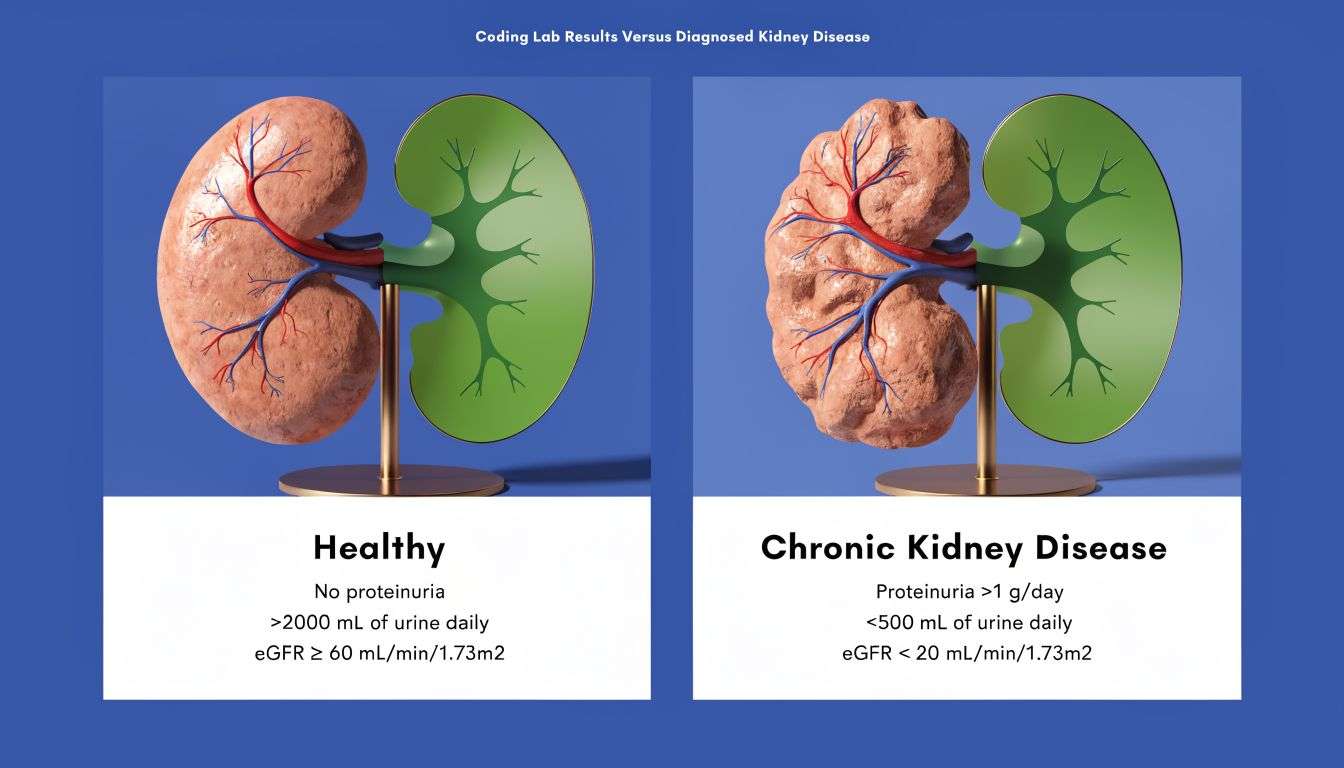
Coding Lab Results Versus Diagnosed Kidney Disease
The most important fork in the road is simple. Are you coding an abnormal study or a documented disease?
That sounds obvious, but charts often blur the distinction. A provider may discuss increased creatinine, reduced eGFR, repeat labs, medication review, and follow-up plans without ever stating chronic kidney disease. Coders can see the pattern, but coding has to follow the record, not assumption.
When R94.4 Fits
Use R94.4 when the chart supports an abnormal kidney function result and the provider has not documented a confirmed renal diagnosis. That’s the right code family for a finding that still needs interpretation, repeat testing, or clinical correlation.
This is common in early workup, medication monitoring, urgent care follow-up, and multispecialty settings where the renal issue is secondary to the main reason for care. It also helps when the provider appropriately avoids overcalling CKD before documenting chronicity or stage.
When You Need To Push For N18 Documentation
The coding risk rises when the chart clearly points toward chronic disease but the provider never closes the loop. An international primary-care study found that only about 11.8% of patients with eGFR <60 mL/min/1.73 m² had a registered CKD diagnosis coded in the clinical record, which highlights the gap between abnormal lab evidence and formal coding, as reported in this primary-care CKD coding study.
That undercoding problem shows up every day in revenue cycle operations. The patient has diabetes, longstanding hypertension, repeat renal monitoring, and sustained kidney dysfunction in the chart. But if the assessment never documents CKD, the coder is left with a finding code or a query.
A practical chart review approach looks like this:
- Use R94.4 when: The provider documents abnormal kidney function testing without establishing acute or chronic disease.
- Query for CKD when: The note supports chronicity, management implications, and enough clinical context for a confirmed renal diagnosis.
- Escalate sooner when: The encounter includes medication decisions, chronic disease management, or referrals that clearly depend on kidney status.
A claim gets stronger when the assessment tells the same story as the labs.
This is also where patient education and coding logic diverge. A consumer resource on optimizing kidney function for longevity may help patients understand test values, but payers want documentation that translates those values into a coded condition when clinically appropriate. Teams that tighten this handoff usually improve both compliance and coding consistency. If your staff needs cleaner diagnosis selection habits across related chronic conditions, a focused review of A 1 C diagnosis code documentation patterns can also help, especially in diabetes-heavy practices where renal findings are often part of the same encounter.
Differentiating Acute N17 And Chronic N18 Codes
Confusion between N17 and N18 usually starts with language that sounds renal but isn’t coding-ready. “Renal insufficiency,” “acute kidney disease,” and “worsening kidney function” may describe the clinical situation loosely. They don’t always support the code family a payer expects.
The clean distinction is this. N17 is for acute kidney failure. N18 is for chronic kidney disease. If the chart doesn’t clearly establish acuity, chronicity, or both, coders need clarification before they choose.
What Supports N17
Acute kidney failure coding requires documentation that the provider is diagnosing an acute process, not just observing a lab shift. The coding guidance is explicit that “acute kidney disease” and “acute renal insufficiency” should not be coded as acute renal failure, as explained in this kidney-related coding guidance.
That matters because many claims fail on terminology alone. A provider may intend AKI, but if the note uses softer or nonspecific language, the coder can’t automatically convert that into N17.
Documentation cues that support N17 usually include:
- A clear acute diagnosis: The provider states acute kidney failure or a specific acute renal condition within the N17 family.
- A time-based clinical story: The note describes sudden decline, recent trigger, inpatient follow-up, dehydration, nephrotoxic exposure, infection, or another acute context.
- Active management: Medication changes, urgent monitoring, fluid management, referral, or treatment tied to the acute issue.
What Supports N18
N18 requires documented chronic kidney disease and stage, when available. Chronicity has to be established by the provider. Coders should not infer CKD from a single reduced eGFR alone if the provider hasn’t documented the diagnosis.
The operational difference is important. Acute claims are often reviewed for severity, precipitating cause, and whether the documentation really supports failure. Chronic claims are reviewed for stage specificity, underlying disease linkage, and whether the labs match the submitted stage.
If the provider documents both acute and chronic kidney conditions, both codes may be reported with proper sequencing when the record supports each condition.
When Both Apply
This is a frequent miss in hospital follow-up, complex primary care, and endocrinology. A patient with established CKD can also have an acute worsening episode. When the provider documents both, coding both conditions is appropriate with proper sequencing based on the encounter.
That’s where coder education matters more than memorization. Staff need to read for timing, terminology, and provider intent. Many organizations improve accuracy after building kidney coding examples into broader ICD 10 education for clinical and billing teams, especially for shared-service coding departments that support multiple specialties.
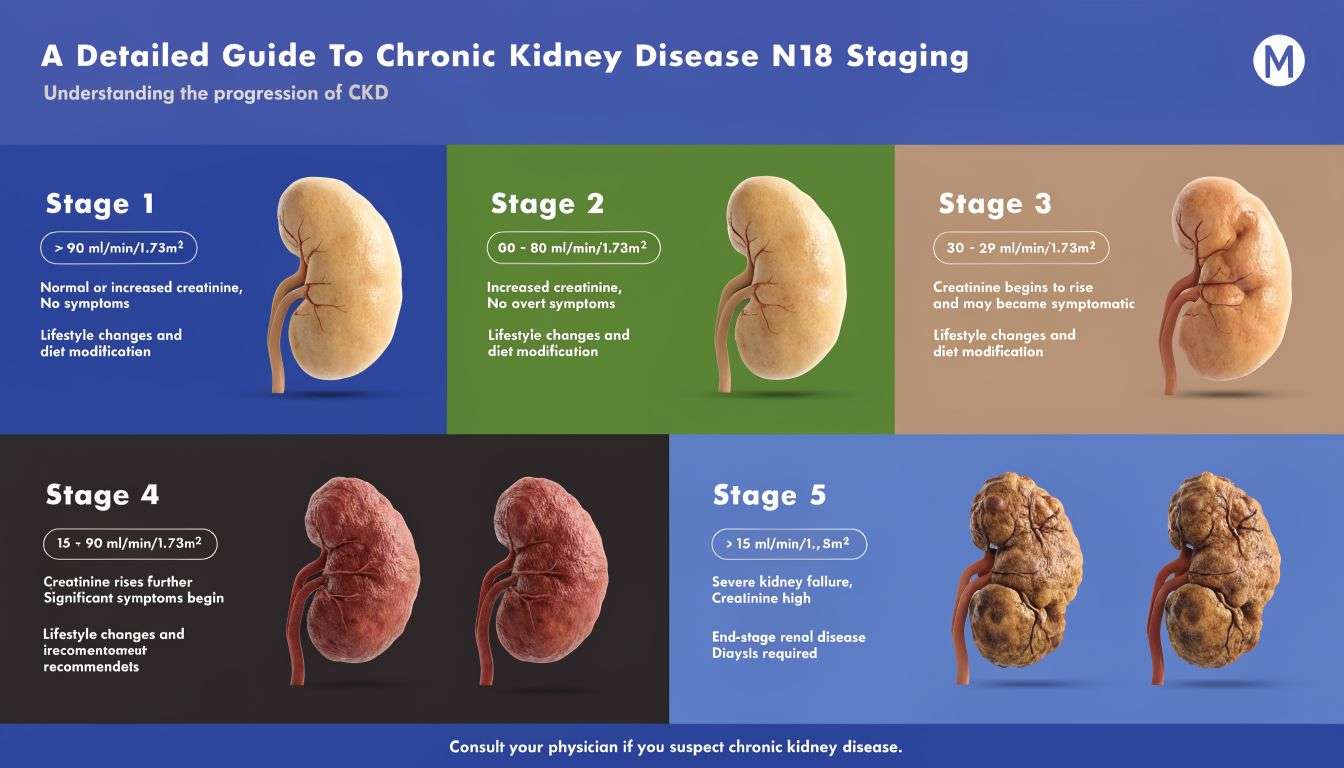
A Detailed Guide To Chronic Kidney Disease N18 Staging
Once the provider documents CKD, vague staging becomes the next denial trap. The N18 series works only when the stage matches the documented clinical picture and available GFR detail.
Payers increasingly compare stage-specific claims to the chart. When the record supports more detail than the submitted code, unspecified staging creates avoidable friction.
The N18 Stage Map
A payer-facing CKD coding workflow should always align documented stage with GFR thresholds. The CKD staging guidance in this CKD coding tip sheet ties ICD-10 CKD stages to these ranges:
- N18.1: Stage 1, GFR >90 mL/min/1.73 m²
- N18.2: Stage 2, GFR 60-89 mL/min/1.73 m²
- N18.31: Stage 3a, GFR 45-59
- N18.32: Stage 3b, GFR 30-44
- N18.4: Stage 4, GFR 15-29 mL/min/1.73 m²
- N18.5: Stage 5, GFR <15 mL/min/1.73 m²
That same guidance also makes a point many practices still miss. Stage 3 is split. If the documentation and GFR support 3a or 3b, coders shouldn’t default to a generic stage 3 code.
Why N18.30 Causes So Much Rework
N18.30 has a role, but it’s narrow. It should be used when the subcategory can’t be determined from the record. It should not be used as a convenience code when the GFR already supports N18.31 or N18.32.
That’s one of the more common denial triggers in nephrology-adjacent specialties. The provider may document “CKD stage 3,” the lab is already in the chart, and the payer expects the billed code to reflect the available specificity. If your coders aren’t trained to extract and validate that detail, you’ll see unnecessary edits and post-submission corrections.
ESRD Needs More Than N18.6
End stage renal disease coding deserves extra caution. N18.6 isn’t just a more severe CKD stage. It requires the documentation to support ESRD status, and the coding guidance also requires Z99.2 to identify dialysis status when applicable.
Coding checkpoint: Don’t let “kidney disease, severe” drift into ESRD coding unless the provider documentation clearly supports ESRD and the related dialysis status requirements.
Strong teams build a stage-verification habit into pre-bill review. If the note says CKD, the coder checks for stage. If the stage is 3, the coder checks whether the GFR supports 3a or 3b. If ESRD appears, the coder checks dialysis status and supporting documentation before the claim leaves the queue.
Preventing Common Billing Pitfalls And Claim Denials
Most kidney-function denials aren’t random. They follow predictable payer logic.
When a payer sees R94.4 on a claim from a non-nephrology specialty, it may ask a basic question: was this abnormal finding part of active disease management, or was it just an isolated lab result with no billable diagnostic context? If the chart doesn’t answer that clearly, the claim becomes vulnerable.

Why R94.4 Gets Denied
Payer scrutiny is sharper when the rendering specialty doesn’t primarily treat renal disease. Guidance summarized by Find-A-Code on R94.4 denial risk notes that payers increasingly target R94.4 for denial when non-nephrology providers bill it without clear documentation linking the abnormal finding to a primary diagnosis such as diabetes or drug-induced nephrotoxicity.
In plain terms, R94.4 alone often reads like an uncovered sign. A payer may view the test as screening, incidental, or unsupported unless the note ties it to active treatment decisions.
What Usually Fails In The Chart
The common failures are operational, not mysterious:
- The assessment is too vague: “Abnormal kidney function” without cause, chronicity, or treatment significance.
- The primary diagnosis isn’t linked: The chart discusses diabetes, hypertension, medication review, or nephrotoxic risk, but the claim doesn’t connect those conditions to the renal finding.
- The code sequence tells the wrong story: A symptom or finding appears unsupported because the more clinically relevant diagnosis is missing or under-documented.
- Specificity is available but unused: The provider documents enough for CKD stage detail, but the claim uses an unspecified code.
What Works Better
A stronger claim does three things before submission:
- It identifies the clinical reason for monitoring. If the patient is being followed for diabetes, hypertension, medication toxicity risk, or existing renal disease, that needs to be visible in the assessment.
- It states what the abnormal study means today. Is the result under evaluation, medication-related, acute, chronic, improving, worsening, or prompting repeat labs?
- It matches diagnosis specificity to the chart. Don’t bill broad kidney findings when the note supports a more specific linked diagnosis.
The payer doesn’t need a long note. The payer needs a coherent one.
Revenue cycle leaders should also treat kidney-function denials as a pattern category, not one-off claims. If the same issue appears across urgent care, endocrinology, and pain management, your workflow needs a fix. Building that review process into medical billing denial management operations usually does more than appeal work ever will.
Specialty-Specific Coding Scenarios And Examples
Kidney coding breaks down fastest when the renal issue sits inside another specialty’s visit. The denial pattern looks different by specialty, so the documentation strategy should too.
Primary Care
A family medicine provider sees a patient with diabetes and hypertension for chronic disease follow-up. Labs show reduced kidney function. The note acknowledges the result, plans medication review, and orders repeat renal testing.
If the provider documents only “abnormal renal labs,” the coder may be limited to R94.4. If the provider documents diabetic CKD or hypertensive CKD with stage support in the record, the claim becomes much more defensible because the renal abnormality is tied to an active condition being managed in primary care.
What works in primary care is explicit linkage. Don’t leave the kidney issue floating as a detached lab note.
Endocrinology
An endocrinologist adjusts diabetes medication and reviews kidney function because renal status affects treatment choice and safety. The chart should connect the lab review to diabetes management, not treat it as a side comment.
A common mistake is separating the medication decision from the kidney documentation. The provider explains the medication change in one part of the note and the abnormal kidney finding in another, without stating the relationship. That creates a coding and medical necessity gap.
A cleaner documentation style is to state that the diabetes management plan was modified in light of abnormal kidney function or documented CKD. That gives the coder a much stronger foundation for diagnosis selection and sequencing.
Rheumatology And Pain Management
These specialties often monitor renal function during long-term medication management. NSAIDs, chronic analgesic use, and complex inflammatory disease treatment can make kidney monitoring medically necessary, but only if the note says so.
Common weak documentation:
- “Labs reviewed”
- “Creatinine high”
- “Continue current meds”
Stronger documentation:
- The provider documents that renal function was reviewed because of ongoing medication management.
- The note explains whether the finding suggests a medication-related issue, a chronic comorbidity, or a need for closer monitoring.
- The assessment reflects how the kidney result changes the plan, even if the provider is not diagnosing a definitive renal disease at that visit.
Multisite Group Example
A multisite organization often sees the same patient in different departments with different documentation habits. One location records “renal insufficiency,” another records “CKD stage 3,” and a third submits only the lab-related finding. That inconsistency creates denials and audit risk even when each encounter seems reasonable in isolation.
The fix is standardization, not more coder heroics.
Every specialty needs a kidney documentation shortcut that fits its own workflow. The wording for nephrology won’t work unchanged in pain management or endocrinology.
A practical internal playbook should define what providers in each specialty must document when they review abnormal renal labs, when coders should query, and when a finding code is acceptable versus when a linked diagnosis is expected.
EHR And Claim Submission Best Practices For RCM Teams
Teams don’t solve kidney coding problems by reminding staff to “be more specific.” They solve them by making specificity easier than vagueness.
That starts in the EHR. If the provider orders kidney studies, the assessment template should prompt for what the result represents. Is it an abnormal finding still under evaluation, an acute condition, chronic kidney disease, a medication-related issue, or a comorbidity linked to diabetes or hypertension? If the provider documents CKD, the template should immediately prompt for stage and any supporting lab review.
Build The Workflow Around Real Decisions
A durable process usually includes:
- Provider prompts tied to kidney labs: The note should ask for chronicity, etiology if known, and whether the finding changed the treatment plan.
- Coder escalation rules: If the chart supports more specificity than the assessment states, the claim shouldn’t move forward untouched.
- Claim edits before submission: EHR or practice management edits should flag unsupported N18 staging, isolated R94.4 use in high-denial specialties, and missing linked diagnoses.
Shared EHR environments need especially tight standards. Without them, one site may code from the lab list, another from the assessment, and another from historical diagnoses. That inconsistency produces avoidable downstream work.
Why System Design Matters More Than Individual Memory
When kidney-function coding depends on who happened to review the chart that day, denials will keep recurring. Standard templates, internal coding crosswalks, and payer-specific edit logic make the process repeatable. That’s the only reliable way to reduce variance across specialties and locations.
Organizations that want cleaner claims long term should also review how their workflows align with broader EHR meaningful use and documentation standards, because the greatest benefit comes from structured capture of clinically relevant detail before the claim is built.
If your team is dealing with repeat denials, inconsistent kidney diagnosis coding, or multisite documentation drift, One For All Medical Billing can help tighten the process from chart review through claim submission. Their team supports practices that need stronger coding accuracy, denial prevention, and scalable RCM workflows without adding more internal billing stress.

