

table of contents
When you hear the term community health insurance, don't think of a specific policy from a big-name carrier. It’s a completely different approach—a collaborative healthcare model built from the ground up to serve a local population. These plans pool resources at a community level, making them a powerful tool for delivering affordable and accessible care, especially for underserved groups.
What Is Community Health Insurance And How Does It Work?

Think of community health insurance like a neighborhood co-op for healthcare. Instead of a large, national corporation managing benefits for profit, members of a specific geographic area or social group pool their money together. This collective fund then acts as a safety net, covering the medical costs of its members when they face unexpected health issues.
This is a fundamental shift from traditional commercial insurance. While a national carrier operates on a massive scale to generate shareholder returns, community-based plans are often non-profit, member-owned, and locally governed. Their primary goal isn't profit; it's the health and financial well-being of the community they serve.
The Core Principles Of The Model
These plans are built on a few foundational ideas that really set them apart. For any healthcare provider looking to serve this unique patient population, understanding these concepts is the first step.
- Shared Risk: Members contribute small, regular premiums into a collective pot. This shares the financial risk of high medical expenses across the entire group, so no single family is overwhelmed.
- Local Focus: The plan is designed by and for a specific community. This means benefits and provider networks are often tailored to address local health needs and use local resources.
- Community Governance: Big decisions about premiums, coverage, and operations are typically made by a board of local representatives, giving members a direct voice in their own healthcare.
This model has proven incredibly effective around the world. In many developing nations, community health insurance has been the key to ensuring that getting sick doesn't mean financial ruin.
For example, Rwanda's community-based health insurance program, Mutuelles de Santé, helped skyrocket coverage from almost zero to over 90% of the population within a decade. This model is a major reason for the significant global progress toward universal health coverage. You can explore more on this by reading the latest findings on universal health coverage from the World Health Organization.
At its heart, community health insurance is about solidarity. It’s a system where neighbors help neighbors, making sure that when illness strikes, the financial burden doesn't fall on one person or family alone.
To help you quickly identify the type of community plan a patient might have, here's a look at the most common structures you'll encounter.
Community Health Insurance Models At A Glance
- Mutual Health Organization (MHO): Funded by member premiums and sometimes government subsidies, this model typically covers primary care, outpatient services, and basic hospital care. Rwanda's Mutuelles de Santé is a prime example.
- Provider-Sponsored Plan: Funded by provider network contributions and member premiums, these plans usually cover services within the sponsoring provider's own network, such as a low-cost plan offered by a local hospital system.
- Community-Based Health Fund: Relying on donations, member contributions, and local fundraising, this model often covers specific services like maternal health or emergency transport. A village-run fund for emergency medical costs is a good example.
- Cooperative Model: This is a member-owned and operated model funded through premiums. A member board decides on comprehensive benefits. You can find health cooperatives like this in parts of the U.S. and Europe.
Each model has its own nuances, but they all share that core focus on community-level risk-sharing and governance.
Why This Matters For Your Practice
For your healthcare practice, patients with community health insurance are a distinct group. Their coverage probably won't follow the same rules as the major commercial payers you're used to. This can introduce some real complexities into your revenue cycle, from verifying eligibility to submitting claims and getting paid.
Payment structures can also be different. While many plans use a traditional fee-for-service approach, others might use capitation, where your practice receives a fixed payment per patient per month. Understanding the differences is critical for your financial planning. To get a better handle on this, check out our guide on fee-for-service vs capitation models.
Successfully serving these patients requires a deep understanding of their unique insurance framework. Without the right approach to revenue cycle management (RCM), practices risk lower reimbursement, higher denial rates, and a major administrative headache. This guide will give you the insights to navigate these challenges, so you can provide excellent care while keeping your practice financially healthy.
A Look At The Pros And Cons For Patients And Providers
Community health insurance creates a unique world with real benefits and tough hurdles for both the people it covers and the doctors who care for them. For patients, these plans are often a lifeline, offering access to healthcare that’s both local and affordable. For providers, they’re a chance to serve a wider, often overlooked part of the community, which is incredibly rewarding.
But stepping into this world means knowing what you're getting into. The upsides are huge, but the day-to-day operational and financial headaches can be just as significant, especially for practices used to the straightforward world of commercial insurance.
For Patients: More Than Just An Insurance Card
For many families, a community health plan isn't just another policy—it's their ticket to consistent, trusted medical care. The biggest draw is almost always affordability. With lower premiums and cost-sharing built around the local economy, these plans take a huge bite out of the financial stress that comes with getting sick.
This hyper-local focus also builds a strong sense of community trust and access. It just feels different when your health plan is managed by your neighbors and designed for your town. The care feels closer to home, in more ways than one.
Still, there are trade-offs patients might run into.
- Limited Provider Networks: To keep costs down, many community plans work with a smaller, hand-picked group of doctors. This can mean less choice when it comes to picking a specialist or even a primary care physician.
- Benefit Caps: Coverage is often geared toward essential primary and preventive care. You might find stricter limits on specialized treatments or elective procedures compared to what a big commercial plan offers.
- Navigational Complexity: The rules for signing up and using your benefits can sometimes be confusing. Without clear guidance, members can get lost in the fine print.
For Providers: Where Mission Meets Obstacles
For healthcare providers, joining a community health insurance plan is a great way to grow your patient base and make a real difference in public health. It opens your doors to people who might otherwise skip necessary care because of cost, which ultimately makes the whole community healthier.
That mission-driven work, however, brings its own set of financial and administrative challenges that can really stretch a practice’s resources if you’re not prepared. The very design of these plans adds new layers of complexity to your revenue cycle. A major piece of the puzzle for both patient access and provider pay is understanding provider networks, since the rules for participation can be worlds apart from major insurance companies.
The real balancing act for providers is serving the community you care about while keeping your practice financially healthy. This demands a completely different approach to billing and revenue management.
The Financial Hurdles For Your Practice
For providers, the biggest headaches are almost always tied to the revenue cycle. These financial hurdles aren’t impossible to clear, but they do require a smart, proactive strategy. If you don't have a plan, your practice is setting itself up for significant revenue loss.
Three challenges really stand out:
- Complex Billing and Payer Rules: Community health plans often come with their own unique submission guidelines, non-standard member IDs, and quirky pre-authorization rules. A one-size-fits-all billing approach is a recipe for errors and delays.
- Lower Reimbursement Rates: To stay affordable for members, these plans have to pay providers less than what commercial insurance or Medicare offers. This makes it absolutely critical to maximize every single dollar through airtight, efficient billing.
- Higher Risk of Claim Denials: When you combine complicated rules with lower reimbursement, your margin for error gets razor-thin. Even tiny mistakes can lead to denied claims, which drain your staff's time with appeals and follow-ups, chipping away at your bottom line.
These financial pressures make it clear why an expert billing partner is so valuable. Managing this patient population is often too much for a standard in-house team to handle effectively. If you're curious about how a specialized partner can turn these challenges into a smooth, manageable process, check out our guide on the benefits of outsourcing medical billing. An expert RCM firm can help ensure your practice continues to serve the community without putting its own financial health at risk.
Your RCM Playbook For Community Health Insurance
Working with community health insurance plans requires a different kind of financial playbook. It’s not just standard billing with lower reimbursement—these plans come with their own unique rules, and even small mistakes can create a cascade of denials and administrative headaches. For your practice to serve this vital patient population without hurting your bottom line, a proactive and incredibly detail-oriented approach isn't just a good idea; it's essential.
Think of it as building a systematic process for every community plan claim, broken down into five core stages. This playbook will help you turn what can often feel like a high-risk, low-reward venture into a predictable and manageable part of your revenue cycle.
This flowchart shows the patient's side of the story, but it also highlights just how quickly things can go wrong for your practice when your processes aren't dialed in for these specific plans.
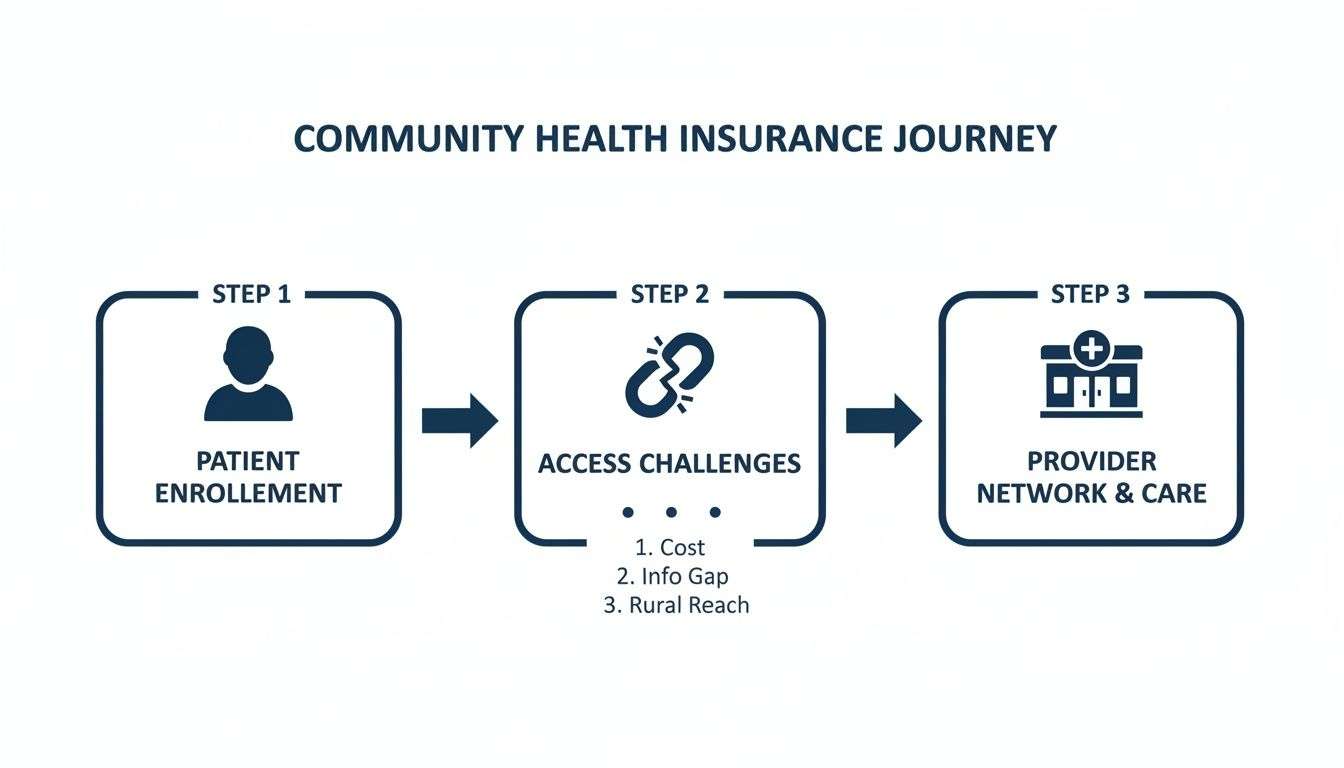
When a patient with community health coverage runs into a system that isn’t ready for them, it creates roadblocks to care that almost always lead to payment problems for you.
Step 1: Rigorous Upfront Eligibility Verification
The most important step in your entire playbook happens before a patient is even seen. Hands down, failing to properly verify eligibility and benefits is the number one reason claims from community health plans get denied. Unlike the big commercial carriers, these plans aren't always integrated into your usual clearinghouse portals, which means your team needs to do a little more legwork.
Your front-desk staff needs to be trained to do more than just scan a member ID card. They must become investigators, confirming specific details directly with the payer every single time.
- Active Coverage: Is the plan actually active for today's date of service?
- Patient Responsibility: What are the exact copay, coinsurance, and deductible amounts? Don't guess.
- Service-Specific Coverage: Is the service you're about to provide a covered benefit under this specific plan?
- Prior Authorization Rules: Does this visit or procedure need pre-authorization? Community plans often have strict and unique auth rules.
Never assume. That one extra phone call or check on a payer-specific portal can be the difference between getting paid on time and fighting a denial for months.
A clean claim starts at the front desk. Investing an extra five minutes in upfront verification can save your billing team five hours of work on the back end.
Step 2: Accurate Coding And Charge Capture
Once the visit is done, the focus moves to translating that clinical work into a billable claim. With community health plans, there’s no margin for error here. Reimbursement rates are already tight, so any coding mistakes or missed charges will directly eat into your revenue.
Your coding process needs to be airtight. This means every ICD-10, CPT, and HCPCS code must be spot-on and, just as importantly, fully supported by what’s in the clinical notes. Your coders should also be on the lookout for any specific billing guidance from the community plan itself—some have quirky preferences for certain modifiers or code combinations.
Charge capture is just as critical. Make sure every single billable item—from procedures and supplies to administered medications—makes it onto the claim. A solid charge-entry process, whether it's built into your EHR or involves a manual review, is key to getting paid what you’ve earned.
Step 3: Clean Claims Submission Protocols
Submitting a "clean claim"—one that’s 100% free of errors and sails through the payer’s system without a hiccup—is the ultimate goal. For community health insurance, this requires a level of precision that might feel excessive for other payers. They are simply less forgiving of minor clerical errors.
Create a pre-submission checklist to scrub every single claim before it goes out the door:
- Patient Demographics: Does the patient’s name (spelling!), date of birth, and address match the payer's records exactly?
- Payer Information: Are you using the correct payer ID and submission address? These can differ from a carrier's main commercial plans.
- Provider Credentials: Are the rendering and billing NPI numbers correct and linked to the right location?
- Code and Modifier Review: One last check to ensure all codes are valid for the date of service and that every required modifier is in place.
Getting these fundamentals right is crucial. For practices looking to elevate their performance across all payers, digging into broader revenue cycle management strategies can offer powerful insights. These core principles are especially critical when you’re navigating the complexities of community health plans.
Step 4: Proactive Denial Management
Let's be realistic: even with perfect processes, some denials will happen. What truly matters is how you handle them. To protect your revenue, you need a proactive system for managing denials and following up on Accounts Receivable (AR). Letting denied claims from community health plans pile up is a recipe for write-offs.
Instead of just reacting to denial letters, build a structured follow-up workflow. Start by categorizing denials by their root cause (eligibility, coding, missing authorization, etc.). This will help you spot trends. If you see the same denial reason popping up over and over, you've found a crack in one of the earlier steps that needs to be fixed.
Step 5: Insightful Reporting For Financial Health
Finally, you can't manage what you don't measure. To really know if your approach is working, you have to track your performance. Regular reporting gives you the insights needed to gauge the financial impact of these plans on your practice and see how effective your RCM process truly is.
Be sure to monitor key metrics like your clean claim rate, days in AR, and denial rate specifically for this group of payers. This data will tell you exactly where your playbook is strong and where it needs to be revised. Consistent reporting helps you make smart, data-driven decisions that protect your practice's revenue and allow you to keep your focus where it belongs: on your patients.
To put this all into practice, here is a simple checklist your team can use to ensure every stage of the RCM process is handled correctly for community health plan patients.
Provider Action Checklist For Community Plan RCM
This checklist breaks down the essential actions for your staff at each stage of the revenue cycle. Following these steps consistently will dramatically reduce errors and improve your collection rate for community health plans.
Stage 1: Patient Registration
- Action: Verify eligibility, benefits, and authorization requirements directly with the payer for every visit.
- Why it's critical: This is the #1 cause of denials. It prevents non-payment due to inactive coverage or non-covered services.
Stage 2: Charge Capture & Coding
- Action: Review clinical notes to ensure all services are captured and coded with specificity, including any plan-specific modifiers.
- Why it's critical: Maximizes reimbursement and prevents under-coding. Ensures documentation supports medical necessity.
Stage 3: Claim Submission
- Action: Use a pre-submission checklist to scrub claims for demographic errors, correct payer IDs, and valid provider credentials.
- Why it's critical: Prevents simple clerical errors that cause immediate rejections and payment delays.
Stage 4: Denial Management
- Action: Categorize all denials by reason code and assign them for follow-up within 48 hours.
- Why it's critical: Identifies root causes of denials and prevents claims from aging out and becoming uncollectible.
Stage 5: Reporting & Analysis
- Action: Track your clean claim rate, denial rate, and days in AR specifically for your top community health plans.
- Why it's critical: Provides the data needed to see what's working, fix what isn't, and forecast revenue accurately.
By making this checklist a routine part of your workflow, you create a system of checks and balances that safeguards your revenue while you continue providing essential care to your community.
Navigating Credentialing And Compliance Requirements
Working with a community health insurance network isn't as simple as just opening your doors to a new group of patients. It often comes with its own separate and demanding credentialing process, which can catch even the most experienced practice managers off guard. This administrative hurdle is critical—miss it, and your claims will be denied before they’re ever even looked at for medical necessity.
You can't just assume that being in-network with a big-name carrier automatically gets you into their community or state-sponsored plans. Many of these programs are run as completely separate legal and financial entities. For your practice, this means treating each community plan like a brand-new relationship and starting the credentialing process from scratch.
This process is all about submitting and verifying a provider’s education, licenses, training, and practice history to prove they meet the plan’s specific standards. It’s a detailed, often slow-moving task where even one missing document can cause major delays in getting paid.
The Credentialing Hurdle With Community Plans
Getting credentialed with a community health plan can feel a lot more intensive than it does with the large commercial payers. These plans are usually smaller and have fewer administrative resources, which can mean longer waits and more follow-up from your team. They may also have unique requirements tied to their local focus or government funding sources, like Medicaid.
Here are a few key steps you need to be ready for:
- Separate Application Packages: Expect to fill out a complete, unique application for each community plan, even if it operates under the umbrella of an insurance company you already work with.
- Unique Documentation Requests: On top of the usuals like your medical license and DEA certificate, some plans might ask for extra info about your practice’s specific services or your history of serving low-income communities.
- Diligent Follow-Up: This is non-negotiable. You have to stay in proactive contact with the plan’s provider relations team. This is the only way to make sure your application doesn’t get stuck in a pile and to quickly answer any questions they have.
If you don't manage this process well, your practice can get stuck in a frustrating limbo, seeing patients but being completely unable to bill for the services you’ve provided. To get a better handle on the basics, our guide on what is credentialing in healthcare breaks down the fundamentals every practice should know.
Upholding Compliance Across All Payers
While credentialing gets you into a network, compliance is about staying in good standing and protecting your practice from huge legal and financial risks. When it comes to HIPAA and patient data security, the rules don’t bend for different payers. Every single patient is entitled to the same tough privacy protections.
Whether a patient is covered by a premium commercial plan or a local community health insurance program, your practice's commitment to HIPAA compliance and data security must be absolute and unwavering.
This is even more important when you consider the sensitive financial and personal information often collected to determine if a patient is eligible for a community plan. A data breach here doesn't just destroy patient trust; it can bring on crushing fines and legal battles. This is precisely why having a U.S.-based, HIPAA-compliant billing expert on your side is so valuable. An experienced partner knows how to handle this data securely, lowering your audit risk and protecting your practice.
Beyond your own credentialing, staying current on broader insurance industry regulatory compliance is vital for any provider to make sure all legal and administrative boxes are checked.
What's Next For Community Health Insurance And Your Practice?
The healthcare landscape is always shifting, and community health insurance is quickly moving from a niche topic to a central piece of the puzzle. These plans aren't just filling a temporary void; they represent a fundamental shift toward a more local, resilient healthcare system. For any practice planning for the long haul, understanding where this market is headed is non-negotiable.
A few powerful trends are pushing community-focused coverage into the spotlight. We have an aging population that needs more consistent, local care. At the same time, rising rates of chronic diseases demand a hands-on, preventive approach—which is exactly what community health models are built for. These realities mean the need for affordable, accessible care is only going to grow.
An Exploding Market For Health Coverage
The global demand for health insurance is surging, and that rising tide is lifting all boats, including community-based plans. Projections show the health insurance market is on track to grow from $2.32 trillion in 2025 to a staggering $4.45 trillion by 2032. That’s a compound annual growth rate of 9.7%.
Add to that the fact that global medical costs are expected to jump by 10.4% in 2025, with an 8.7% hike in North America alone. As costs climb, the hunt for affordable coverage will intensify, making community health plans even more attractive. You can see the complete global health insurance market outlook on Actupool.com for a deeper look at the numbers.
This explosive growth makes one thing clear: learning to manage a diverse mix of payers isn't just a "nice-to-have" skill anymore. It’s a core business competency your practice needs to stay financially stable.
As healthcare costs continue to climb, community health insurance will become an even more vital tool for families seeking protection from financial strain. Practices that build the capabilities to serve these patients now are positioning themselves for sustained success.
How Technology Will Shape The Future
New tech is also on the horizon, promising to make community health plans more efficient and far easier for providers to handle. Innovations like Artificial Intelligence (AI) are already being tested to streamline claims processing and denial management, which could slash the administrative friction that makes these plans tricky today.
For your practice, this means the days of tedious manual verifications and endless phone calls might be numbered. Imagine AI tools that can instantly check eligibility against a community plan’s database or flag coding errors before a claim even goes out the door. This tech shift will make it much more financially viable to partner with these important local health plans. To get a better handle on your practice's performance, check out our guide on the role of benchmarking in healthcare.
Why Your Practice Needs To Adapt—Right Now
The writing is on the wall. Community health insurance is expanding, fueled by demographics, economic pressure, and technology. Practices that continue to treat these plans as a minor inconvenience or an administrative headache are going to get left behind.
This is where a sharp Revenue Cycle Management (RCM) partner becomes a game-changer. A specialized firm already has the systems, know-how, and technology to navigate the quirks of community plans. They can take on the intricate verification, coding, and credentialing, freeing you up to serve this growing patient base without burning out your team.
Investing in this capability now—either by training your staff or hiring an expert RCM firm—isn't just about capturing a new market. It's about future-proofing your practice for what's coming and making sure you can keep delivering quality care to everyone who walks through your doors.
Frequently Asked Questions About Community Health Insurance
Working with community health insurance plans can feel like learning a whole new set of rules. The processes often look nothing like what you’re used to with major commercial payers, and that can create real challenges for your practice's workflow and bottom line.
We get a lot of questions from providers trying to make sense of it all. Here are clear, straightforward answers to the questions we hear most often.
How Do We Verify Eligibility For A Patient With Community Health Insurance?
This is the single most important step, and it’s where most practices stumble. Forget your standard clearinghouse workflow—many smaller community plans aren’t connected to those systems. This means your front-desk team needs to be more hands-on.
The only way to be sure is to verify eligibility directly with the payer before every single visit. This usually means picking up the phone or logging into a specific payer portal you might not use every day. Train your staff to confirm not just that coverage is active, but also the specific copay, deductible status, and whether the service you’re providing needs a prior authorization. Never assume anything is the same as the patient's last appointment.
Are Reimbursement Rates From Community Plans Always Lower?
In most cases, yes. Community health plans are built around affordability for members, so their budgets are naturally tighter. To keep premiums and patient out-of-pocket costs down, they reimburse providers at rates that are typically lower than commercial plans and sometimes even Medicare.
It’s a common myth that all community plan rates are too low to be sustainable. While the margins are slimmer, an incredibly efficient billing operation can make serving this population both financially viable and deeply rewarding.
This is exactly why your revenue cycle has to be airtight. When you’re working with smaller margins, there’s no room for revenue leakage from coding mistakes, unworked denials, or simple administrative errors. Every claim needs to be squeaky clean to ensure you capture every dollar you've earned.
What Is The Most Common Reason For Claim Denials From These Plans?
By a huge margin, the number one reason for denials is a failure in eligibility and benefits verification. It’s almost always traced back to an issue that could have been caught upfront, like lapsed coverage, a non-covered service, or a missing prior authorization.
After eligibility, a few other common culprits pop up:
- Simple Clerical Errors: Typos in a patient's name, date of birth, or member ID are easy mistakes that lead to instant rejections.
- Payer-Specific Coding Rules: You might use a code or modifier that’s perfectly valid for Medicare but gets denied by a community plan because they follow a different rulebook.
- Credentialing Issues: The claim gets kicked back because the rendering provider isn't properly credentialed and enrolled with that specific plan.
Can Our Practice Participate In An Out-of-State Community Health Plan?
Almost never. The entire model of community health insurance is built on a local framework. These plans exist to serve a defined geographic area—a specific county, region, or state—and their provider networks are constructed within those same boundaries.
While a plan might make a rare exception for out-of-network emergency care, it’s safe to assume you can't be an in-network provider for routine services if you're outside their service area. Unless you hear otherwise directly from the plan's provider relations team, consider participation to be strictly local.
Partner With An RCM Expert For Financial Success
Trying to manage community health insurance plans without the right support is more than just a headache—it’s a major financial risk. These plans come with their own unique billing rules, lower reimbursement rates, and a high potential for denials. Without a dedicated Revenue Cycle Management (RCM) strategy, what starts as a mission to serve your community can quickly become a drain on your practice's resources.

This is precisely why bringing in an RCM expert is one of the smartest decisions you can make. A skilled partner completely changes the game, transforming this patient group from a financial question mark into a stable, rewarding part of your practice. They have the specialized knowledge and focused systems to handle all the complexities you don't have time for.
The Real Cost Of Doing It Yourself
It’s easy to think your in-house team can just add a few more health plans to their daily workflow. But that assumption often ignores the steep learning curve and the sheer amount of detailed work involved. Because these plans operate on tighter margins, even small, infrequent mistakes can add up to thousands in lost revenue over time.
Let’s be honest: your internal team is probably already stretched thin juggling commercial payers and Medicare. Expecting them to also master dozens of hyper-local plans, each with its own quirky rules, is a recipe for burnout, frustration, and a spike in costly billing errors.
A specialized RCM partner isn't another line item on your expense sheet; they're a revenue engine. By catching the errors, preventing denials, and stopping the write-offs that plague community health plan billing, they deliver a return that far outweighs their fees.
An expert partner lifts this entire administrative weight off your shoulders. They dedicate their team to mastering every nuance of every community plan, ensuring each claim is submitted with the precision needed to get you paid correctly and on time.
How An Expert Partner Gives You An Edge
A seasoned RCM firm does a lot more than just file claims. Think of them as a strategic part of your practice, built to turn the biggest headaches of community health insurance into your operational strengths. This partnership fundamentally rewires the financial side of serving these patients.
Here’s the immediate and lasting advantage they bring to the table:
- They Know the Payer Quirks: They’re already experts on the unique credentialing steps, non-standard eligibility checks, and specific coding modifiers that trip up most billing teams.
- They Prevent Denials Systematically: Their entire process is built to stop denials before they even happen. It starts with tough front-end verification and meticulous claim scrubbing.
- They Have a Dedicated Follow-Up Team: When a denial slips through, they have a team ready to jump on the follow-up and appeals process immediately. No claim gets left behind.
This structured approach is the perfect antidote to the financial risks we've been discussing. You'll see a healthier clean claim rate, a drop in your days in A/R, and a much stronger collections performance for this entire patient group.
Finding Financial Stability Through Expertise
Working with an RCM specialist isn't just about outsourcing your billing—it’s a strategic move to secure your practice's financial future. As community-based coverage continues to grow, your ability to manage these plans efficiently will set you apart from the competition.
The results of this kind of partnership are clear and easy to measure. A skilled RCM firm will help you:
- Maximize Every Reimbursement: By making sure every claim is coded right and submitted cleanly, you capture every single dollar you've earned from these lower-margin plans.
- Cut Your Administrative Burden: Your staff gets their time back. No more chasing down information, fighting with payers over denials, or following up on unpaid claims.
- Get Real Financial Clarity: You’ll receive detailed, payer-specific reports that show you exactly how you're performing, so you can make smart business decisions based on actual data.
Take rural hospitals and clinics, for example. Many depend on state and local health programs to keep their doors open. Inefficient billing can directly threaten their ability to serve their community. A great RCM partner makes sure these vital facilities capture all possible revenue, strengthening the health of the entire area.
The Final Takeaway: Your Practice Needs A Specialist
The message couldn't be clearer. If you want to thrive while serving patients with community health insurance, a generalist approach just won't cut it. The financial and administrative hurdles are too high and too specific—they demand a specialist.
An expert RCM partner brings the focused skills, technology, and attention to detail needed to make this patient group a financially sound part of your practice. They handle the billing complexities so you can get back to what matters most: providing outstanding care to your patients. In today's healthcare world, this isn't just an operational choice. It's a strategic investment in your practice's stability and success.
Ready to turn your community health insurance challenges into financial success? The certified, U.S.-based team at One For All Medical Billing has over two decades of experience helping practices like yours get paid faster and with fewer denials. Schedule your free, no-obligation consultation today and see how our expertise can strengthen your bottom line.

