

table of contents
When it comes to bariatric surgery billing, getting the CPT codes right is half the battle. Selecting the correct code, like 43775 for a laparoscopic sleeve gastrectomy or 43644 for a Roux-en-Y gastric bypass, is the very first step toward building a clean claim that payers will actually accept.
Your Quick Reference For Bariatric Surgery CPT Codes

Think of this guide as your go-to reference for navigating the tricky world of bariatric surgery billing. It’s built for practice managers and billing staff who need clear, accurate information without the fluff. Getting paid starts with choosing the CPT code that perfectly matches what the surgeon did in the OR.
Mistakes at this stage are a surefire way to trigger denials and slow down your revenue cycle. This section is designed to be a quick-lookup tool for your daily billing tasks—a starting point before we get into the nitty-gritty of modifiers, ICD-10 codes, and payer rules later on.
Key CPT Codes At A Glance
To make your job a little easier, here are the primary CPT codes you’ll see day in and day out. Each one corresponds to a specific weight-loss procedure.
- CPT 43775: This is your code for a laparoscopic sleeve gastrectomy. It reports the removal of a large part of the stomach, leaving a smaller, banana-shaped "sleeve."
- CPT 43644: Use this for a laparoscopic Roux-en-Y gastric bypass. This procedure involves creating a small stomach pouch and rerouting the small intestine directly to it.
- CPT 43845: This code covers a biliopancreatic diversion with duodenal switch, a more complex surgery that combines a sleeve gastrectomy with a major intestinal bypass.
Of course, these codes only cover the main procedures. It’s just as important to understand how to bill for related services. For instance, a diagnostic endoscopy might need to be reported separately depending on the circumstances. You might find our detailed breakdown of the CPT code for EGD helpful to see how those services differ. Mastering these distinctions ensures every part of the patient's care is reported correctly and reimbursed properly.
Understanding The Bariatric Billing And Reimbursement Landscape
Getting bariatric surgery claims paid is more than just a matter of knowing the right CPT codes. It’s about understanding a financial landscape that's become incredibly challenging. Bariatric practices are currently caught in a tough spot: patient demand for life-changing surgery is higher than ever, yet insurance reimbursements are steadily shrinking.
This dynamic puts immense pressure on your billing department. On one side, you have a clear and growing need for surgical solutions. On the other, payers are tightening their reimbursement policies and medical necessity criteria, turning every single claim into a high-stakes submission.
The Challenge Of Shrinking Reimbursements
The numbers tell a story that every bariatric practice knows well. With the prevalence of obesity in U.S. adults now topping 42%, the demand for these procedures has exploded. Surgical volume alone jumped by 62% between 2011 and 2019.
But while demand grew, Medicare reimbursement rates went in the opposite direction. For instance, the most common procedure, the laparoscopic sleeve gastrectomy (CPT 43775), saw its reimbursement rate fall by nearly 33% over a 12-year period.
This trend is happening as payers adopt more aggressive review systems, often using sophisticated software to flag any claim that deviates from their strict—and constantly changing—guidelines. For practices looking to improve claim accuracy and efficiency, looking into tools for health insurance document automation can be a smart move.
For bariatric practices, this means there is virtually no room for error. Perfect claim submission is not just a goal; it's a requirement for financial stability in a market where profit margins are continuously squeezed by payer policies.
This climate is exactly why mastering bariatric surgery CPT codes and their associated rules is so critical. Accurate coding is your best defense against claim denials and the single most important key to protecting your practice’s revenue. Getting your practice's financial health in order requires a firm grip on the entire billing process. For a deeper dive into this topic, you might find our guide on the healthcare revenue cycle helpful.
A Detailed Breakdown Of Primary Bariatric CPT Codes

Knowing the CPT codes for bariatric surgery is one thing; understanding exactly what they cover—and what they don't—is another. Correctly assigning a primary code means digging into the surgeon’s operative report and matching it to the letter of the CPT definition. Think of this section as your go-to reference for getting it right.
Each code comes with its own set of rules and documentation needs. A mismatch between the procedure performed and the code you submit is one of the fastest ways to get a claim denied. Let's walk through the key codes your team will be working with day in and day out.
CPT Code 43775 Laparoscopic Sleeve Gastrectomy
You'll see CPT 43775 more than just about any other bariatric code. It’s the standard for a laparoscopic sleeve gastrectomy, where the surgeon removes a large portion of the stomach to create a smaller, tube-like "sleeve." This is a purely restrictive procedure that helps patients feel full on less food.
This code is meant to cover the entire laparoscopic procedure, from the creation of the sleeve itself to all the work involved in closing up. It does not, however, include any separate procedures like a hiatal hernia repair or a conversion to an open surgery—those need to be billed separately with the right modifier.
Example Scenario: A patient with a BMI of 42 and type 2 diabetes undergoes a planned laparoscopic sleeve gastrectomy. The surgeon removes roughly 80% of the stomach laparoscopically. For this straightforward case, CPT 43775 is the only primary surgical code you'll need to report.
CPT Code 43644 Laparoscopic Gastric Bypass
Next up is CPT 43644, which covers the Roux-en-Y gastric bypass performed laparoscopically. This procedure is both restrictive and malabsorptive. The surgeon creates a tiny stomach pouch and connects it directly to the small intestine, bypassing most of the stomach and the first part of the small intestine.
The code is comprehensive, including both the creation of the gastric pouch and the rerouting of the small intestine (the "Roux-en-Y limb"). It's absolutely crucial that the operative note clearly describes both components to justify this code. If your practice consistently runs into coding snags, it might be worth reviewing some common medical coding errors.
CPT Code 43645 Laparoscopic Gastric Bypass With Small Intestine Resection
While it sounds a lot like 43644, CPT 43645 is used for a more extensive procedure: a gastric bypass that also includes the surgical removal of a segment of the small intestine. Because it's a bigger operation, it gets its own code.
To use CPT 43645, the surgeon's documentation must explicitly state that a small intestine resection was performed. Without that specific language, you'll have to stick with 43644.
Correct Usage Tip: The difference between 43644 and 43645 comes down entirely to the operative report.
- If the op note describes creating the gastric pouch and the Roux-en-Y limb without removing any intestine, you use 43644.
- If the op note clearly mentions resecting a piece of the small intestine as part of the bypass, you use 43645.
By carefully combing through the procedural details, your billing team can select the right code with confidence and lay the groundwork for a clean claim.
Navigating Add-On And Revision Procedure Codes
Bariatric surgery billing rarely stops with a single, primary procedure. When cases involve revisions or additional services, a new layer of complexity is introduced—one that can easily trip up even experienced billers and lead to denials. Mastering the correct use of add-on and revision codes is a must for capturing the surgeon's full scope of work and getting paid properly.
These codes aren't standalone. They have to be paired correctly with primary procedure codes and backed up by meticulous documentation. A common point of failure is knowing when a service is bundled into the primary procedure versus when it qualifies as a separately reportable service. Getting this right is crucial for keeping your clean claim rate high and avoiding painful audits.
Coding For Revisions And Conversions
Revisional bariatric surgery is performed to fix complications, address insufficient weight loss, or manage side effects from a previous weight-loss operation. Every scenario has a specific set of bariatric surgery CPT codes.
- CPT 43771 (Laparoscopy, surgical, removal of adjustable gastric restrictive device component(s)): This is your go-to code when a surgeon laparoscopically removes a gastric band. Your documentation must clearly spell out the reason for removal, whether it's band erosion, slippage, or patient intolerance.
- CPT 43860 (Revision of gastric reservoir and stoma for morbid obesity): Use this code when a surgeon revises a previous bariatric procedure, like adjusting a gastric pouch. It's critical to remember this code is for an open procedure, not a laparoscopic one.
- CPT 43848 (Revision of gastric bypass): This is another key revision code, frequently used when converting one procedure to another, such as turning a sleeve into a bypass. The operative report has to detail the original surgery and the specific work performed in the current revision.
Example Scenario: A patient who previously had a sleeve gastrectomy (CPT 43775) is now dealing with severe acid reflux and hasn't lost enough weight. The surgeon decides the best course of action is to convert the sleeve to a Roux-en-Y gastric bypass. In this case, you would report CPT 43848 for the revision—not the code for an initial bypass.
Handling Add-On Services
Add-on services are procedures performed in addition to the primary surgery. A perfect example in bariatric cases is an esophagogastroduodenoscopy (EGD). While a diagnostic EGD performed during the surgery is usually considered part of the main event and isn't separately billable, a therapeutic EGD performed for a distinct reason absolutely could be.
For a deeper dive on billing for separate services on the same day, our guide on CPT modifier 25 provides some excellent context.
Properly coding these complex scenarios demands a solid grasp of which codes can be billed together and what documentation you need to prove medical necessity. Without precise coding for every revision and add-on, practices are leaving significant revenue on the table.
Integrating 2026 CPT Code Updates Into Your Workflow
Keeping up with annual CPT updates isn’t just good practice—it’s fundamental to maintaining a high clean claim rate and keeping your practice financially healthy. The upcoming 2026 changes are a big deal, introducing new codes that will directly change how bariatric practices report some of their most important procedures. Getting these updates integrated into your workflow requires a proactive plan, not a reactive scramble.
The 2026 CPT code set is bringing 418 total changes across the board, with some major additions hitting gastroenterology and bariatric surgery. One of the most significant developments is the introduction of new codes for endoscopic sleeve gastroplasty (ESG), a less invasive weight-loss procedure that's becoming more common. This finally standardizes how practices report ESG and reflects its growing role in modern bariatric care. As you prepare, thinking about how to apply AI workflow automation for 2026 can give you an edge in handling the new complexities.
Key Steps For Successful Integration
To get the 2026 updates into your practice smoothly, you need a structured plan. The goal is simple: make sure every part of your revenue cycle, from the front desk to the back office, is ready for the new coding reality on day one.
A solid plan is your best defense against the claim disruptions and payment delays that happen when payers and practices aren't on the same page.
- Update Your Charge Master and EHR: This is step one, and it's non-negotiable. All new and revised bariatric CPT codes must be loaded into your charge master and EHR templates. Just as important, make sure old codes are deactivated so nobody uses them by mistake.
- Revise Prior Authorization Protocols: New codes mean new prior authorization rules. You need to proactively contact your top payers to find out exactly what they require for procedures like the new ESG codes. Don't wait for the denials to start rolling in.
- Train Your Clinical and Billing Teams: Your coders, billers, and even your surgeons and clinical staff need to understand the new codes. They also need to know what specific documentation is required to support them. Our ICD-10 education resources are a great place to start for keeping your team's skills sharp.
Proactively Engaging With Payers
There’s almost always a lag between when a new CPT code goes live and when payers get their coverage policies and fee schedules finalized. This gap is a recipe for denied claims and cash flow headaches.
Do not wait for payers to send you updates. Reach out to your provider representatives in the months leading up to January 1, 2026. Ask for their new medical policies and fee schedules for the updated bariatric surgery CPT codes.
This kind of proactive communication does more than just prevent payment disruptions. It shows you're an informed, organized partner, and it ensures you’re fully prepared to submit clean claims from the very first day the new codes take effect.
Mastering Modifiers And ICD-10 Diagnosis Pairings
Submitting the right primary CPT code is just the first step. To build a claim that accurately tells the whole story of a patient’s surgery, you have to master the relationship between procedure codes, modifiers, and ICD-10 diagnosis codes. This combination is what proves medical necessity to the payer.
Think of it like a three-part puzzle. The CPT code says what the surgeon did. The ICD-10 code explains why it was necessary. The modifier adds crucial context, detailing how the service was performed under special circumstances. When all three pieces fit together perfectly, they create a clear and undeniable narrative for reimbursement. Without the right pairing, even a perfectly valid claim can be denied.
Applying Key Bariatric Surgery Modifiers
Modifiers are essential for adding detail to your bariatric surgery CPT codes. They signal that a procedure was altered in some way from its standard definition, and using them correctly is critical for getting paid for the full scope of work performed.
Here are a few you’ll see often:
- Modifier 22 (Increased Procedural Services): This is for cases that are significantly more complex than usual. You might use it if the surgeon encountered extensive adhesions from previous surgeries that substantially increased the operative time and difficulty. Your documentation must be impeccable, detailing exactly what made the procedure so challenging.
- Modifier 59 (Distinct Procedural Service): This modifier is used to show that two procedures performed on the same day are separate and distinct. For example, if a surgeon performed a medically necessary diagnostic procedure that was separate from the planned bariatric surgery, Modifier 59 could be used to unbundle them—but this requires strong justification.
- Modifier 78 (Unplanned Return to the Operating Room): Use this when a patient has to go back to the OR for a related procedure during the post-operative period of the initial surgery. This could be for a complication like a post-surgical bleed that requires another intervention.
Crucial Tip: Never append a modifier just to bypass an edit or increase payment. Payers scrutinize modifier usage, and improper application is a major red flag for audits. Your documentation must always paint a clear picture that supports any modifier you use.
Keeping your team aligned on coding updates is a continuous process. This flowchart illustrates the simple five-step cycle of updating, integrating, and engaging with new CPT changes.
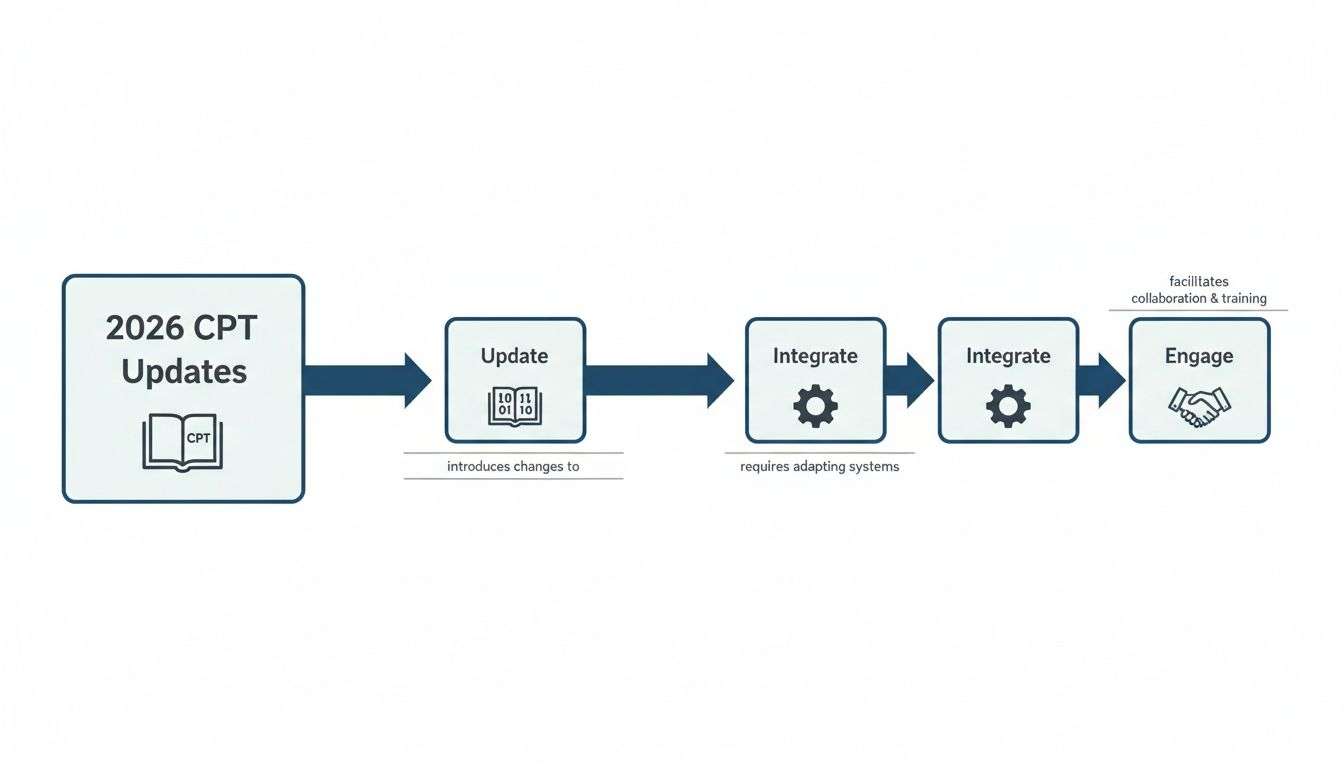
This cycle emphasizes that adapting to new codes isn't just an IT task; it requires updating internal systems and communicating changes with payers to ensure everyone is on the same page.
Pairing CPT Codes With Correct ICD-10 Diagnoses
The final piece of the puzzle is linking your CPT code to the right ICD-10 diagnosis code. This pairing is your primary tool for establishing medical necessity. A bariatric procedure CPT code without a supporting obesity-related diagnosis is a guaranteed denial.
Correct Pairing Example:
- CPT Code: 43775 (Laparoscopic Sleeve Gastrectomy)
- Primary ICD-10: E66.01 (Morbid obesity due to excess calories)
- Secondary ICD-10: Z68.42 (Body Mass Index [BMI] 45.0-49.9, adult)
This combination clearly tells the payer that a sleeve gastrectomy was performed on a patient with morbid obesity and a documented BMI over 40, meeting typical medical necessity criteria.
Incorrect Pairing Example:
- CPT Code: 43644 (Laparoscopic Gastric Bypass)
- ICD-10 Code: E66.9 (Obesity, unspecified)
This pairing is too vague. Payers require specificity. Using a general code like E66.9 fails to prove the patient meets the strict criteria for morbid obesity, making the claim an easy target for denial.
Strategies To Prevent Common Bariatric Claim Denials

Claim denials can seriously disrupt the financial health of any bariatric practice. They stall cash flow and create a mountain of costly rework for your team. A proactive denial prevention strategy isn't just a good idea; it's a core operational necessity.
Most denials in bariatric surgery are predictable. They usually fall into a few key categories: incomplete documentation, failure to prove medical necessity, simple coding mistakes, and not meeting strict payer requirements. The key to a healthy revenue cycle is catching these issues long before a claim ever goes out the door.
Tackling Documentation And Medical Necessity Denials
One of the biggest reasons for bariatric claim denials is failing to prove the procedure was medically necessary according to the payer’s specific policy. This often happens when documentation is vague or incomplete—it just doesn't tell a compelling clinical story. Payers need clear, evidence-backed justification.
To get ahead of this, your practice needs a rock-solid documentation checklist for every single bariatric patient. This ensures all the required pieces are in place well before surgery is even on the calendar.
Documented BMI: The patient's BMI must be clearly recorded. Payers typically look for a BMI of ≥40 or a BMI of ≥35 with at least one significant obesity-related comorbidity.
Failed Weight-Loss Attempts: Most insurance plans require proof of at least six months of medically supervised, non-surgical weight-loss efforts. This has to be meticulously logged in the patient's chart.
Psychology and Nutrition Clearances: Formal clearance reports from both a psychologist and a registered dietitian are almost always required. Make sure these reports are signed, dated, and included in the pre-authorization packet.
A common pitfall we see is submitting a claim with a generic "obesity" diagnosis. You have to be specific. Always use precise ICD-10 codes, like E66.01 (Morbid obesity) and a corresponding BMI code from the Z68.4- series, to paint a clear picture of medical necessity for the payer.
Preventing Coding And Authorization Errors
Beyond documentation, simple administrative and coding slip-ups cause a huge percentage of bariatric claim denials. The good news is these errors are highly preventable with the right workflow and attention to detail. Submitting the correct bariatric surgery CPT codes is critical, but it’s only half the battle—you have to do it within the context of payer rules.
A frequent mistake is unbundling, which is billing separately for services that are already included in the primary procedure. For example, a standard diagnostic EGD performed during a sleeve gastrectomy (CPT 43775) is generally considered part of the main surgery and shouldn't be billed as a separate service.
Denial Prevention Workflow Tips:
- Create a Pre-Authorization Checklist: Before you even think about submitting an authorization request, run through a checklist. Confirm that every single payer requirement has been met, from BMI documentation to psych evaluations.
- Verify Coverage for Specific Codes: Never assume. Always verify the patient's benefits and confirm that the specific CPT code for the planned procedure is a covered service under their plan.
- Conduct Internal Audits: On a regular basis, pull a sample of your claims and audit them internally. This is the best way to spot recurring error patterns and provide targeted training to your team to fix the issues at their source.
Frequently Asked Questions About Bariatric Surgery Coding
Even for seasoned bariatric coders, some scenarios just aren't straightforward. We see the same tricky situations pop up time and time again. This section cuts through the confusion with clear, direct answers to the questions our billing experts hear most often.
Getting these details right is the key to preventing denials that should never have happened in the first place.
What If A Laparoscopic Procedure Is Converted To Open?
It’s a common question: a surgeon plans a laparoscopic bariatric procedure, but complications force them to convert to an open approach. So, how do you bill it?
The rule is simple: you only report the CPT code for the final, successful open procedure.
You should never bill for the attempted laparoscopic part of the surgery. The work involved in that initial approach is considered part of the completed open procedure and isn’t separately reportable. For instance, if a laparoscopic sleeve gastrectomy (43775) gets converted, you would only bill the CPT code for the open procedure that was ultimately performed.
How Do I Justify Modifier 22 For A Complex Case?
Modifier 22 is your tool for getting properly reimbursed for surgeries that were significantly more difficult than usual. But be warned: payers scrutinize claims with this modifier, so your documentation has to be bulletproof.
To append Modifier 22 to a bariatric CPT code, the operative report must paint a vivid picture of why the case was unusually complex. Vague statements won’t cut it. You need to detail specific circumstances like:
- Excessive bleeding that demanded significant extra time and effort to control.
- Unexpected anatomical variations that threw a wrench in the standard surgical approach.
- Severe adhesions from previous surgeries that made dissection substantially harder and more time-consuming.
Your provider’s documentation must clearly quantify the extra work and time involved compared to a typical case. This is your evidence to justify the increased payment.
Can I Bill An EGD On The Same Day As Bariatric Surgery?
Generally, no. A diagnostic esophagogastroduodenoscopy (EGD) performed at the same time as a bariatric surgery (like a sleeve gastrectomy) is almost always bundled into the main procedure. You can't bill for it separately.
The one major exception is if the EGD becomes a distinct, separately identifiable therapeutic procedure. A perfect example is if the surgeon discovers unexpected bleeding during the scope and has to intervene therapeutically to stop it. In that scenario, it may be billable with modifier 59, but the documentation must leave no doubt that the intervention was medically necessary and separate from the primary surgery.
Managing the nuances of bariatric coding is a full-time job. One For All Medical Billing provides specialty-specific expertise to help your practice slash denial rates, boost your clean claim rate, and get your revenue cycle moving faster. Schedule your free consultation and start billing with confidence.

