

table of contents
When it comes to medical billing, CPT modifier 25 is one of the most important—and scrutinized—tools in your arsenal. Think of it as a signal to payers that a provider performed a significant, separately identifiable Evaluation and Management (E/M) service on the very same day as another procedure.
Getting this right is absolutely essential for protecting your practice’s revenue cycle and ensuring you’re paid fairly for the work you do.
What CPT Modifier 25 Means For Your Practice
Modifier 25 is all about telling the complete story of a patient encounter. It communicates to an insurance company that two distinct, medically necessary services happened during a single visit, and both deserve to be paid for separately.
If you leave it off, the E/M service will almost certainly be bundled into the payment for the procedure. That’s lost revenue, plain and simple.
Let's walk through a common scenario. A patient comes into a dermatology clinic for a scheduled mole removal. That's the planned procedure. During the visit, however, the patient points out a new, rapidly spreading rash on their arm. The dermatologist can't just ignore it—they now have to perform a separate evaluation for this new problem, which involves its own line of questioning, a distinct physical exam, and unique medical decision-making.
Justifying The Separate Service
Here’s the key: the work done for the rash goes far beyond the typical pre-op check for the mole removal. It isn't just about making sure the patient is ready for the procedure. It’s about diagnosing and addressing a completely separate clinical issue.
By attaching CPT modifier 25 to the E/M code for the rash evaluation, you’re signaling that it was a significant and separate service from the mole removal.
This distinction is critical for a few big reasons:
- Ensures Fair Compensation: It allows the provider to be reimbursed for all the legitimate work they performed during that visit.
- Improves Patient Care: It encourages doctors to address new or urgent patient concerns on the spot, rather than forcing the patient to schedule another appointment.
- Reduces Claim Denials: When used correctly and backed by strong documentation, it helps you avoid automatic bundling from payers. You can learn more about successfully appealing claims in our guide to medical billing denial management.

The High Stakes Of Misuse
Because modifier 25 directly impacts how much you get paid, it’s constantly under a microscope. Payers and federal agencies are always on the lookout for misuse. Applying it incorrectly can trigger audits, lead to payment recoupments, and even result in hefty financial penalties.
This modifier has drawn repeated federal scrutiny, with high-profile settlements totaling millions, signaling risks for providers nationwide if coding isn't handled expertly. For instance, one specialty group agreed to pay $1.7 million to resolve False Claims Act allegations involving its misuse, while another settled for $4.1 million over similar issues.
Mastering its application isn't just a billing task—it's a fundamental part of keeping your practice compliant and financially healthy.
The Core Rules For Applying Modifier 25
When it comes to using CPT modifier 25, it all boils down to two things: solid medical necessity and the documentation to prove it. The Evaluation and Management (E/M) service you’re billing for must be truly “significant and separately identifiable” from whatever procedure you performed on the same day.
This means the E/M service has to be more than just the usual pre-procedure checkup. A quick look at the surgical site or a brief patient history review right before a minor procedure? That’s already bundled into the procedure payment and doesn't count. The E/M service needs to stand on its own as a distinct piece of cognitive work by the provider.
What Is A Significant And Separately Identifiable Service?
Think of it like this: did the patient come in for one thing but also present a totally new problem? Or maybe a chronic condition they have suddenly got worse, demanding the provider's immediate attention and a new plan.
These are the scenarios that require a separate level of medical decision-making. The provider isn't just prepping for the procedure; they're performing a distinct history and exam, thinking through a differential diagnosis, and creating a management plan for that other issue.
The real test for using CPT modifier 25 is simple: would the E/M service have been necessary and billable on its own, even if the other procedure never happened?
If you can answer "yes" to that question, you're on the right track. This keeps the modifier reserved for times when a provider is genuinely managing two different clinical situations in one visit, justifying payment for both their brainpower and their procedural skills.
The Power Of Clear And Separate Documentation
Your clinical documentation is your ultimate line of defense. It needs to tell a clear, compelling story that justifies using modifier 25, leaving no room for a payer to second-guess the claim. Vague or jumbled-together notes are the number one reason these claims get denied.
The best practice is to structure your documentation like two "mini-notes" within one encounter. One part should focus entirely on the procedure, while a completely separate section details every component of the E/M service.
Here’s what your E/M documentation absolutely must show:
- A Distinct Chief Complaint: Note the specific reason for the E/M service, separate from the procedure's purpose. For example, "Patient here for scheduled mole removal, but also reports new-onset shortness of breath."
- Separate History and Exam: Detail the history of present illness (HPI), review of systems (ROS), and physical exam findings that relate only to the separate problem. This must be clearly different from any pre-op assessment done for the procedure.
- Independent Medical Decision-Making (MDM): This is the heart of it all. Your note has to capture the provider’s thought process, the complexity of the problem, the data they reviewed, and the risk involved with the separate issue they addressed.
By structuring notes this way, you create an airtight record that will satisfy payer scrutiny every time. Strong records are your best defense against audits and denials. For practices looking to build a rock-solid framework, exploring strategies for clinical documentation improvement can strengthen your entire billing cycle. This proactive approach turns documentation from a chore into a powerful tool for protecting your revenue.
When To Use And When To Avoid Modifier 25
Knowing the textbook definition of CPT modifier 25 is one thing. Applying it correctly in the middle of a busy clinic day is a whole different ballgame. The key to preventing denials and protecting your revenue is to think in terms of clear “green light” and “red light” scenarios.
This simple distinction can empower your team to make confident, compliant decisions on the fly.
A classic “green light” example plays out in dermatology offices every day. A patient comes in for a scheduled follow-up on their chronic eczema, which is a full-blown E/M service. During that same visit, the patient points to a new, suspicious-looking mole and asks the doctor to check it out. The provider examines it, decides it needs to come off, and performs a biopsy right then and there.
In this situation, the eczema management is a significant, separately identifiable E/M service. It’s completely distinct from the mole biopsy procedure. Appending modifier 25 to the E/M code is the right move, ensuring the provider is paid for both the distinct cognitive work and the procedure.
Clear Examples Of Correct Modifier 25 Application
The core principle always comes back to one question: would the E/M service have been medically necessary on its own, even if no procedure happened? If the answer is yes, you’ve probably got a green light.
Here are a few common situations where using CPT modifier 25 is the correct call:
- Primary Care: A patient arrives for their annual wellness exam but also complains of new, acute shoulder pain. The provider completes the preventive service and then performs a separate, problem-focused exam of the shoulder, which leads to a diagnosis and a corticosteroid injection. The problem-oriented E/M for the shoulder can be billed with modifier 25.
- Orthopedics: A patient with osteoarthritis has a follow-up to manage their condition. During the exam, they bring up a painful cyst on their wrist. The orthopedist evaluates the osteoarthritis (the E/M service) and also performs an aspiration of the cyst (the procedure).
- Cardiology: During a scheduled follow-up for hypertension, a patient mentions recent dizzy spells. The cardiologist performs a full E/M service to investigate the new symptom, which is entirely separate from the routine EKG performed in the office.
The ultimate test is always your documentation. A payer should be able to read your E/M note and your procedure note as two separate stories. If the E/M note can’t stand on its own without the context of the procedure, modifier 25 probably isn’t appropriate.
This decision path flowchart boils down the key questions you need to ask before adding the modifier.
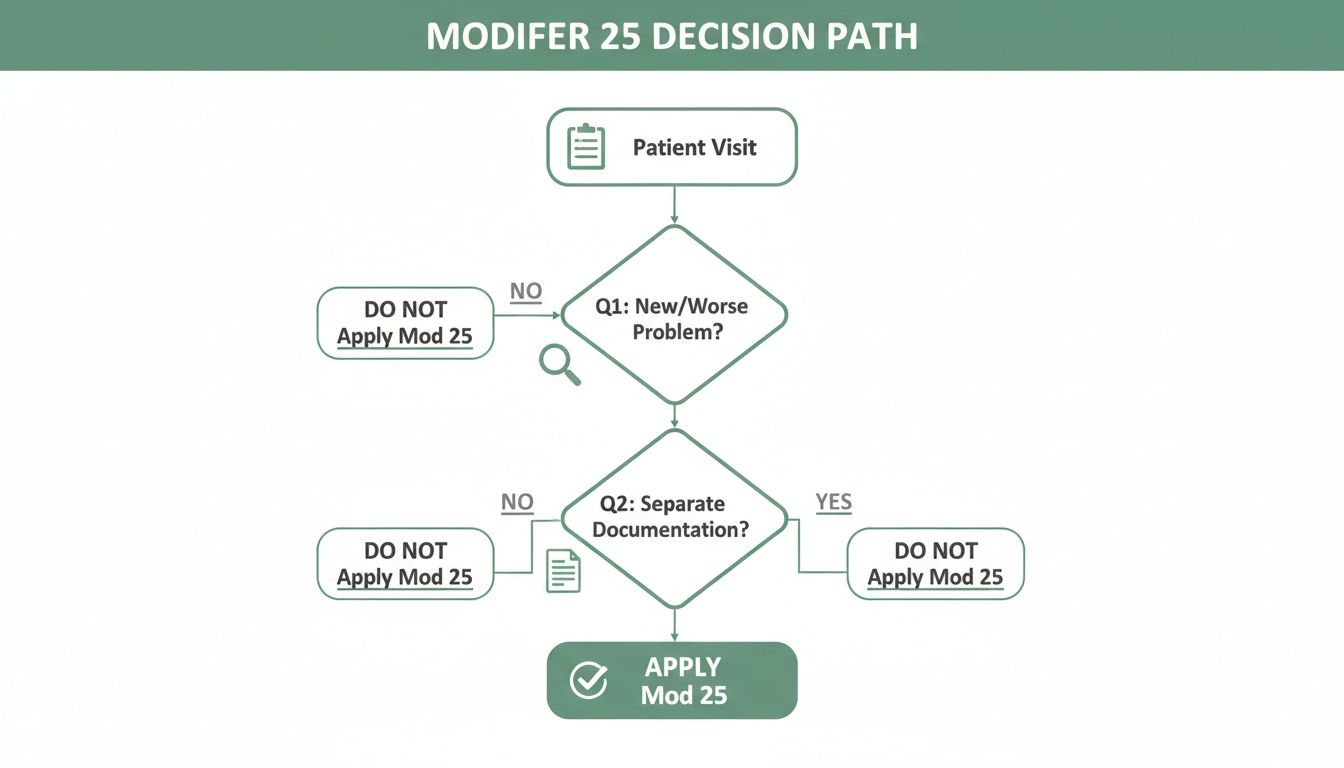
As the visual guide shows, the correct path to using CPT modifier 25 involves a new or worsened problem backed by separate, clear-cut documentation.
Modifier 25 Application Cheat Sheet
To make this even simpler, here's a quick cheat sheet that breaks down common scenarios. Think of it as a go-to reference for your billing team and providers.
Scenario 1: Patient with a planned procedure
- Correct Usage (Apply Modifier 25): Patient is scheduled for a wart removal but also asks the provider to evaluate a new, persistent cough and fever. The cough evaluation is a separate E/M service.
- Incorrect Usage (Do Not Apply Modifier 25): Patient is scheduled for a wart removal. The provider only examines the wart, confirms the plan, and obtains consent before the procedure. This is pre-operative work, not a separate E/M.
Scenario 2: Follow-up visit with a new problem
- Correct Usage (Apply Modifier 25): A patient comes in for a routine blood pressure check and also reports a painful, swollen ankle from a fall yesterday. The provider evaluates the new ankle injury.
- Incorrect Usage (Do Not Apply Modifier 25): A patient is in for post-op care following a minor surgery last week. The visit is part of the procedure's global period.
Scenario 3: Acute visit leading to a procedure
- Correct Usage (Apply Modifier 25): A patient presents with severe ear pain. The provider performs a full otoscopic exam, diagnoses an infection, and then performs an incision and drainage of an abscess found during the exam.
- Incorrect Usage (Do Not Apply Modifier 25): A patient comes in for a scheduled B12 injection. No other medical problems are discussed or evaluated. The visit's sole purpose is the procedure.
This breakdown highlights the fundamental difference: Modifier 25 is for when a provider performs two distinct services—one cognitive (E/M) and one procedural—not for the routine evaluation that’s part of any minor surgery.
Red Light Scenarios: When You Should Not Use Modifier 25
Just as important as knowing when to use the modifier is knowing when to hit the brakes. Applying it incorrectly is a huge red flag for payers and a fast track to denials. These "red light" situations almost always involve services that are considered an inherent part of the procedure itself.
Here are the scenarios where CPT modifier 25 should not be used:
- The E/M is Just a Pre-Operative Check: If a patient is scheduled for a minor skin biopsy and the provider does a quick check to confirm the lesion's location and get consent, that’s not a separate E/M service. This evaluation is standard pre-procedure work and is already bundled into the payment for the biopsy.
- The Visit's Sole Purpose Is the Procedure: When a patient is scheduled for something specific, like a joint injection or wart removal, and no other medical issues are addressed, there’s no separate E/M to bill. The decision to perform the procedure was made at a prior visit.
- The E/M is for Post-Operative Care: Never use modifier 25 for E/M services that fall within the routine follow-up care included in the global period of a previous surgery.
Understanding these lines is crucial for billing accuracy. For example, billing for a higher-level E/M service like a 99214 CPT code demands significant medical decision-making that must be clearly documented and completely separate from any minor procedure done on the same day. Training your providers and coders on these specific examples can dramatically cut down on errors and boost your clean claim rate.
Navigating Payer Policies And Common Denials
If you want to use modifier 25 successfully, rock-solid documentation is only half the battle. You also need a deep understanding of individual payer rules, and unfortunately, there’s no universal playbook. Every insurance company, from big players like Medicare to private commercial carriers, has its own guidelines, quirks, and hidden "gotchas."
This variability is one of the biggest headaches in medical billing. One payer might demand the complete medical record with every modifier 25 claim, no questions asked. Another might automatically slash the E/M payment by a fixed percentage, while a third flags specific diagnosis codes for immediate review. Staying on top of these differences is absolutely essential for keeping your revenue cycle healthy and predictable.
Why Payer Policies Differ So Much
So, why the inconsistency? It really boils down to cost control. Payers create their own policies to prevent what they see as overutilization. Since modifier 25 directly triggers a second payment on a single day, it’s a permanent fixture on their audit radar. Some insurers are simply more aggressive than others in how they scrutinize these claims, creating a tangled web of rules for your billing team to navigate.
This isn’t a new problem. Ever since modifier 25 appeared in the 1992 CPT manual, it's been a source of confusion for providers and payers alike. The wild differences in policies—from demanding documentation upfront to applying unique deductible rules—have even pushed the American Medical Association to call for better, more streamlined reporting tools. You can learn more about the history and ongoing challenges by revisiting modifier 25 and its complexities.
The bottom line is that you cannot take a one-size-fits-all approach. What gets a claim paid with one insurance company could trigger an instant denial from another. Proactive knowledge of each major payer's rules is your best defense against surprises.
Taking this proactive approach helps your billing team get ahead of potential roadblocks, cut down on time-sucking appeals, and ultimately lower your days in accounts receivable (A/R).
Unpacking The Most Common Denial Reasons
When a claim with modifier 25 gets kicked back, the reason almost always falls into one of a few familiar buckets. If you can recognize these denial reasons, you can spot weaknesses in your own documentation or billing workflow and fix them before they become a recurring drain on your revenue.
Here are the top reasons payers deny these claims:
- Insufficient Documentation: This is, without a doubt, the #1 reason for denial. The medical record simply fails to prove the E/M service was truly significant and separately identifiable. Maybe the note is too vague, or it improperly blends the E/M and procedure details together into one narrative.
- Service Considered Incidental to Procedure: The payer has decided that the E/M work you described was just routine pre-op or post-op care. In their eyes, that work is already included—or "bundled"—into the payment for the main procedure.
- Missing or Incorrect Modifier: This is a pure clerical error. Forgetting to add the modifier to the E/M code or, even worse, putting it on the procedure code instead will earn you an automatic rejection.
- Diagnosis Code Lacks Medical Necessity: The diagnosis code linked to the E/M service doesn’t give a strong enough reason for a separate evaluation. For example, using the exact same diagnosis for both the E/M and a minor procedure is a classic red flag for certain payers.
- Payer-Specific Policy Violation: Sometimes, your claim is perfectly coded and documented by CPT standards, but it still breaks a specific internal rule for that insurance company. This could be anything from a bundling edit to some other obscure payment policy buried in their provider manual.
For some complex claims, you might even need the insurer's green light beforehand. You can get a better handle on that process by reading our overview of what prior authorization is in healthcare.
Crafting An Effective Denial Appeal
A denial isn’t the end of the road—not by a long shot. With a strong, evidence-based appeal, you can successfully overturn many modifier 25 denials. The secret is to use the payer’s own logic against them, backed by your robust documentation to build an airtight case.
Your appeal letter should be clear, concise, and professional. Always include a copy of the original claim, the Explanation of Benefits (EOB) showing the denial, and a clean copy of the provider’s clinical note. In your letter, point directly to the specific parts of the note that prove the E/M service was significant and separate. Don’t be afraid to quote the documentation directly to build your argument. This focused approach makes it easy for the reviewer to see the evidence and approve the payment.
Building A Compliant Documentation Workflow
Getting paid for modifier 25 claims isn’t about luck. It’s about building a rock-solid workflow that makes compliant documentation feel like second nature. When you have a smart system in place, you stop reacting to denials and start preventing them from ever happening.
A well-designed workflow bridges the gap between the clinical work happening in the exam room and the billing requirements on the back end. Every claim you submit should be built on a foundation of clear, unambiguous evidence.

Optimize Your EHR Templates
Your EHR can be your greatest ally or your biggest obstacle. Generic, out-of-the-box templates often fail to capture the specific details needed to justify modifier 25. The solution? Customize them to actively prompt providers for the right information.
Consider adding a dedicated, optional section within your encounter note labeled something like "Separately Identifiable E/M Service." This section should have distinct fields for the chief complaint, HPI, and medical decision-making related only to the E/M portion of the visit. This structural separation makes it easy for providers to document correctly and for auditors to immediately see the distinction.
Here are a few practical EHR tweaks you can make:
- Smart Prompts: Use conditional logic to trigger a pop-up if an E/M code and a procedure code are entered for the same visit. The prompt can ask, "Is the E/M service significant and separate? If so, complete the dedicated E/M section."
- Pre-Built Phrases: Create ".dot" phrases or smart text that providers can easily pull into the note. For example: "A significant, separately identifiable E/M service was performed for the evaluation of [Problem]…"
- Visual Separation: Use headers, bold text, or even different colored fonts within the template to visually segregate the procedure note from the E/M note.
Strengthen Clinical And Billing Communication
Even with perfect templates, miscommunications between your clinical and billing teams can sink a claim. You need simple, direct communication channels to flag potential issues before a claim ever goes out the door. This internal feedback loop is a core part of a compliant medical billing process, catching errors before they become costly denials.
A weekly or bi-weekly "coding huddle" can be incredibly effective. In these quick meetings, billers can present examples of flagged or denied claims, and providers can offer the clinical context. This collaborative review helps both sides understand each other's challenges and improves accuracy across the board.
This level of scrutiny is more important than ever. Back in 2001, the U.S. Office of Inspector General (OIG) reported that of $23 billion billed for E/M services under Medicare, $1.7 billion—or 7.4%—was associated with CPT modifier 25, highlighting its significant use and potential for review. This is a key reason the OIG continues to focus on modifier 25 in its work plans.
Implement Routine Self-Audits
The final piece of a durable workflow is regular self-auditing. You can't fix problems you don't know exist. By proactively reviewing your own claims, you can spot patterns of misuse, identify documentation gaps, and pinpoint provider-specific educational needs.
Start small. Pull a random sample of 10-15 claims per provider each quarter that include modifier 25. Then, review them against a simple checklist:
- Is the E/M documentation physically and logically separate from the procedure note?
- Does the note clearly state a chief complaint for the E/M service?
- Is the medical necessity for the separate E/M service obvious?
- Would the E/M note stand on its own if the procedure note were completely removed?
By embedding these three practices—optimized templates, clear communication, and self-audits—into your daily operations, you build a resilient and defensible workflow. This transforms compliance from a reactive scramble into a proactive strategy that protects your revenue and reduces everyone's stress.
Answering Your Top Questions About Modifier 25
Even with a solid grasp of the rules, modifier 25 has a few gray areas that always seem to cause confusion. These tricky situations can leave both providers and billing teams feeling uncertain, leading to missed revenue or compliance risks.
Let's clear the air. This final section tackles the most common questions we hear from practices every day, giving you direct, practical answers to navigate these scenarios with confidence. Think of it as locking in the final pieces of the puzzle, so you can apply the modifier correctly and secure the reimbursement you've earned.
Can I Use Modifier 25 With A Preventive Visit?
Yes, you absolutely can, but this is a scenario that demands crystal-clear documentation. It happens all the time in primary care: a patient comes in for their scheduled annual physical, but during the visit, they bring up a new, acute problem that needs attention.
For instance, a patient is in for their yearly wellness check-up but mentions they’ve been battling a nasty, worsening cough for the past two weeks. The provider can't just ignore it. To properly diagnose the cough, they have to perform a separate, problem-focused evaluation that goes far beyond the scope of a standard preventive service. This involves a distinct history, a focused respiratory exam, and medical decision-making.
In this case, you can bill for both services on the same day:
- The preventive medicine CPT code for the annual physical.
- A separate, problem-oriented E/M code for the cough evaluation, with modifier 25 appended to it.
The key to getting paid is creating a clear firewall in your documentation. Your note must distinctly separate the elements of the preventive visit from the workup done for the acute problem. Without that clean separation, payers will almost certainly bundle the E/M service into the preventive visit and deny it.
Do I Need A Different Diagnosis Code?
This is one of the biggest myths about modifier 25. While using a different diagnosis code is the cleanest and most straightforward way to justify a separate E/M service, it is not an absolute requirement. The ultimate test isn't the diagnosis; it's whether the E/M work was medically necessary and truly distinct from the work included in the procedure.
Consider a dermatology example: a patient with a known history of actinic keratosis comes in for cryotherapy to treat several pre-diagnosed lesions. During the visit, the provider spots a new, suspicious-looking lesion on the patient's back with different characteristics. The provider then performs a full E/M service to evaluate this new lesion, which might involve a detailed history of its development, a dermoscopic exam, and a discussion about a potential biopsy.
Here, the general diagnosis might be the same (actinic keratosis), but the E/M service for the new, unevaluated lesion is significant and separately identifiable from the procedure of freezing the old, known lesions. Your documentation has to paint this picture clearly, highlighting the distinct cognitive work and medical decision-making that went into assessing the new problem.
How Does This Work With Global Surgery Periods?
Understanding how modifier 25 interacts with global surgery periods is critical, and the rules differ depending on whether the procedure is minor or major.
Minor Procedures (0 or 10-Day Global Period)
This is where you'll see modifier 25 used most often. It’s appended to a significant, separately identifiable E/M service that happens on the exact same day as a minor procedure. A classic example is a patient visit where you evaluate their chronic back pain (the E/M service) and then perform a trigger point injection (the minor procedure) to treat it.
Major Procedures (90-Day Global Period)
Modifier 25 plays a much more specific role here. You use it to bill for an E/M service on the day of—or the day before—a major surgery only if that visit is where the initial decision to perform the surgery was made.
For example, a patient sees an orthopedic surgeon for a consultation about severe knee pain. The surgeon conducts a comprehensive E/M service, diagnoses a torn meniscus, and recommends surgical repair. If that decision is made during that very visit to schedule the surgery for the next day, the E/M service can be billed with modifier 25. This tells the payer that the visit wasn’t just a routine pre-op check; it was the key diagnostic encounter where the need for major surgery was established.
Navigating the complexities of medical billing and coding requires dedicated expertise and a proactive approach. At One For All Medical Billing, we provide the specialized support your practice needs to reduce denials, improve revenue, and stay compliant. Our U.S.-based, certified team becomes an extension of your practice, ensuring every claim is handled with precision. Schedule your free consultation today and discover how we can help you achieve your financial goals.

