

table of contents
The 99214 CPT code is one of the workhorses of outpatient medicine. It’s meant to capture an office visit for an established patient that involves a moderate level of complexity—more involved than a straightforward follow-up (99213) but not quite as intensive as a visit for a severe or life-threatening issue (99215).
Think of it as the go-to code for managing a stable chronic condition that's suddenly acting up, or for evaluating a new problem that requires a bit more diagnostic detective work.
Decoding The 99214 CPT Code Description

While 99214 is one of the most frequently used evaluation and management (E/M) codes, its high usage also puts it squarely on the radar for audits from Medicare, Medicaid, and commercial payers. Because of this, truly understanding what qualifies is non-negotiable for both compliance and the financial health of your practice.
Essentially, a provider can justify billing a 99214 in one of two ways, thanks to the updated E/M guidelines. The path you choose depends entirely on what best reflects the intensity of the patient encounter.
The Two Pathways To Billing 99214
You only need to meet the requirements for one of these two pathways—not both. Your documentation just needs to strongly support the one you choose.
- Medical Decision Making (MDM): This is the most common path, and it requires a moderate level of MDM. This is all about the provider's thought process—analyzing problems, reviewing data, and weighing the risks and benefits of treatment options.
- Total Time: The second path is based on the total time the provider spent on the date of the encounter. For a 99214, this is a documented 30-39 minutes. This isn't just face-to-face time; it includes chart review, ordering tests, and care coordination done on the same day.
The core principle behind the 99214 CPT code is to accurately capture a clinical encounter of moderate complexity. This could mean managing a chronic illness with a new complication or dedicating significant time to coordinating a patient’s care plan.
Why Mastering This Code Matters
Getting 99214 right is a big deal. If you under-code and bill a 99213 for a visit that really qualified as a 99214, you're leaving significant revenue on the table. Over time, that adds up to a major financial hit.
On the flip side, over-coding without the documentation to back up that "moderate complexity" is a red flag for payers. It invites scrutiny, denials, and potentially stressful, costly audits.
For any busy practice, the reimbursement difference between a 99213 and a 99214 can have a real impact on your bottom line. Making sure every provider and biller in your practice understands the specific criteria for this code isn't just about compliance—it's a fundamental part of a healthy revenue cycle. The key is always in the documentation: tell the story of the encounter, and you'll secure the right reimbursement for the valuable work you do.
Creating Audit-Proof Documentation For 99214
When you submit a claim for 99214, your clinical note is your evidence. It’s the story you tell an auditor to justify the moderate complexity of the visit, proving the service was both necessary and correctly coded. Getting this narrative right is the single best way to protect your revenue and stay compliant.
To build a solid case for 99214, you need to anchor your documentation in one of two pillars: Medical Decision Making (MDM) or total time spent on the day of the encounter. You only have to meet the requirements for one of them, but your notes must make it crystal clear which path you took and why.
Documenting Moderate Medical Decision Making
If you're billing based on MDM, your note needs to reveal your thought process. It's about showing the work that went into your clinical choices, demonstrating the moderate level of complexity involved in managing the patient's care. This is more than just rattling off a problem list or noting a prescription refill.
To hit the moderate MDM threshold for 99214, your documentation has to satisfy at least two of these three elements:
- Problems Addressed: This could be managing one or more chronic illnesses that are getting worse (exacerbation). Or, it might be juggling two or more stable chronic illnesses at once. Diagnosing a new problem with an uncertain prognosis also fits the bill here.
- Data Reviewed: Did you analyze lab results? Interpret an EKG? Read a specialist's consult note? Maybe you had to get history from a caregiver because the patient couldn't provide it. You need to detail exactly what data you reviewed and considered.
- Risk of Complications: This element is all about the potential for harm from the condition itself or the treatment plan. Managing prescription drugs is a classic example. Deciding to perform minor surgery or dealing with a patient whose care is complicated by social determinants of health also clearly demonstrates this level of risk.
Think of it like this: your documentation should paint a vivid picture. Instead of just writing "hypertension," describe it as "uncontrolled hypertension despite medication adjustments, requiring review of patient's home BP log and consideration of adding a second agent." That specific detail is what elevates a visit to a 99214.
Capturing Time-Based Billing Accurately
The other route to a 99214 is by documenting 30-39 minutes of total time spent on the date of service. A common misconception is that this is limited to face-to-face time—it's not. The key is to include a clear statement in your note summarizing the total time and what you did during that period.
A simple attestation is usually all you need. For example: "I spent a total of 35 minutes on this patient's care today, which included reviewing recent lab work, counseling the patient on medication side effects, and documenting the care plan."
Here are some of the activities that count toward that total time:
- Prepping for the visit by reviewing old records and test results
- Performing the history and examination
- Counseling and educating the patient, their family, or a caregiver
- Ordering medications, tests, or procedures
- Communicating with other healthcare professionals about the patient's care
This time-based method is incredibly useful for those visits that are heavy on counseling or care coordination but might not tick all the boxes for moderate MDM.
The Financial Stakes Of Documentation
Getting 99214 documentation right isn't just a compliance chore; it's fundamental to your practice's financial health. While 99214 is one of the most common E/M codes, it's also one of the most frequently audited. On the flip side, under-coding is a massive source of lost income. One report found that family physicians lose an estimated $57,600 each year just by billing at lower levels than their services justify.
Avoiding revenue loss and audit risk comes down to one thing: a commitment to thorough, detailed documentation. Building strong habits for clinical documentation improvement is an investment that always pays off.
Choosing Between 99213, 99214, And 99215
Picking the right Evaluation and Management (E/M) code is a balancing act. If you under-code, you’re leaving hard-earned money on the table. But if you over-code, you’re practically sending an engraved invitation for a payer audit.
Getting comfortable with the subtle yet critical differences between CPT codes 99213, 99214, and 99215 is non-negotiable for a practice’s financial health and compliance.
Think of these codes as a ladder of clinical complexity. Each step up represents a more involved patient encounter that demands more cognitive work from you, the provider. To make this tangible, let's follow a single patient's hypertension journey and see how it can justify each of these three distinct code levels.
The decision tree below maps out the core components—Medical Decision Making (MDM) and time—that guide your choice and help you build audit-proof documentation for a 99214 visit.
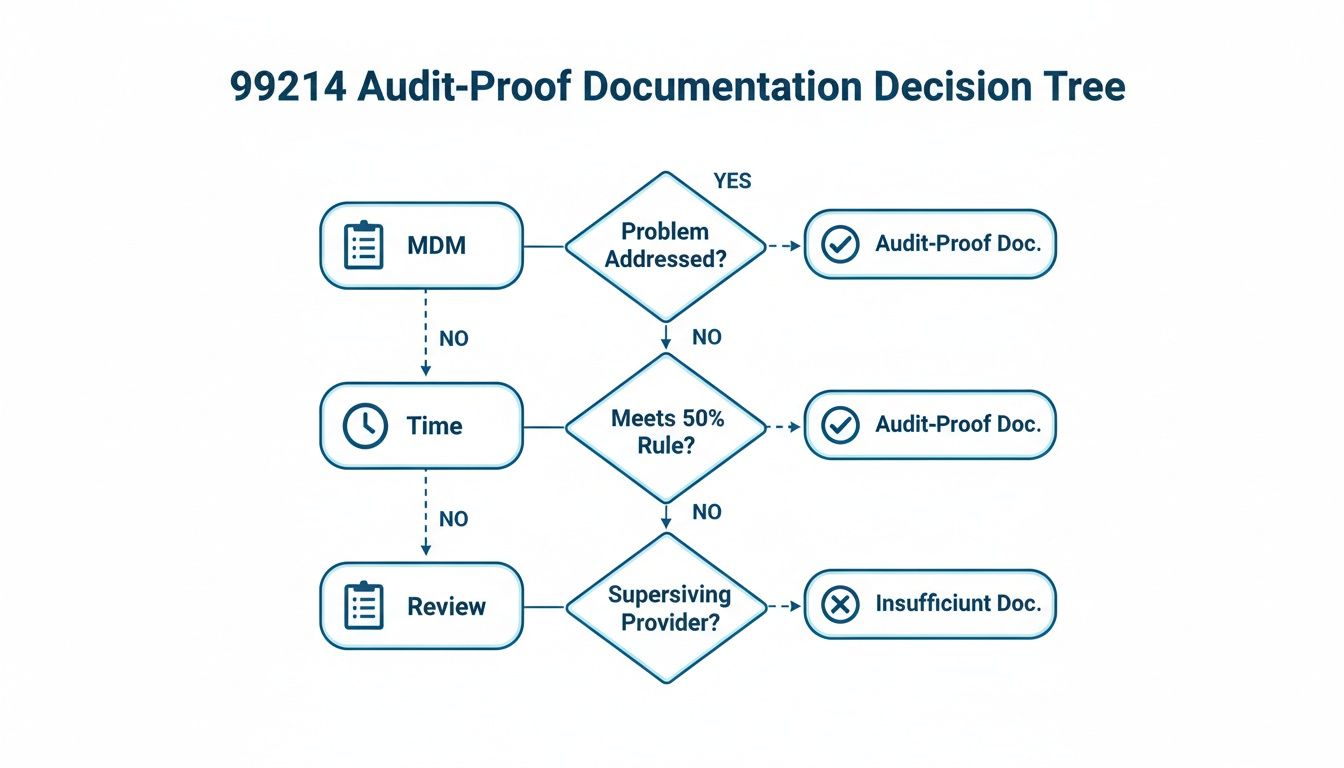
As the visual shows, your documentation must clearly support either the moderate complexity of your MDM or the total time you spent to justify billing a 99214.
The 99213 Scenario: Low Complexity
A 99213 CPT code visit is your bread-and-butter, low-complexity encounter. Picture a patient with stable, well-managed hypertension coming in for their routine three-month follow-up.
- Clinical Picture: The patient’s blood pressure is right where it should be. They have no new symptoms and are sticking to their current medication plan.
- MDM Level: This is low complexity. You're managing one stable chronic illness, reviewing a limited amount of data (like a home BP log), and the risk is minimal because the plan is simple: "keep doing what you're doing."
- Time: The visit is efficient, usually wrapping up in 20-29 minutes.
This is a straightforward check-in with no new problems to solve, making 99213 the perfect fit.
The 99214 Scenario: Moderate Complexity
Now, let's turn up the heat to a 99214 level. The same patient returns, but this time, the situation has evolved. This is the heartland of the 99214 CPT code description.
- Clinical Picture: The patient’s blood pressure is now high, even though they’ve been taking their medication as prescribed. They also mention a nagging dry cough—a known side effect of their ACE inhibitor.
- MDM Level: We’ve jumped to moderate complexity. Now you're managing a chronic illness with a new problem or complication. You have to analyze the elevated BP, review their medication history, and consider alternatives for the cough. The risk is also higher because it involves prescription drug management, specifically stopping one drug and starting another.
- Time: The visit naturally takes longer, falling into the 30-39 minute range. You need time to counsel the patient on the new medication, discuss its potential side effects, and stress the importance of monitoring their BP.
The key trigger for 99214 here is the new complication—the cough—which forces a change in the management plan. This clearly elevates the cognitive effort and risk beyond a routine check-up.
The 99215 Scenario: High Complexity
So, what pushes this same patient into 99215 territory? This code is reserved for encounters that are truly high-stakes.
- Clinical Picture: The patient presents with dangerously high blood pressure. They are complaining of headaches and blurred vision, raising immediate concerns about end-organ damage.
- MDM Level: This is unquestionably high complexity. You are managing a chronic illness with a severe exacerbation that poses a direct threat to the patient's health. The decision-making is intense, potentially involving urgent labs, an EKG, and a discussion about an immediate trip to the emergency department.
- Time: These critical visits demand more attention, typically taking 40-54 minutes due to the extensive evaluation, patient counseling, and coordination of urgent care.
The jump from 99214 to 99215 is all about the severity of the threat and the high-stakes decisions you have to make on the spot.
To help you see these differences at a glance, here’s a quick comparison.
Key Differences Between E/M Codes 99213, 99214, And 99215
CPT Code 99213
- Complexity: Low
- MDM: Low Complexity (e.g., 1 stable chronic illness OR 2 self-limited problems)
- Total Time: 20-29 minutes
- Example: Routine follow-up for stable hypertension or diabetes.
CPT Code 99214
- Complexity: Moderate
- MDM: Moderate Complexity (e.g., 1 chronic illness with exacerbation)
- Total Time: 30-39 minutes
- Example: Hypertension with new side effects requiring a medication change.
CPT Code 99215
- Complexity: High
- MDM: High Complexity (e.g., 1 chronic illness with severe exacerbation)
- Total Time: 40-54 minutes
- Example: Hypertensive crisis with symptoms suggesting potential end-organ damage.
By recognizing these distinct clinical triggers, both in your decision-making and the time spent, your practice can code with confidence. This ensures you accurately capture the value of every patient encounter without raising red flags.
The Financial Impact Of Accurate 99214 Reimbursement
Getting paid correctly for a 99214 visit is much more than a box-ticking exercise for compliance—it's a critical part of your practice's financial engine. While the clinical work is what justifies the code, the numbers behind it show exactly why precision is so important for keeping your practice healthy and growing. Every single patient visit has a value, and making sure you capture it correctly is the bedrock of a strong revenue cycle.
This value is measured using a system called Relative Value Units (RVUs). The easiest way to think about RVUs is as a standardized score for a medical service. This score accounts for the provider's work, the practice's overhead expenses, and malpractice insurance costs. Payers like Medicare then use a "conversion factor"—a set dollar amount—to turn those RVU points into the actual cash that lands in your bank account.

Why Under-Coding Is So Financially Damaging
The dollar gap between a 99213 and a 99214 is significant, and it shows the real-world cost of under-coding. When a provider performs a moderately complex service but bills for a low-complexity one, it creates an immediate revenue leak. This isn't just a one-off mistake; it's a compounding issue that quietly drains your practice's resources month after month.
Take the Medicare rate for a 99214 visit, which corresponds to 25 minutes of service time. It currently reimburses at $135.61, making it a key revenue driver for practices that bill it appropriately. Compare that to the lower-level 99213, which reimburses at $95.19 for 15 minutes of service. The difference is stark and clearly incentivizes accurate coding.
However, the picture changes with Medicaid. A 99214 reimburses at just $93.94 for the same 25-minute visit, while a 99213 pays $70.65. This massive gap between Medicare and Medicaid—where the Medicaid rate is about 44% lower—creates serious financial headwinds, especially for practices with a large Medicaid patient base.
The Annual Cost Of Small Coding Errors
Let's break this down with some simple math. Imagine a single provider under-codes just two 99214 visits as 99213s every day. The impact adds up faster than you'd think.
- Daily Loss (Medicare): The difference between a 99214 ($135.61) and a 99213 ($95.19) is $40.42. Missing out twice a day costs $80.84.
- Annual Loss (Single Provider): If that provider works 240 days a year, that $80.84 daily loss snowballs into a staggering $19,401.60 in lost revenue.
Now, scale that across a practice with five providers. The annual revenue leakage from this seemingly minor coding habit explodes to $97,008—nearly six figures lost simply because the billing didn't accurately reflect the work performed.
This math makes it painfully clear that precise coding isn't just an administrative chore. It’s a core business function tied directly to your practice's ability to cover overhead, invest in new equipment, and pay your staff what they're worth. Honing your approach is one of the most effective revenue cycle management strategies you can implement.
Protecting Your Bottom Line
Ultimately, every time a 99214 is billed as a 99213, your practice is giving away its services at a steep discount. Protecting your revenue starts by recognizing the true value of your providers' work and ensuring your coding reflects it. This means ongoing provider education, better documentation templates, and a billing process that can flag potential under-coding before claims even go out the door.
By focusing on coding accuracy, you aren't just following rules—you are securing the financial foundation that allows you to keep providing high-quality care to your community. This proactive mindset turns a major revenue drain into a source of stability and strength.
Pairing CPT 99214 With The Right Modifiers And ICD-10 Codes
Billing a 99214 isn’t just about the E/M code itself. A clean, denial-proof claim tells a complete story, and that requires pairing the CPT code with the right modifiers and International Classification of Diseases, Tenth Revision (ICD-10) codes. Think of them as the supporting cast that justifies the medical necessity of the visit.
Without this crucial context, payers are left guessing, and that almost always leads to delays, denials, and a mountain of administrative work. Nailing how these elements work together is the key to getting paid correctly and promptly for the complex care you provide.
Using Modifier 25 For Separate Services
One of the most essential and frequently used codes in this context is Modifier 25. This little add-on sends a clear signal to the payer: a significant, separately identifiable E/M service was performed by the same provider on the same day as a minor procedure. It essentially says, "This wasn't just the routine pre-op check; a distinct and medically necessary evaluation took place here."
Let’s walk through a common scenario. A patient comes in for a scheduled joint injection (CPT 20610). Before you even get to the procedure, they mention they’ve been having new, unrelated chest pain. You stop, perform a detailed history, examine their cardiovascular system, and make a moderate-complexity decision about managing this acute and concerning new problem.
The E/M service for the chest pain is completely separate from the work involved in the injection. Here’s how you’d bill it:
- 99214-25 for the E/M service addressing the new problem.
- 20610 for the joint injection procedure.
Using Modifier 25 correctly is non-negotiable. Slapping it onto a 99214 claim when the visit's only purpose was the procedure is a huge red flag for auditors. Your documentation must clearly spell out the separate history, exam, and medical decision-making that justifies the E/M service.
Linking ICD-10 Codes That Prove Medical Necessity
Just as a modifier adds context, the right diagnosis codes prove why the 99214 visit was necessary to begin with. The ICD-10 codes linked to your 99214 claim must logically support a moderate level of complexity. It's a simple gut check: a low-complexity diagnosis paired with a moderate-complexity E/M code is an immediate mismatch that payers will kick back.
For a 99214 claim to stand strong, the diagnoses should reflect the kinds of clinical situations that demand this level of service. You can learn more about how diagnosis codes drive the entire billing process in our comprehensive guide to ICD-10 education.
Here are the types of ICD-10 codes that create a solid foundation for a 99214 visit:
- Chronic Illness with an Exacerbation: A code for type 2 diabetes with hyperglycemia (E11.65) instantly shows a stable condition has become uncontrolled, requiring a higher level of thinking and management.
- Multiple Stable Chronic Conditions: Linking codes for stable hypertension (I10) and stable hyperlipidemia (E78.5) together demonstrates the cognitive load of managing several ongoing issues at once, even if they're currently stable.
- Undiagnosed New Problem with an Uncertain Prognosis: A code for abdominal pain, unspecified site (R10.9), represents a diagnostic puzzle that requires a moderate workup to figure out the cause.
- Acute Illness or Injury: Using a code for an acute upper respiratory infection (J06.9) shows the need to evaluate, diagnose, and create a new treatment plan for an immediate health problem.
By thoughtfully picking ICD-10 codes that align with the moderate complexity of 99214, you build a claim that’s both logically sound and highly defensible. This tight alignment between the "what" (CPT code) and the "why" (ICD-10 code) is the bedrock of successful medical billing.
How To Reduce 99214 Denials And Audit Risk
Because CPT code 99214 is both a high-volume and high-value code, it lives permanently on the radar of payers. Its frequent use makes it a prime target for scrutiny, which means practices have to be diligent to avoid the headaches of costly denials and audits.
Staying compliant isn’t about luck; it’s about having a proactive strategy to spot and fix common risks before they ever turn into a rejected claim.
The biggest red flags for auditors almost always involve patterns. If you're billing an unusually high percentage of 99214s compared to your peers, or if your notes look consistently cloned or templated, you’re practically inviting a review. Payers are looking for documentation that tells a unique story for each encounter. Notes that lack specifics about the patient's condition or the provider’s thought process are easily challenged.
Proactive Steps To Mitigate Risk
Staying off the audit radar is all about building strong internal processes. By adopting a few key habits, you can bill for 99214 with confidence, knowing your documentation is solid enough to defend.
- Conduct Regular Internal Audits: Every so often, pull a sample of your 99214 claims. Make sure the documentation squarely supports the moderate complexity you billed for, whether it’s based on MDM or time.
- Avoid Cloned Documentation: This is a big one. Ensure every note is specific to the encounter. Templated phrases are fine for structure, but the core clinical story—the history, the data you reviewed, and the risk assessment—must be unique to that patient, on that day.
- Educate Your Providers: Ongoing education is non-negotiable. Many providers simply under-document their work because they aren't aware of the specific details needed to justify a moderate-complexity visit. A little training goes a long way.
Your documentation should paint a clear picture, allowing any auditor to understand the "why" behind your clinical decisions. If your thought process is visible in the note, the claim is far more likely to sail through without a problem.
The Role Of A Dedicated Billing Partner
A specialized billing partner can act as your first line of defense against denials and audits. Instead of just reacting to rejections after the fact, a dedicated team can identify documentation weaknesses and coding inconsistencies before a claim is ever sent out. This proactive approach is the cornerstone of effective medical billing denial management.
This partnership helps your practice in a few key ways. Certified coders can give direct feedback to clinicians, highlighting opportunities to strengthen notes to better support the services billed. They also analyze denial trends to spot payer-specific patterns, allowing your practice to adapt its strategy in real time.
Ultimately, it ensures you are always prepared for scrutiny, protecting your revenue while you focus on taking care of your patients.
Frequently Asked Questions About CPT Code 99214
Even after you get the hang of the 99214 CPT code description, certain questions pop up again and again in daily practice. Here are some straight answers to the most common queries we hear, so you can handle those tricky scenarios with confidence.
Can I Bill 99214 Based On Time For Counseling?
Yes, absolutely. The modern E/M guidelines were specifically designed to give providers credit for all the work that goes into a visit, not just the physical exam. You can choose to level your code based on either Medical Decision Making (MDM) or the total time you spent on the date of service.
If a significant portion of your visit was dedicated to counseling, patient education, or coordinating care, and that time fell between 30 and 39 minutes, you can definitely bill 99214. The key is to document it properly. Just add a quick note like, "Spent 35 minutes total, with the majority of time counseling the patient on new medication risks and lifestyle changes."
What Is The Biggest Mistake To Avoid When Billing 99214?
The most common—and most expensive—mistake is not having enough documentation to back up a moderate level of MDM. This usually happens when notes are "cloned" from a previous encounter or when a generic template is used that doesn't capture the provider's actual thought process for that specific visit.
For instance, a note might list a patient's chronic conditions but fail to explain how a new symptom, a change in treatment, or the analysis of recent lab results influenced the care plan. An auditor needs to see a clear, logical path to moderate complexity, and a copy-paste note just won't cut it.
The core principle is simple: your documentation must tell the story of the visit. If an outside reviewer can't understand why the visit was moderately complex just by reading your note, the claim is at risk.
How Does A Billing Partner Improve 99214 Coding Accuracy?
Think of a specialized billing partner as a critical safeguard for your practice’s revenue and compliance. Their certified coders review your documentation to make sure it checks all the boxes for a 99214 claim before it ever goes out the door. This simple step can slash your denial rates.
Beyond that, a good partner provides direct feedback to providers on how to strengthen their notes. They also spot patterns of under-coding that leave money on the table, helping you capture the revenue you’ve rightfully earned. By keeping up with payer-specific rules and denial trends, a dedicated partner fine-tunes your billing strategy to maximize reimbursement while keeping you compliant, freeing you up to focus on patient care.
Navigating the complexities of 99214 billing is a challenge, but you don't have to tackle it alone. One For All Medical Billing provides expert support to ensure your practice codes accurately, reduces denials, and secures the reimbursement you deserve. Schedule your free consultation today at https://oneforallmed.com.

