

table of contents
The true medical billing services cost isn't just an expense line on a spreadsheet—it's an investment in your practice's financial health. Most services charge between 3% to 9% of your practice's monthly collections, but thinking about it as a simple fee is the wrong approach.
Decoding The Real Cost Of Medical Billing Services
Choosing a medical billing service is like hiring a specialized financial advisor for your practice. You're not looking for the cheapest option; you're looking for a partner who can optimize your revenue cycle and maximize what you take home.
The conversation needs to shift from "How much does this cost?" to "How much more revenue can this generate?" This mindset turns billing from a reactive expense into a proactive growth strategy, making it the engine that drives your financial success.
Medical Billing Pricing Models At A Glance
To help you get a handle on potential costs, it's good to know how billing companies structure their fees. We'll dive deeper into these models later, but here’s a quick overview of the most common approaches and who they work best for.
Percentage-Based
- Typical Cost Structure: A percentage (3-9%) of total monthly collections.
- Best For: Practices that want a partner whose success is tied directly to their own.
Per-Claim
- Typical Cost Structure: A flat fee for each claim submitted, regardless of its value.
- Best For: Practices with a high volume of low-value, straightforward claims.
Flat-Fee
- Typical Cost Structure: A fixed, predictable monthly fee for all billing services.
- Best For: Larger practices or those with stable claim volumes that prefer budget certainty.
Ultimately, the right model depends on your claim volume, specialty, and financial goals. The key is finding a structure that aligns with your practice's unique needs.
Typical Cost Ranges For Practices
The exact percentage a billing service charges often comes down to your practice's size and complexity. For most independent healthcare practices, you can expect outsourced billing to land somewhere between 3% and 9% of collections, sometimes with a few small administrative fees tacked on.
Industry surveys show that solo practitioners might pay a bit more, closer to 10.9% of their total collections, while small to mid-sized practices average around 8%. These numbers reflect the hands-on work required for smaller accounts. You can learn more about how billing services calculate these costs in our detailed guide.
Choosing the right partner is about more than just comparing percentages. It’s about finding a team that truly understands the financial nuances of how you operate. For more guidance, our article on finding medical billing services near you that boost revenue can help you select a service that not only fits your budget but actively improves your bottom line.
Breaking Down The Three Core Pricing Models
Before you can figure out what medical billing services will cost your practice, you have to get a handle on how billing companies actually structure their fees. While the final number can vary, almost every company uses one of three core pricing models. Each comes with its own set of pros and cons, making them a better or worse fit depending on your practice's size, claim volume, and financial strategy.
Think of it like choosing the right tool for a job. You wouldn't use a sledgehammer for a finishing nail. In the same way, the pricing structure that works wonders for a high-volume urgent care clinic could be a financial drain on a low-volume surgical practice. Let's pull back the curtain on these models to see which one aligns with your practice.
The Percentage Of Collections Model
This is the most common setup you'll find, and for good reason. With the percentage of collections model, the billing service takes a cut—typically between 3% and 9%—of the money they successfully collect for you. This structure creates a powerful partnership where their success is directly tied to yours.
It’s essentially a commission-based role. Your billing partner is highly motivated to chase down every dollar, appeal every denial, and maximize every reimbursement because their paycheck depends on it. This shared incentive is a huge plus for practices that want to be sure their billing team is just as invested in their financial health as they are.
This model is a fantastic fit for practices with fluctuating monthly revenue or those that handle complex, high-dollar claims where a persistent follow-up can make a massive difference to the bottom line.
The Per-Claim Fee Model
Next up is the per-claim fee model. With this approach, you pay a small, fixed fee for every single claim sent to an insurance company, no matter the dollar amount. For instance, a company might charge $5 per claim, whether it’s for a simple $75 office visit or a complex $5,000 procedure.
This model offers incredible predictability, which is great for budgeting. It’s often a cost-effective choice for practices with a high volume of straightforward, similar claims, like general family medicine or some pediatric clinics. The catch? The billing company has less direct financial skin in the game when it comes to fighting denials or chasing underpayments since they get paid for submitting the claim, not collecting on it.
To get a better sense of how billing software can support different practice needs, check out our guide on the best medical billing software for small practices.
The Flat-Fee Model
Last but not least is the flat-fee model, which works just like a monthly subscription. Your practice pays a fixed amount every month for all billing services, regardless of how many claims you submit or how much revenue you collect. This gives you absolute budget stability with no surprises.
This model often appeals to larger, more established practices or multi-provider groups that have a steady, predictable patient flow. They can comfortably handle the higher fixed cost in return for simplicity and consistency in their monthly expenses.
The big challenge with a flat-fee model, especially for smaller or growing practices, is that you're on the hook for the same payment during slow months. You pay the full fee whether you have a record-breaking month or a quiet one, which can put a real strain on cash flow when revenue dips.
This decision tree gives you a quick visual of how practice size typically influences the cost.
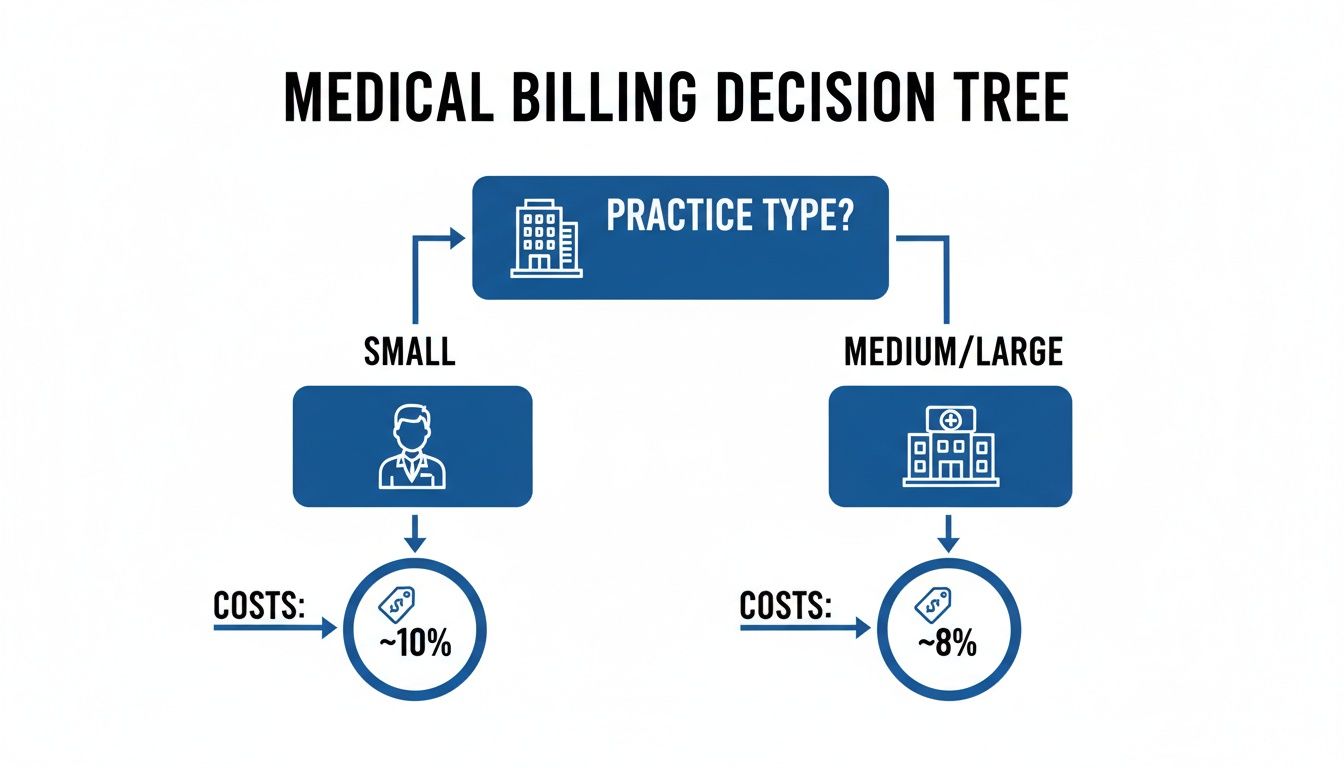
As you can see, smaller solo practices often end up paying a higher percentage. That’s because they require more hands-on attention per claim, whereas larger groups can get better rates thanks to their higher volume and the economies of scale that come with it.
Key Factors That Influence Your Billing Costs
Ever wonder why one practice pays a 4% billing fee while a similar one down the street is quoted 8%? The final medical billing services cost is rarely a simple, off-the-shelf number. It’s a carefully calculated figure that hinges on a few key variables unique to how your practice operates.
Getting a handle on these factors is crucial. It helps you set realistic expectations for your expenses and gives you the context to know whether a quote is fair for the work involved. Think of it like a car insurance premium—your rate depends on your driving record, the car you drive, and where you live. In the same way, your practice’s specific profile directly shapes your billing rate.
Claim Volume And Practice Size
The most straightforward factor is the sheer volume of claims you process every month. Larger practices and multi-location groups that generate a high number of claims often qualify for lower percentage rates. It’s a simple matter of economies of scale.
A billing company can process 1,000 claims from a single large client far more efficiently than 100 claims from ten different small clients. The administrative overhead per claim drops, and those savings are often passed along to you. On the flip side, a solo practitioner with lower claim volume might see a slightly higher percentage, since their account requires a similar level of dedicated oversight without the high-volume advantage.
Payer Mix And Reimbursement Complexity
Your practice's payer mix—the blend of government payers like Medicare and Medicaid versus commercial insurance companies—plays a massive role in your costs. Billing for government payers is often a heavier lift, involving more complex rules, lower reimbursement rates, and rigid compliance standards.
A practice that deals heavily with Medicare and Medicaid might face a higher billing fee to compensate for the extra expertise and effort needed to get claims paid. In contrast, a practice where most patients are covered by a few major commercial insurers might have a more streamlined billing process, which could lead to a lower service cost.
The complexity doesn't just stop at the payer type. In-network versus out-of-network claims, workers' compensation cases, and personal injury claims all add layers of administrative work that can influence your final rate.
Specialty And Claim Complexity
Not all medical claims are created equal. The complexity of the services you provide is a huge cost driver. It’s one thing to bill for a routine primary care visit; it’s another entirely to code and bill for a multi-stage surgical procedure or a series of oncology treatments.
Specialties that involve intricate procedures, multiple CPT codes per claim, and frequent pre-authorizations demand more time and a higher level of expertise from your billers. That increased workload is naturally reflected in the price.
Here’s a quick look at how a specialty can ramp up the billing effort:
- Anesthesiology: Requires precise time-based coding and a dizzying number of modifiers.
- Cardiology: Involves complex diagnostic and interventional procedure codes.
- Mental Health: Often means navigating strict authorization rules and session limits.
- Orthopedics: Frequently deals with surgical packages, implants, and durable medical equipment (DME).
All of this is happening against a backdrop of rising healthcare costs. CMS projects that provider spending will jump by 50% between 2022 and 2030, making efficient, expert billing more critical than ever.
Making sure your billing is dialed in is a core part of a healthy financial strategy. To learn more about improving your entire financial workflow, check out our guide on revenue cycle management best practices.
In-House Vs. Outsourced Billing: A Cost-Benefit Analysis
Deciding whether to manage medical billing in-house or outsource it is one of the most critical financial choices a practice can make. At first glance, keeping billing on your payroll might seem like the cheaper route. But a true cost-benefit analysis reveals a much more complex picture—one where the final medical billing services cost goes far beyond a simple salary.

This decision isn’t just about saving money. It's a strategic move that directly impacts your practice's efficiency, compliance risk, and long-term financial health. To make an informed choice, you have to look past the obvious expenses and calculate the true, fully-loaded cost of each option.
Calculating The True Cost Of An In-House Team
The most common mistake practices make is underestimating the total expense of running their own billing department. The calculation starts with salaries, but it certainly doesn't end there. A comprehensive look reveals numerous direct and indirect costs that add up fast.
To get a real sense of the numbers, you need to factor in all the associated expenses. These "hidden" costs are what often make the in-house model far more expensive than it first appears.
Think about all the investments required:
- Salaries and Benefits: This isn’t just base pay. It includes payroll taxes, health insurance, retirement contributions, and paid time off.
- Ongoing Training: Payer rules and coding regulations are always changing. Your staff needs continuous education to stay compliant and effective, which means paying for courses, certifications, and seminars.
- Software and Technology: You’re on the hook for purchasing and maintaining billing software, paying for licenses, and covering clearinghouse fees for every claim submission.
- Administrative Overhead: This covers the cost of office space, computers, supplies, and the portion of utilities your billing team uses.
- Productivity Gaps: What happens when your biller goes on vacation, calls in sick, or resigns? Your revenue cycle can grind to a halt. The cost of hiring, onboarding, and training a replacement adds even more financial strain.
The Streamlined Economics Of Outsourcing
Outsourcing medical billing fundamentally changes the cost structure. Instead of juggling dozens of variable expenses, you pay a predictable fee—often a percentage of what you collect. This model bundles all the necessary resources—expert staff, advanced software, and continuous training—into one clear cost.
When you partner with a dedicated billing service, you get immediate access to a team of certified specialists whose sole focus is maximizing your revenue. They handle all the administrative headaches, allowing your practice to get back to what it does best: patient care.
Outsourcing transforms billing from a fixed operational cost into a scalable investment. As your practice grows, your billing partner can easily handle the increased claim volume without you needing to hire and train more staff.
The benefits go beyond just cost savings. An expert partner can significantly improve your clean claim rate, reduce days in A/R, and aggressively pursue denied claims, often leading to a substantial increase in overall collections. For a deeper dive, check out how outsourcing medical billing can save your practice time and money.
A Side-By-Side Cost Comparison
To make the decision clearer, let's break down the expenses and outcomes of each approach. This comparison highlights how an outsourced model consolidates costs and often delivers superior financial results.
Cost Comparison: In-House Vs. Outsourced Medical Billing
This comparison provides a head-to-head look at where your money goes with each billing model, moving beyond just salaries to capture the full financial picture.
Cost Factor: Staffing Costs
- In-House Billing: High and fixed (salaries, benefits, taxes, PTO).
- Outsourced Billing Service: Included in a predictable service fee.
Cost Factor: Training
- In-House Billing: Continuous expense for staff certifications and education.
- Outsourced Billing Service: Included; handled by the service provider.
Cost Factor: Software Fees
- In-House Billing: Practice pays for software licenses and clearinghouse fees.
- Outsourced Billing Service: Included in the service fee.
Cost Factor: Productivity
- In-House Billing: Vulnerable to staff turnover, sick days, and vacations.
- Outsourced Billing Service: Uninterrupted service with a full team of experts.
Cost Factor: Expertise
- In-House Billing: Limited to the knowledge of your in-house staff.
- Outsourced Billing Service: Access to specialty-specific, certified coders and billers.
Cost Factor: Administrative Burden
- In-House Billing: High; practice manages hiring, training, and supervision.
- Outsourced Billing Service: Minimal; the billing partner handles all billing operations.
Cost Factor: Performance
- In-House Billing: Dependent on staff skill and motivation.
- Outsourced Billing Service: Incentivized to maximize your collections.
Ultimately, while running an in-house team offers direct control, outsourcing provides access to specialized expertise and operational efficiencies that are difficult and expensive to replicate on your own.
How To Calculate Your Potential ROI

It’s easy to get stuck on the sticker price of medical billing services. But the smarter conversation isn’t about cost—it’s about value. The true measure of a billing partner isn’t what they charge, but how much more revenue they can bring into your practice. This is where calculating your potential return on investment (ROI) flips the script.
A top-tier billing service does way more than just file claims. They actively hunt down and plug revenue leaks, speed up your cash flow, and transform your billing department from a cost center into a growth engine. Think of it as an investment that should pay for itself many times over.
Focusing On Key Performance Indicators
To get a real sense of your potential ROI, you need to look at the specific key performance indicators (KPIs) a professional partner can realistically improve. These metrics give you a clear "before and after" snapshot of your practice's financial health.
Three of the most important KPIs to focus on are:
- Clean Claim Rate: What percentage of your claims get accepted on the first try? A high rate means fewer frustrating denials, less rework for your team, and much faster payments.
- Days in Accounts Receivable (A/R): This is the average time it takes to get paid. Bringing this number down is one of the quickest ways to improve your practice's cash flow.
- Overall Collection Rate: What percentage of the money you bill for do you actually collect? Even a tiny bump in this number can make a huge difference to your bottom line.
By improving these core metrics, a billing partner delivers tangible financial gains that should easily outweigh their fee.
A Simple ROI Scenario
Let's walk through a quick example. Imagine a specialty practice that generates $1,000,000 in annual revenue. Their current in-house team has a collection rate of 90%, which means they’re bringing in $900,000.
They decide to partner with a billing service that charges 6% of collections. The new partner gets to work, improving denial management and A/R follow-up, and boosts the collection rate to 95%.
Here's how the math breaks down:
- New Revenue: $1,000,000 x 95% = $950,000
- Revenue Increase: $950,000 – $900,000 = $50,000
- Billing Service Cost: $950,000 x 6% = $57,000
- Net Gain: $50,000 (additional revenue) – $57,000 (cost) = -$7,000
At first glance, that looks like a loss, right? But here’s the critical piece of the puzzle: that $50,000 is new money that was previously being left on the table. The practice now has $893,000 in hand after the billing fee—almost the same as their previous $900,000, but now they’ve eliminated the salaries, software costs, and administrative headaches of an in-house team. Once you factor in those savings, the ROI becomes overwhelmingly positive.
The goal is to partner with a service that boosts revenue enough to cover its own fee while also eliminating the substantial hidden costs of in-house billing. This frees up staff and resources for patient care.
The demand for this kind of financial expertise is soaring. The global medical billing market is on track to hit around $63.19 billion by 2035, which tells you just how valuable these services have become. You can explore detailed market analysis on Arizton.com to see the trends for yourself.
For a deeper dive into optimizing your financial workflows, check out our guide on how to improve revenue cycle management.
Critical Questions To Ask A Billing Service Provider
Choosing a billing partner is a huge decision, one that will echo through your practice’s finances for years to come. Before you even think about signing a contract, you need to do your homework. Asking the right questions upfront can save you from a world of financial leaks, compliance nightmares, and administrative headaches.
Think of it like hiring a CFO. You wouldn’t just glance at a resume and make a hire; you’d verify their skills, check their references, and make sure they’re the right fit for your team. A hasty decision based on a low price tag is a recipe for disaster.
Vetting Their Expertise And Performance
Your first round of questions should dig into their real-world experience and track record. A billing service can have a slick website and a great sales pitch, but what really matters is whether they can handle the unique challenges of your practice. Generic experience just doesn't cut it.
Start with these essential performance questions:
- What’s your direct experience with our medical specialty? A cardiology practice bills completely differently than a behavioral health clinic. Ask for specific examples of how they’ve managed coding and billing for procedures you perform every day.
- Do you have experience with our EHR and practice management system? This is non-negotiable. A company that already knows your software can get up and running faster and with far fewer technical hiccups. Seamless integration is key.
- What is your average first-pass acceptance (clean claim) rate? This is one of the most important numbers they can give you. A high rate—ideally 95% or more—means they’re experts at submitting clean claims that get paid fast. That directly impacts your cash flow.
- Walk me through your exact process for denial management. Don't accept a vague answer like, “we work all denials.” Ask for a step-by-step breakdown of their workflow. Who’s responsible? What’s the timeline for an appeal? How do you spot trends to stop future denials before they happen?
Understanding Transparency And Security
Once you’re confident in their skills, it's time to vet their business practices. A trustworthy partnership is built on two things: transparent reporting and a rock-solid commitment to data security. You should never feel like you're flying blind when it comes to your own financial data.
A great billing partner operates as a transparent extension of your own team. They should provide clear, easy-to-understand reports that give you complete visibility into your financial health, not just data dumps that leave you guessing.
Here are the critical questions to ask about their processes:
- What kind of reports will I receive, and how often? You should expect regular, detailed reports on key metrics like collections, days in A/R, denial rates, and payer performance. Ask to see a sample report—don't just take their word for it.
- How do you ensure HIPAA compliance and data security? Dig into their security protocols, staff privacy training, and HIPAA compliance measures. This is one area where there’s absolutely no room for ambiguity.
- Can you provide client references, preferably from practices similar to ours? Talking to a company’s current clients is the single best way to get an honest look at their performance, communication, and reliability. If they hesitate, that’s a major red flag.
Your Questions About Medical Billing Costs, Answered
Diving into the world of medical billing services can feel a little overwhelming, especially when it comes to the costs. To clear things up and help you make a confident decision, we’ve put together answers to some of the most common questions we hear from practices just like yours.
What Is A Typical Percentage For Medical Billing Services?
The most common model you’ll see is percentage-based billing, and the industry standard typically falls between 3% and 9% of your total collections.
Where you land in that range depends on a few key factors. Your monthly claim volume, medical specialty, and the complexity of your payer mix all play a role. For example, a high-volume practice with straightforward claims might get a lower rate, while a low-volume, highly complex specialty might see a percentage on the higher end to account for the extra work involved.
How Can I Spot Hidden Fees?
This is a big one. Hidden fees can quickly turn a great deal into a financial headache, so it’s crucial to know what to look for before you sign anything. Always ask a potential partner to break down any and all charges beyond their main service fee.
Keep an eye out for these common extras:
- Onboarding or Setup Fees: A one-time charge to get your practice integrated with their system.
- Clearinghouse Fees: Some companies will pass these per-claim transaction costs directly on to you.
- Reporting Fees: Charges for running standard financial reports or creating custom ones.
- Early Termination Fees: A penalty if you decide to end your contract before the agreed-upon term is up.
A truly transparent partner will give you a clear, all-inclusive quote and be upfront about any costs not covered in their main percentage or flat fee.
Is Outsourcing Too Expensive For Small Practices?
It’s a common myth that outsourcing is only for large medical groups, but it’s just not true. While a solo or small practice might pay a slightly higher percentage, outsourcing is often far more cost-effective than hiring an in-house biller.
Think about the true, fully-loaded cost of an employee: salary, benefits, training, software licenses, and paid time off. When you add it all up, the expense is almost always significantly higher than a billing service's fee.
For small practices, outsourcing converts the fixed, often unpredictable costs of an employee into a variable expense that scales directly with your revenue. You get an entire team of experts for a fraction of what it would cost to build one yourself.
Ready to see how a dedicated billing partner can boost your revenue and cut down on administrative headaches? One For All Medical Billing combines specialty-specific expertise with a proven process to deliver a 90% clean claim rate, helping practices like yours get paid faster with fewer denials. Schedule your free consultation today!

