

table of contents
Medical billing credentialing is the process of getting a healthcare provider formally approved by insurance companies. Think of it as a license to bill—it's the mandatory first step before you can submit a single claim or receive a single payment for the services you provide.
Why Credentialing Is The Foundation Of Your Revenue
Let’s put it simply: credentialing is the official handshake between your providers and the insurance payers. Without it, you can't get paid for patient care. Period. This isn't just administrative paperwork; it's the absolute bedrock of your practice's financial health. It’s what unlocks your ability to get reimbursements from networks like Medicare, Medicaid, and all the major commercial insurers.
When credentialing is handled correctly from day one, it stops a whole cascade of costly problems before they start. It prevents claim denials, gets money in the door faster, and builds a steady, predictable revenue stream. You'd be surprised how many claim rejections trace back to simple provider enrollment errors—mistakes that are entirely avoidable with a solid process.
The Key Players In The Credentialing Ecosystem
The process is a coordinated dance between a few key parties. Knowing who does what is the first step to making sure the dance goes smoothly.
- Providers: This is everyone from physicians and specialists to physician assistants and nurse practitioners who need to be verified.
- Payers: These are the insurance companies that require this verification before they’ll add a provider to their network and pay for their services.
- Verification Bodies: These are the organizations that do the legwork—confirming a provider's education, licensure, malpractice history, and other credentials are all legitimate.
A misstep with any one of these can cause massive delays. For example, an incomplete application or an outdated provider profile on a platform like CAQH can easily push back a start date by months, leading to thousands in lost revenue while a new provider sits on the sidelines, unable to bill for the patients they see.
Credentialing isn't a one-and-done task; it's an ongoing commitment that directly fuels your practice's ability to operate. A single lapse in re-credentialing can instantly halt all payments from a major payer, creating a financial crisis that brings your cash flow to a screeching halt.
Why A Solid Process Is Mission-Critical
For any practice looking to succeed—whether you're a solo practitioner just starting out, a thriving multi-site clinic, or a specialized group—a buttoned-up credentialing process is non-negotiable. It ensures every provider is properly enrolled and eligible for payment before their first patient walks through the door.
This proactive approach is a core part of strong financial performance. As you build a healthier income system, remember that knowing how to improve revenue cycle management starts with a flawless credentialing foundation. Get this right, and you’ll have fewer billing headaches, a much healthier bottom line, and more time to focus on what actually matters: your patients.
The Credentialing Process From Start To Finish
The journey of medical credentialing can feel like a tangled mess of paperwork and deadlines, but it’s actually a pretty logical roadmap. Think of it as the official process that verifies a provider’s qualifications, ultimately giving them the green light to bill insurance companies. Nail this process, and you ensure your practice gets paid for the incredible care you provide.
It all starts with a bit of strategy: identifying and applying to the right insurance networks. This isn't about casting the widest net possible. A pediatric practice, for instance, should be targeting payers with strong family plan coverage in their community. A cardiology group? They’ll want to focus on networks that cover an older, higher-risk population. Applying to every payer out there is a surefire way to waste time and resources. A targeted approach gets you in-network where it counts.
This chart really simplifies how a streamlined credentialing process connects the provider, the payer, and your practice’s revenue.
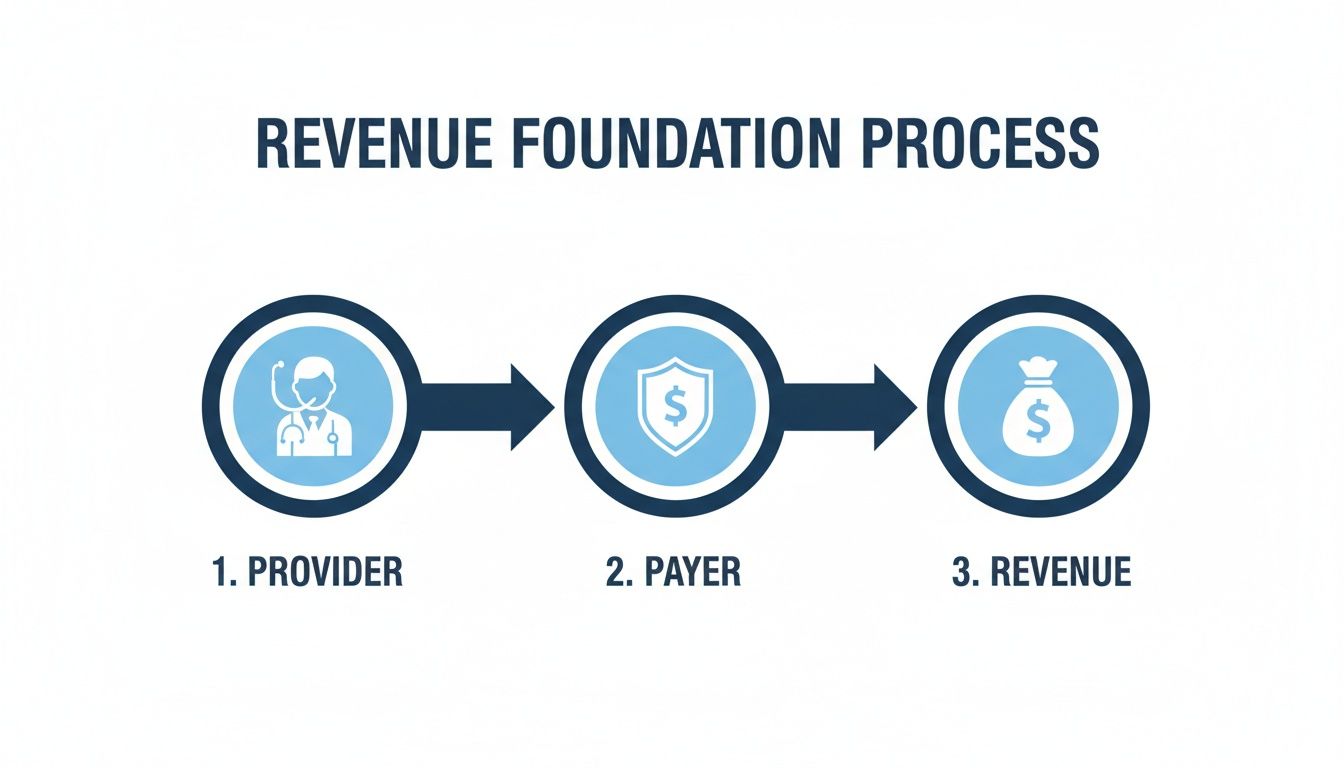
As you can see, a properly credentialed provider is the foundation. That status unlocks successful interactions with payers, which in turn creates a healthy, consistent revenue stream.
Mastering Your CAQH ProView Profile
Once you’ve picked your target payers, your next stop is almost always the Council for Affordable Quality Healthcare (CAQH). The best way to think about your CAQH ProView profile is as a centralized, digital filing cabinet that holds every critical piece of your provider’s information—their medical license, DEA number, work history, malpractice insurance details, you name it.
Instead of tediously filling out dozens of separate applications, many insurance companies just pull the data they need directly from this universal profile. This is why keeping your CAQH profile obsessively up-to-date is non-negotiable. A single discrepancy, like an old practice address or an expired license, can bring the entire process to a screeching halt.
Understanding Primary Source Verification
After you hit ‘submit’ on an application, the payer kicks off a crucial phase called Primary Source Verification (PSV). This is where the insurance company independently confirms every single detail you’ve provided. They don’t just take your word for it; they go straight to the source.
This deep-dive verification includes things like:
- Calling state medical boards to confirm a provider’s license is active and in good standing.
- Contacting medical schools and residency programs to verify their education and training.
- Checking the National Practitioner Data Bank (NPDB) for any reported malpractice claims or disciplinary actions.
PSV is the payer’s due diligence, plain and simple. It ensures every provider in their network meets strict quality and safety standards, protecting both the insurance company and the patients they serve. The sheer depth of this verification is a big reason why expert guidance on the credentialing process for physicians is so valuable—it helps get all your ducks in a row before the scrutiny begins.
A single error or forgotten detail uncovered during Primary Source Verification can push a provider's start date back by weeks, sometimes even months. When it comes to credentialing, accuracy and completeness aren't just goals—they're absolute requirements for getting paid on time.
Staying Ahead Of Re-Credentialing And Revalidation
Here’s something many practices forget: credentialing isn’t a one-and-done task. To keep their in-network status, providers have to go through re-credentialing every two to three years. It’s essentially a refresh, where payers re-verify all of the provider’s qualifications to make sure everything is still current and in good standing.
Similarly, government payers like Medicare and Medicaid require periodic revalidation to confirm the provider's information hasn't changed. Missing one of these deadlines is a nightmare. It can lead to immediate termination from the health plan, which means all payments stop cold until the provider is fully reinstated—a process that can drag on for months and blow a huge hole in your revenue.
The growing importance of this ongoing maintenance is mirrored in the industry itself. The global market for medical credentialing services was valued at USD 633.15 million in 2024 and is expected to hit USD 935.45 million by 2033, growing at a steady 5.00% clip. This isn't surprising when you consider the mounting pressure from regulatory bodies like the NCQA and The Joint Commission. Partnering with experts in medical billing credentialing services helps practices stay on top of these recurring deadlines, avoiding those costly and completely preventable lapses in payment.
Common Credentialing Mistakes That Hurt Your Bottom Line
A single credentialing error can freeze payments for months, kicking off a frustrating and expensive cascade of claim denials. The process is unforgiving, and even a tiny oversight can bring your entire revenue cycle to a screeching halt. The best defense is being proactive, and that starts with knowing the most common—and costly—mistakes practices make every single day.
Think of your credentialing application like a final exam where a 99% is still a failing grade. Payers are looking for perfection. Any missing signature, unchecked box, or unexplained gap in work history will almost certainly get your application tossed out, forcing you to start the long, tedious process all over again.

Overlooking The Details In Provider Information
One of the most frequent yet preventable errors is submitting provider information that doesn't match across all documents and platforms. It sounds simple, but a mismatch between a provider’s legal name on their medical license and the name used on their CAQH profile can raise an immediate red flag for payers.
These little inconsistencies force payers to stop everything and investigate, easily adding weeks to your timeline. Meticulous, obsessive record-keeping is the only way forward. Every single piece of data—from Social Security Numbers and NPIs to practice addresses—must be perfectly consistent everywhere it appears. No exceptions.
Neglecting The CAQH Profile
Your provider's CAQH profile is the central hub for their credentialing data, yet so many practices treat it with a "set it and forget it" mentality. This is a massive mistake. Payers pull data directly from this profile, and if it's outdated, their information is wrong from the very start.
Common CAQH-related errors we see all the time include:
- Expired Documents: Failing to upload a renewed medical license, DEA certificate, or malpractice insurance policy is a top cause for rejection.
- Outdated Attestations: CAQH requires providers to re-attest that their information is accurate every 120 days. Missing this deadline can lock the profile and stop applications dead in their tracks.
- Incomplete Work History: Unexplained gaps of more than a few months in a provider's employment history will always require a detailed, written explanation.
You have to treat the CAQH profile as a living document that needs regular check-ups. It’s absolutely essential for a smooth credentialing process.
A provider's credentialing status is not permanent. Missing a single re-credentialing or revalidation deadline can result in immediate termination from a health plan, stopping all payments and requiring a full re-application to get back in-network.
Missing Critical Re-Credentialing Deadlines
Getting that initial credentialing approved is just the beginning of the race, not the end. Payers require providers to be re-credentialed every two to three years, and government programs like Medicare demand periodic revalidation. These aren't friendly reminders; they are hard deadlines with severe consequences.
Failing to respond to a re-credentialing request can lead to automatic termination from an insurance network. Once a provider is dropped, every single claim submitted will be denied. You’ll have to start the entire, lengthy enrollment process from scratch just to get them reinstated. This single oversight can create a financial crisis, wiping out a huge portion of your practice's revenue for months.
Managing these timelines requires a robust tracking system. Expert medical billing credentialing services build this proactive monitoring right into their workflow, making sure no deadline ever gets missed. By avoiding these common pitfalls, you turn meticulous record-keeping and proactive communication into your best defense against the payment delays that tank your bottom line. This focus on detail is what separates the struggling practices from the financially successful ones.
How Strong Credentialing Improves Your Clean Claim Rate
Many practices treat credentialing like a one-and-done administrative chore. Get the paperwork filed, get the provider in-network, and move on. But in reality, credentialing is the first, most critical step in your entire billing lifecycle. It’s your primary defense against a flood of claim denials that can absolutely cripple your cash flow.
Think of it this way: a clean claim is one that gets paid on its first try, no questions asked. When a provider’s credentialing is flawed—or worse, expired or incomplete—every single claim submitted for their services is dead on arrival. The insurance company's system immediately flags the provider as ineligible, triggering an automatic rejection. This isn't a complex coding error; it's a fundamental breakdown that leads to 100% write-offs for services you've already provided.
The Direct Link Between Enrollment And Payment
Credentialing is the foundation of your billing house. If that foundation is cracked, everything you build on top of it—coding, claim submission, patient statements—is unstable and destined to collapse. If a provider isn't correctly enrolled with a payer, no amount of perfect coding or diligent follow-up will ever get that claim paid. The entire system breaks down at the source.
This is where expert medical billing credentialing services become a core part of your revenue cycle management, not just a preliminary task. They ensure that from the moment a patient checks in, the provider's status with their insurance plan is verified, active, and secure.
This proactive approach prevents the most common and frustrating types of denials right out of the gate:
- Provider Not Enrolled: The claim is rejected simply because the payer doesn’t recognize the provider.
- Service Not Covered at Location: The provider is credentialed, but not for the specific clinic address where the service was performed.
- Lapsed Credentials: The provider’s re-credentialing deadline was missed, causing a temporary—or even permanent—removal from the network.
Each of these issues stops revenue cold and demands hours of administrative work to fix. A rock-solid credentialing process prevents them from ever happening. For a deeper look at how these rejections hit your finances, our guide on effective medical billing denial management offers some valuable insights.
Proper credentialing acts as the gatekeeper for your entire revenue cycle. It ensures that only valid, payable claims enter the billing workflow, automatically boosting your clean claim rate by eliminating eligibility-related denials before they can even be submitted.
Integrating Credentialing Into The Billing Workflow
Viewing credentialing as a separate function is one of the most common and costly mistakes a practice can make. The most financially successful practices understand that credentialing, billing, and collections are all interconnected gears in a single revenue engine. When a provider's information is meticulously maintained, it feeds accurate data into every subsequent step of the process.
This seamless integration is a huge driver in the booming medical billing outsourcing market. Globally, this market hit USD 17.02 billion in 2024 and is projected to reach USD 31.58 billion by 2029. Why? Because credentialing is the bedrock of this ecosystem. A single delay can stall reimbursements for three to six months, adding to the staggering USD 265 billion in annual U.S. healthcare claim denials.
By outsourcing, practices can slash their accounts receivable days by an average of 20-30 days—a direct result of having providers correctly enrolled from day one. You can read the full research on these market trends to see the financial impact for yourself. It proves that investing in expert credentialing isn’t just an expense—it’s a direct investment in a higher clean claim rate and a much healthier bottom line.
Choosing The Right Partner For Credentialing Services
Outsourcing your credentialing can be a massive relief for your practice, but its success comes down to one thing: picking the right partner. The best credentialing service acts as a true extension of your team, proactively managing every last detail so you can get back to patient care.
Make the wrong choice, though, and you’ll end up with the very same delays, denials, and revenue leaks you were trying to escape.
Finding a reliable expert starts with checking their real-world experience. A one-size-fits-all approach to credentialing just doesn’t cut it. You need a partner who gets the unique challenges of your specialty and already knows the ins and outs of the payers in your region.

Key Questions To Ask Potential Partners
Before you sign any contract, you have to ask the right questions. Their answers will tell you everything you need to know about how they operate, how transparent they are, and whether they can truly protect your revenue streams.
Don't be afraid to dig deep. Here are a few must-ask questions:
- What's your experience with my specific medical specialty? A partner who knows endocrinology or OB/GYN will already be familiar with the common payers and billing nuances for those fields.
- How do you track and manage our re-credentialing deadlines? They need a rock-solid system to make sure no provider ever falls out of network because of a missed deadline.
- What does your communication look like? Look for clear, consistent updates and a dedicated point of contact. You shouldn't have to chase them down for a status report.
- What's your game plan for denials or rejections? A great partner has a clear, immediate strategy for appealing and fixing issues the moment they pop up.
The growth of this sector really highlights how critical it is. In the U.S., the credentialing market was valued at USD 267.72 million in 2024 and is on track to hit USD 493.56 million by 2033. This boom is fueled by the need for better verification and compliance with regulators like CMS, which rolled out stricter mandates in 2025 to improve provider accountability. For practices, finding U.S.-based experts who understand this landscape is key for integrating with EHRs and cutting down the manual errors that lead to high denial rates.
A true credentialing partner does more than just fill out forms. They provide strategic guidance, anticipate potential roadblocks, and communicate proactively, ensuring your practice’s financial health is always protected.
To help you get started, we've put together a checklist to guide your conversations with potential vendors. Think of this as your playbook for vetting partners and making a confident choice.
Vendor Selection Checklist For Credentialing Services
Specialty Experience
- Key Questions To Ask: "Which medical specialties do you have the most experience with?" "Can you provide references from practices similar to mine?"
- Why It Matters: A partner familiar with your specialty understands the common payers, coding nuances, and potential hurdles, leading to faster approvals.
Process Transparency
- Key Questions To Ask: "What is your communication protocol?" "How will I receive status updates on my applications?"
- Why It Matters: You need a partner who keeps you in the loop. Vague answers are a red flag that you might be left in the dark when issues arise.
Denial Management
- Key Questions To Ask: "What is your process for handling application denials or rejections?" "What is your success rate with appeals?"
- Why It Matters: Denials happen. A great partner has a proven, proactive process for resolving them quickly to minimize revenue disruption.
Technology & Systems
- Key Questions To Ask: "What software do you use to track deadlines and applications?" "Does your system integrate with our PM/EHR software?"
- Why It Matters: Modern credentialing relies on robust software to prevent missed deadlines and manual errors. Their tech should make your life easier, not harder.
U.S.-Based Expertise
- Key Questions To Ask: "Is your team based in the U.S.?" "How do you stay current on changing payer and state-specific regulations?"
- Why It Matters: Healthcare regulations are complex and local. A U.S.-based team ensures they understand HIPAA, CMS, and state-level rules that could impact your practice.
Using a structured checklist like this ensures you cover all your bases and compare potential partners on the factors that truly impact your revenue and peace of mind.
Verifying Compliance And U.S. Expertise
Compliance isn't just a buzzword—it's non-negotiable. Your chosen partner must have a deep, up-to-the-minute understanding of the U.S. healthcare system, including HIPAA regulations and state-specific payer rules. Any firm that isn’t fluent in these requirements puts your practice at serious financial and legal risk.
This is especially true for multi-site health systems or practices offering telehealth across state lines, where credentialing demands get exponentially more complex. Finding a company with certified, U.S.-based billers and credentialing specialists ensures your operations stay compliant and efficient.
If you are evaluating different options, you might be interested in our guide on finding expert medical billing services near me. Ultimately, the goal is to find a partner who secures your revenue, giving you the peace of mind to focus on what you do best: delivering excellent patient care.
Frequently Asked Questions About Medical Credentialing
If you manage a medical practice, you know that navigating credentialing can feel like a maze of paperwork and follow-ups. It’s a process that often sparks a lot of practical, and sometimes urgent, questions. Getting clear answers is the first step toward managing provider onboarding smoothly and keeping your revenue cycle healthy.
Let's tackle some of the most common questions we hear from practices just like yours.
How Long Does The Initial Credentialing Process Take?
This is easily the most pressing question for any practice bringing on a new provider. The honest answer? Plan for 90 to 120 days.
That timeline isn’t set in stone, of course. It can swing one way or the other based on a few key things. The biggest variable is how quickly a payer responds—some are just notoriously slower than others. The other major factor is the application itself. If it’s incomplete, inaccurate, or if something gets flagged during the background check (primary source verification), you can expect delays.
Setting this 90 to 120-day window as a firm expectation is critical. It prevents you from scheduling patients for a new provider before they’re officially in-network and billable.
Credentialing Vs. Provider Enrollment: What Is The Difference?
These two terms get thrown around a lot, and often interchangeably, but they’re actually two distinct steps in getting a provider paid. Think of it as a two-part journey.
- Credentialing: This is the "vetting" phase. It’s where the insurance company does its due diligence, verifying a provider’s qualifications—their license, education, malpractice history, and work experience. It's essentially a background check to confirm they meet the payer's standards.
- Provider Enrollment: This is the "contracting" phase. Once the provider passes the credentialing check, enrollment is the final step where they officially join the payer's network. This is what makes them eligible for reimbursement for their services.
You can't have one without the other. Successful credentialing is the ticket that gets you into the enrollment game.
Can We Manage Credentialing Without Outsourcing?
Absolutely. But before you dive in, it’s important to be realistic about the resources it takes to do it right. Managing credentialing in-house requires a dedicated staff member who lives and breathes payer rules and submission requirements—which, as you know, change constantly. You’ll also need good software to track endless applications, deadlines, and re-credentialing dates.
Outsourcing is often a strategic decision rather than a necessity. It is chosen to improve accuracy, reduce the administrative load on your team, and ultimately allow your staff to focus their energy on patient care instead of paperwork.
For most practices, handing this off to a partner specializing in medical billing credentialing services comes down to efficiency and peace of mind. Are you curious about what that looks like? You can learn more about whether we can help with credentialing or payer enrollment for your specific needs. It frees up your team’s time and ensures the financial backbone of your practice is solid.
Ready to stop worrying about credentialing errors and start focusing on your patients? One For All Medical Billing provides expert credentialing and billing services that protect your revenue and reduce administrative stress. Schedule your free consultation today and discover a smarter way to manage your revenue cycle.

