

table of contents
Claim denial reasons are the specific causes why insurers reject or leave healthcare claims unpaid, typically rooted in documentation failures, coding errors, authorization gaps, eligibility oversights, and missed filing deadlines. These are not random events. They follow predictable patterns that billing teams can identify, track, and prevent. Insufficient documentation accounts for 77.17% of Medicaid improper payments in FY 2025, making it the single largest driver of revenue loss across the industry. Understanding the full chain of operational decisions behind each denial is the first step toward protecting your practice’s cash flow.
What are the most common claim denial reasons in healthcare billing?
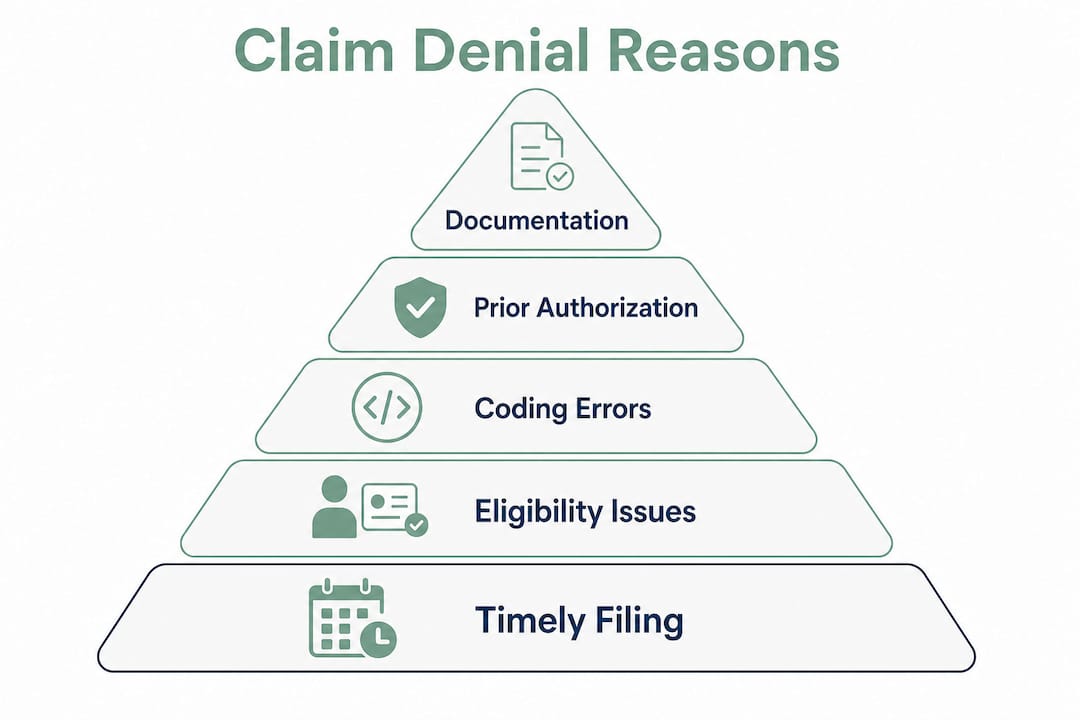
The top claim denial causes fall into five categories: documentation deficiencies, prior authorization failures, coding errors, eligibility issues, and timely filing violations. Each category carries a different recovery path, and some offer no path at all.
Documentation deficiencies sit at the top of the list. Clinical records that fail to support medical necessity trigger the majority of Medicaid improper payments. Payers require that every billed service is backed by a note that clearly documents the clinical rationale, the provider’s assessment, and the treatment plan. A missing progress note or a vague physician statement is enough to generate a denial.

Prior authorization failures are the second most damaging category. Prior authorization issues cause 35% of all claim denials. This figure matters because authorization denials are among the hardest to reverse once a service has already been rendered without approval.
Coding errors cover a wide range of mistakes:
- Mismatched CPT and ICD-10 codes that do not support each other clinically
- Missing or incorrect modifiers that change reimbursement eligibility
- Unbundling of services that payers expect to be billed together
- Use of outdated or deleted codes from prior-year code sets
Eligibility and coverage issues remain persistently high. Out-of-network claims carry a 37% denial rate according to 2024 CMS ACA data. That rate reflects what happens when coverage status is not confirmed before the patient is seen.
Timely filing violations produce hard denials. Late filing beyond a payer’s filing window results in a permanent denial with no resubmission or appeal option, unless you can prove a systemic or payer-side error caused the delay.
The distinction between soft and hard denials matters here. Soft denials are fixable errors like missing modifiers or incorrect patient information. They require fast correction before they age into hard denials that cannot be appealed. Hard denials, such as timely filing violations or non-covered services, require a different response strategy entirely.
How do front-end processes influence claim denials?
Front-end accuracy is the most direct lever you have for reducing insurance claim rejections before they happen. Half of providers identify improving front-end data accuracy as their top denial reduction strategy. That consensus reflects a clear industry shift: fix the intake process, and the downstream denial volume drops.
The front-end workflow covers four critical checkpoints:
- Patient demographics verification. Confirm the patient’s name, date of birth, address, and insurance ID at every visit. A single transposed digit in a member ID generates an eligibility denial that could have been caught in 30 seconds at check-in.
- Real-time eligibility checks. Run insurance coverage verification against the payer’s system on the day of service, not the day before. Coverage can change overnight due to employer plan changes or Medicaid redeterminations.
- Prior authorization tracking. Maintain a centralized authorization log that ties each authorization number to the specific procedure, date of service, and rendering provider. A mismatch between any of these fields can void the authorization entirely.
- Network status confirmation. Verify that the rendering provider is in-network for the patient’s specific plan, not just the payer. Many payers operate multiple networks within the same product line.
Manual billing workflows and disconnected IT systems increase error rates and slow claims processing. Automation at the front end, through real-time eligibility APIs and authorization management tools, removes the human error variable from the most common denial triggers.
Pro Tip: Set up automated eligibility sweeps 72 hours before scheduled appointments. This gives your team enough time to contact the patient or payer before the visit, rather than discovering a coverage problem after the claim is filed.
What roles do medical coding and documentation play in claim denials?
Coding accuracy and clinical documentation quality are directly linked. A claim fails when the diagnosis code does not support the CPT code billed, when a modifier is missing, or when the clinical note does not reflect the complexity of the service charged. These are not isolated mistakes. They are symptoms of a workflow that lacks structured checkpoints.
The most frequent coding pitfalls that generate insurance dispute reasons include:
- Unbundling: Billing component procedures separately when a single comprehensive code covers all of them. Payers flag this as a billing integrity issue and deny the individual components.
- Incorrect modifiers: Modifier 25 and modifier 59 are among the most audited. Using them incorrectly, or failing to use them when required, changes the reimbursement outcome significantly.
- Obsolete codes: Using a CPT or ICD-10 code that was deleted or revised in the current code year. Payers reject these automatically at the clearinghouse level.
- Diagnosis code specificity: Submitting an unspecified diagnosis code when a more specific code is available and documented in the clinical record.
Documentation supports medical necessity, and medical necessity drives reimbursement. Appeals for medical necessity denials succeed most often when the submission includes detailed clinical notes and a physician letter that directly addresses the payer’s stated reason for denial. That evidence does not appear from nowhere. It has to be captured at the point of care.
Routine coder education is not optional. Payers update their policies, and code sets change every January. A coder working from last year’s guidelines will generate denials on claims that should have been clean. Monthly audit reviews of denied claims, sorted by denial reason code, give your coding team a targeted feedback loop rather than a generic training exercise.
Pro Tip: Build a documentation checklist into your EHR templates for high-denial service lines. Require providers to confirm medical necessity language, relevant history, and treatment response before signing the note. This takes 60 seconds and eliminates the most common documentation gap.
How does the claim resubmission and appeals process work?
A denied claim is not a closed case. It is a roadmap. Denial letters are required under federal law to detail the exact reason for denial and the steps available to appeal. Reading that letter carefully is the first and most important step in the recovery process.
The appeals process follows a structured sequence:
- Identify the denial reason code. Each denial carries a CARC (Claim Adjustment Reason Code) and often a RARC (Remittance Advice Remark Code). These codes tell you exactly what the payer objected to, whether it is a coverage issue, a coding mismatch, or a missing authorization.
- Confirm the appeal deadline. Most payers require internal appeals within 30–60 days of the denial date. Missing this window eliminates your right to appeal, regardless of how strong your case is.
- Assemble targeted evidence. Match your supporting documentation to the specific denial reason. A medical necessity denial requires clinical notes and a physician letter. A coding denial requires a corrected claim or a coding rationale. A prior authorization denial may require a peer-to-peer review request.
- Submit through the correct channel. Some payers require written appeals by mail. Others accept electronic submissions through their provider portal. Submitting through the wrong channel can reset your deadline or void the appeal entirely.
Internal appeals succeed approximately 44% of the time. That rate climbs significantly when providers use the denial letter’s exact policy language to frame their response, rather than submitting a generic resubmission.
Tracking denial outcomes by reason code, payer, and service line gives your team the data to identify systemic problems. If the same denial reason appears repeatedly across a specific payer, that is a process gap, not a one-off error. Accurate denial tracking converts reactive appeals into proactive workflow fixes. You can explore a detailed appeal strategy guide to build a more structured recovery process for your practice.
Key Takeaways
Reducing claim denials requires fixing the front-end intake process, maintaining coding accuracy, and using denial letters as structured guides for targeted appeals.
| Point | Details |
|---|---|
| Documentation is the top denial driver | 77.17% of Medicaid improper payments trace back to insufficient clinical documentation. |
| Prior authorization causes one-third of denials | Secure authorization before service; post-service reversals are rarely successful. |
| Soft denials require immediate action | Correct missing modifiers and patient data errors before they age into hard, non-appealable denials. |
| Front-end accuracy prevents most denials | Real-time eligibility checks and centralized authorization logs eliminate the most common rejection triggers. |
| Appeals succeed with targeted evidence | Internal appeals average a 44% success rate when responses cite exact payer policy language and supporting clinical documentation. |
Why I stopped treating denials as a billing problem
After working with practices across multiple specialties, the pattern I see most often is this: billing teams spend the majority of their time managing denials that were created weeks earlier at the front desk or in the exam room. The denial is a billing event, but the cause almost never lives in the billing department.
The practices that reduce their denial rates most effectively are the ones that stop treating denials as a billing problem and start treating them as a clinical and administrative workflow problem. That means pulling coders into documentation conversations with providers. It means making eligibility verification a non-negotiable step at check-in, not an afterthought. It means building prior authorization tracking into the scheduling workflow, not the billing workflow.
The financial case for this shift is straightforward. Every denied claim costs time to work, and many are never recovered at all. The operational cost of chasing denials is real, and it compounds across a high-volume practice. Investing in front-end process quality and coder education pays back faster than any appeals workflow improvement.
Payer rules also change constantly. A coverage policy that applied in january may not apply in july. Practices that track payer policy updates as a routine operational task, rather than discovering changes through denials, stay ahead of the most common reasons for insurance denial. That kind of discipline is what separates practices with clean claim rates above 90% from those perpetually working a backlog.
— Anthony
How Oneforallmed helps practices reduce claim denials
Claim denials cost practices revenue they have already earned. Oneforallmed’s revenue cycle management services address the full chain of denial causes, from front-end eligibility verification and prior authorization tracking to coding accuracy and A/R follow-up.
With over 20 years of specialty billing experience and a 90% clean claim rate, Oneforallmed gives practices the infrastructure to catch errors before submission rather than chase them after denial. Their team works across Oklahoma and nationwide, supporting individual providers and multi-site health systems with billing solutions built around your specific payer mix and service lines. If your denial rate is affecting cash flow, connect with One For All Medical Billing’s medical coding and billing specialists to get a clear picture of where your revenue is leaking and how to stop it.
FAQ
What is the most common claim denial reason?
Insufficient documentation is the leading cause, accounting for 77.17% of Medicaid improper payments in FY 2025. Claims fail when clinical records do not clearly support the medical necessity of the billed service.
What is the difference between a soft denial and a hard denial?
A soft denial is a fixable error, such as a missing modifier or incorrect patient information, that can be corrected and resubmitted. A hard denial, such as a timely filing violation, cannot be appealed and results in permanent revenue loss.
How long do providers have to appeal a denied claim?
Most payers require internal appeals within 30–60 days of the denial date. Missing this deadline eliminates the right to appeal, regardless of the strength of the clinical or coding argument.
How can practices prevent eligibility-related denials?
Run real-time eligibility checks on the day of service and confirm the rendering provider’s network status for the patient’s specific plan. Out-of-network claims carry a 37% denial rate, most of which are preventable with same-day verification.
Does appealing a denied claim actually work?
Internal appeals succeed approximately 44% of the time. Success rates improve significantly when providers use the denial letter’s exact policy language and submit targeted clinical evidence matched to the specific denial reason code.
Recommended
- How to Appeal a Denied Insurance Claim: Provider Guide – One For All Medical Billing
- What Is Claim Scrubbing: A 2026 Guide – One For All Medical Billing
- Boost Cash Flow: Medical Claims Management Process Guide – One For All Medical Billing
- CPT Code 49320: A Guide To Stop Denials – One For All Medical Billing

