

table of contents
Medical billing in the mental health space is a different beast altogether. It’s a specialized dance of submitting and chasing down claims with insurance companies to get paid for therapy, counseling, and other behavioral health services you provide. To do it right, you need a solid grasp of unique CPT codes, shifting payer regulations, and the prior authorization rules that trip up so many practices.
Getting this process right isn't just an administrative task—it’s essential for your practice's financial health and your ability to keep providing care.
Building A Solid Foundation For Mental Health Billing
Let's be honest, the financial side of running a mental health practice can feel like a maze. But with a strong billing foundation, you can turn that complexity into a smooth, predictable workflow. This whole process, known in the industry as Revenue Cycle Management (RCM), actually starts long before your client ever sits down for their first session.
Think of it as a series of connected steps, all designed to make sure you’re paid correctly and on time for the vital work you do. It’s less of a burden and more of the financial engine that keeps your doors open, freeing you up to focus on what really matters: your patients.
A proactive approach is more important than ever. Demand for mental health services is surging, and a massive support industry has grown around it. In fact, the mental health billing service market is projected to hit $2.5 billion by 2025. This isn't surprising when you consider that over 970 million people worldwide are affected by mental health conditions.

The Pre-Visit Financial Groundwork
If there's one thing you can do to prevent claim denials, it's this: verify a patient’s eligibility and benefits before their first appointment. This single step sets the stage for a clean claim and helps you avoid those awkward, frustrating conversations about money down the road. It’s a non-negotiable part of modern medical billing for mental health.
During this check, your front office team needs to get on the phone or log into the payer portal and confirm a few key details directly with the insurer:
- Active Coverage: Is the policy actually active for the date of service? You'd be surprised how often this is the source of a denial.
- Mental Health Benefits: Does the plan specifically cover outpatient mental health services? Some plans have carve-outs or limitations.
- Copay, Deductible, and Coinsurance: What portion is the patient responsible for? Knowing this upfront means you can collect it at the time of service, which dramatically improves collections.
- Prior Authorization Requirements: Is pre-approval needed for sessions? This is a huge one in behavioral health and a major reason claims get rejected.
By confirming these details beforehand, you create financial transparency with your patients and drastically reduce the likelihood of future payment issues. This front-end work is the cornerstone of a healthy revenue cycle.
This structured approach is fundamental to understanding what medical billing is and why it matters, especially for independent practices trying to stay financially strong. Once you have this information, document it clearly in the patient’s file. This ensures everyone on your team, from the front desk to the clinician, is on the same page.
Decoding CPT And ICD-10 For Accurate Reimbursement
Accurate coding is the heart of your practice's financial health. It’s the language you use to tell insurance companies exactly what service you provided and why. Getting this translation right is the difference between a claim that sails through and one that gets stuck in a cycle of denials and frustrating delays.
Think of it this way: CPT (Current Procedural Terminology) codes are the "what you did," and ICD-10 codes are the "why you did it." A CPT code describes the service itself—like a 45-minute therapy session—while the ICD-10 code specifies the patient's diagnosis, such as Major Depressive Disorder, Recurrent, Severe (F33.2). For a claim to get paid, these two pieces must tell a logical and clinically supported story.
Mastering Common CPT Codes
For most mental health providers, a handful of CPT codes will make up the bulk of your billing. Getting the time-based psychotherapy codes right is absolutely essential for both proper reimbursement and compliance.
The key is to document the actual, face-to-face time spent with the patient. Payers are incredibly strict about these time thresholds, and your session notes have to back up the code you choose.
Here are the heavy hitters:
- 90834 (Psychotherapy, 45 minutes): This is the workhorse code for many therapists, used for sessions lasting 38 to 52 minutes. It represents the standard "therapy hour" in most settings.
- 90837 (Psychotherapy, 60 minutes): Reserve this code for longer, more intensive sessions that last 53 minutes or more. A common mistake is billing this code for a 50-minute session—don't do it! This is a frequent red flag during audits.
- 90791 (Psychiatric diagnostic evaluation): This is your code for the initial intake or diagnostic interview. It's typically billed only once at the start of a new treatment episode with a client.
Let’s look at a real-world scenario. You wrap up a session that ran for 50 minutes. While it feels like a full hour, billing it as 90837 would be incorrect. The right code is 90834, because 50 minutes falls squarely within its 38-52 minute window. That kind of precision is what keeps you off the payers' radar.
Here's a quick reference to keep these codes straight.
Common CPT Codes For Mental Health Services
- 90791: Psychiatric diagnostic evaluation. Use case: The initial intake session with a new patient to establish a diagnosis and treatment plan.
- 90832: Psychotherapy, 30 minutes. Use case: A brief therapy session, often for check-ins or medication management follow-ups, lasting 16-37 minutes.
- 90834: Psychotherapy, 45 minutes. Use case: The most common code for a standard individual therapy session, lasting 38-52 minutes.
- 90837: Psychotherapy, 60 minutes. Use case: An extended therapy session, typically for more complex cases or modalities like EMDR, lasting 53 minutes or more.
- 90847: Family psychotherapy (with patient present). Use case: A therapy session involving the patient and one or more family members.
- 90853: Group psychotherapy. Use case: A therapy session conducted in a group setting, billed per patient.
- 95: Modifier for telehealth. Use case: Appended to a primary CPT code (e.g., 90834-95) to indicate the service was provided via video or phone.
Having this information handy can save you a ton of time and prevent simple mistakes that lead to denials.
The Critical Role Of Modifiers
Modifiers are the secret sauce of accurate coding. These two-digit codes get tacked onto a CPT code to provide crucial context about the service. Using them correctly is non-negotiable, especially now with the prevalence of telehealth.
Without a doubt, the most important modifier today is 95. This little code tells the payer a service was delivered via synchronous telehealth. If you hold a 45-minute virtual session, you must bill it as 90834-95. Forgetting that modifier is one of the fastest ways to get a claim kicked back.
Other codes come into play in more complex situations:
- +90839 (Psychotherapy for crisis; first 60 minutes): This is an add-on code used when a patient presents in a high-risk state that requires immediate intervention.
- +90840 (Psychotherapy for crisis; each additional 30 minutes): Use this alongside 90839 for crisis sessions that extend beyond the first hour.
Key Takeaway: These crisis codes are add-ons, meaning they can't be billed alone. They must accompany a primary psychotherapy service code. Your documentation absolutely must paint a vivid picture of the crisis, the interventions used, and the time spent to justify using them.
Tying The Diagnosis To The Treatment
Your choice of ICD-10 code is what establishes the medical necessity for the service you're billing. The diagnosis has to logically support the treatment. For example, billing for family therapy (90847) makes perfect sense when a patient's diagnosis is Parent-Child Relational Problem (Z62.820)—the diagnosis itself points to a family dynamic.
On the other hand, billing for intensive trauma therapy when the diagnosis is a mild, single-episode anxiety disorder might raise some eyebrows with an insurer. Your clinical documentation is your evidence. The session notes, treatment plan, and intake assessment must create a clear, unbroken line connecting the patient's symptoms to the services on your claim form.
Finally, remember that these codes aren't static; they get updated every year. Staying on top of these changes is a non-negotiable part of maintaining a healthy revenue cycle. To help, you can learn more by checking out our guide on recent ICD-10 coding updates and how they might affect your billing.
Mastering Payer Rules And The Claims Journey
Submitting a claim and actually getting paid should be a straight line, but in mental health billing, it’s more like a maze. Every insurance company plays by its own rulebook, creating a complex web of requirements you have to navigate. Getting a handle on this landscape is non-negotiable if you want to maintain a healthy cash flow and stop chasing down payments.
The claims journey starts the second you create a claim and doesn't end until that payment is fully posted and reconciled. The ultimate goal is to submit a "clean claim" on the first try—one that’s so accurate it sails through the payer's system without a single correction. This means every last detail, from a patient's date of birth to the right CPT code modifier, has to be perfect before you hit submit.
Think of electronic claim submission as your first major checkpoint. Modern practice management systems are great for efficiency, but they're only as good as the data you feed them. A few extra seconds spent double-checking patient demographics, confirming service codes match your documentation, and ensuring the correct payer ID is listed can prevent massive headaches down the road.
Proactively Managing Prior Authorizations
If there’s one major hurdle in medical billing for mental health, it's prior authorizations. So many plans require pre-approval for certain services, and skipping this step is a guaranteed denial. The best defense isn't reacting to rejections—it's building a proactive workflow to get ahead of them.
This process should kick off the moment you verify a new patient’s benefits. If their plan requires an auth, your team needs to get the request started immediately.
Here’s what that looks like in practice:
- Submitting the necessary clinical details to prove medical necessity.
- Clearly documenting the authorization number, approved sessions, and expiration date right in the patient’s chart.
- Creating a tracking system for expiring authorizations so you can request renewals long before a patient's care gets interrupted.
This kind of proactive approach doesn't just prevent denials; it brings clarity for both your practice and your patients about what their coverage actually includes.
From Submission To Payment Posting
Once you send off a clean claim, it enters the payer’s adjudication system, where software scrubs it for errors. A flawless claim will pass this check and get processed for payment, which usually lands in 15-45 days, depending on the payer and your contract terms.
When the payment comes through, it arrives with an Explanation of Payment (EOP) or an Electronic Remittance Advice (ERA). This document is your roadmap—it breaks down what was paid, what was adjusted based on your contracted rate, and what portion the patient now owes.
Accurate payment posting is far more than just data entry. It’s about meticulously reconciling every dollar to the specific service provided. It's a critical piece of the puzzle for any effective revenue cycle management strategy, giving you an accurate picture of your patient accounts and your practice's overall financial health. For a deeper dive, check out our resources explaining what revenue cycle management is.
The path from detailed session notes to an audit-proof claim is all about following a careful, logical sequence.
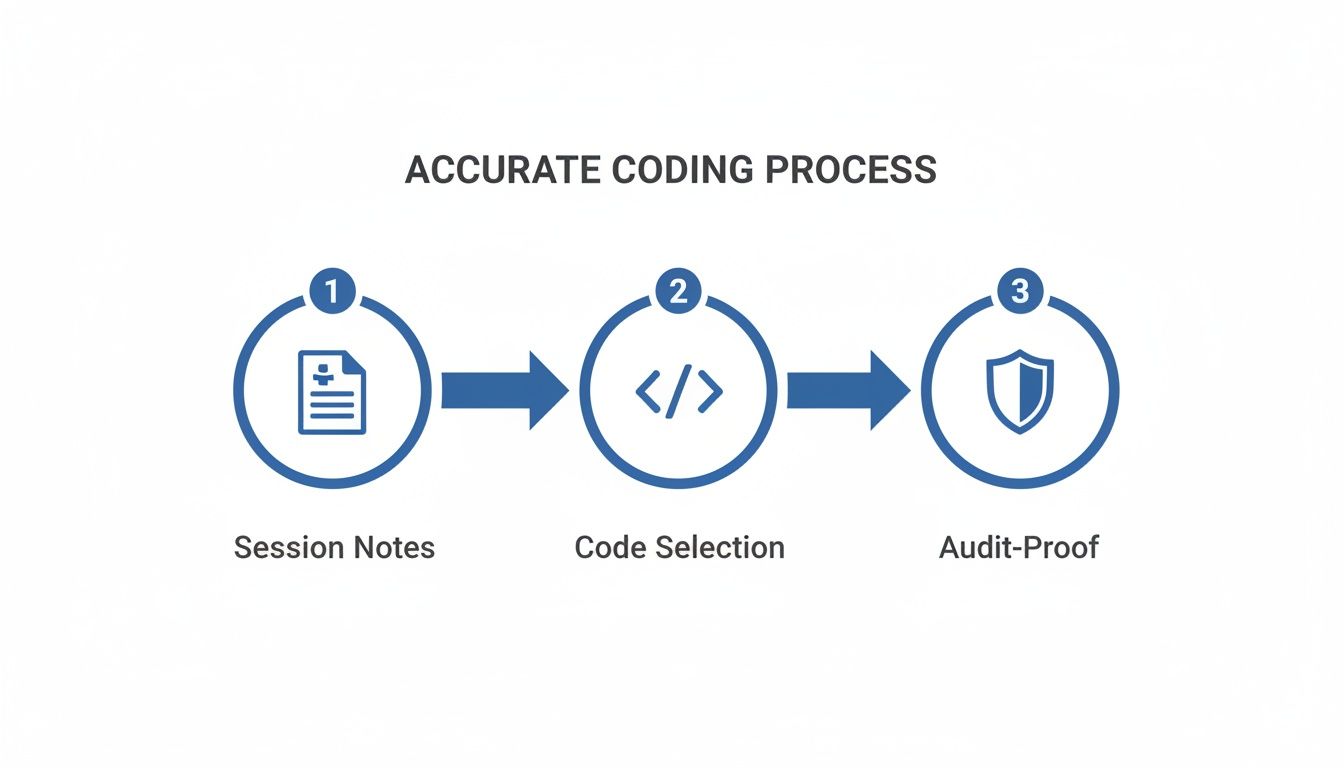
As this shows, it all starts with solid documentation. Those notes inform your code selection, which ultimately protects your practice from audits and takebacks.
Unfortunately, payer inconsistencies make this whole process a constant challenge. Behavioral health denial rates often hover between 18-25%—that’s significantly higher than the 10-12% average in physical health. This gap is mostly due to tricky coding rules and authorization pitfalls unique to our field. For instance, while Medicare might reimburse telehealth at parity, some private insurers impose strict session limits or demand prior auths that can hold up payments for 60-90 days.
Every step in the claims journey—from pre-visit verification to final payment reconciliation—is an opportunity to either secure your revenue or lose it. Precision and a proactive mindset are your greatest assets.
Proven Strategies For Preventing And Appealing Denials
Claim denials are a frustrating reality in the world of medical billing for mental health. They don’t just disrupt your cash flow; they create a mountain of administrative work. But you don't have to stay stuck in a reactive cycle of damage control. By shifting to a proactive system of prevention, you can slash your rejection rates and secure the revenue you've rightfully earned.

The financial toll of denials in behavioral health is staggering. On average, denial rates hover between 20-30% globally—more than double the rate for most other medical specialties. This gap, often caused by tricky prior authorization rules and simple coding mistakes, adds up to an estimated $10-15 billion in lost revenue for U.S. behavioral health providers every single year.
Pinpointing The Most Common Denial Reasons
The best way to stop denials is to understand exactly why they happen in the first place. While every payer has its quirks, a handful of common culprits are behind most rejections in mental health billing. If you focus your energy here, you’ll see the biggest improvement in your clean claim rate.
Think of it as creating a pre-flight checklist for every claim. Before you hit "submit," make sure you’ve double-checked these frequent problem spots:
- Missing or Invalid Prior Authorizations: This is, without a doubt, the number one reason for denials in our field. Building a rock-solid workflow to confirm authorization requirements during eligibility checks is non-negotiable.
- Simple Data Entry Errors: It's amazing how a misspelled name, a wrong date of birth, or a transposed policy number can bring the entire process to a halt. These are completely avoidable with a quick verification step.
- Coding Mismatches: Using a CPT code that doesn't match the session length in your notes or forgetting a telehealth modifier like -95 is an easy way to trigger an instant denial.
- Lack of Medical Necessity: Payers need to see the "why" behind the treatment. If an auditor can't connect the diagnosis in the claim to the services documented in your notes, they'll reject it.
Building a system to scrub every claim for these issues before submission is the single most effective way to protect your revenue.
Crafting A Strategic Appeals Process
Even with a great prevention plan, some denials will still get through. When they do, a fast, strategic response is crucial. Not all rejections are created equal—knowing the difference between a quick fix and a formal appeal will save you time and dramatically improve your success rate.
Start by digging into the Explanation of Payment (EOP) or Remittance Advice (RA) from the payer. Find the denial code and the reason they provided. That code tells you exactly what they think is wrong with your claim.
A denial is not a final "no." It's an invitation to provide more information or correct an error. A methodical and timely appeals process can recover a significant portion of initially rejected claims.
Once you know the "why," you can plan your next move. Many denials, like those from a simple data entry mistake, just need a corrected resubmission. Others, especially those questioning medical necessity, require a formal appeal.
For those more complex cases, your appeal letter needs to be clear, professional, and built on evidence. This isn't the time for emotion; it's about presenting the facts. Your letter should:
- Clearly Identify the Claim: Include all the key details: patient's name, policy number, date of service, and the original claim number. Make it easy for them to find.
- State the Reason for the Appeal: Reference the specific denial code and explain precisely why you believe their decision was incorrect.
- Provide Supporting Documentation: This is where you win or lose. Attach the relevant session notes, the patient's treatment plan, and any other clinical evidence that proves medical necessity.
- Reference Payer Policies: If you can, find the payer's own medical policy or clinical guidelines and cite them directly to strengthen your case.
This structured approach turns a hopeful request into a persuasive, evidence-backed argument. Having a solid strategy here is a core component of successful claim denial reduction and a healthier bottom line for your practice.
Optimizing Your Revenue Cycle For Financial Health
A thriving mental health practice runs on more than just skilled clinicians—it needs a healthy revenue cycle. Optimizing your financial operations isn't just about chasing payments; it’s about building a sustainable system that supports your core mission of providing care. This means looking at the big picture, from a patient's first call all the way to the final payment.
To do this right, you need to think like a business analyst and measure what matters. By tracking a few key performance indicators (KPIs), you can get a clear, data-driven picture of your practice's financial health and pinpoint exactly where your processes need a tune-up.
Key Performance Indicators You Must Track
Vague feelings about your practice's finances aren't going to cut it. You need hard numbers to guide your decisions. Monitoring these KPIs regularly will tell the real story of your revenue cycle and show you where the opportunities for growth are hiding.
Clean Claim Rate (CCR): This is the percentage of claims accepted by a payer on the very first try, with no errors. A high CCR is a great sign that your front-end processes—like eligibility checks and coding—are working smoothly. The industry benchmark is 90% or higher. If you’re falling short, it’s time to audit your pre-submission workflow for common slip-ups.
Days in Accounts Receivable (A/R): This metric tells you the average number of days it takes to actually collect payments. A lower number is always better, with a healthy goal being under 45 days. If your Days in A/R are creeping up, it often points to problems with denial management or a slow follow-up process on unpaid claims.
Denial Rate: This is the percentage of claims that get flat-out denied by payers. While a zero percent rate is probably unrealistic, you should aim for a rate below 10%. Tracking this helps you spot patterns. Are most denials coming from one specific payer or for a particular service? Answering that question is the first step toward fixing the root cause.
These metrics aren't just numbers on a spreadsheet; they are the vital signs of your practice. They expose weaknesses in your billing process before they spiral into critical financial problems, allowing you to make proactive, informed adjustments.
A quick look at these numbers can tell you more about your billing process than you might think. Keeping a simple dashboard or report with these KPIs is one of the most effective things you can do to stay on top of your practice's financial health.
Key Performance Indicators For Mental Health Billing
- Clean Claim Rate (CCR): Benchmark: 90% or higher. What it tells you: How effective your front-end processes are. Low rates mean you're losing time and money on rework.
- Days in A/R: Benchmark: Under 45 days. What it tells you: The average time it takes to get paid. High numbers signal cash flow problems.
- Denial Rate: Benchmark: Under 10%. What it tells you: The percentage of rejected claims, helping you fix recurring billing issues.
- Net Collection Rate: Benchmark: 95% or higher. What it tells you: The percentage of allowed reimbursement you actually collect. The ultimate measure of your billing effectiveness.
- First Pass Resolution Rate (FPRR): Benchmark: 85% or higher. What it tells you: The percentage of claims paid correctly on the first submission. A high FPRR means less time spent on appeals.
By tracking these KPIs, you move from guessing to knowing, transforming your revenue cycle from a source of stress into a powerful asset for your practice.
Navigating The Complexities Of Compliance
Compliance isn't just a box to check; it's a foundational requirement for running any healthcare practice. For mental health providers, two areas are especially critical: protecting patient data and following parity laws. Getting this wrong can lead to serious penalties, so a proactive approach is non-negotiable.
The Health Insurance Portability and Accountability Act (HIPAA) is the national standard for protecting sensitive patient health information. In the world of billing, this means ensuring all your systems—from your EHR to your billing software and any third-party services you use—are completely secure. Every single claim you send contains Protected Health Information (PHI), so your transmission and storage processes must be fully encrypted and compliant.
Maintaining strict HIPAA compliance is more than a legal obligation; it’s a commitment to your patients. It builds the trust that is essential for effective therapeutic relationships and protects your practice from devastating fines and reputational damage.
On top of that, state and federal mental health parity laws are in place to ensure insurance coverage for mental health and substance use disorders is no more restrictive than coverage for medical or surgical care. The reality, however, is that applying these laws can be tricky, and reimbursement for cognitive work still often lags behind procedural services. You have to stay informed about your state's specific parity regulations to effectively advocate for fair reimbursement for both your practice and your patients.
Integrating Systems And Exploring Partnerships
In this day and age, a disconnected workflow is just asking for errors and wasted time. Your Electronic Health Record (EHR) and your billing software need to talk to each other seamlessly. When they’re integrated, the clinical information documented during a session flows directly into the claim form, which dramatically cuts down on manual data entry mistakes. For example, when a clinician finalizes a note for a 45-minute session, the system should automatically suggest CPT code 90834. It’s a simple step that prevents countless coding errors.
As your practice grows, managing the entire revenue cycle in-house can become a huge burden. This is usually the point where providers start thinking about partnering with a specialized billing service. Outsourcing your billing doesn’t mean losing control. It means gaining a team of experts whose entire job is to maximize your revenue. These partners bring a deep knowledge of payer rules, coding nuances, and denial management strategies that are almost impossible to replicate internally.
They take on the tedious follow-up on unpaid claims and navigate the maze of appeals processes, which frees up your administrative staff and clinicians to focus on what they do best: patient care. For many practices, making this strategic move is the key to scaling sustainably. You can learn more about the benefits of automating your medical billing workflow and see how the right technology and partners can truly transform your financial operations.
A Few Common Questions About Mental Health Billing
When you're trying to navigate the maze of mental health billing, a lot of questions come up. It's completely normal, especially with every payer having its own set of rules and quirks. Here are a few straightforward answers to the questions we hear most often from providers like you.
What’s The Real Difference Between CPT Codes 90834 And 90837?
This is probably one of the most common coding questions, and the answer comes down to one thing: time.
CPT code 90834 is your go-to for a standard 45-minute therapy session. The key here is that your face-to-face time with the patient must fall between 38 and 52 minutes.
On the other hand, CPT code 90837 is for the extended 60-minute hour. You can only bill this code if your direct, face-to-face time with the patient is 53 minutes or longer. Documenting your time accurately isn't just good practice—it's absolutely essential for staying compliant and sailing through any potential audits.
How Do I Fight A "Not Medically Necessary" Denial?
Seeing a claim denied for not being "medically necessary" is frustrating, but it's almost always a sign that your documentation needs to be stronger. This isn't about the quality of your care; it's about how well you've told the story in your notes.
To build an appeal that actually works, you need to paint a clear, compelling picture of why the treatment was justified. Your appeal letter has to connect the dots for the reviewer.
Make sure it clearly lays out:
- The patient’s exact diagnosis and the symptoms they presented with.
- The functional impairments that are messing with their day-to-day life.
- The treatment plan you established, complete with measurable goals.
Your progress notes are your best evidence. They must show how each session directly ties back to those goals and proves why continuing care is critical for your patient’s progress. A pro tip? Find the payer’s own medical necessity guidelines and reference them in your appeal. It's tough for them to argue with their own rules.
A "not medically necessary" denial is less about the validity of your care and more about the strength of your documentation. Your notes must paint a clear picture that leaves no doubt about the need for treatment.
When Should A Small Practice Think About Outsourcing Its Billing?
This is a big decision for any small or growing practice. The tipping point usually comes when you realize billing is stealing too much time from your clinical work, or when you're staring down a denial rate that just won't budge.
Bringing in a specialized billing service gives you access to expertise that's incredibly hard—and expensive—to build on your own. These folks live and breathe mental health coding, payer negotiations, and denial management. The result is almost always faster payments, a much higher clean claim rate, and a huge weight off your shoulders.
To decide if it's the right move, weigh the cost against the revenue you'll gain back and the hours you'll reclaim for your patients. Most practices find the investment pays for itself pretty quickly through better collections and smoother operations.
Keeping up with the complexities of mental health billing is a full-time job. One For All Medical Billing acts as a true partner, managing every detail of your revenue cycle so you can get back to focusing on your patients. We help practices across the country cut down on denials, boost their collections, and find financial stability.

