

table of contents
Delegated credentialing is the formal arrangement in which a payer or health plan grants a provider organization, such as a hospital system, medical group, management services organization (MSO), or credentialing verification organization (CVO), the authority to perform credentialing activities on the payer’s behalf. If your organization manages a large number of providers, operates across multiple payers or states, and already has a functioning credentialing committee with documented policies, pursuing delegation is worth serious consideration. If your credentialing program is understaffed, your governance is informal, or your primary source verification (PSV) process is inconsistent, delegation will expose those gaps fast.
Three quick readiness signals to check before going further:
- Your active provider roster is large enough that payer-side credentialing delays are measurably slowing onboarding and costing revenue.
- Your credentialing committee meets on a documented schedule and produces minutes that could survive an external audit.
- You have a repeatable PSV process with dated, sourced verification records for each provider file.
If all three apply, keep reading. If even one is missing, the sections on implementation and compliance below will tell you exactly what to fix first.
Key Takeaways
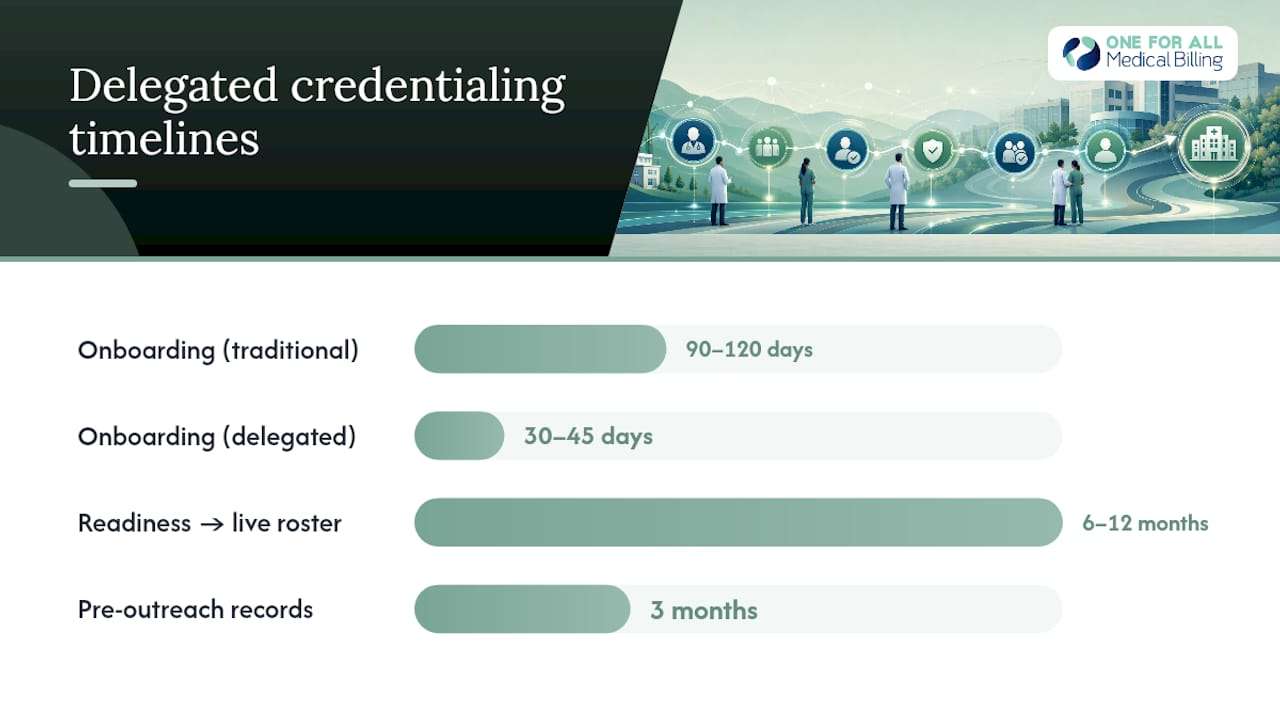
Delegated credentialing compresses provider onboarding from 90–120 days to 30–45 days, but only for organizations with governance, PSV processes, and monitoring infrastructure already in place.
| Point | Details |
|---|---|
| Readiness before outreach | Build three months of committee minutes, PSV records, and monitoring logs before approaching any payer. |
| NCQA threshold rules | Delegating more than 50% of PSV requires an NCQA Accredited or Certified delegate; delegating more than 50% of decisions disqualifies CR Accreditation. |
| Timeline expectation | Plan for 6–12 months from readiness assessment to live roster submission; most of that time is audit preparation, not negotiation. |
| NPDB query allocation | Certain NPDB query responsibilities cannot be transferred by delegation agreement; confirm allocation with legal counsel before signing. |
| One For All Medical Billing | Supports delegated credentialing readiness through PSV operations, audit preparation, roster management, and ongoing monitoring for provider organizations nationwide. |
What is delegated credentialing and who plays which role?
Delegated credentialing transfers specific credentialing functions from a payer to a provider organization, but the scope of what gets transferred matters enormously. Most agreements delegate primary source verification, roster submission, and ongoing monitoring. What payers typically retain is final network participation decision authority, and in some agreements, specific National Practitioner Data Bank (NPDB) query responsibilities.
The parties break down this way:
- Delegating entity: The payer or health plan that holds network authority and transfers specific credentialing functions to the delegate.
- Delegate: The organization that accepts those functions. Common delegate types include health systems, large physician groups, MSOs, and CVOs.
- Full delegation: The delegate performs PSV and makes credentialing decisions within defined parameters.
- Partial delegation: The delegate performs PSV but the payer retains credentialing committee review or final approval.
One distinction that trips up credentialing teams regularly: payer credentialing and medical staff privileging are separate processes. Payer credentialing determines network participation and billing eligibility. Medical staff privileging determines clinical scope of practice within a facility. Delegated credentialing agreements govern the payer side only. Conflating the two creates audit risk and common failure modes.
The NPDB Guidebook describes delegated credentialing as an authority transfer between healthcare entities and is explicit that certain NPDB query responsibilities must be performed directly by the reporting entity. A delegate cannot simply absorb all NPDB obligations by virtue of the delegation agreement. That distinction has real compliance consequences.
NAMSS, the National Association Medical Staff Services, is the professional body whose credentialing standards and certification programs (CPCS, CPMSM) set the practical baseline for credentialing staff competency across delegate organizations.
How does delegated credentialing differ from non-delegated processes?
The operational difference is straightforward: in a non-delegated model, the payer’s own credentialing team performs PSV, runs committee review, and loads providers into payer systems. The provider organization submits an application and waits. In a delegated model, the provider organization owns those steps and submits a completed, verified file to the payer.
Process ownership comparison:
- PSV: Payer-performed in non-delegated; delegate-performed in delegated.
- Committee review: Payer committee in non-delegated; delegate committee (with payer oversight rights) in delegated.
- Payer system loading: Payer-initiated after approval in both models, though delegated rosters often load faster because files arrive complete.
- Audit liability: Payer assumes credentialing accuracy risk in non-delegated; delegate assumes primary liability for credentialing accuracy in delegated.
Timeline is where delegation pays off most visibly. Industry-cited typical ranges put non-delegated credentialing at 90–120 days from application to active participation, while delegated processes commonly run 30–45 days. For a growing group adding 20 providers per quarter, that compression translates directly into earlier billing eligibility and faster revenue realization.
The liability shift is the trade-off. When a payer delegates credentialing, the delegate assumes primary responsibility for credentialing accuracy. If a provider with a sanctioned license slips through because monitoring lapsed, the delegate owns that failure. That accountability is why governance and documentation are not optional extras in a delegated program.
What are the real operational benefits of delegated credentialing?
Speed is the headline benefit, but the operational advantages run deeper than timeline compression alone.
- Faster provider onboarding: Cutting credentialing time from 90–120 days to 30–45 days means providers reach billing-eligible status weeks earlier, directly accelerating revenue per new hire.
- Reduced duplicative PSV: Without delegation, each payer independently verifies the same provider credentials. Delegation centralizes that work, eliminating redundant verification across multiple payers.
- Centralized provider data: A delegated program creates a single source of truth for provider credentials, making directory accuracy easier to maintain and update.
- Scalability for growth: MSOs and health systems adding providers across multiple states benefit from a single credentialing workflow rather than managing separate payer timelines for each new provider.
- Improved directory accuracy: Because the delegate controls roster submissions, updates to provider information reach payer directories faster and more consistently.
Provider credentialing’s operational impact on network performance and provider mobility is well-documented. Distributed credentialing models, of which delegation is the most structured form, are increasingly how multi-state provider organizations manage network participation without drowning in payer-specific timelines.
The revenue argument is concrete. A provider who cannot bill for 60 extra days because of a non-delegated payer queue represents real lost collections, not a theoretical inefficiency. For specialty practices with high per-visit reimbursement, that gap compounds quickly.
Who qualifies, and what do payers and NCQA require?
Payers set their own thresholds, often requiring a delegate to manage a meaningful provider volume before offering delegation; smaller or larger thresholds may apply depending on the payer. The rationale is straightforward: the audit overhead of monitoring a delegate is only justified when the delegate’s scale makes centralized credentialing more efficient than payer-side processing.
Organizational prerequisites most payers require:
- Written credentialing policies and procedures, reviewed and approved by the credentialing committee.
- A functioning credentialing committee with documented meeting minutes and quorum records.
- A repeatable PSV process with dated, sourced verification for each credential element.
- Ongoing monitoring for sanctions, license expirations, and exclusions, with documented monthly logs.
- A recredentialing cycle, typically every three years, with evidence of timely completion.
NCQA’s credentialing accreditation standards add a specific structural rule: organizations that delegate more than 50% of primary source verification must use delegates that are NCQA Accredited or NCQA Certified. That threshold matters whether you are the payer structuring a delegation or the delegate trying to qualify.
NCQA Health Plan Accreditation standards require evidence-based oversight of delegation, covering governance structure, PSV sequencing and timing, ongoing monitoring protocols, and audit-readiness documentation. These are not aspirational guidelines. They are the checklist payer auditors use when they review your program.
NCQA’s HPA standards make clear that delegation does not reduce a payer’s accountability. The payer remains responsible for the quality of credentialing performed by its delegates, which is why pre-delegation audits and annual oversight reviews are non-negotiable under accreditation frameworks.
On the federal side, CMS expectations for Medicare Advantage plans add another layer. Plans operating under CMS contracts must ensure their credentialing oversight extends to delegated entities, and CMS audits can reach delegate-level documentation. NPDB query responsibilities under federal rules require careful allocation in the delegation agreement, since certain queries must be performed by the entity with direct reporting obligations, not assumed by a delegate.
How do you implement delegated credentialing step by step?
Implementation typically spans several months from readiness assessment to live roster submission, with the majority of time dedicated to building audit-ready documentation rather than negotiating agreements.
- Conduct a policy gap analysis (Month 1–2). Compare your current credentialing policies against NCQA standards and your target payer’s audit tool. Identify missing policy elements, outdated procedures, and governance gaps.
- Establish or strengthen your credentialing committee (Month 1–3). Document meeting frequency, quorum requirements, voting procedures, and decision criteria. Collect at least three months of consistent committee minutes before approaching any payer.
- Build a complete PSV process (Month 1–3). Every provider file should have dated, sourced verification for licensure, DEA registration, board certification, malpractice history, and education/training. Gaps in any element are audit citations.
- Stand up ongoing monitoring (Month 2–4). Run monthly sanctions and exclusions checks against OIG, SAM.gov, and state licensing boards. Log every check with dates and results, even when results are clean.
- Conduct an internal pre-delegation file audit (Month 3–5). Pull a random sample of provider files and score them against your target payer’s audit criteria. Document findings and complete corrective action before the payer sees your files.
- Engage target payers and request delegation (Month 4–6). Submit a formal request with your policies, committee evidence, PSV samples, and monitoring logs. Expect a pre-delegation assessment from the payer.
- Complete payer pre-delegation audit and remediation (Month 5–9). Respond to audit findings with documented corrective actions. Some payers require a remediation period before granting delegation.
- Negotiate and execute the delegation agreement (Month 6–10). Finalize scope, audit schedule, reporting cadence, and liability terms.
- Configure roster submission and go-live (Month 9–12). Load your initial roster, establish submission cadence, and confirm payer system receipt.
Pro Tip: Start your ongoing monitoring logs at least three months before you approach any payer. Payers routinely sample recent monitoring records during pre-delegation audits, and a monitoring log that starts the week before your audit request is a red flag. Practitioner reporting confirms that three months of consistent committee minutes and PSV evidence is the practical minimum payers expect to see.
NAMSS practitioners recommend obtaining each target payer’s specific audit tool before you begin remediation work. Those tools frequently contain requirements that exceed NCQA or URAC baseline standards, and tailoring your internal processes to the actual audit instrument is far more efficient than building to a generic standard and discovering the gaps later.
What should your delegation agreement actually include?
The delegation agreement is a legal and operational contract, not a formality. Every clause has downstream compliance and liability implications.
Essential clauses to negotiate:
- Scope of delegated activities: List exactly which functions are delegated (PSV, committee review, roster submission, ongoing monitoring) and which the payer retains.
- Documentation standards: Specify required PSV elements, file formats, and retention periods.
- Reporting and roster frequency: Define submission cadence (typically monthly or quarterly) and the format the payer accepts.
- Audit schedule and sample size: Negotiate reasonable sample sizes and advance notice periods. Unlimited or unannounced audits with large sample requirements create operational strain.
- Corrective action triggers and timelines: Define what constitutes a deficiency, how quickly you must respond, and what remediation looks like.
- NPDB query allocation: Clarify which party performs which NPDB queries. Per NPDB Guidebook guidance, certain query responsibilities cannot be transferred by agreement alone.
- Indemnity and liability allocation: The delegate assumes primary credentialing accuracy liability. Negotiate the scope of indemnification carefully with legal counsel.
- Data security and PHI provisions: Address how provider and patient data is handled, stored, and transmitted.
- Termination conditions: Define notice periods, wind-down procedures, and what happens to in-progress credentialing files.
Negotiation talking points:
- Push for defined audit sample sizes rather than open-ended payer discretion.
- Request a minimum 30-day remediation window before any corrective action escalates.
- Confirm in writing which party queries NPDB for initial credentialing versus ongoing monitoring.
- Agree on acceptable monitoring tools and report formats before signing.
- Clarify whether the payer’s pre-delegation audit findings trigger a formal remediation period or are resolved informally.
Internal sign-off should involve legal counsel, compliance, operations leadership, IT (for data security provisions), and clinical leadership. Do not route the agreement only through credentialing staff.
How do you stay audit-ready after delegation goes live?
Ongoing compliance is where many delegated programs erode. The pre-delegation push creates strong documentation habits, and those habits decay without deliberate maintenance.
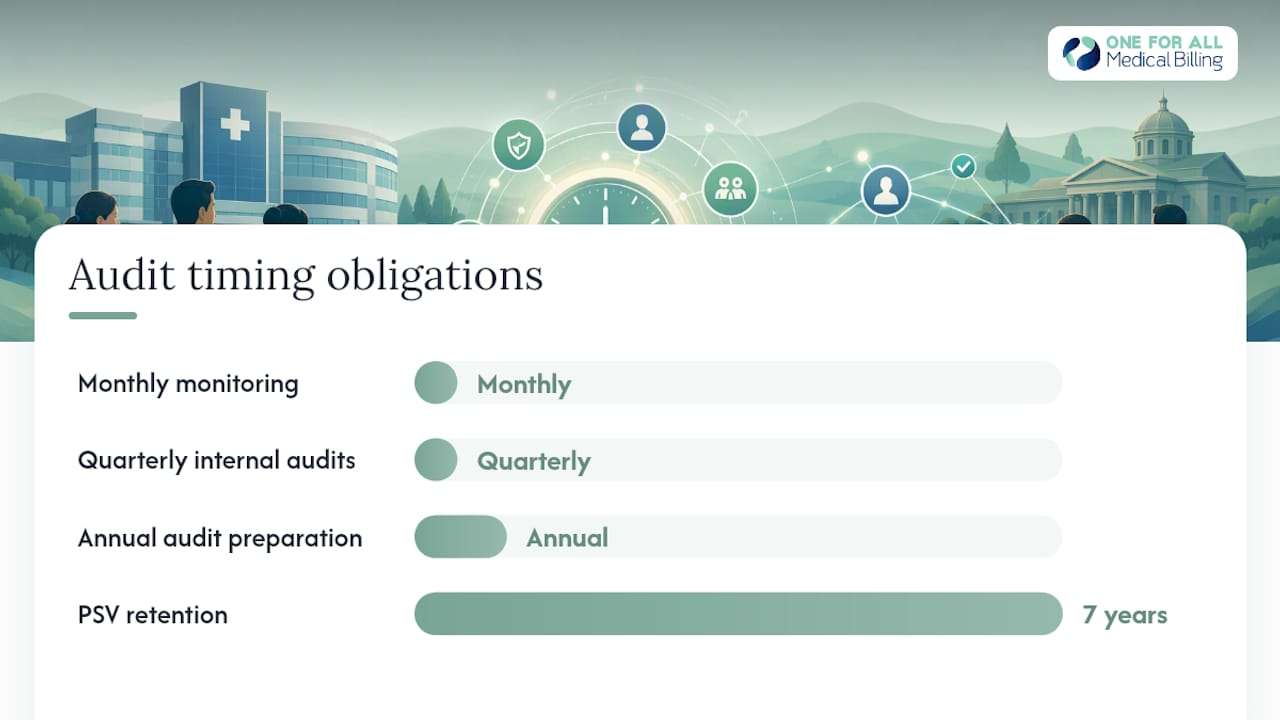
Monthly monitoring requirements:
- Run sanctions and exclusion checks against OIG List of Excluded Individuals/Entities, SAM.gov, and applicable state licensing boards.
- Log every check with the date, source queried, and result. A clean result still needs a log entry.
- Track license expiration dates and initiate renewal follow-up at least 90 days in advance.
- Document malpractice coverage currency for each provider.
Annual audit preparation:
- Maintain a file audit calendar and conduct internal audits quarterly, not just before payer audits.
- Keep committee minutes current, with quorum records and decision rationale documented for every credentialing action.
- Retain PSV documentation for the period your agreement and state law require, typically a minimum of seven years, though payer agreements may specify longer.
- Prepare a corrective action log that shows findings, response dates, and resolution status.
NPDB rules deserve specific attention. The NPDB Guidebook is explicit that certain query obligations belong to the entity with direct reporting relationships and cannot be assumed by a delegate through contract language. Confirm with legal counsel which queries your organization must perform directly and which the payer retains.
CMS requirements for Medicare Advantage plans extend oversight to delegate-level documentation. If your organization credentials providers who participate in MA plans, CMS audit exposure is real and your documentation standards need to reflect that.
Pro Tip: Build your audit trail in real time, not retrospectively. A file that looks complete today but has PSV records added after the fact is an audit liability. Date-stamp every verification at the time it is performed, and use a credentialing software system that logs user actions with timestamps.
NCQA’s updated standards make documentation and governance the primary fault line for audit citations. Informal practices that passed muster five years ago no longer satisfy auditors, and resource sufficiency, meaning adequate staffing to maintain the program, is now an explicit audit consideration.
What are the most common failure modes and how do you prevent them?
Most delegated credentialing programs that fail audits do so for predictable, preventable reasons.
Top failure modes:
- Missing or incomplete PSV elements: A provider file missing a dated malpractice verification or a board certification check is an automatic citation. Templates and checklists prevent this.
- Undocumented committee decisions: A credentialing committee that meets but produces vague or incomplete minutes creates an audit gap. Every credentialing action needs a documented decision with rationale.
- Late recredentialing: Providers whose recredentialing cycle lapses, even by a few weeks, create compliance exposure. A tracking system with automated alerts is not optional at scale.
- Inadequate ongoing monitoring: Monthly monitoring logs that are missing months, or that show checks were run but results were not recorded, are among the most common audit citations.
- Treating delegation as an operational shortcut: Industry analysis is direct on this point. Organizations that pursue delegation without building governance infrastructure first routinely fail pre-delegation audits and delay their timelines by months.
Mitigation checklist:
- Implement a standardized PSV evidence template for every credential element, with required fields for source, date, and verifier.
- Establish committee governance rules in writing: quorum, voting thresholds, conflict of interest procedures, and documentation standards.
- Build an escalation process for providers with adverse findings, with defined timelines for committee review and payer notification.
- Track corrective actions in a dedicated log with open/closed status and resolution dates.
- Conduct internal file audits on a quarterly cycle, scoring files against the payer’s actual audit instrument.
On liability: when a payer delegates credentialing, the delegate assumes primary responsibility for credentialing accuracy. That liability is not theoretical. A provider who causes patient harm and whose credentialing file contains a gap the delegate was responsible for verifying creates direct legal exposure for the delegate organization. NPDB guidance on query responsibilities is the starting point for understanding where that liability begins and ends.
When does it make sense to partner with a CVO or outsource?
Not every organization should build a fully internal delegated credentialing program. The build-versus-buy decision depends on several factors.
Scenarios where outsourcing or a CVO partnership makes sense:
- Your provider count is growing faster than your credentialing staff can absorb.
- You operate across multiple states with varying licensure requirements and payer rules.
- Your internal team lacks NCQA or NAMSS-certified credentialing professionals.
- You are approaching delegation for the first time and need audit-ready processes built quickly.
- Your tolerance for audit risk is low and you want an experienced team managing compliance.
What outsourcing commonly covers:
- Primary source verification for all credential elements.
- Ongoing monthly monitoring and exclusion checks.
- Roster preparation and submission to payers.
- Audit packet preparation and response support.
- Recredentialing cycle management.
A hybrid model, where your internal team owns committee governance and credentialing decisions while a partner handles PSV and monitoring operations, is a practical middle ground for mid-size organizations. You retain the governance accountability that payers expect from a delegate while offloading the high-volume verification work.
When evaluating a credentialing partner, apply structured due diligence criteria to any vendor you consider. Key items to verify:
- NCQA or URAC accreditation status of the CVO.
- Demonstrated experience with your target payers’ specific audit tools.
- Turnaround SLAs for PSV completion and roster submissions.
- Data security certifications and PHI handling protocols.
- References from organizations with comparable provider counts and payer mix.
One For All Medical Billing supports delegated credentialing readiness across all of these functions, from PSV operations and audit preparation to roster management and ongoing monitoring, for provider organizations nationwide.
What does implementation actually cost and how long does it take?
The 6–12 month timeline is the honest answer for most organizations, and the range reflects how much remediation work is needed before a payer will grant delegation.
Primary cost drivers:
- Staff FTEs: A credentialing coordinator or manager dedicated to building and maintaining the program. For larger organizations, a team of two to four is common.
- NCQA or CVO certification costs: If your organization pursues NCQA Credentialing Accreditation or partners with an accredited CVO, certification and maintenance fees apply.
- Credentialing software: A system that manages provider files, tracks PSV completion, logs monitoring, and generates audit reports. Costs vary by platform and provider volume.
- Legal fees: Delegation agreement review and negotiation with payer legal teams.
- Audit remediation: If the pre-delegation audit surfaces gaps, corrective action may require additional staff time, file reconstruction, or external consulting support.
- External consulting: Organizations without internal NCQA expertise often engage a consultant for the pre-delegation readiness phase.
KPIs to track once live:
- Days-to-active from application receipt to payer network participation.
- PSV completion time per provider file.
- Audit pass rate on internal quarterly file audits.
- Monthly monitoring completion rate (target: 100% of active providers checked each month).
- Recredentialing compliance rate (target: zero providers with lapsed cycles).
Credentialing’s role in provider mobility and network performance means these KPIs connect directly to revenue cycle outcomes. A credentialing program that consistently hits 30–45 day onboarding timelines generates measurably faster revenue realization than one running at 90–120 days.
What One For All Medical Billing has learned from running these programs
Three lessons stand out from working with provider organizations across the credentialing and billing spectrum.
First, governance quality often determines audit outcomes. Organizations with rigorous committee discipline, documented decision rationales, and thorough meeting minutes advance through pre-delegation assessments more smoothly. Those lacking formal governance may face extended remediation delays.
Second, credentialing readiness significantly impacts revenue cycle performance. Faster network participation supports earlier revenue generation and reduces billing complications, highlighting credentialing as a crucial early step.
Third, treating delegation as a governance shift rather than an operational shortcut strengthens program resilience. Rushing delegation without appropriate documentation foundations often leads to audit failures and setbacks.
How One For All Medical Billing supports your delegated credentialing program
Credentialing programs that are built correctly from the start generate faster provider onboarding, cleaner rosters, and fewer audit surprises. One For All Medical Billing brings over 20 years of credentialing and billing experience to organizations that need to build or strengthen a delegated program, with services that cover the full operational scope.
Specific support includes PSV operations for all credential elements, ongoing monthly monitoring and exclusion checks, roster preparation and payer submission, pre-delegation audit packet preparation, and corrective action response support. For organizations pursuing NCQA alignment, the team can assess your current program against accreditation standards and identify gaps before a payer auditor does.
Outcomes clients can expect:
- Faster provider onboarding through complete, audit-ready files submitted on first pass.
- Fewer rejected rosters through accurate, timely submissions aligned to payer-specific formats.
- Audit confidence through documented PSV, monitoring logs, and committee evidence maintained in real time.
To discuss your organization’s credentialing readiness and whether delegation is the right next step, contact One For All Medical Billing for an assessment.
Sources
Key regulatory and industry resources your credentialing team should review:
- NCQA Credentialing accreditation FAQs
- NPDB Guidebook, Chapter D: Queries, Delegated Credentialing
- How to Prepare Your Healthcare Organization for Delegated Credentialing and NCQA Audits (HitConsultant)
- Achieve success with delegated credentialing (NAMSS)
- Provider credentialing explained (CAQH blog)
This article is general information, not a substitute for advice from a qualified lawyer. Consult a qualified legal professional about your own circumstances before acting on anything here.
FAQ
What is delegated credentialing?
Delegated credentialing is a formal arrangement in which a payer or health plan grants a provider organization, such as a hospital, MSO, or CVO, the authority to perform credentialing activities, including primary source verification and ongoing monitoring, on the payer’s behalf.
What is the difference between delegated and non-delegated credentialing?
In a non-delegated model, the payer performs all PSV, committee review, and provider loading, typically taking 90–120 days. In a delegated model, the provider organization owns those steps, compressing timelines to 30–45 days while assuming primary liability for credentialing accuracy.
What does NCQA require for delegated credentialing?
NCQA requires that organizations delegating more than 50% of primary source verification use delegates that are NCQA Accredited or Certified, and prohibits CR Accreditation for organizations that delegate more than 50% of credentialing decision-making.
What are the two main types of credentialing in healthcare?
The two primary types are payer credentialing, which determines a provider’s eligibility to participate in a health plan’s network and bill for services, and medical staff credentialing or privileging, which determines a provider’s clinical scope of practice within a specific facility. Delegated credentialing applies to the payer credentialing side.
How long does it take to implement a delegated credentialing program?
Most organizations should plan for 6–12 months from initial readiness assessment to live roster submission, with the majority of that time spent building audit-ready documentation, conducting internal file audits, and completing the payer’s pre-delegation assessment process.

