

table of contents
A centralized billing office (CBO) is a single, dedicated department that manages claims, denials, payment posting, and accounts receivable follow-up for an entire health system instead of leaving those tasks scattered across individual practice sites. Health systems that centralize billing typically see three things improve: cash arrives faster, denials drop because one team enforces one set of payer rules, and patients get consistent statements instead of five different formats from five different offices.
Systems that centralize billing well tend to target these benchmarks:
- A clean claim rate around the industry target on first submission
- Days in accounts receivable trending downward, not flat
- A denial rate that falls as root-cause patterns get fixed instead of reworked one claim at a time
Key Takeaways
A centralized billing office improves cash flow and reduces denials by consolidating claims, posting, and AR follow-up into one standardized, specialty-aware process.
| Point | Details |
|---|---|
| Define CBO scope clearly | Centralize eligibility, claims, posting, and AR follow-up; keep specialty coding local when clinical nuance matters. |
| Choose hybrid over extremes | Most successful systems centralize generic RCM tasks while decentralizing specialty-specific coding. |
| Track the right KPIs | Monitor clean claim rate, denial rate, days in AR, cost to collect, and first-pass acceptance together. |
| Invest in governance, not just tech | SLAs, escalation paths, and physician champions determine success more than software alone. |
| Choose specialty-focused support | One For All Medical Billing delivers a 90% clean claim rate through specialty-specific billing practices refined over 20 years. |
What a Centralized Billing Office Is and Where It Sits in the Revenue Cycle
A CBO does not swallow the entire revenue cycle. It typically absorbs the volume-driven, rules-based work: eligibility verification, claims submission, payment posting, denial management, and AR follow-up. These tasks follow the same payer logic regardless of which clinic generated the encounter, so one team can run them at scale more consistently than ten separate front desks each doing it their own way.
What usually stays local:
- Specialty-specific coding that requires clinical context only the treating department has
- Point-of-service patient collections and financial counseling conversations
- Charge capture validation tied to a specific provider’s documentation habits
Central reporting is where the payoff compounds. A central billing office unifies data from every site into one dashboard, so leadership sees denial trends, payer performance, and collection velocity across the whole system instead of piecing together five spreadsheets.
Key Functions and Workflows a CBO Manages
The daily engine of a CBO runs on four connected workflows, and a breakdown in any one of them slows down the other three.
- Claims submission. Claims move through scrubbing logic that checks for missing modifiers, mismatched NPI numbers, and eligibility gaps before they ever reach the payer. Most rejections trace back to a handful of repeat offenders: bad demographic data, expired authorizations, and coding mismatches.
- Denial triage and appeals. Denials get sorted by root cause, not just resubmitted blindly. A CBO with a mature process groups denials by payer, reason code, and originating site, then routes the pattern back to whoever can fix the source, not just the symptom.
- Payment posting and reconciliation. Remittances get posted daily against expected reimbursement, with variances flagged immediately rather than discovered during month-end close.
- AR follow-up and patient statements. Aging accounts get worked on a set cadence, typically at 30, 60, and 90 day intervals, and patients receive one consistent statement format regardless of which location they visited.
Pro Tip: Track denial reason codes back to the specific site and provider that generated the claim. A CBO that only measures its own denial rate misses the upstream fix that would prevent the denial in the first place.
For a deeper walkthrough of how these steps connect end to end, see this medical billing process guide.
Benefits a Health System Gains From Centralizing Billing
The business case for a CBO rests on four measurable gains.
- Operational consistency. One team trained on one set of payer rules produces fewer variations in how claims get worked, which shortens onboarding time for new staff.
- Faster, steadier cash flow. Centralized billing offices tend to outperform distributed models on AR performance because standardized processes and single-team accountability catch errors before they age into write-offs.
- Better patient experience. Standardized statements cut down on the confused calls that come from patients receiving different bill formats from different departments, which reduces inbound billing inquiries back to clinical staff.
- Stronger audit readiness. One set of documentation standards is easier to defend in a payer audit than ten inconsistent ones.
Analytics is often the real driver behind the decision to centralize. More than two-thirds of healthcare decision makers now rank analytics as a top-three priority, and a CBO is what makes consolidated, system-wide reporting possible in the first place.
Staffing, Roles, and Governance for a CBO
A functioning CBO needs a small set of clearly defined roles rather than a large undifferentiated pool of “billers.”
- Billing specialists who handle claim submission and scrubbing
- AR collectors who work aging accounts on a defined schedule
- Appeals specialists who handle the more complex denial disputes that need payer-specific knowledge
- Payment posters who reconcile remittances daily
Specialty coders, particularly for surgical or high-complexity specialties, often stay embedded closer to the clinical team, because they need direct access to operative notes and physician clarification. Governance matters as much as staffing: define service-level agreements for turnaround time, a clear escalation path when a claim gets stuck, and a change-control process so a new payer rule gets updated once, centrally, instead of five times inconsistently.
Technology and Automation That Enable an Effective CBO
The technology stack determines whether a CBO actually delivers on its promises or just centralizes the same manual chaos into one building.
- PM/EHR integration that feeds accurate charge data into the billing system without manual re-entry
- Clearinghouse connections that scrub and route claims automatically
- Payment-posting automation that matches remittances against expected reimbursement without a human retyping numbers
- Denial-management and analytics platforms that group denials by root cause instead of treating each one as an isolated event
- Patient access tools like eligibility verification and identity checks at intake, which reduce the errors that turn into denials three weeks later
Pro Tip: Fix intake-level eligibility checks before you invest in denial-management software. A denial prevented at check-in is cheaper than the smartest appeals workflow you can buy.
Consolidated reporting only works when every site feeds data into the same structure, using the same field definitions and the same payer mapping. Skip that groundwork and your dashboard just displays five disconnected data sets side by side.
Centralized vs Decentralized vs Hybrid: Trade-Offs and Decision Criteria
Full centralization gives you consistency and system-wide visibility but can create friction when a specialty’s billing needs genuinely differ from the norm. Full decentralization preserves local flexibility but sacrifices the reporting clarity leadership needs to spot trends.
Most systems that get this right land on a hybrid. A hybrid RCM strategy centralizes generic, high-volume tasks like payment posting and AR follow-up while keeping specialty-specific coding decentralized where clinical nuance matters most.
Decide based on:
- Specialty mix. A system heavy in surgical or oncology specialties needs more local coding autonomy than a primary-care-dominant network.
- IT maturity. Centralization only works as well as your data integration allows.
- Scale. Smaller multi-site practices often see faster returns from full centralization than sprawling systems with dozens of disparate specialties.
- Change readiness. Staff and physician buy-in determines how fast a transition actually sticks.
Some organizations also layer in an extended business office model to handle backlogs or unusually complex accounts without disrupting the core CBO’s daily throughput.
Implementation Checklist and KPIs to Measure Success
Rolling out a CBO works best in phases, not an overnight flip of the switch.
- Establish governance first. Define ownership, escalation paths, and who signs off on process changes before a single account moves.
- Pilot with one site or one payer category. A phased pilot limits risk and gives you real data before a system-wide rollout.
- Map EHR/PM data fields. Inconsistent field mapping across sites is the single most common cause of centralization delays.
- Train staff on standardized workflows, not just the software.
- Monitor and adjust using a defined KPI dashboard, not gut feel.
Track these KPIs, and know which direction “good” means for each:
- Clean claim rate (higher is better, target around 90% or above)
- Denial rate (lower is better, trending down month over month)
- Days in AR (lower is better, and should trend down as centralization matures)
- Cost to collect (lower is better as automation reduces manual rework)
- First-pass acceptance rate (higher is better, and a leading indicator of clean claim rate)
The most common pitfall isn’t technical, it’s political: sites that feel like they’re losing control resist the change. Bring department leaders into the pilot design early, and share the KPI data with them regularly so centralization reads as a shared win, not an imposed mandate.
One For All Medical Billing’s Approach and Proof Points
One For All Medical Billing has spent more than 20 years building specialty-specific billing practices, and that focus shows up directly in results: a 90% clean claim rate driven by rules tuned to the specialty, not generic templates applied across every provider.
- Specialty-specific claim scrubbing built around the actual documentation patterns of surgical, urgent care, and multi-site practices
- Transparent reporting that shows a client exactly where denials originate, not just that they happened
- A staffing model that scales from single-provider practices to large multi-site health systems without losing the personalized service smaller practices rely on
Generic billing services apply the same rules to every specialty and call it efficiency. A 90% clean claim rate only holds up when the coding logic actually understands the specialty behind the claim.
That distinction, treating specialty nuance as a feature rather than an inconvenience, is what separates a CBO that merely centralizes paperwork from one that actually moves the financial needle.
Compliance Touchpoints: HIPAA Privacy, Accuracy, and Patient Communications
Centralizing billing concentrates protected health information into fewer hands, which raises the stakes on privacy controls even as it simplifies oversight. A CBO handling data from multiple sites needs role-based access controls so a billing specialist working orthopedic claims can’t casually browse behavioral health records from another department, even though both live in the same consolidated system.
Accuracy is a compliance issue as much as a financial one. Claims submitted with incorrect codes or unsupported charges create audit exposure under federal billing accuracy standards, and a CBO’s centralized workflow makes it easier to catch these errors consistently, but only if the scrubbing logic is actually built to catch them. Standardized documentation requirements across every site reduce the odds that one location’s shortcuts create liability for the whole system.
Patient communications carry their own compliance weight. Statements need to be accurate, timely, and consistent with what a patient’s insurance explanation of benefits actually says, because a mismatch between the two is one of the fastest ways to generate a complaint or a compliance inquiry. A CBO that standardizes statement language and format across every site reduces the risk of a patient receiving conflicting information from two different departments about the same account.
For providers managing a growing footprint of remote or telehealth services, compliance requirements shift again. This telehealth compliance checklist covers the operational changes that come with distributed care delivery, which increasingly intersects with centralized billing workflows. For a broader view of documentation and audit standards, see this medical billing compliance guide.
How Centralization Changes Financial Counseling and Payment Plans
Patient financial counseling suffers most when it’s fragmented, because a patient who owes money across three different departments gets three different conversations, three different payment plan structures, and no coordinated view of their total balance. A CBO fixes that by consolidating a patient’s full financial picture into one place, so a counselor can see the complete balance across every visit and every department before offering a payment plan.
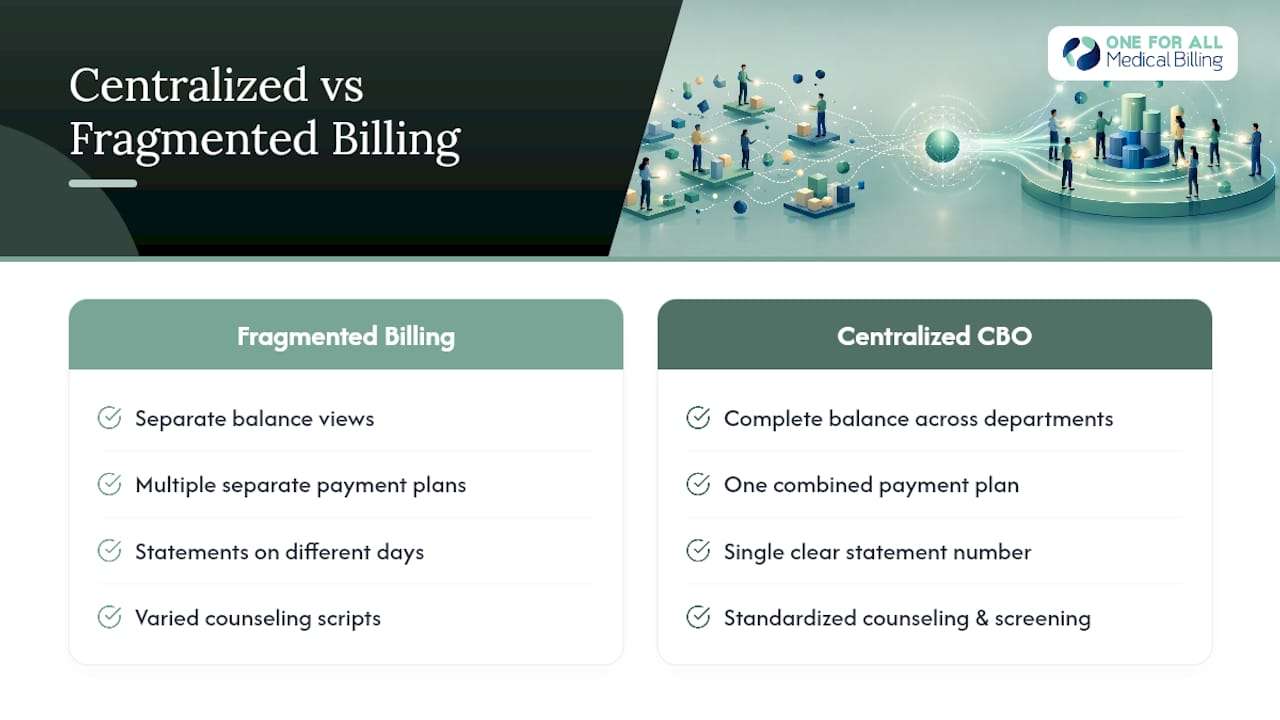
That consolidated view changes what’s possible. Instead of a $200 balance from radiology and a separate $150 balance from the primary care visit generating two collection calls, a centralized office can combine them into one manageable plan with one payment schedule. Patients respond better to a single clear number than to a stack of disconnected statements arriving on different days.
Centralization also standardizes how financial counseling itself gets delivered. Instead of each front desk improvising its own approach to discussing costs, a CBO can train counselors on a consistent script, consistent eligibility screening for financial assistance programs, and consistent payment plan terms. That consistency matters most for patients navigating high-deductible plans, who often need a counselor who can explain exactly what they owe and why, not a generic “call this number” referral.
The result is fewer accounts sliding into bad debt simply because nobody coordinated the conversation. A patient who agrees to a manageable plan early is far more likely to pay than one who ignores three separate bills until they land with a collections agency. That single point of contact is one of the more underappreciated benefits of centralizing billing, and it rarely makes the pitch decks focused purely on denial rates and days in AR.
Training and Continuous Education Requirements for CBO Staff
Billing staff in a centralized office need training that goes well beyond a one-time onboarding session, because payer rules, coding sets, and compliance requirements shift constantly. ICD-10 and CPT code updates happen annually, and a CBO that doesn’t build in structured refresher training will see its clean claim rate quietly erode as staff keep applying outdated logic.
New hire onboarding should cover the specific payer mix the CBO handles, not generic billing theory. A biller who understands Medicare’s rules but has never worked with a regional commercial payer’s specific denial patterns will make avoidable mistakes in the first few months. Pairing new staff with experienced team members for shadowing during that ramp-up period catches errors before they become habits.
Ongoing education needs a cadence, not a once-a-year seminar. Monthly or quarterly training sessions that walk through recent denial trends, new payer policy changes, and coding updates keep the whole team calibrated to the same standards. Cross-training also matters: a CBO where every specialist can cover claims submission, denial follow-up, and payment posting is far more resilient to turnover than one where knowledge lives in a single person’s head.
Certification matters too. Staff holding credentials through organizations like the American Academy of Professional Coders or the American Health Information Management Association bring a baseline of verified expertise, and continuing education requirements tied to those credentials give the CBO a built-in structure for keeping skills current. A CBO that invests in certification and ongoing training isn’t just checking a box, it’s protecting the clean claim rate that the entire business case for centralization depends on.
Data Security Measures Specific to Centralized Billing Offices
HIPAA sets the floor for protecting patient health information, but a centralized billing office handling claims data from multiple sites faces security risks that go beyond the baseline regulatory requirements. Concentrating financial and clinical data from every location into one system creates a single, high-value target, and that concentration demands controls tailored to the CBO’s specific structure.
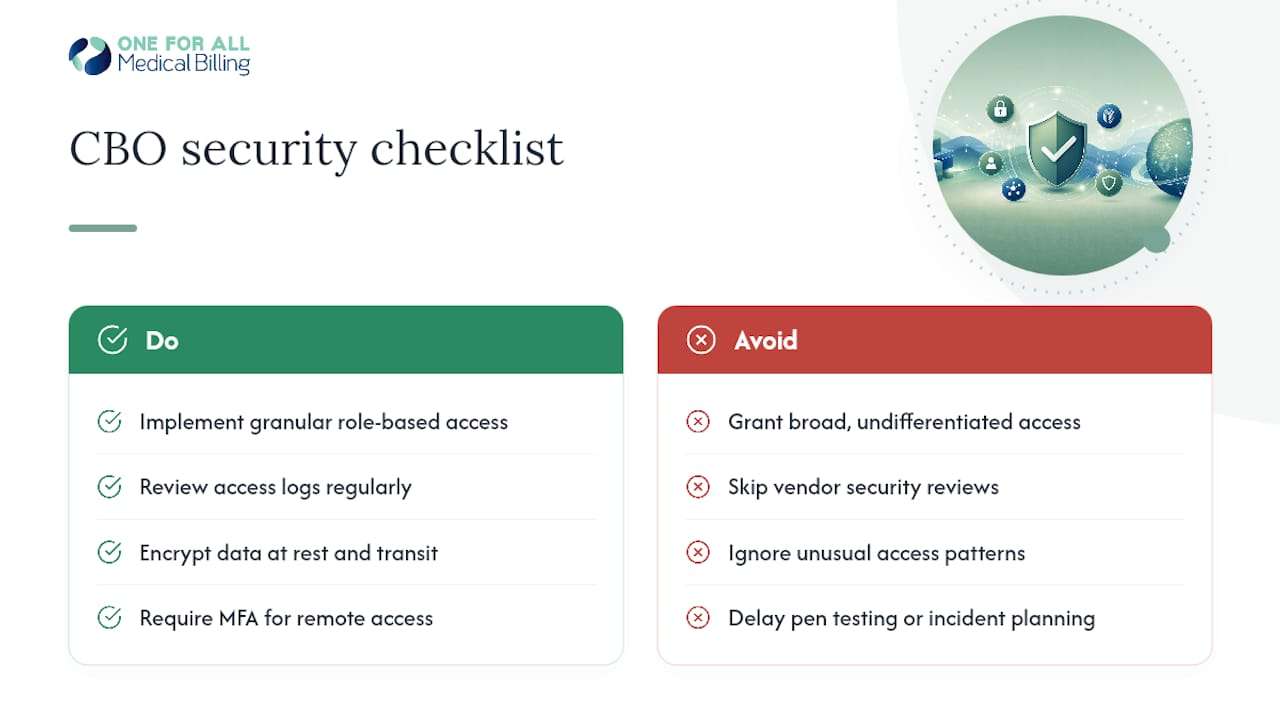
Role-based access control needs to be granular, not just present. A payment poster shouldn’t have the same system access as an appeals specialist working complex denial disputes, and access logs need regular review to catch unusual patterns, like a staff member pulling records for accounts they have no reason to touch.
Encryption matters both at rest and in transit, particularly as claims data moves between the CBO, the clearinghouse, and multiple payer systems throughout a single day. Multi-factor authentication for any staff member accessing the billing platform remotely closes one of the most common entry points for a breach, especially as more billing staff work in hybrid or remote arrangements.
Vendor risk management deserves its own attention. A CBO typically relies on a clearinghouse, a practice management system, and often a separate denial-analytics platform, and every one of those third-party connections is a potential vulnerability if the vendor’s own security practices are weak. Reviewing vendor security certifications and data-handling agreements before integration, not after a breach, is the difference between a manageable risk and a system-wide incident.
Regular penetration testing and a documented incident response plan round out a security posture built for the reality that a CBO holds significantly more concentrated data than any single practice site ever would on its own.
Strategies for Handling Complex or Specialty-Specific Billing Exceptions
Not every claim fits the standard workflow, and a CBO that treats every exception like a routine denial will mishandle the cases that actually need specialized attention. Surgical claims with multiple procedures, oncology billing with complex drug administration codes, and claims involving coordination of benefits across multiple payers all require judgment that a generic scrubbing rule can’t replicate.
The most effective approach keeps a small team of specialists dedicated to these exceptions rather than routing them through the general claims queue. A biller who handles routine primary care claims all day shouldn’t also be expected to correctly code a multi-stage surgical case with bundled procedures, because the two require entirely different knowledge bases.
Building an escalation path matters as much as the specialist team itself. Front-line billing staff need a clear, fast way to flag a claim that falls outside standard logic, rather than guessing or, worse, submitting it incorrectly and generating an avoidable denial. That escalation path should connect directly to someone with both billing expertise and enough clinical fluency to interpret the documentation correctly.
Specialty coders embedded closer to the clinical team, rather than fully centralized, often handle these exceptions best, because they have direct access to the physician who can clarify ambiguous documentation. This is exactly where the hybrid model earns its keep: centralize the high-volume, rules-based work, but keep a dedicated bridge between the CBO and clinical documentation experts for the genuinely complex cases. For more on preventing the denials that often stem from these exceptions, see this claim denial guide.
Best Practices for Cross-Departmental Collaboration Between CBO and Clinical Teams
A CBO that operates in isolation from clinical staff eventually drifts out of sync with how care actually gets documented, and that drift shows up as denials. The strongest CBOs build structured, recurring touchpoints with clinical departments rather than only reaching out when something goes wrong.
Regular denial review meetings between CBO staff and department leaders close the loop that most systems miss. When a specific provider’s documentation habits are generating repeat denials, that pattern needs to reach the provider directly, not just get reworked quietly by the billing team every time. A CBO can flag the pattern, but only clinical leadership can fix the documentation behavior at its source.
Shared dashboards help too. When clinical department heads can see their own denial rates, clean claim percentages, and AR trends alongside the rest of the system, billing performance stops feeling like a black box managed somewhere else. That visibility turns billing from an adversarial relationship into a shared metric both sides are accountable for.
Physician champions make a measurable difference in how smoothly this collaboration works. A single respected physician in each major department who understands why documentation specificity matters for billing accuracy can influence peer behavior far more effectively than a memo from administration. Investing time in that relationship pays off across every claim that department generates going forward.
Finally, new service line launches or major EHR changes need CBO involvement from the planning stage, not as an afterthought once claims start failing. A department that changes its documentation template without looping in billing will generate a wave of denials that could have been avoided with a fifteen-minute conversation beforehand.
What Actually Determines Whether a CBO Works
Most articles on centralized billing offices treat the decision as binary: centralize everything or don’t bother. That framing misses the point. The health systems getting real value from a CBO are the ones that resisted the urge to centralize for centralization’s sake and instead built a hybrid structure matched to their actual specialty mix.
The conventional advice oversells technology as the fix. A denial-management platform doesn’t fix a broken escalation path between billing and clinical staff, and no software patches a documentation habit that a physician never learns is causing denials. The technology matters, but it’s a multiplier on a good process, not a substitute for one.
If you’re weighing this decision, prioritize governance and cross-departmental relationships before you shop for platforms. A CBO with clear SLAs, a real escalation path, and physician champions in each department will outperform a technically sophisticated system with none of that structure. The KPI dashboard tells you where you stand. The relationships determine whether you can actually move the numbers.
— One For All Medical Billing
Get Specialty-Focused Billing Support From One For All Medical Billing
Building an in-house CBO from scratch takes years of governance work, staff training, and technology integration that most practices and even mid-sized health systems don’t have the bandwidth to run alongside patient care. One For All Medical Billing offers that centralized structure already built, tuned specifically for medical, surgical, urgent care, and multi-site practices instead of generic billing templates.
The difference shows up in the details: specialty-specific coding logic that understands the documentation patterns of your actual practice type, transparent reporting so you see exactly where denials originate, and a 90% clean claim rate built on 20 years of refining that specialty focus. Whether you’re a single-site practice looking to stop losing revenue to preventable denials or a multi-site system deciding whether a CBO makes sense at all, this is the kind of revenue cycle management partnership built around your specialty, not a one-size-fits-all script.
If your current billing setup is costing you more in denials and delayed payments than it should, reach out to One For All Medical Billing for a review of your current claims performance and a clear picture of what centralized, specialty-focused billing could do for your cash flow.
Sources
- Centralize, decentralize and customize: Choosing the right RCM strategy to maximize value and success – Becker’s Hospital Review
- Central Billing Office (CBO) – Imprivata knowledge hub
- Centralized Billing vs EBO Models | AR Performance – Meddatsys
FAQ
What Does Centralized Billing Mean?
Centralized billing means one dedicated team manages claims, denials, payment posting, and AR follow-up for an entire organization instead of each location handling billing independently.
What Is a CBO in Healthcare?
A CBO, or centralized billing office, is the department that oversees the full life cycle of patient accounts, from eligibility verification through claims, denials, and AR tracking.
Why Am I Getting a Bill From a Health System’s Central Office Instead of My Doctor?
Many health systems route all patient billing through a centralized office rather than individual clinics, so a bill from a system-wide billing department, rather than the specific practice you visited, is a normal result of that centralized model.
What Are the Three Types of Billing?
Healthcare billing structures are generally described as centralized, decentralized, or hybrid, with hybrid models centralizing high-volume tasks while keeping specialty-specific work at the local level.

