

table of contents
Think of billing codes as the secret handshake between your practice and an insurance company. You use one set of codes (CPT codes) to describe what you did (like a therapy session) and another set (ICD-10 codes) to explain why you did it (the patient's diagnosis).
When these two pieces fit together perfectly, your claim gets paid. When they don't, you get denials. Getting this right is the cornerstone of a financially stable mental health practice.
Cracking The Code Of Mental Health Billing
If you've ever stared at a claim form feeling like you're trying to solve a puzzle with missing pieces, you're not alone. This guide is here to turn that confusion into confidence.
We're going to reframe billing codes not as a chore, but as the language you use to clearly communicate the value of your clinical work to payers. Mastering this is what keeps your revenue stream flowing smoothly.
Why Mastering Billing Codes Matters
Getting a firm grip on CPT, HCPCS, and ICD-10 codes isn't just about administrative box-checking—it's about survival. This knowledge is your direct line to consistent revenue, fewer claim denials, and fair compensation for your hard work.
When you use codes correctly, you’re telling the insurance company a clear, compelling story that proves your services were medically necessary. On the flip side, even small mistakes can trigger payment delays, rejections, and hours of frustrating appeals. To get a better sense of this, check out our guide on the common medical coding errors to avoid.
The goal is simple: translate your valuable clinical work into a language that payers understand and accept. This mastery removes financial uncertainty and allows you to focus on what matters most—patient care.
The Unique Challenges In Mental Health
Billing for mental and behavioral health has its own rulebook, and it's quite different from other medical specialties. For starters, the entire system leans heavily on time-based session codes, which means your documentation has to be airtight, with start and stop times clearly noted.
Then there's the explosion of virtual care, which adds another layer of complexity. You have to navigate a whole new world of specific telehealth modifiers and place-of-service codes that must be applied perfectly. Get it wrong, and the claim bounces right back.
This guide is your roadmap. We’ll break down these unique challenges piece by piece, giving you the foundation you need to build a financially sound practice.
Understanding Your Billing Building Blocks
To get your claims paid, you need to tell insurance companies a clear and logical story. Think of mental health billing codes as the literal building blocks for that story. There are two fundamental types of codes you'll use every single day, and mastering how they work together is the first step toward a healthier revenue cycle.
Imagine you’re sending an itemized receipt to an insurance company. That receipt has to answer two simple questions: what did you do, and why did you do it? In the world of medical billing, Current Procedural Terminology (CPT) codes handle the "what," while International Classification of Diseases (ICD-10) codes explain the "why."
CPT Codes: The What Of Your Service
CPT codes are the action words on your claim. They describe the specific, tangible service you provided to the patient during your session. Each code represents a distinct clinical activity, from an initial intake to a standard therapy session.
For example, a CPT code tells the payer whether you performed:
- An initial psychiatric diagnostic evaluation.
- A 45-minute individual psychotherapy session.
- A 60-minute family therapy session with the patient present.
Essentially, CPT codes are how you bill for your time and expertise. They turn your hard work into a standardized format that every insurance company can understand. Without the right CPT code, the payer has no idea what service they’re being asked to pay for.
CPT codes are like a menu of services. Just as a restaurant guest orders a specific dish, you select the CPT code that precisely matches the service you delivered.
ICD-10 Codes: The Why Behind Your Care
While CPT codes describe your actions, ICD-10 codes establish the medical necessity for them. These are the diagnostic codes that communicate the patient’s condition—think Major Depressive Disorder or Generalized Anxiety Disorder. They answer the million-dollar question: why did this patient need this particular service today?
An ICD-10 code provides the clinical justification for the CPT code you’ve billed. For instance, billing for a psychotherapy session (the CPT code) makes sense to a payer only when it’s linked to a relevant mental health diagnosis (the ICD-10 code). This connection proves your service was essential for treating the patient's diagnosed condition.
Getting this alignment right is absolutely crucial, especially when you're navigating the complexities of getting on insurance panels. If you're looking for more guidance, you might find value in our detailed overview of insurance credentialing for therapists.
Creating A Cohesive Claim Story
For a claim to breeze through to approval, the CPT and ICD-10 codes must tell a consistent, believable story. A payer’s automated system will immediately flag a claim if the service provided doesn't logically align with the patient’s diagnosis. Billing for family therapy when the diagnosis is for an individual-specific condition, for instance, could raise a red flag.
Think of it this way:
- CPT Code (The What): 90834 – Psychotherapy, 45 minutes
- ICD-10 Code (The Why): F41.1 – Generalized Anxiety Disorder
This combination tells a clear, simple story: "I provided a 45-minute psychotherapy session to treat the patient's Generalized Anxiety Disorder." This coherence is what gets claims approved without a hitch.
Mismatched codes are one of the leading causes of claim denials, creating frustrating administrative work and delaying your payments. Mastering this foundational partnership between CPT and ICD-10 codes is non-negotiable for building a financially resilient practice.
Applying Essential CPT Codes In Your Practice

Moving from theory to practice is where you turn knowledge into revenue. The daily rhythm of a mental health practice revolves around just a handful of key CPT codes. Getting their specific rules right is absolutely non-negotiable if you want to get paid correctly and on time.
These codes are far more than just numbers on a claim form; they are precise descriptors of the time and clinical effort you invest in your clients. Most are time-based, which means your documentation has to be flawless. Think of it like punching a time clock for each session—payers need to see clear, undeniable proof of the session’s duration to justify the code you’ve billed. Mastering these core codes is the first real step toward building a denial-proof billing workflow.
The Foundation: Your Initial Evaluation
Every new client relationship kicks off with a comprehensive assessment. This is where you dig into their history, establish a diagnosis, and map out a treatment plan. For this crucial first step, you’ll use CPT code 90791, the psychiatric diagnostic evaluation.
This code covers the entire intake process. It’s not time-based, which is a nod to the fact that these initial sessions can vary quite a bit in length. It's designed to be used just once per client, per treatment episode. An insurer might approve it again if a client returns after a long break or has a major clinical shift that requires a full re-evaluation, but it’s definitely not for regular follow-up visits.
Navigating Time-Based Psychotherapy Codes
Once treatment is underway, you’ll switch to using time-based psychotherapy codes. These are the workhorses of mental health billing, and their rules are incredibly strict. The American Medical Association (AMA) defines precise time windows for each one, and you have to bill for the code that matches the actual face-to-face time you spent with the client.
Here’s a quick-reference list of the most common psychotherapy codes you'll be using day in and day out.
- 90832: Used for psychotherapy sessions lasting between 16 and 37 minutes.
- 90834: Used for psychotherapy sessions lasting between 38 and 52 minutes.
- 90837: Used for psychotherapy sessions lasting 53 minutes or more.
Pay close attention to these time brackets—they're the key to avoiding simple but costly billing errors.
You absolutely cannot round up. It's a hard and fast rule. If your session lasts 51 minutes, you must bill 90834, not 90837. The best way to protect yourself against audits and claim denials is to accurately document session start and end times in your clinical notes, every single time.
How Provider Credentials Affect Reimbursement
Here’s a critical detail that directly impacts your practice’s bottom line: provider credentials change reimbursement rates. Payers often reimburse different license types at different rates for the exact same service. This is a nuance you have to factor into your financial forecasting.
For instance, mental health billing relies on a very select group of CPT codes—only about 24 are relevant out of thousands, and most therapists use just 2-3 regularly, like 90791 and 90837.
Medicare reimbursement rates really highlight these differences. For the initial intake (90791), a licensed clinical social worker or PhD-level psychologist gets paid $173.35. In contrast, an LPC or LMFT receives $130.01—that’s a 25% difference. The gap exists for therapy sessions, too: a 60-minute session (90837) reimburses at $167.00 for higher-level providers versus $125.25 for others. While some codes are more common in general medicine, they can be relevant in integrated care. If you're curious, we have a deep dive on the 99213 CPT code description and how it's applied.
Using Add-On Codes For Complex Situations
Sometimes, a standard session involves extra complexities that demand more of your clinical skill and time. For these situations, you can use "add-on" codes on top of the primary service code to reflect that increased intensity.
Two of the most important add-on codes to have in your back pocket are:
- Interactive Complexity (90785): This is for when communication challenges make the session tougher. Think working with young children, clients with cognitive impairments, or when you need to use interpreters.
- Crisis Intervention (90839 and +90840): Code 90839 is a standalone code for the first 60 minutes of urgent therapy when a client is in crisis. If you need more time, +90840 is the add-on code you’ll use for each additional 30 minutes of crisis care.
These billing codes aren't just administrative hoops to jump through. They are the tools you use to accurately tell the story of the essential care you provide. When you apply them correctly, you ensure your practice is compensated fairly for its vital work.
Coding For Virtual Care And Telehealth

The explosion of virtual care has completely reshaped how mental health services are delivered. But with this shift comes a whole new set of billing rules that you absolutely can't afford to ignore. Getting paid for these remote sessions hinges on using the right codes to signal to payers that care happened virtually.
Think of these codes as digital signposts on your claim. They tell the insurance company, "Hey, this session didn't happen in a brick-and-mortar office." Without them, a claim for a standard psychotherapy code will likely get kicked back, leading to payment delays and a whole lot of administrative frustration. Nailing these virtual care rules is non-negotiable for a healthy revenue cycle.
Using Modifiers To Specify Telehealth
The single most important tool in your telehealth billing toolkit is Modifier 95. This little two-digit code gets tacked onto a standard CPT code—like 90834 for a 45-minute therapy session—to show that the service was delivered through a real-time, audio-video connection.
Forgetting this modifier is one of the quickest ways to get a telehealth claim denied. It’s the primary signal payers look for to process the claim under their specific telehealth policies, so using it correctly is crucial for getting your claim routed properly right from the start.
The Role Of Place Of Service Codes
Beyond modifiers, you also need to use the right Place of Service (POS) code. This tells the payer where the patient was during the virtual appointment, which is a critical piece of the telehealth puzzle.
You'll mainly use one of two POS codes for virtual care:
- POS 02: Use this code when the patient is receiving telehealth services from a location that is not their home. Think a private room at their workplace, a school nurse's office, or another healthcare setting.
- POS 10: This one is straightforward—it’s used when the patient receives care while they are in their home. As you can imagine, this has become the far more common code since the pandemic.
Picking the correct POS code isn't optional; it's a compliance requirement. For a deeper dive into how these codes work across different settings, our guide on CMS Place of Service Codes is a great resource.
Navigating A Patchwork Of Payer Rules
While telehealth is clearly here to stay, the rules are anything but consistent. The payment landscape is a messy combination of federal, state, and commercial payer policies that seem to be changing all the time.
Telehealth has revolutionized mental health, with projections showing 40-60% of therapy sessions in 2026 will be virtual. While these sessions use identical CPT codes like 90834, they require Modifier 95 and detailed notes on modality and patient location. Discover more insights about the future of telehealth billing on datainsightsmarket.com.
Medicare made waves by permanently covering many synchronous audio-video behavioral health services, but that doesn't mean every other payer is on the same page. Many commercial plans and state Medicaid programs have their own quirky rules, and some have even started rolling back the broad coverage expansions from the public health emergency.
This is why you absolutely must verify each patient's benefits and understand their specific plan's telehealth coverage before you even start virtual sessions. It’s the only way to avoid surprises and ensure you get paid for your work.
Proactive Strategies To Prevent Claim Denials
Nothing grinds your practice’s cash flow to a halt like a denied claim. It might feel like a minor administrative headache, but every denial is lost revenue and wasted time you’ll never get back. The single most powerful change you can make for your bottom line is shifting from reacting to denials to proactively preventing them in the first place.
This isn’t about chasing down appeals after the fact. It’s about building a rock-solid, front-end process that catches tiny errors before they become big problems. The goal is to submit claims so clean and accurate they sail right through the payer's automated reviews without raising a single red flag.
Fortify Your Front-End Processes
The vast majority of claim denials don't come from complex coding issues. They come from simple, preventable mistakes made right at the front desk during patient intake. A single typo in a name, a transposed digit in a policy number, or an old address can stop the entire payment process cold.
That’s why your first and best line of defense is perfecting your front-end workflow. This means creating a non-negotiable checklist for every single client before their first session. It's not just about collecting information; it's about verifying every last detail.
- Meticulous Eligibility Checks: Before that first appointment, your team needs to confirm the patient’s coverage is active. Go deeper and verify their specific mental health benefits, what their copay and deductible status are, and whether the services you plan to offer require pre-authorization.
- Demographic Data Scrubbing: Triple-check that the patient's name, date of birth, and address match their insurance card exactly. Even small discrepancies are a common trigger for an instant automated denial.
- Payer-Specific Rule Tracking: Every insurance company plays by its own rulebook. You need a system to track these little nuances, like which payers demand a specific modifier for telehealth or have strict limits on the number of sessions allowed per year.
Align Your Documentation With Billing Codes
Payers are using increasingly sophisticated software to review claims, which means your clinical documentation is more critical than ever. Your notes have to tell a clear, compelling story that justifies the billing codes for mental health services you’ve chosen. Any mismatch is an open invitation for a denial.
Think of it this way: Payer algorithms are designed to spot inconsistencies. If you bill for a 60-minute session (90837) but your notes are sparse and don't reflect that level of service, the system will almost certainly flag it. Your documentation is your ultimate proof of medical necessity.
Denial rates in mental health billing are alarmingly high, averaging 16-20% in 2026—that's nearly double the 5-10% seen in other medical fields. This spike is driven by AI-powered reviews that catch inconsistencies in documentation, especially for codes like 90837, which requires 53+ minutes of therapy and clear clinical complexity in your notes. Time-based rules are strict; 90834 demands 38-52 minutes, and under-documenting is a fast track to getting downcoded or rejected entirely. You can learn more about compliance and documentation on 247medicalbillingservices.com.
Create A Denial-Proof Billing System
A truly proactive strategy is all about continuous monitoring and improvement. It’s not enough to fix errors as they pop up; you have to understand why they’re happening and tweak your process so they don’t happen again. This takes a systematic approach to tracking and analyzing your claim data.
Start by figuring out your most common denial reasons. Are you constantly getting hit with rejections for missing telehealth modifiers? Or maybe for services that needed prior authorization? Once you pinpoint these patterns, you can roll out targeted training for your staff and refine your workflows to fix the root cause.
This feedback loop transforms your billing process from a reactive chore into a strategic asset that protects your revenue. For more actionable tips, check out our guide on medical billing denial management. By building this kind of denial-proof system, you'll save yourself countless administrative headaches and free up your energy for what really matters: patient care.
Putting Your Coding Skills Into A Healthy Revenue Cycle Workflow
Accurate coding doesn't happen in a bubble. It's actually a critical piece of a much larger system known as the revenue cycle. Think of this cycle as the complete financial journey of a patient's care, starting the moment they book an appointment and only ending when the final payment from the insurance company hits your account.
Viewing this as one interconnected process is essential for the financial health of your practice. It's surprisingly easy for a small mistake at the very beginning—like a single typo in a patient's insurance ID—to snowball into a major claim denial weeks down the road. This is why seamless communication and clean handoffs between your clinical and administrative teams are non-negotiable.
This flow chart breaks down the core three-step process for getting ahead of denials and making sure every claim you send is a clean one.
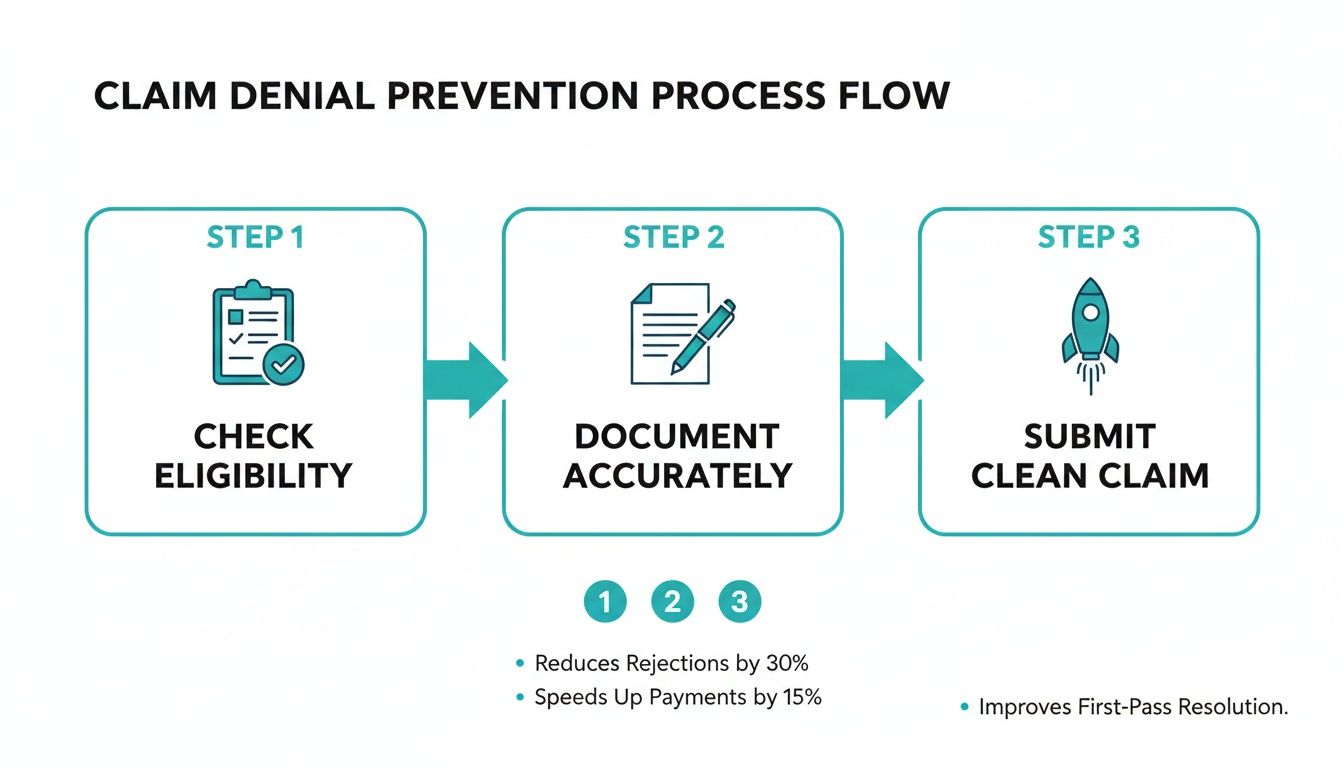
The key takeaway here is that a successful claim starts long before you ever select the billing codes for mental health. It starts at the front desk.
Mapping The Key Stages Of Your Revenue Cycle
To build a resilient financial foundation for your practice, you have to understand how each part of the revenue cycle connects. A weakness in one area will inevitably create problems downstream, leading to delayed payments and a mountain of administrative busywork. It's like a relay race; if the baton gets dropped at any handoff, you lose.
The process flows through several distinct but completely linked stages:
- Patient Intake and Registration: This is ground zero. Your front-desk team needs to capture and verify every piece of demographic and insurance information with near-perfect accuracy.
- Eligibility and Benefits Verification: Before the first session even happens, your team has to confirm the patient’s coverage is active, understand their specific mental health benefits, and check for any pesky pre-authorization requirements.
- Clinical Documentation and Coding: This is where the therapist comes in. After providing the service, they create detailed notes that justify the care. The correct CPT and ICD-10 codes are then assigned based on that documentation, telling the payer's story of what was done and why.
- Claim Submission and Scrubbing: The claim is put together and "scrubbed" for any potential errors before it's sent electronically to the insurance company.
- Payment Posting and Reconciliation: Payments are received from the payer and posted to the patient’s account. Any differences between what you expected and what you got are investigated and reconciled.
- Denial Management and A/R Follow-Up: If a claim gets kicked back, your team investigates the reason, makes the necessary corrections, and resubmits it. They also follow up on any unpaid claims that are getting old in your accounts receivable (A/R).
A healthy revenue cycle is proactive, not reactive. The goal is to build a system so tight that it catches potential errors back at stage one or two, ensuring that by the time you get to coding, the claim is already set up for success.
When each of these steps is humming along and the teams responsible for them are talking to each other, the whole process becomes incredibly efficient. That financial stability means you can dedicate more of your energy and resources to what really matters: patient care.
Answering Your Top Mental Health Billing Questions
Let's be honest—navigating the world of mental health billing codes can feel like learning a new language. A few common questions pop up time and time again, and getting them wrong can lead to denied claims and compliance headaches.
Here are some clear, straightforward answers to the questions we hear most often from providers.
What's The Real Difference Between CPT Codes 90834 And 90837?
This is easily one of the most frequent points of confusion, but the answer is simple: it all comes down to time. These are the two workhorse codes for individual psychotherapy, and the distinction is based on the documented length of your session.
- CPT Code 90834: This is your code for a 45-minute session. To use it, your face-to-face time with the client needs to be between 38 and 52 minutes.
- CPT Code 90837: This one’s for a 60-minute hour. You can only bill this code if the direct client time is 53 minutes or longer.
It's critical to choose the code that matches your documented time. Anything else could be flagged as upcoding during an audit.
How Often Can I Bill For A Diagnostic Evaluation (90791)?
Think of CPT code 90791 as a one-time event for a new client or a new episode of care. It’s designed for that initial, comprehensive diagnostic evaluation you perform at the very beginning of treatment.
Most insurance payers will only reimburse 90791 once per client. You can't use it for your regular, ongoing therapy sessions. There are rare exceptions, like if a client returns after a very long break in treatment (think 6-12 months) or if something drastic happens clinically that requires a full re-evaluation from square one. But as a rule of thumb, it's reserved for the intake process.
My Session Was 52 Minutes. Can I Round Up To 90837?
This is a hard no. When it comes to time-based billing, you can't round up. You have to bill for the time bracket you actually fall into.
If your session lasts 52 minutes, you are still within the window for CPT code 90834 (38-52 minutes). You absolutely cannot bill 90837, as that code requires a minimum of 53 minutes. Your best defense here is meticulous note-taking. Always document the session's start and end times. When in doubt, bill for the lower-level code. It’s the safest way to stay compliant and protect your practice.
Getting these details right builds the foundation for a clean and efficient billing process, cutting down on errors and keeping your revenue cycle healthy.
Struggling with claim denials and complex billing rules? One For All Medical Billing provides expert revenue cycle management to help mental health providers get paid faster and with less stress. Learn how our dedicated, U.S.-based team can streamline your billing at https://oneforallmed.com.

