

table of contents
An RCM workflow is the end-to-end chain of operational decisions and handoffs that moves a patient encounter from pre-registration through final payment, with patient access, clinical, coding, billing, and A/R teams each owning defined stages. HFMA defines RCM as the process healthcare systems use to track revenue from initial appointment to final payment, covering scheduling, insurance verification, charge capture, claim processing, denial management, and collections. The three fastest moves to improve collections right now are:
- Collect copayments and deductibles at the point of service. Front-desk POS collection is the single most effective intervention for preventing patient balance backlogs.
- Run real-time eligibility checks at scheduling, not just at check-in. Catching coverage gaps a few days before the appointment gives your team time to act.
- Scrub every claim before submission. Automated claim scrubbing catches coding and formatting errors before they reach the payer, cutting first-pass rejections.
Pro Tip: Train your front-desk staff with a two-sentence financial script: “Your estimated responsibility today is $X. We accept card, check, or payment plan — which works best for you?” Practices that script this conversation collect significantly more at the point of service than those that leave it to staff discretion.
What does an RCM workflow actually cover?
The revenue cycle management process spans everything from the moment a patient schedules an appointment to the moment the final balance is resolved, whether paid by a payer, the patient, or written off. Understanding its full scope, and who owns each piece, is where most organizations find their first significant revenue leak.
“Simply working hard is not enough to maintain a profitable clinical practice. Prompt and complete payment for services is just as critical. Revenue cycle management tracks the payment process from patient scheduling through treatment, coding, billing, and reimbursement.”
In-scope stages include pre-registration, registration and financial clearance, charge capture, clinical documentation, coding and charge entry, claim scrubbing and submission, remittance posting, payer follow-up and denial management, patient billing, and A/R resolution. Out of scope for most RCM definitions: clinical care delivery, supply chain, and general accounting functions, though all three affect revenue integrity indirectly.
The typical role map looks like this:
- Patient access team: pre-registration, eligibility verification, prior authorization, financial counseling
- Clinical and documentation staff: charge capture, clinical documentation improvement (CDI)
- Coding team: ICD-10, CPT, and HCPCS code assignment; charge entry
- Billing and A/R team: claim scrubbing, submission, remittance posting, denial management, follow-up
- Payer operations / revenue integrity: contract management, underpayment recovery, compliance monitoring
The handoff between clinical documentation and coding is where responsibility is most often misassigned. When physicians assume coders will infer diagnoses from sparse notes, and coders assume physicians will query back, charges fall through the gap. A single missed secondary diagnosis on a complex case can reduce reimbursement by hundreds of dollars per encounter, multiplied across thousands of visits annually.
Interoperability constraints shape every handoff. Your EHR feeds demographic and clinical data to the clearinghouse; the clearinghouse validates claims against payer edits before submission; payer portals return remittance data that must reconcile back to the EHR. HIPAA transaction standards (837P/837I for claims, 835 for remittance, 270/271 for eligibility) govern each exchange. HL7 FHIR is increasingly used for real-time data sharing between EHRs and payer systems, and practices that have not yet mapped their integration points often discover gaps only after a denial surge.
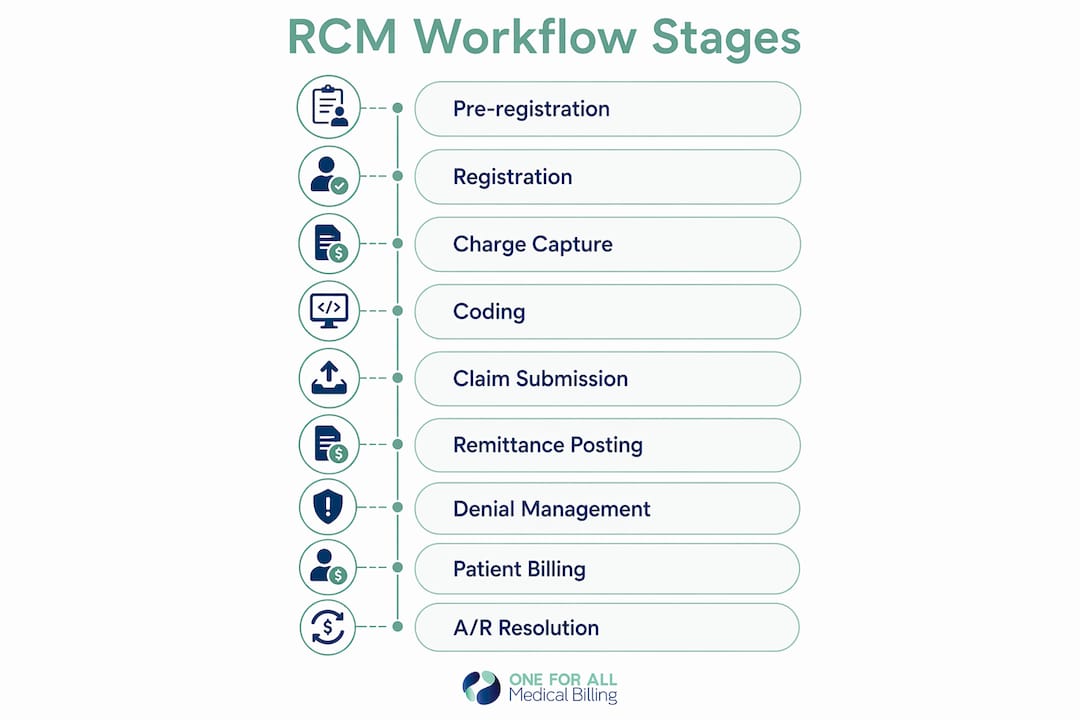
Step-by-step: what happens at each stage of the revenue cycle
A practical seven-step RCM model covers pre-registration, registration, charge capture, claim submission, remittance processing, insurance follow-up, and patient collections. The version below expands that to nine stages to reflect how high-performing U.S. practices actually operate.
1. Pre-registration and eligibility verification
Objective: Confirm patient demographics, insurance coverage, and authorization requirements before the visit. Owners: Patient access, scheduling staff. Tools: EHR scheduling module, clearinghouse eligibility API (270/271 transactions). Good looks like: Eligibility confirmed at scheduling and again 24–48 hours before the appointment; prior auth initiated at least 3–5 business days out. Common failure: Eligibility checked only at check-in, leaving no time to resolve coverage issues before the patient arrives.
2. Registration and financial clearance
Objective: Verify and update all patient data, collect financial responsibility information, and obtain assignment of benefits. Owners: Front-desk, patient access. Good looks like: Registration accuracy rate above 95%; financial counseling offered to self-pay and high-deductible patients. Common failure: Outdated insurance information carried forward from prior visits without re-verification.

Pro Tip: Use digital intake forms that auto-populate the EHR to eliminate transcription errors. Practices that shift from paper intake to digital intake reduce registration-error-driven denials measurably.
3. Charge capture and clinical documentation
Objective: Accurately record every service, procedure, and supply delivered during the encounter. Owners: Clinical staff, physicians, CDI specialists. Tools: EHR charge capture module, ambient AI scribes (increasingly used per AMA guidance), CDI software. Good looks like: Charge lag of 2 days or less; no unbilled encounters older than 48 hours. Common failure: Physicians document at a level sufficient for clinical care but insufficient for coding, generating coder queries that delay billing.
4. Coding and charge entry
Objective: Assign accurate ICD-10, CPT, and HCPCS codes that reflect the documented encounter. Owners: Coding team, revenue integrity. Good looks like: Coding productivity rate above 95% (less than 5% of the coding load stuck in queue at any time). Common failure: Upcoding or downcoding driven by template-based documentation rather than individualized clinical notes.
5. Claim scrubbing and submission
Objective: Identify and correct errors before claims reach the payer. Owners: Billing team, clearinghouse. Tools: Clearinghouse claim scrubber, AI-assisted editing tools. Good looks like: Clean claim rate of 90% or higher on first submission; rejections resolved and resubmitted within 24–48 hours. Common failure: Submitting claims without scrubbing, relying on payer rejections to surface errors.

Pro Tip: Set up automated scrubbing rules specific to your top five payers. Payer-specific edits catch issues that generic clearinghouse rules miss, particularly for Medicare Advantage and Medicaid managed care plans.
6. Remittance posting and reconciliation
Objective: Post payments, contractual adjustments, and denials accurately; reconcile against contracted fee schedules. Owners: Billing/payment posting team. Tools: ERA (835 transactions), EHR payment module. Good looks like: Payments posted within 24–48 hours of receipt; underpayments flagged for recovery. Common failure: Posting contractual adjustments as write-offs, permanently burying underpayments.
7. Payer follow-up and denial management
Objective: Work unpaid and denied claims to resolution. Owners: A/R follow-up team, denial management specialists. Good looks like: Denial rate below typical industry thresholds; first-pass acceptance rate at or above 95%. Common failure: Aging denials worked in FIFO order rather than by dollar value and appeal deadline, leaving high-value claims to expire.
8. Patient billing and collections
Objective: Collect the patient’s remaining balance after insurance adjudication. Owners: Patient financial services, front desk. Good looks like: Patient statements sent within 3–5 days of adjudication; payment plans offered proactively. Common failure: Statements sent once, with no follow-up cadence, leading to balance write-offs.
9. A/R resolution and process review
Objective: Close out accounts and identify systemic gaps driving recurring revenue leakage. Owners: Revenue integrity, finance leadership. Good looks like: A/R over 90 days should be kept low as a percentage of total A/R; monthly process review meetings with KPI dashboards. Common failure: Skipping the review step entirely, so the same denial patterns repeat quarter after quarter.
Where RCM workflows break down most often
Most revenue leakage is not random. It concentrates in a handful of predictable failure categories, and recognizing them is the first step toward fixing them.
Eligibility and registration errors are the upstream cause of a large share of claim denials. A patient whose insurance changed since their last visit, or whose name is entered with a typo, can generate a denial that takes weeks to resolve. These errors are almost entirely preventable with real-time eligibility checks and digital intake.
Incomplete documentation and missed charges are the silent revenue killers. When a physician’s note does not support the billed level of service, coders either downcode to stay compliant or query back, adding days to the billing cycle. AMA guidance specifically calls out physician engagement and CDI programs as prerequisites for reliable charge capture.
Prior authorization failures cascade quickly. A missed auth means the claim is denied on submission. The appeal process takes weeks. If the auth window has expired, the denial may be unrecoverable. A single high-cost procedure denied for missing prior auth can represent thousands of dollars in unrecoverable revenue.
Payer rules and coding mismatches generate technical denials that are easy to prevent but time-consuming to appeal. Payers update their coverage policies, bundling edits, and modifier requirements regularly. Billing teams that do not track payer bulletins find themselves chasing denials for rules that changed months ago.
Point-of-service undercollection is the most underestimated failure mode. Collecting patient balances after the visit is significantly harder than collecting at the point of service. Staff who are not trained or scripted to have financial conversations routinely defer collection, and those balances age quickly into bad debt.
A practical playbook for optimizing your revenue cycle
Fixing an RCM workflow is not a single project. It is a sequence of prioritized sprints, each building on the last. Here is how to structure that sequence.
Quick wins (Days 1–30)
- Deploy real-time eligibility at scheduling. Connect your EHR or scheduling platform to a clearinghouse eligibility API. Automate the 270/271 transaction so every appointment triggers a coverage check.
- Script and train POS collections. Give front-desk staff a two-sentence financial script and the authority to collect copayments and deductibles before the patient leaves. This is the fastest cash-flow lever available to most practices.
- Activate claim scrubbing rules for your top payers. If your clearinghouse supports payer-specific edits, turn them on. If not, build a manual pre-submission checklist for your highest-volume payers.
Medium-term projects (Days 31–60)
- Build a denial analytics dashboard. Categorize denials by root cause (eligibility, authorization, coding, timely filing) and track volume and dollar value by payer. This turns denial management from reactive firefighting into a data-driven process.
- Implement automated payment posting. ERA-based auto-posting eliminates manual payment entry errors and frees your posting team to focus on exceptions, underpayments, and complex remits.
- Launch a CDI review program. Start with your highest-volume DRGs or CPT families. CDI programs and physician engagement reduce coder queries, cut charge lag, and improve coding accuracy simultaneously.
Pro Tip: When launching CDI, start with a physician champion, not a mandate. One engaged physician who sees the connection between documentation quality and reimbursement will do more to shift culture than a policy memo.
Long-term investments (Days 61–90 and beyond)
- Integrate RCM automation solutions for eligibility, claim scrubbing, payment posting, and basic denial routing. Per CERTIFY Health, these high-volume, repeatable tasks are the right starting point for automation pilots. Humans should handle exceptions and appeals.
- Establish a revenue integrity governance committee. Pair predictive denial scoring and smart queues with a governance structure that reviews automation errors, updates payer rules, and owns process improvement. Leading RCM teams use this combination to catch automation drift before it becomes a denial surge.
- Conduct a revenue integrity audit. Review your top 20 payer contracts against actual reimbursements to surface systematic underpayments. Underpayment recovery is often the highest-ROI project a billing team can run.
For specialty practices managing complex billing, specialty-specific RCM guidance can help you map these plays to your payer mix and documentation requirements.
On staffing and role design: centralize denial management and A/R follow-up under a dedicated team rather than distributing it across front-desk staff. Distributed ownership means no one is accountable for aging buckets. Assign denial categories to specific staff members so patterns are visible and ownership is clear. For practices considering whether to keep RCM in-house or partner with a managed service, the decision often turns on whether you have the scale to justify dedicated denial analysts and automation infrastructure.
Key RCM metrics every finance team should track
Tracking the right metrics separates teams that react to cash flow problems from those that prevent them. Here are the core KPIs, with target ranges for U.S. providers.
Days in A/R
- Definition: Average number of days from service date to payment receipt
- Target: Below 35–40 days for most ambulatory and specialty practices
- Why it matters: Rising days in A/R is the earliest warning sign of upstream workflow failures
Denial rate
- Definition: Percentage of claims denied on first submission
- Target: Below 5–10% (benchmark rates are typically 5%–10% per PMC research)
- Why it matters: Each denial costs staff time to appeal and delays cash flow
Clean claim rate
- Definition: Percentage of claims accepted by the payer on first pass without correction
- Target: 90% or higher on first submission; this threshold reduces denial volume and accelerates payment cycles
- Why it matters: The industry benchmark is a 90%+ clean claim rate as a baseline; values below that trigger a review of the claim submission process
Net collection rate
- Definition: Actual collections divided by net collectible revenue (after contractual adjustments)
- Target: 95%–98% for well-run practices
- Why it matters: Values below 95% indicate revenue leakage from write-offs, underpayments, or uncollected patient balances
First-pass acceptance rate
- Definition: Claims accepted by the payer on the first submission attempt
- Target: 95% or above
- Why it matters: Directly tied to clean claim rate; tracks clearinghouse and payer-level acceptance separately
Charge lag
- Definition: Days between service delivery and charge entry
- Target: 2 days or less
- Why it matters: Charge lag delays the entire downstream workflow and can push claims past timely filing deadlines
Point-of-service collection rate
- Definition: Percentage of patient responsibility collected at the time of service
- Target: Varies by practice type; higher is always better; most practices have significant room to improve
- Why it matters: POS collection is the most reliable way to capture patient balances before they age
A/R aging distribution
- Definition: Percentage of total A/R in each aging bucket (0–30, 31–60, 61–90, 90+ days)
- Target: A/R over 90 days should stay below 15–20% of total A/R
- Why it matters: A growing 90+ bucket signals denial backlogs or follow-up gaps
For revenue cycle management analytics and dashboard design, structure your reporting in two tiers: an executive view showing days in A/R, net collection rate, and denial rate trends; and an operational view showing charge lag, aging buckets, denial categories by payer, and first-pass rates by coder or biller. Specialty and payer mix affect all of these targets, so benchmark against your own historical baseline first, then compare to published ranges.
A 30/60/90-day audit checklist for your team
This checklist gives you a time-boxed framework for finding and fixing the highest-impact gaps in your current workflow.
Days 1–30: Baseline assessment
- Pre-visit eligibility sample audit (Owner: Patient access manager) — Pull a random sample of 50 recent encounters and check whether eligibility was verified before the visit date. Success criterion: 90%+ of sampled encounters show pre-visit verification.
- Registration accuracy audit (Owner: Patient access manager) — Review the same 50 encounters for demographic and insurance data accuracy. Flag any that generated a denial attributable to registration errors.
- Charge capture reconciliation (Owner: Revenue integrity or billing supervisor) — Compare scheduled appointments to billed encounters for a two-week period. Any appointment without a corresponding charge is a missed revenue opportunity.
- POS collection compliance spot-check (Owner: Practice manager) — Review daily batch reports to confirm copayments and deductibles were collected at check-in. Interview two or three front-desk staff to understand whether they feel equipped to have financial conversations.
Days 31–60: Root-cause analysis
- Denial root-cause analysis (Owner: Billing supervisor) — Categorize all denials from the prior 60 days by root cause. Rank by dollar value and frequency. Identify the top three denial categories driving the most revenue impact.
- Coding accuracy review (Owner: Coding manager or external auditor) — Pull a sample of 25–30 charts across your top CPT codes and verify that documentation supports the billed level of service. Flag any patterns of undercoding or overcoding.
- Timely filing exposure check (Owner: A/R team lead) — Identify any claims approaching or past payer timely filing deadlines. Prioritize these for immediate submission or appeal.
- Staff interview: process drift (Owner: Revenue cycle director) — Ask billing and front-desk staff where they feel the workflow breaks down. Process drift, where staff develop workarounds that deviate from policy, is often invisible to leadership until a denial surge surfaces it.
Days 61–90: Remediation and measurement
- Implement top-priority fix (Owner: Revenue cycle director) — Based on the root-cause analysis, deploy the single highest-impact fix (e.g., real-time eligibility at scheduling, POS collection scripting, or payer-specific claim scrubbing rules).
- Re-audit the baseline metrics (Owner: Revenue integrity) — Re-run the Day 1–30 checks on a new sample to measure improvement. Compare denial rate, clean claim rate, and charge lag against the baseline.
- Document and socialize findings (Owner: Revenue cycle director) — Present findings and improvement metrics to clinical and administrative leadership. Governance and visibility are what sustain gains after the audit ends.
For a deeper medical practice revenue cycle management framework, including how to structure ongoing performance reviews, the audit findings from this checklist become the foundation for your quarterly improvement roadmap.
When does outsourcing RCM make sense?
Keeping RCM in-house works well when you have the staff, technology, and expertise to manage every stage consistently. When those conditions are not met, the cost of staying in-house is measured in denied claims, aging A/R, and staff burnout.
Decision signals that favor outsourcing:
- Chronic cash flow problems despite adequate patient volume
- Denial rate consistently high with no clear improvement trend
- Lack of scale to justify dedicated denial analysts or automation infrastructure
- Staffing shortages that leave A/R follow-up and denial management understaffed
- Specialty billing complexity (surgical, multi-site, behavioral health, urgent care) that exceeds in-house coding expertise
- No capacity to stay current with payer rule changes, CMS updates, and coding revisions
What a full-service RCM partner should deliver:
- End-to-end claims management: eligibility, charge capture support, coding, scrubbing, submission, and posting
- Denial prevention and appeals: proactive payer rule monitoring, root-cause analytics, and timely appeals
- Analytics and KPI dashboards: regular reporting on days in A/R, denial rate, clean claim rate, and net collection rate
- Revenue integrity: contract management, underpayment recovery, and compliance monitoring
- Specialty coding expertise: certified coders with experience in your specific service lines
- HIPAA-compliant data security: documented security controls, BAA in place, and audit trail for all PHI access
Vendor expectations checklist:
- Clean claim rate target stated in the contract (look for 90%+ as a baseline)
- Defined SLAs for claim submission turnaround, denial response time, and reporting cadence
- Transparent reporting: you should be able to see your own KPIs at any time, not just in monthly summaries
- Integration ownership: the vendor should manage EHR and clearinghouse integrations, not leave that to your IT team
- Contracting model clarity: understand whether you are paying a percentage of collections or a fee-for-service rate, and model both against your current revenue to compare true cost
Red flags in vendor proposals: vague SLAs, no stated clean claim rate target, reluctance to provide references from similar practice types, and contracts that make it difficult to exit if performance falls short.
Pro Tip: Before signing with any RCM partner, use a structured due diligence checklist to evaluate their technology stack, coding credentials, denial management process, and data security controls. A vendor who cannot answer those questions in detail is not ready to manage your revenue.
For practices weighing the build-vs.-buy decision, healthcare revenue cycle consulting can help you model the true cost of in-house RCM against a managed-service arrangement before you commit.
Specialty practices dealing with billing and privacy considerations, particularly behavioral health and rehab providers, should also review how insurance billing affects rehab privacy before selecting a vendor, since HIPAA-sensitive workflows require specific controls that not all RCM partners support equally.
Key Takeaways
An optimized RCM workflow requires closing gaps at every stage from pre-registration through final collections, with real-time eligibility, POS collections, and automated claim scrubbing delivering the fastest and most measurable revenue improvements.
| Point | Details |
|---|---|
| Start with eligibility and POS | Real-time eligibility at scheduling and point-of-service collections are the fastest cash-flow levers available to most practices. |
| Target a 90%+ clean claim rate | A clean claim rate of 90% or higher on first submission reduces denial volume and accelerates payment cycles. |
| Keep denial rate below 5–10% | Benchmark denial rates run 5%–10%; anything above that signals upstream workflow failures requiring root-cause analysis. |
| Run a 30/60/90 audit | A structured audit covering eligibility, registration accuracy, charge capture, and denial root causes surfaces the highest-impact fixes within 90 days. |
| One For All Medical Billing | One For All Medical Billing delivers end-to-end managed RCM with a 90% clean claim rate target, specialty coding expertise, and denial management for providers nationwide. |
What actually moves the needle in RCM
Most RCM improvement projects stall not because the tactics are wrong, but because the sequence is. Teams invest in technology before fixing the upstream process gaps that technology will simply automate at scale. The result is faster denials, not fewer.
What consistently produces reliable revenue improvement is a different order of operations. Fix eligibility and registration first, because every downstream problem is smaller when the front end is clean. Then address charge capture and documentation, because no amount of billing efficiency recovers revenue from services that were never captured. Only then does automation deliver its full value, because it is accelerating a process that already works rather than compounding one that does not.
The change management piece is where most organizations underinvest. Physicians and front-desk staff are not resistant to RCM improvement because they do not care about revenue. They are resistant because no one has explained the connection between their daily workflow and the practice’s financial health in terms that are concrete and relevant to them. A coder who understands that a missing secondary diagnosis costs the practice $300 per encounter behaves differently than one who is simply told to “improve documentation.” Governance, visibility, and regular feedback loops are what sustain gains after the initial sprint ends.
One For All Medical Billing: managed RCM that delivers measurable results
If your team is stretched thin, your denial rate is climbing, or your A/R is aging faster than you can work it, the problem is rarely effort. It is usually a workflow gap that compounds over time.

One For All Medical Billing provides full-service revenue cycle management for healthcare providers across Oklahoma and nationwide, with over 20 years of specialty billing expertise. The work is end-to-end: eligibility verification, charge capture support, ICD-10/CPT/HCPCS coding, claim scrubbing and submission, payment posting, denial management, and patient collections programs.
What that means in practice:
- 90% clean claim rate as a baseline performance target, not a marketing claim
- Denial management and appeals handled by specialists who track payer rule changes and file timely appeals
- Integrated payment posting using ERA-based auto-posting with exception handling
- KPI dashboards and reporting so you see your own performance data, not just a monthly summary
- Specialty coding expertise across medical, surgical, urgent care, behavioral health, and multi-site health systems
Ready to see where your current workflow is losing revenue? Review our due diligence checklist to evaluate any RCM partner, including us, or contact One For All Medical Billing to schedule a discovery call and get a no-obligation assessment of your current revenue cycle performance.
Useful sources and further reading
The recommendations in this article apply to U.S.-based healthcare providers operating under CMS guidelines, HIPAA transaction standards, and standard payer contracting practices.
- HFMA: Revenue Cycle Management Overview — The industry’s primary definition and scope reference for RCM functions and governance
- AMA: A Physician’s Guide to Effective Revenue Cycle Management — Practical guidance on physician engagement, CDI, and automation for clinical teams
- PMC: Revenue Cycle Management: The Art and the Science — Peer-reviewed framework covering RCM steps, KPIs, and best practices
- CERTIFY Health: 10 RCM Best Practices for Healthcare in 2026 — Phased roadmap and automation guidance for current RCM improvement projects
- One For All Medical Billing: Healthcare RCM Solutions — Overview of managed RCM services and how integrated tools improve cash flow
- One For All Medical Billing: RCM for Healthcare Providers — Comprehensive guide to RCM services and outcomes for U.S. providers
- One For All Medical Billing: Revenue Cycle Management Billing Guide — Detailed coverage of billing processes, claim types, and denial categories
This article provides general informational guidance on U.S. healthcare revenue cycle management. It is not legal, compliance, or financial advice. Confirm current CMS guidelines, payer rules, and HIPAA requirements with qualified professionals for your specific situation.
FAQ
What is the RCM cycle in U.S. healthcare?
The RCM cycle is the end-to-end process of tracking and collecting payment for healthcare services, starting at patient scheduling and ending with final payment or balance resolution. HFMA defines it as covering scheduling, insurance verification, charge capture, claim processing, denial management, and collections.
What are the core steps in the RCM process?
The core revenue cycle management steps are pre-registration, registration and financial clearance, charge capture, coding, claim scrubbing and submission, remittance posting, payer follow-up and denial management, patient billing, and A/R resolution. Most U.S. practices operate a seven-to-nine stage model depending on how they segment billing and follow-up functions.
What is a good clean claim rate for a U.S. provider?
A clean claim rate of 90% or higher is the typical industry target for first-pass acceptance. Values below 90% typically indicate upstream issues in registration, coding, or charge capture that need root-cause analysis.
How do you improve an RCM workflow quickly?
The fastest improvements come from three actions: running real-time eligibility checks at scheduling, collecting copayments and deductibles at the point of service, and activating automated claim scrubbing before submission. These three changes address the most common sources of denials and patient balance backlogs without requiring a long implementation cycle.
When should a practice outsource its RCM workflow?
Outsourcing makes sense when denial rates are consistently above 10%, A/R is aging without improvement, or the practice lacks the staff and coding expertise to manage specialty billing in-house. A full-service partner like One For All Medical Billing should deliver end-to-end claims management, denial prevention, analytics dashboards, and HIPAA-compliant data security under defined SLAs.
Recommended
- RCM For Healthcare Providers: Your 2026 Financial Guide – One For All Medical Billing
- Mastering Mental Health Revenue Cycle Management – One For All Medical Billing
- Revenue Cycle Management Analytics: A Guide For Practices – One For All Medical Billing
- Boost Profits: Medical Practice Revenue Cycle Management – One For All Medical Billing

