

table of contents
Medical billing compliance means your practice follows every applicable federal law, payer rule, coding standard, and documentation requirement when submitting claims. Get it right and you protect your revenue, your reputation, and your ability to participate in Medicare and Medicaid. Get it wrong and the consequences range from claim denials to federal prosecution. The core elements every practice must address include:
- Accurate use of ICD-10, CPT, and HCPCS codes that reflect documented services
- Complete, timely medical record documentation supporting each billed service
- Ethical claim submission free from upcoding, unbundling, or duplicate billing
- HIPAA compliance in billing to protect Protected Health Information throughout the revenue cycle
- Adherence to Medicare, Medicaid, and commercial payer guidelines
- Written billing compliance policies reviewed and updated regularly
- Prompt identification and return of any overpayments received
What federal laws govern medical billing compliance?
Several statutes form the legal backbone of healthcare billing regulations in the United States. Understanding each one is not optional for practice administrators.
- False Claims Act (FCA). The government’s primary enforcement tool against fraudulent billing. Violations carry treble damages plus per-claim fines. The government recovered over $6.8 billion in FCA settlements in FY 2025, with healthcare cases accounting for 84% of that total.
- Anti-Kickback Statute (AKS). Prohibits offering, paying, soliciting, or receiving anything of value to induce referrals for federally reimbursed services. Violations can trigger both criminal penalties and FCA liability.
- Stark Law. Restricts physician self-referrals for designated health services. The 2026 Stark Law updates include revised designated health services codes and tightened restrictions on per-click equipment leasing tied to referrals.
- HIPAA. Governs the use and disclosure of Protected Health Information throughout the billing process, including electronic claims transmission and patient data storage.
- No Surprises Act. Requires good-faith cost estimates for uninsured patients and limits surprise billing for out-of-network emergency services.
- 2026 Hospital OPPS updates. Effective January 1, 2026, CMS capped copayment amounts at a maximum of 40% of the APC payment rate, not to exceed the CY 2026 inpatient deductible of $1,736. Billing staff at outpatient facilities must update their systems accordingly.
Why non-compliance puts your practice at serious risk
The financial exposure from a compliance failure can be severe enough to threaten a practice’s viability. Treble damages under the FCA mean overpayments can multiply liabilities significantly before per-claim fines are added. Beyond dollars, the risks fall into three categories:
- Financial. Fines, payment recoupments, and repayment demands from Medicare Recovery Audit Contractors (RACs), which conduct both automated and complex post-payment claim reviews across all 50 states.
- Legal. Government enforcement actions, whistleblower lawsuits under the FCA’s qui tam provisions, and potential exclusion from federal health programs.
- Operational. Audit exposure, reputational damage with payers and patients, and the administrative burden of responding to investigations while trying to run a practice.
Practices that treat compliance as a low priority tend to discover its value only after a RAC audit letter arrives.
Common challenges in maintaining billing compliance
Even well-run practices struggle with compliance in medical billing because the rules change constantly and the margin for error is narrow.
- Upcoding and unbundling. These are among the most frequent compliance risks attracting government enforcement. Billing a higher-level E/M code than documentation supports, or billing component codes separately when a bundled code applies, are both audit triggers.
- Insufficient documentation. Coding must reflect what the medical record actually says. When documentation is vague or incomplete, even a correctly coded claim becomes indefensible under audit.
- Keeping pace with regulatory changes. Annual CPT, ICD-10, and HCPCS code updates, plus mid-year CMS transmittals, require ongoing attention from billing and clinical staff alike.
- Staff training gaps. Billing errors often trace back to staff who were trained once and never updated. Payer rules evolve; training must keep pace.
- Weak internal audit processes. Without regular self-audits, errors compound quietly until they attract external scrutiny.
Pro Tip: Start your compliance program by pulling your claim denial history. The patterns you find there will tell you exactly where your highest-risk coding and documentation gaps are, faster than any generic checklist.
Practical steps to build a sustainable compliance program
A compliance program does not need to be elaborate to be effective, especially for smaller practices. The OIG explicitly encourages a step-by-step approach scaled to your resources.
- Write your billing compliance policies. Document your coding standards, claim submission procedures, and documentation requirements. Written policies create accountability and give staff a clear reference point.
- Designate a compliance officer. Someone in your practice needs to own this function, monitor regulatory updates, and enforce standards. In a small practice, this can be a part-time role.
- Train staff regularly. Annual training at minimum; quarterly updates when major coding changes occur. Both billing and clinical staff need to understand how documentation drives coding.
- Conduct internal audits. Review claims against medical records at least once per year. The OIG recommends baseline auditing of claims submitted during the first three months after training, then periodic audits of five or more records per federal payer.
- Open reporting channels. Staff need a way to flag potential errors or misconduct without fear of retaliation. An anonymous reporting mechanism, even something as simple as a dedicated email address, fulfills this function.
- Return overpayments within 60 days. Once your practice identifies a Medicare or Medicaid overpayment, you have 60 days to report and return it. Missing that window converts an honest mistake into potential FCA liability.
- Use technology to reduce errors. Claim scrubbing software, coding validation tools, and eligibility verification systems catch errors before submission, which directly supports your revenue cycle management.
How the OIG’s seven compliance components apply in 2026
The OIG defines seven core components that form the foundation of any effective compliance program. Practices of all sizes can adapt these to fit their operations.
- Written policies and procedures covering coding, billing, documentation, and prohibited conduct.
- Designated compliance officer or contact responsible for day-to-day oversight.
- Training and education for all staff involved in billing and clinical documentation.
- Open lines of communication so employees can report concerns without fear.
- Internal auditing and monitoring to detect errors and measure improvement over time.
- Enforcement of disciplinary standards through clear, published guidelines applied consistently.
- Proactive corrective action when issues are identified, including self-disclosure to the government when appropriate.
The OIG is clear that there is no single template that fits every practice. A solo physician and a multi-site health system will implement these components differently, and that flexibility is intentional.
Common billing errors that lead to non-compliance
Most compliance failures trace back to a short list of recurring errors. Knowing them makes them preventable.
- Billing for services not rendered. Submitting a claim for a procedure that did not happen, whether intentional or a data entry error, is a direct FCA violation.
- Duplicate billing. Submitting the same claim twice, or billing both a global surgical package and its components separately, triggers automated payer edits and audit flags.
- Incorrect use of modifiers. Modifiers like -25 and -59 are among the most scrutinized. Misapplying them to bypass bundling edits is a well-documented enforcement target.
- Mismatched diagnosis and procedure codes. When the ICD-10 diagnosis code does not support the medical necessity of the billed CPT code, the claim fails on its face.
- Failure to verify eligibility. Billing a service that was not covered on the date of service, or billing the wrong payer, creates both a denial and a potential overpayment situation. Proactive eligibility verification before each visit prevents most of these errors.
- Inadequate documentation for the level of service billed. An E/M level 4 or 5 requires specific documentation elements. Billing that level without meeting the threshold is upcoding, regardless of intent.
How to correct billing errors and handle compliance investigations
Finding an error is not the problem. How you respond to it determines your legal exposure.

When your internal audit uncovers a billing error, act quickly. Correct the claim, update the underlying documentation if appropriate, and determine whether an overpayment was received. If Medicare or Medicaid funds were involved, the 60-day repayment rule applies from the date you identified the issue, not the date you calculated the exact amount.

For patterns of errors affecting multiple claims, a structured corrective action plan is the right response. Document what went wrong, what process change you are implementing, and how you will monitor for recurrence. This paper trail demonstrates good faith and is your best defense if the issue later attracts external scrutiny.
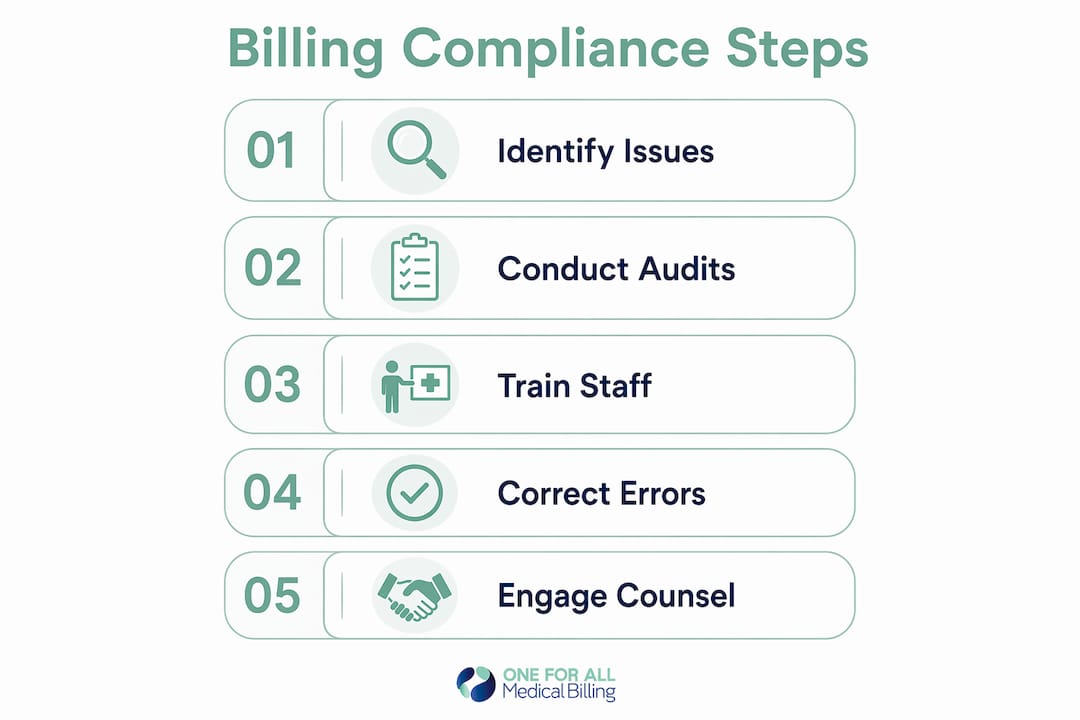
When a government investigation or RAC audit begins, do not respond without legal counsel. Engage a healthcare attorney immediately, preserve all relevant records, and cooperate fully with documentation requests. Practices that self-disclose through the OIG’s Provider Self-Disclosure Protocol typically receive more favorable resolution terms than those where the government discovers the issue independently. Staying audit-ready year-round means this scenario is far less disruptive when it does occur.
One For All Medical Billing supports your compliance from day one
Compliance failures are expensive. The administrative burden of managing coding updates, audit responses, and overpayment returns on top of patient care is exactly where practices lose ground. One For All Medical Billing brings over 20 years of revenue cycle expertise and a 90% clean claim rate to practices that need more than a generic billing service.
Their team handles specialty-specific coding, eligibility verification, denial management, and compliance consulting, so your claims go out clean and your exposure stays low. Whether you run a single-provider practice or a multi-site health system, their approach is built around your payer mix and your specialty, not a one-size template. If you are ready to reduce denials and keep your billing on the right side of every regulation, explore their billing services or review their full revenue cycle management guide to get started.
Key Takeaways
Effective medical billing compliance requires written policies, regular audits, staff training, and prompt overpayment repayment to protect your practice from financial and legal penalties.
| Point | Details |
|---|---|
| FCA enforcement is substantial | The government recovered over $6.8 billion in FCA settlements in FY 2025; healthcare accounted for 84%. |
| 60-day overpayment rule | Medicare and Medicaid overpayments must be reported and returned within 60 days of identification. |
| OIG seven components | Written policies, compliance officer, training, open communication, auditing, discipline, and corrective action form the compliance foundation. |
| 2026 OPPS copayment cap | CMS capped Hospital OPPS copayments at 40% of the APC payment rate, not to exceed $1,736. |
| One For All Medical Billing | Offers specialty-specific billing, denial management, and compliance consulting with a 90% clean claim rate. |
FAQ
What is medical billing compliance?
Medical billing compliance is the practice of submitting healthcare claims in accordance with federal laws, payer rules, coding standards, and documentation requirements to prevent fraud and secure accurate reimbursement.
What are the biggest risks of non-compliance in medical billing?
The primary risks include FCA treble damages and per-claim fines, exclusion from Medicare and Medicaid, RAC audit recoupments, and whistleblower lawsuits under the FCA’s qui tam provisions.
How often should a practice conduct internal billing audits?
The OIG recommends at least one audit per year following a baseline audit, reviewing five or more medical records per federal payer to measure compliance progress over time.
What happens if you miss the 60-day overpayment repayment deadline?
Failing to report and return a Medicare or Medicaid overpayment within 60 days of identification can convert the overpayment into a False Claims Act violation, with treble damages and per-claim penalties.
How can One For All Medical Billing help with compliance?
One For All Medical Billing provides specialty-specific coding, eligibility verification, denial management, and compliance consulting, supporting practices in maintaining accurate claims and reducing audit exposure.
Recommended
- Healthcare Payment Solutions A Complete 2026 Guide – One For All Medical Billing
- HIPAA Enforcement Rule: Prevent Penalties, Stay Compliant – One For All Medical Billing
- Confidentiality in Healthcare: A Practical Guide – One For All Medical Billing
- Medical Billing Payment Posting: Strategic Guide 2026 – One For All Medical Billing

