

table of contents
Picking a revenue cycle management partner that reduces denials, supports credentialing, and delivers clear reporting is still risky for healthcare administrators. Many RCM services mask exact pricing, limit public performance reviews, or require up-front staff time without custom specialty support. This guide compares six RCM agencies on claims accuracy, reporting access, service model, and specialty fit so healthcare administrators can shortlist a partner for their risk level and workflow needs.
Table of Contents
- One For All Medical Billing
- Ensemble Health Partners Revenue Cycle Management
- Receivable Solutions, LLC (RSi)
- Optum Revenue Cycle Management (RCM) solutions
- NCDS Medical Billing
- Physicians Revenue Group, Inc.
- Comparison of alternatives
One For All Medical Billing
At a Glance
The vendor advertises a 90% clean claim rate. One For All Medical Billing combines specialty billing rules with local Oklahoma support and national coverage. The service emphasizes hands-on credentialing and regular, transparent reporting reducing denials and speed collections.
Core Features
One For All Medical Billing delivers full-service RCM that covers claims submission, AR follow-up, and appeals, plus credentialing and compliance consulting. The team performs patient eligibility verification and medical coding for ICD-10, CPT, HCPCS, then uses reporting tools to highlight claim failures and revenue bottlenecks. Staff are U.S.-based and certified, and the service targets specialty-specific coding complexities.
Key Differentiator
The firm focuses on specialty-specific billing workflows rather than one-size-fits-all rules. That focus means coding edits and claim checks are tailored to each specialty, which reduces routine denials that arise from generic rules. Local Oklahoma support combined with national reach keeps small practices and larger systems on the same operational page.
Pros
The company reports over 20 years of industry experience and offers U.S.-based, HIPAA-compliant billing experts who handle coding, claims, credentialing, and AR follow-up. Transparent communication and custom reporting make it easier to track denials by payer and clinician, which helps prioritize appeals and staff work. National coverage with local Oklahoma support suits multi-site systems and solo practices that need specialty billing knowledge.
Cons
- Depends on active cooperation from the practice for accurate documentation and eligibility checks; practices that do not commit staff time may see delayed results.
Who It’s For
Healthcare administrators and billing managers who need specialty-focused coding and hands-on credentialing will benefit most. The service fits solo providers, specialty clinics, and multi-site health systems that can commit staff to onboarding and documentation. Practices based in Oklahoma or operating nationwide that want U.S.-based billing support should consider this option.
Unique Value Proposition
Specialty-focused coding and credentialing for nearly every medical specialty turns payer rules into claim-level edits and tailored reporting. That approach reduces rework on denied claims and directs appeals where they recover revenue fastest. For teams willing to maintain documentation, the workflow converts specialty expertise into clearer first-pass acceptance and steadier cash flow.
Real World Use Case
According to the company, a multi-specialty practice in Oklahoma saw denials fall from 15% to below 5% after switching to One For All Medical Billing. That reported reduction improved cash flow and freed administrative staff to handle patient-facing tasks rather than reworking claims. The example shows how focused specialty coding and credentialing can affect monthly collections.
Pricing
Pricing is typically a percentage of collections or a flat monthly fee. The vendor advertises transparent fees with no hidden costs, but exact rates depend on specialty, volume, and required services and must be discussed during outreach.
Website: https://oneforallmed.com
Ensemble Health Partners Revenue Cycle Management
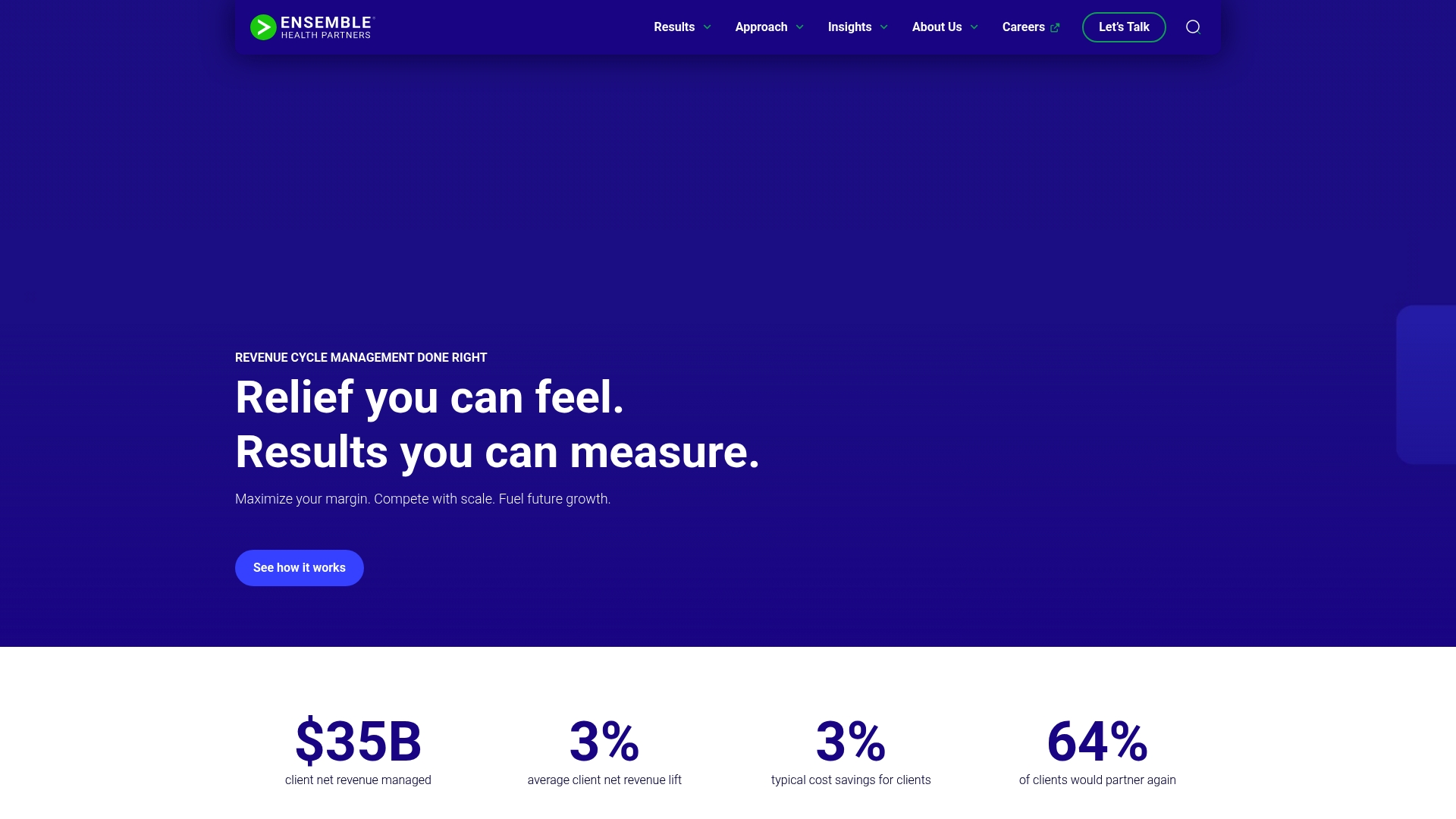
At a Glance
Ensemble’s marketing materials state it is ranked #1 in the industry. The firm combines software-driven workflows with staffed teams to cover the full revenue cycle from patient engagement to payer strategy. The company markets AI orchestration alongside certified operators to speed claims processing and denial resolution.
Core Features
Ensemble delivers end to end revenue cycle management capabilities that include claims processing, denial management, patient financial counseling, and payer advocacy. The platform layer uses AI orchestration for rules-driven claims routing and automated denial triage, while staff handle appeals and complex payer negotiations. The offering also focuses on EHR optimization for systems such as Epic to reduce manual work and cut billing friction.
Key Differentiator
The most distinctive element is the combined use of automated workflows and staffed operators. Ensemble pairs algorithmic decisioning with human review to escalate complex denials and manage payer strategy. That model aims to reduce vendor handoffs by keeping technology and people under one program.
Pros
Ensemble reports a top industry ranking, which speaks to the vendor positioning and market recognition for revenue cycle performance. Clients benefit from a single engagement that covers registration through reimbursement, removing the need to coordinate multiple vendors. The vendor advertises strong client loyalty and retention, and it emphasizes a people-first workplace that supports sustained operational performance. Ensemble also highlights its use of AI to reduce repetitive tasks and to free staff for higher value work.
Cons
- No independent third-party reviews are publicly available, which makes impartial evaluation harder.
- The company publishes limited technical detail about proprietary software and integration methods.
- Heavy reliance on AI and platform upgrades may require ongoing investment from client IT and operations.
When It May Not Fit
This model fits organizations large enough to justify a full outsourcing engagement. Small practices and single-clinic operations will likely find the scale and commercial terms misaligned with their budgets. Buyers seeking detailed public case studies or a transparent tech stack may be disappointed by the limited disclosure. Organizations without an internal change management capability should plan for dedicated oversight during onboarding.
Who It’s For
Health systems, large hospitals, and sizable physician groups that need a consolidated revenue cycle partner will find this approach relevant. If your priority is reducing vendor count and centralizing payer strategy, this model aligns with that goal. Teams looking for a white glove operational partner plus automated rules will get the most from Ensemble.
Real World Use Case
Roper St. Francis Healthcare engaged Ensemble after a cyberattack to restore claims processing and stabilize collections. Ensemble coordinated staffed operators and automated workflows to recover claim throughput and reduce backlog. That engagement illustrates the company ability to manage crisis recovery while maintaining payer communications.
Pricing
Pricing is not specified publicly. Ensemble uses customized, tiered pricing based on client size and scope, with costs determined by service mix and the extent of technology integration. Prospective clients should request a scoped proposal and a sample statement of work to compare commercial models.
Website: https://ensemblehp.com
Receivable Solutions, LLC (RSi)
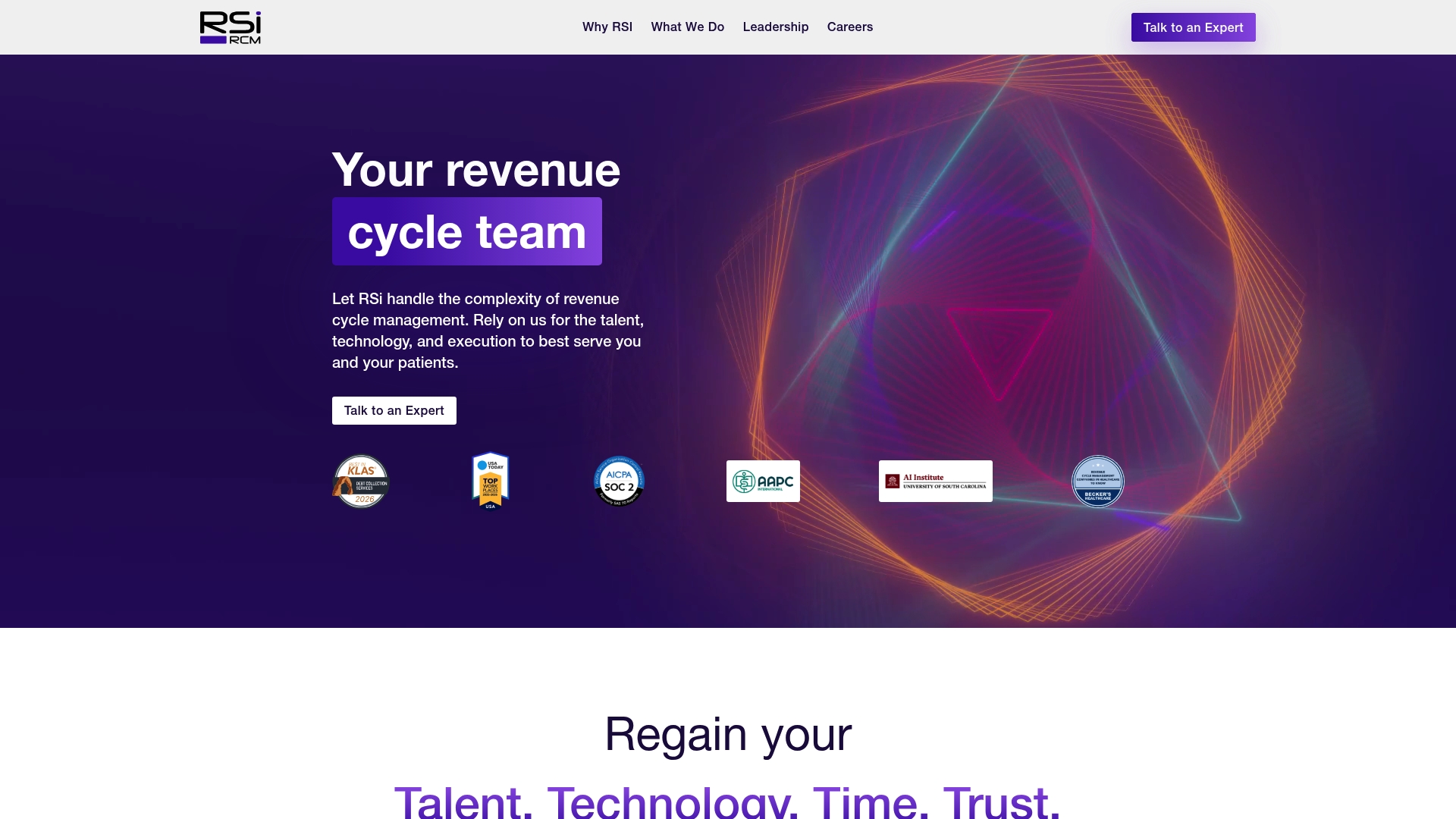
At a Glance
Receivable Solutions, LLC reports 97%+ client retention as a vendor-stated measure tied to long client relationships. The firm positions itself as an operational partner for healthcare systems and hospitals. RSi emphasizes measurable financial performance through staffed teams, workflows, and technology-enabled processes.
Core Features
RSi delivers full cycle revenue cycle services that focus on coding, billing, denials management, and patient outreach. The company embeds staff into client operations and applies automation and AI-driven workflow enhancements to support back-end work. Continuous improvement is driven by connected processes and regular feedback loops.
Key Differentiator
RSi operates as a fully integrated, embedded extension of a client’s team rather than a stand-alone vendor. That model places experienced operators inside hospital workflows so the provider keeps operational control while offloading daily cycle work. The approach aims to reduce handoffs and tighten accountability across claims and collections.
Pros
The vendor advertises high client retention and multiple industry honors, including Best in KLAS and Top Workplaces, which signal broad market recognition. The service model groups operations, technology, and process improvement under one team, reducing coordination burdens for in-house leaders. The company also states compliance with HIPAA, SOC 1 and SOC 2, which speaks to its control environment and audit posture.
Cons
- No substantive independent reviews are publicly available, which limits outside validation of client experience.
- Public materials do not list explicit scenario limits, making fit harder to assess for niche specialties.
- Limited publicly available user feedback makes independent assessment of operational strengths and weaknesses challenging.
When It May Not Fit
Organizations that require third-party published reviews for procurement may find the public record thin. Health systems seeking off-the-shelf software rather than an embedded services team will likely prefer a different vendor. Small clinics that need simple, transaction-focused billing may find RSi’s integrated model proportionally large.
Who It’s For
RSi fits healthcare providers and hospital systems that need a partner to manage complex back-end revenue functions. The service suits organizations that want embedded staff to operate inside existing workflows and accept a vendor-managed operational model. Systems under pressure to improve coding accuracy and denials recovery will find the approach relevant.
Real World Use Case
According to the company, a large hospital system reported a 20% reduction in days in accounts receivable and an 11% increase in collection rates after partnering with RSi. That case illustrates how embedded teams and focused denial workflows can change cash flow and compliance outcomes when applied across a large facility network.
Pricing
Not applicable. RSi lists pricing as informational only and does not publish standard tiers or public rates. Prospective clients must contact the company for custom engagement models and pricing details.
Website: https://rsircm.com
Optum Revenue Cycle Management (RCM) solutions
At a Glance
Optum reports industry awards and extensive accreditation for its revenue cycle work. The vendor positions its offering around faster decisions, fewer denials, and improved patient payment experiences. The suite pairs analytics with advisory services to support large health systems and payers. That positioning targets organizations that need broad operational reach and deep payer insight.
Core Features
The platform delivers end to end automation across patient access, claims, revenue integrity, and payments while exposing real time payer transparency for eligibility and claim status. It combines AI driven decision tools with data and analytics to prioritize A R follow up and guide clinical authorization work. Advisory and consulting services sit alongside modular implementations to support value based care transitions.
Key Differentiator
What sets Optum apart is the scale of its combined advisory practice and analytics capability. That recognition and accreditation come with large program delivery experience across hospitals and payers. The pairing of consultative teams and automated decision tools fits organizations that need both strategic redesign and day to day operational execution.
Pros
The offering covers a broad set of revenue cycle functions, so you can consolidate patient access, claims management, and payment posting under one vendor. Analytics and AI driven tools surface payer rules and denial drivers, which helps staff prioritize work and reduce rework. Expert advisory support helps health systems design governance, staffing, and performance metrics while the modular approach allows phased rollouts across multiple sites.
Cons
Customer feedback reports slow or impersonal support. Several users say reaching a live representative can take extra time.
Support responsiveness appears uneven. Some clients report delays that extend issue resolution timelines.
Implementation at large scale can be complex. Complexity raises the need for strong internal program management and vendor coordination.
When It May Not Fit
If your organization needs immediate, local hands on support or a dedicated small account team, Optum may not fit. Smaller practices that expect white glove, rapid response for minor billing questions will likely find the support cadence too formal. Sites that lack program management capacity should plan for additional internal resources during onboarding.
Who It’s For
Large hospitals, multi hospital systems, and payers looking for enterprise grade revenue cycle automation and analytics will find the fit strongest. Organizations moving toward value based care that need integrated revenue integrity and authorization workflows also match the product profile. Smaller independent practices seeking lightweight billing services are not the intended audience.
Real World Use Case
A regional hospital network implemented Optum RCM solutions to simplify billing and claims processing across multiple facilities. The network reported faster reimbursement cycles and fewer claim denials after consolidated claims workflows and payer rule analytics were in place. That change allowed the network to reallocate staff time from denial appeals to patient facing tasks.
Pricing
Pricing is not publicly listed. Optum offers tailored quotes and custom pricing based on organizational size, scope, and module selection. Expect contract negotiations to reflect implementation scale and advisory engagement level.
Website: https://business.optum.com/en/operations-technology/revenue-cycle-management.html
NCDS Medical Billing
At a Glance
NCDS Medical Billing reports a 92.1% claim accuracy rate and reports average claim turnaround under 30 days. The vendor positions services for small practices through multi-site health systems and highlights 24/7 secure access to practice reports. That mix targets practices that need close compliance oversight alongside routine claim handling.
Core Features
NCDS covers the full revenue cycle from patient intake through final collection, and it combines certified coding with claims clearinghouse submission. The agency provides telemedicine billing, credentialing, eligibility verification, MIPS support, EMR integration, and consulting to address operational gaps. Secure online access and around-the-clock report availability support remote administrators.
Key Differentiator
According to the company, NCDS was HBMA recertified in 2026, which the vendor uses to signal an ongoing compliance program. That recertification sets a higher bar for practices that face complex payer rules and regulatory oversight. For buyers focused on compliance documentation, this is the single most distinguishing credential.
Pros
NCDS pairs targeted services with accessible reporting and dedicated support staff available 24/7, which helps practices that need constant visibility into aging accounts and denials. The agency advertises tailored billing and certified coding, and that accuracy figure and the turnaround claim suggest a focus on faster reimbursements and fewer resubmissions. Secure platform access and credentialing support reduce administrative work for multi-location operations.
Cons
No independent third-party reviews are publicly available to validate user experience or long-term performance.
The marketing materials note high accuracy and quick turnaround, but there is limited public detail about platform scalability for very large health systems.
Publicly reported user feedback is sparse, so specific strengths and pain points seen by clients are not well documented.
Who It’s For
Mid to large healthcare practices that need a full-service billing partner and formal compliance credentials will find NCDS relevant. Clinics offering telemedicine and therapy services will benefit from the agency’s telehealth billing and certified coding focus. Practices that require round-the-clock access to reporting and outsourced credentialing are an especially good match.
Real World Use Case
A multi-location physical therapy chain uses NCDS for claims submission, credentialing, and coding oversight. The practice sees fewer administrative callbacks and a cleaner appeals pipeline when prior authorization issues arise. That operational lift frees clinical staff to focus on patient care while billing staff handle denials and payer follow up.
Pricing
NCDS does not publish pricing. The product entry lists pricing as not applicable and informational only. Prospective buyers should contact NCDS directly for a custom proposal tailored to practice size and service needs.
Website: https://ncdsinc.com
Physicians Revenue Group, Inc.
At a Glance
Physicians Revenue Group, Inc. reports a 99% first-pass resolution rate for claims. According to the company, it has served healthcare providers for more than two decades with billing, credentialing, MACRA/MIPS reporting, and practice management. That combination positions PRG as a long-running agency focused on claims accuracy and practice-level attention.
Core Features
PRG delivers customized medical billing solutions that adapt to specialty workflows and payer rules, and it offers medical billing audits to improve claim acceptance. The agency handles provider credentialing and enrollment, provides MACRA/MIPS reporting support, and adds chronic care management assistance that can affect revenue streams. These services are bundled around a practice management approach rather than a single software product.
Key Differentiator
PRG pairs long industry tenure with practice-specific workflows and hands-on account management. That experience claim underpins a focus on reducing denials through tailored coding reviews and payer follow-up. The agency emphasizes personalized attention to smaller practices and multi-site groups that want dedicated billing oversight.
Pros
The vendor states it is trusted by thousands of clinicians and practices nationwide, which suggests broad market reach. PRG emphasizes a practice-tailored model and offers a broad service portfolio that covers billing, credentialing, revenue cycle management, and digital marketing. The firm highlights practice audits and chronic care management support as ways to recover revenue and tighten A/R follow-up.
Cons
- No independent user reviews are available on major review platforms, limiting third-party perceptual evidence.
- Public pricing is not published; pricing information is listed as not applicable, so you must contact the agency for a quote.
- Integration details with specific EHRs and practice management systems are not documented, which could complicate onboarding for some sites.
When It May Not Fit
If you need published, transparent pricing for rapid procurement, this agency may not match your buying process. Large health systems seeking verified scalability metrics and EHR integration certifications may find the documentation sparse. Practices that require a self-service software contract rather than agency-managed services will want a different model.
Who It’s For
This offering fits practice administrators, solo physicians, and small to mid-size specialty groups that want outsourced billing and credentialing support. You should consider PRG if you prefer an agency-managed relationship and personalized account handling. Large enterprise buyers who require extensive integration documentation may look elsewhere.
Real World Use Case
The company describes a multi-specialty medical practice in Illinois that outsourced billing to PRG and reduced claim rejections while improving collections. PRG handled credentialing and targeted payer follow-up to resolve aged A/R. That example illustrates how the agency applies audits and payer appeals to recover revenue.
Pricing
PRG does not publish standard pricing and lists pricing as not applicable, so rates are available by inquiry only. Expect quotes to vary by practice size, specialty, and service scope. Contact PRG for a custom proposal and fee structure.
Website: https://prgmd.com
Comparison of alternatives
When comparing top revenue cycle management services, each provider delivers distinct benefits, with One For All Medical Billing excelling in specialty-focused solutions.
Tailored solutions for distinct needs
One For All Medical Billing distinguishes itself with its expertise in specialty-specific medical coding and credentialing, making it suited for operations requiring individualized billing practices. On the other hand, Optum RCM Solutions offers a infrastructure for large-scale analytics integration, providing multi-hospital systems valuable operational insights. Organizations focused on embedded staffing might find Receivable Solutions (RSi) highly beneficial, as its model includes on-site team integration for smooth transitions.
Balancing automation and personal support
Optum brings AI-driven decision tools to minimize administrative overhead in larger systems, making it ideal for expansive health systems aiming for efficiency through technology. Ensemble Health Partners complements this with a mix of automated workflows and human review, supporting operational processes in complex facilities. However, for organizations requiring localized expertise and hands-on guidance, One For All Medical Billing prioritizes transparent reporting and collaborative onboarding tailored to specialty requirements.
Best fit
- Specialty clinics and providers seeking expert coding and credentialing with bespoke reporting should choose One For All Medical Billing.
- Large hospital systems desiring advanced analytics and advisory support might find Optum RCM Solutions superior.
- Healthcare networks requiring embedded staff should evaluate Receivable Solutions (RSi) for its integration-focused model.
Our pick
One For All Medical Billing stands out for its specialty-focused coding protocols and curated reporting mechanisms, minimizing claim denials and enhancing revenue clarity for providers specializing in unique medical fields. For organizations prioritizing automation and system-level analytics, Optum RCM Solutions or Ensemble may be more aligned to their scale and strategy.
For organizations prioritizing specialty-focused workflows and credentialing support, the table below compares leading revenue cycle management services.
| Service Name | Core Feature | Key Differentiator | Best For | Pricing | Limitation |
|---|---|---|---|---|---|
| Oneforallmed | Full-service RCM and credentialing | Specialty-specific billing workflows | Solo providers and specialty clinics | Price not published | Requires active cooperation from practice for documentation |
| Ensemble Health Partners | End-to-end revenue cycle management | AI with staffed operator integration | Large hospitals and health systems | Price not published | Limited transparency on proprietary software and integration methods |
| Receivable Solutions, LLC | Embedded full-cycle RCM services | Staff integrated into client workflows | Hospital systems | Price not published | Sparse independent reviews for validation |
| Optum Revenue Cycle Management | Automation and analytics across RCM | Combined advisory and decision tools | Large hospitals and healthcare payers | Price not published | Reported delays in customer support responsiveness |
| NCDS Medical Billing | Certified coding and telemedicine billing | HBMA compliance credential | Mid to large practices and multi-site systems | Price not published | Limited documentation on scalability for large health systems |
| Physicians Revenue Group, Inc. | Customized billing solutions and audits | Tailored practice-specific workflows | Specialty groups and solo practices | Price not published | Sparse independent reviews and limited integration details |
How Can Healthcare Administrators Improve Specialty-Focused Billing Accuracy and Payment Speed?
Revenue cycle management challenges often stem from generic billing services that overlook specialty-specific rules. Oneforallmed addresses this key pain point by offering tailored billing workflows that enhance claim accuracy and reduce denials. With over 20 years of experience and a 90% clean claim rate, Oneforallmed combines local Oklahoma support with national reach to help practices and multi-site health systems stabilize cash flow and ease administrative burden.
Benefits include:
- Specialty-specific coding and credentialing
- Transparent, custom reporting to track payer denials
- Full-service RCM covering claims, credentialing, and appeals
Explore how Oneforallmed can support your billing needs and start improving your revenue efficiency today.
Learn more about their specialty billing expertise and see how focused workflows reduce rework and speed reimbursements.
FAQ
What is Oneforallmed’s claim acceptance rate?
Oneforallmed boasts a 90% clean claim rate. This high rate reflects its ability to effectively manage coding and claim submissions, reducing denials and improving revenue for practices. Consider integrating Oneforallmed’s services to benefit from this efficiency in revenue cycle management.
How does Oneforallmed compare to Ensemble Health Partners in RCM services?
Ensemble Health Partners provides strong end-to-end revenue cycle management services, focusing on integrating software-driven workflows with staff support. In contrast, Oneforallmed offers specialty-specific billing workflows tailored to individual specialties, making it ideal for practices needing personalized attention. Choose Oneforallmed for specialized billing expertise while relying on Ensemble for broad system coverage.
Which platform provides better support for Oregon-based healthcare providers?
Oneforallmed’s local Oklahoma support extends nationally, while Ensemble Health Partners primarily serves larger organizations. For smaller or specialty-focused practices in Oregon, Oneforallmed’s hands-on credentialing and support may fit better. Opt for Oneforallmed if you require specialized attention and local support.
What features make Oneforallmed suitable for small practices?
Oneforallmed’s strengths include hands-on credentialing and a 90% clean claim rate. Its tailored approach to specialty-specific coding directly addresses the challenges faced by small practices. Utilize Oneforallmed to enhance your billing processes and minimize denials effectively.
How does Oneforallmed handle documentation and eligibility checks?
Oneforallmed relies on active cooperation from practices for accurate documentation and eligibility checks. This collaborative approach ensures timely claims and minimal delays. Be ready to dedicate staff time for documentation to achieve better outcomes with Oneforallmed’s services.
Recommended
- Revenue Cycle Management Specialist: Hire & Thrive in 2026 – One For All Medical Billing
- Define Revenue Cycle: What Is the Revenue Cycle? Your 2026 – One For All Medical Billing
- RCM For Healthcare Providers: Your 2026 Financial Guide – One For All Medical Billing
- Boost Revenue: Expert Revenue Cycle Management Services – One For All Medical Billing

