
table of contents
Claim scrubbing is the process of checking medical claims for errors before submission to prevent denials, and it matters more than ever because 68% of healthcare providers say submitting clean claims is harder than it was a year ago while 60% of medical group leaders report rising denial rates. If you're managing a practice and watching claims come back for issues that could have been caught earlier, claim scrubbing is the checkpoint that helps stop revenue from getting stuck.
You've probably seen the pattern. A visit is documented, coding looks fine at first glance, the claim goes out, and then payment stalls because of a mismatched diagnosis, a missing modifier, or a payer rule nobody noticed. Your staff then has to reopen the account, correct the claim, resubmit it, and explain delays to leadership or providers.
That's why understanding what is claim scrubbing matters at an operational level, not just a technical one. It's less like a back-office clerical task and more like quality control for your revenue cycle. A good scrubber works like spell-check for claims, but with much higher stakes. It reviews the claim before it leaves your system and flags problems that would otherwise turn into rework, denials, and slower cash flow.
Your Guide To Understanding Claim Scrubbing
Claim scrubbing is a review process that checks a medical claim for accuracy, completeness, coding validity, and payer-specific issues before the claim is sent to the insurer. The purpose is simple. Catch problems while they're still easy to fix.
If you want the plainest version, think of it as a final preflight check. The visit already happened. The documentation is in. Codes have been assigned. Before the claim takes off, the scrubber asks: Is the patient information complete? Do the diagnosis and procedure codes make sense together? Are required modifiers present? Does this payer have a rule that changes how the claim should be billed?
Why Practices Depend On It
A denial isn't just a rejected transaction. It creates extra touches across the office.
- Front desk teams may need to verify demographics again.
- Billers have to trace the edit, correct the claim, and resubmit it.
- Coders may need to recheck documentation support.
- Managers end up watching aging reports get worse while cash slows down.
That's why scrubbing sits so close to the idea of a clean claim. If you need a practical refresher on that concept, this explanation of clean claims in medical billing is useful because it connects the term to what payers accept on first pass.
What A Scrubber Actually Reviews
Claim scrubbing relies on a rules engine that reviews claims against coding standards such as ICD-10, CPT, and HCPCS, along with payer-specific policies and compliance requirements, and flags problems like missing fields, incorrect diagnosis codes, or mismatched procedures before submission, as explained in this overview of how claim scrubbers work.
Practical rule: The cheapest denial to fix is the one your team never submits.
The important point is that scrubbing is proactive. It doesn't chase denials after the payer has already rejected the claim. It tries to prevent the denial from happening in the first place. For a busy practice manager, that difference shows up in fewer interruptions, cleaner workflows, and less staff time spent revisiting old work.
How Claim Scrubbing Prevents Denials Before They Happen
Claim scrubbing works best when you think of it as a quality checkpoint, not a billing add-on. On an assembly line, quality control happens before the product ships. In revenue cycle management, the claim scrubber plays that role by catching defects before the claim reaches the payer.
Industry pressure makes this even more important. 68% of healthcare providers report that submitting clean claims is more challenging than it was a year ago, and 60% of medical group leaders say their practices have seen higher denial rates, according to Experian's review of claim scrubber software.
Proactive Scrubbing Versus Reactive Denial Work
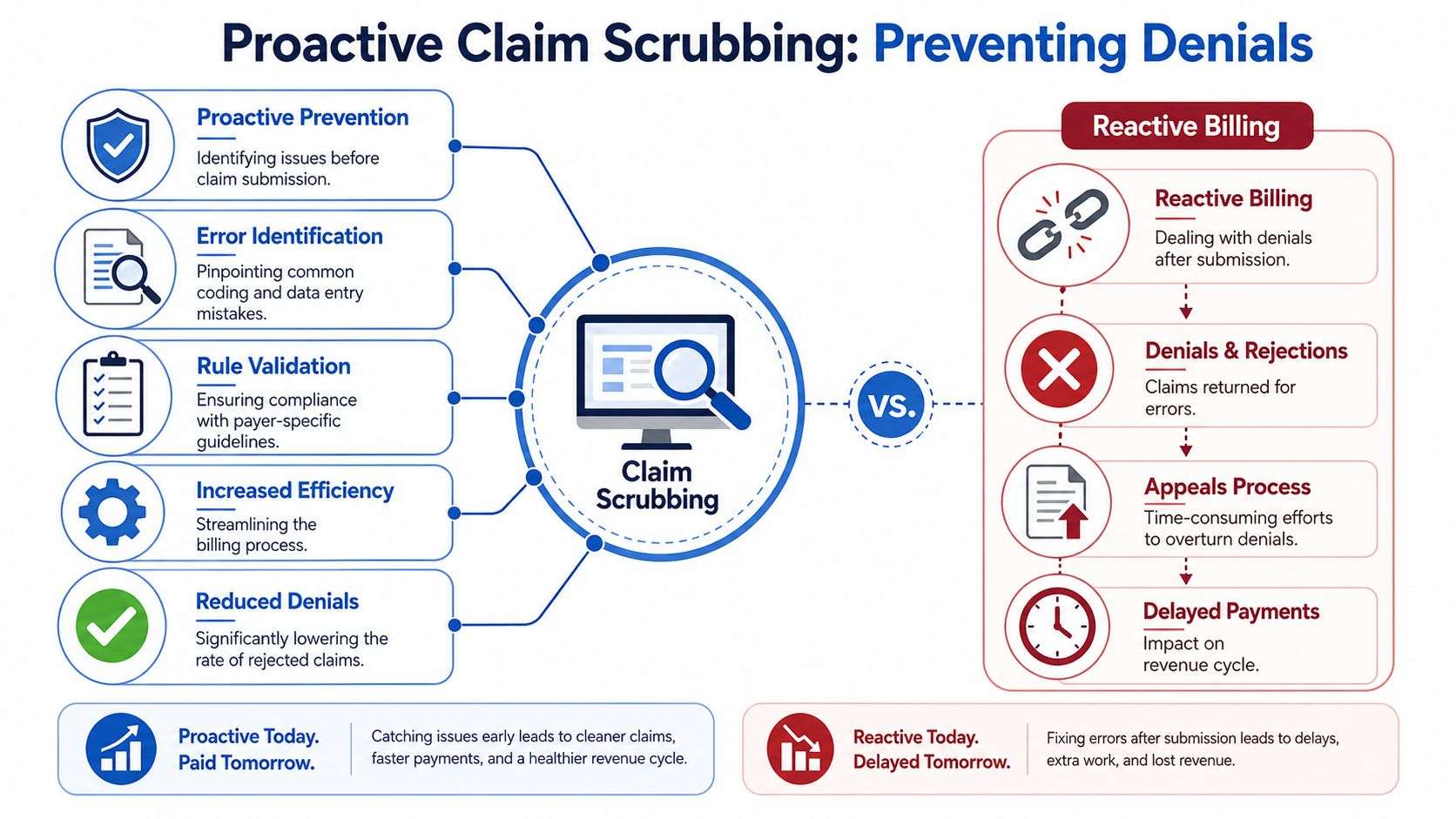
Reactive billing is expensive in time and attention. Once a claim is denied, the team has to identify the reason, locate the account, confirm documentation, correct the error, and resubmit or appeal. That process ties up staff who could be working current claims.
A proactive scrubber changes the sequence:
- It checks the claim before submission
- It flags likely denial triggers
- Staff fix the issue while the encounter is still fresh
- The payer receives a cleaner first-pass claim
That sequence matters because prevention is faster than recovery.
Denial management starts after money is delayed. Claim scrubbing starts before the delay exists.
If your organization is trying to spot patterns in denials, edits, and payer behavior across sites or specialties, a centralized data layer can help. Teams often pair scrubbing workflows with tools like Cloudvara for healthcare data insights to understand where denial trends are coming from and which payer edits are repeating.
Software Does The Bulk Work, People Solve The Exceptions
Automated scrubbers are strong at speed and consistency. They can review large claim volumes without fatigue and apply the same logic every time. That's ideal for common edits such as missing subscriber information, invalid code combinations, or absent modifiers.
Human reviewers are better at nuance. They can look at a payer edit that seems technically incorrect, compare it with the documentation, and decide whether the claim needs revision or whether the payer logic needs a different response. The strongest process combines both.
If your team is also cleaning up claims after they've already failed, this guide to medical billing denial management helps separate pre-submission prevention from post-submission recovery. They're related, but they aren't the same job.
Automated Scrubbing Versus Manual Expert Review
For years, claim scrubbing was mostly manual. Billers and coders reviewed claims line by line, relying on checklists, payer updates, and experience. That worked, but it was slow and easy to overload. As Raintree's explanation of claim scrubbing notes, traditional scrubbing was laborious, while modern software now automates review for coding errors, missing information, and payer-specific requirements before submission, which improves accuracy and compliance.
What Automated Scrubbing Does Well
Automation shines when volume is high and the checks are repeatable.
A few everyday examples:
- Insurance changes missed at check-in. A patient's plan changed this month, but the old payer remains on file. The scrubber catches missing or inconsistent insurance data before the claim leaves the system.
- A procedure code is entered correctly, but the modifier is missing. Software flags the omission right away.
- A claim has incomplete required fields. The scrubber stops it before it can fail at the clearinghouse or payer level.
Automation is also helpful because payer rules change often. Software can apply updated logic consistently across every claim in the queue.
Where Manual Review Still Matters
Now consider a more difficult scenario. A pain management practice bills a service that is properly documented, the CPT code is valid, and the diagnosis code is also valid. But this payer expects a very specific diagnosis-to-procedure pairing for that specialty. A generic rule set may not recognize the mismatch, or it may flag the wrong issue.
That's where expert review matters. A seasoned biller or coder can look at the actual clinical context, compare it to the payer's behavior, and decide what to change. Software can identify patterns. Experts decide how to resolve the edge cases.
A scrubber can tell you that something failed. An expert can tell you why it failed and how to stop it from happening again.
Many groups are now building a human-in-the-loop workflow, where software handles routine edits and specialists intervene only when the logic gets ambiguous. This broader look at AI in revenue cycle management is useful if you're evaluating how automation should support your billing team rather than replace it.
The Best Fit For Busy Practices
A busy practice manager usually doesn't need to choose one or the other. The practical model is:
- Use software for first-pass validation
- Escalate exceptions to skilled staff
- Feed recurring denial reasons back into the rules
That last part is important. If your team keeps seeing the same payer-specific denial, the answer usually isn't “work harder.” It's “adjust the rule before the next batch goes out.”
The Top Errors A Claim Scrubber Must Catch
Monday morning starts with a full schedule, claims go out on time, and two days later the rejections begin. The frustrating part is that many of those claims look correct at first glance. The diagnosis code is active. The procedure code is active. The patient was seen. Yet the payer still kicks the claim back because one detail failed the rule set.
That is why a claim scrubber has to do more than spot obvious typos. It needs to catch the mistakes that block payment, slow follow-up, and create repeat work for your staff. In complex specialties, that also means checking rules that are specific to the payer and the service line, not just general coding logic.
A good scrubber reviews coding relationships and billing conflicts such as upcoding, undercoding, bundling errors, incorrect modifier use, and National Correct Coding Initiative edit violations, as explained in CareCloud's overview of the scrubber's role in revenue cycle management.
The Errors That Cause The Most Trouble
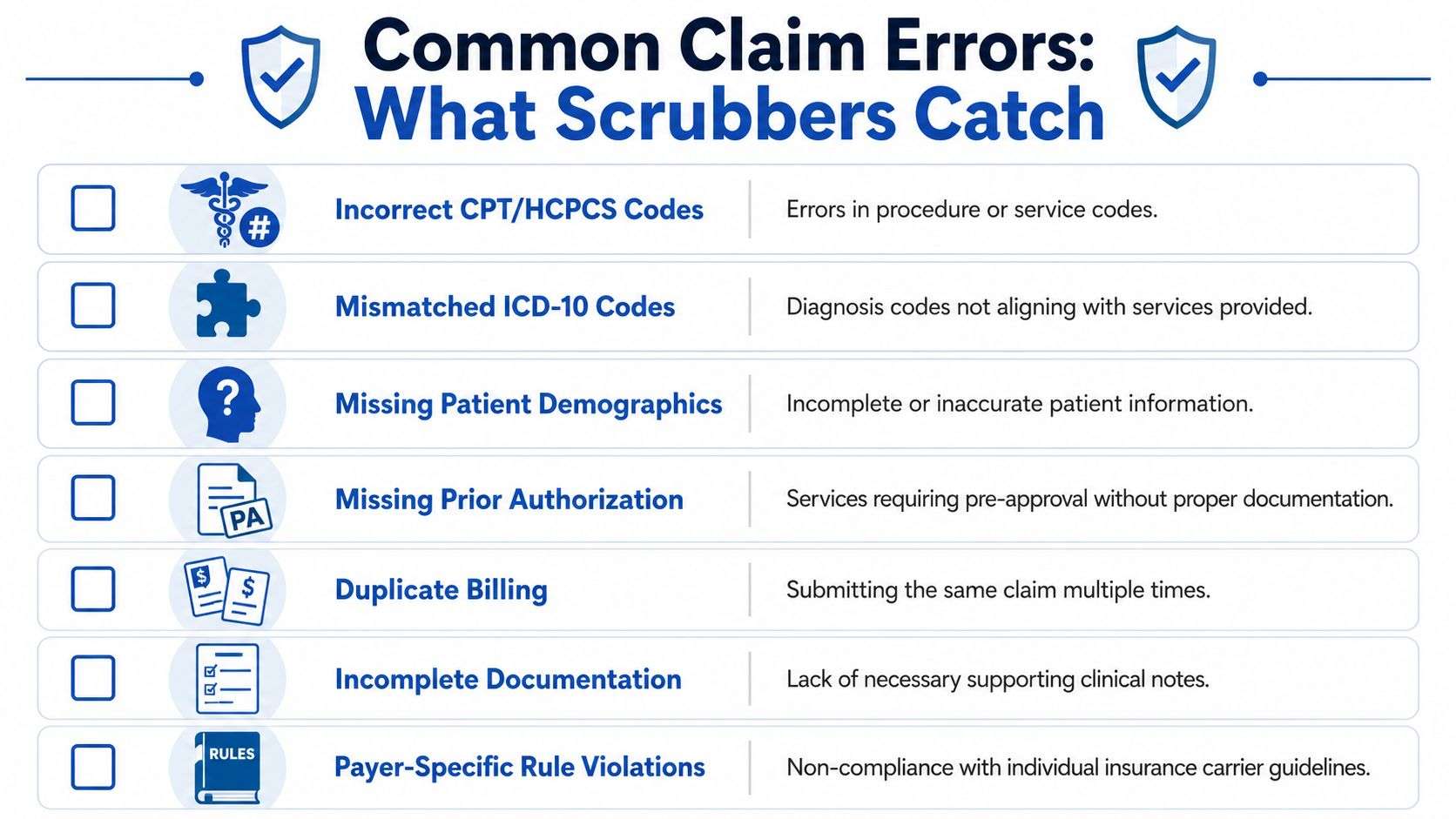
The easiest way to understand these edits is to sort them by where the claim breaks.
Front-end data errors
Wrong date of birth, misspelled names, inactive coverage, or mismatched subscriber details can stop the claim before the payer even looks at medical necessity.Procedure code errors
A CPT or HCPCS code may be outdated, entered incorrectly, or inconsistent with the documented service.Diagnosis-to-procedure mismatches
A claim can contain valid codes and still fail because the diagnosis does not support the billed procedure. This is one of the most common points of confusion for practice teams.Modifier problems
Missing, incorrect, or conflicting modifiers can change how the payer reads the service and whether separate payment is allowed.NCCI edit conflicts
Some code pairs should not be billed together unless the documentation supports a permitted exception and the correct modifier is present.Payer-specific and specialty-specific rules
Generic scrubbers often fall short in handling these. Cardiology, orthopedics, pain management, behavioral health, and other specialties often run into payer edits tied to frequency limits, diagnosis policies, prior authorization rules, or service combinations that do not show up in a basic rules library.
That last category deserves extra attention. A general scrubber may catch a missing modifier. It may not catch that a certain payer wants a different diagnosis sequence for a specialty-specific procedure, or that it rejects a code combination your other payers accept without question. For busy practices, those are expensive misses because they create avoidable denials that keep returning until someone updates the rule.
A Simple Example That Shows Why This Matters
PGM's explanation of medical claim scrubbers gives a useful example. Billing CPT 36415 for a blood draw without linking it to a supporting diagnosis such as E11.9 can cause the claim to reject.
That example helps because it shows the difference between a valid code and a payable claim. The code itself may be correct. The claim still fails if it does not show medical support in the way the payer expects.
For specialty practices, the same logic applies at a more complex level. A pain management claim, infusion claim, or surgical claim may pass a generic coding check but still fail a payer's specialty edit. That is why practices with complicated case mixes usually need rules that are updated by people who understand both coding and payer behavior.
Why Catching These Errors Changes Daily Workflow
Every claim that fails one of these checks creates extra touches. Staff have to reopen the account, research the issue, correct the claim, and submit it again. Payment waits. Work queues grow.
If you want a training resource for recurring coding issues, this roundup of common medical coding errors in medical billing is a practical place to start. For a broader view of how payment patterns can reveal hidden friction in billing operations, see Suby's guide to payment data.
The practical takeaway is simple. A strong claim scrubber should catch basic claim errors, coding logic problems, and the payer-specific edits that matter to your specialty. If it only handles the first layer, your team still ends up doing denial prevention by hand.
Measuring The Financial Impact Of Clean Claims
A busy Monday gives you a clear test. If yesterday's claims went out clean, today's deposit report is steadier, the A/R team is calmer, and fewer accounts are sitting in correction queues. If those claims went out with preventable errors, cash slows down and staff spend the day fixing work that should have been right the first time.
That is how clean claims affect the business. The impact shows up in payment speed, rework volume, collection forecasting, and how much labor your team burns on avoidable follow-up.
The first metric to watch is clean claim rate. It measures how often claims pass on first submission without edits, rejections, or resubmission work. A higher rate usually means fewer handoffs, fewer delays, and a shorter path from encounter to payment.
What Improves When Clean Claim Rate Improves
A clean claim works like a package with the right address, label, and contents listed correctly. It moves through the system with fewer stops. A flawed claim gets pulled aside, checked by hand, corrected, and sent back through the line.
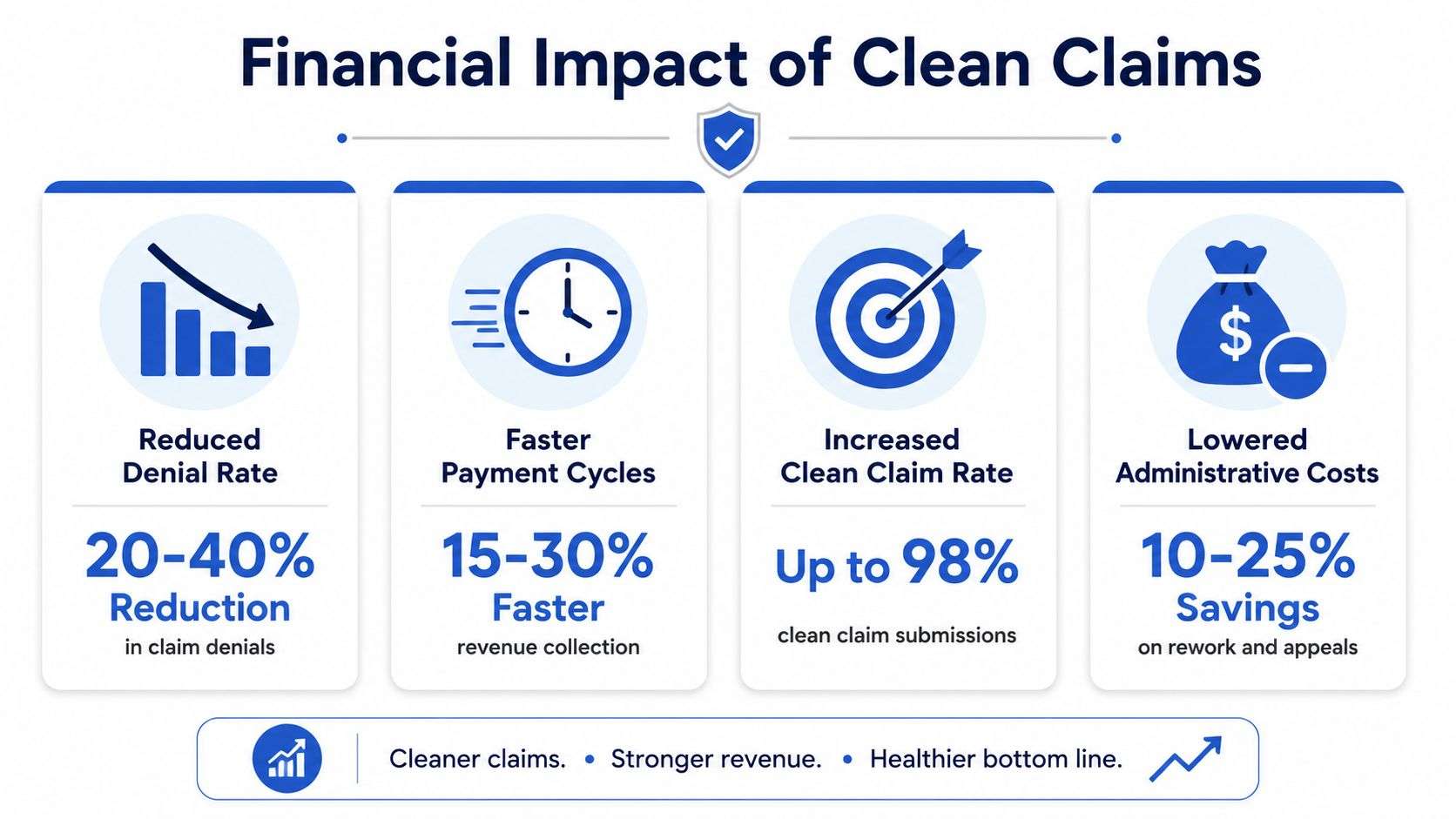
That difference affects several financial outcomes at once:
Cash arrives faster
Claims that pass the first time reach adjudication sooner, so reimbursement is less likely to stall on avoidable front-end issues.Rework costs drop
Staff spend less time reopening accounts, correcting edits, and tracking resubmissions.Forecasting gets more reliable
When first-pass acceptance is more consistent, expected collections are easier to project by week and by month.Managers can spot weak points sooner
Clean claim trends by payer, location, and specialty show where process fixes will produce the biggest return.
Clean claims protect margin because they reduce both delayed cash and the labor cost of fixing preventable errors.
That last point matters more than many practices expect. A generic scrubber may raise baseline claim quality, yet still leave specialty-specific denials untouched. If your pain management, behavioral health, infusion, or surgical claims keep failing on payer logic that a broad rules library does not catch, your clean claim rate can look decent overall while your most profitable service lines still leak revenue.
For administrators who want to get sharper about reading payment behavior and collection trends, Suby's guide to payment data is a helpful complement because it frames how operational billing data can support better financial decisions.
A better measurement approach breaks results down by specialty and payer, not just by practice total. That is where revenue cycle management analytics help. They show whether your scrubber is actually preventing the edits that drive delays in your highest-value claims, or only catching the easy errors that any basic tool would find.
How One For All Medical Billing Perfects The Scrubbing Process
The biggest gap in many scrubbing workflows isn't basic error checking. It's the lack of specialty-specific payer rule adaptation. Generic scrubbers can catch missing fields and invalid codes, but complex denials often come from rules that only make sense within a specialty, a payer contract, or a recurring diagnosis-to-procedure pattern.
Data cited in this discussion of dynamic rule engines and specialty denials says 24% of denials in 2025 were due to coding mismatches specific to high-complexity specialties. The same source argues that generic scrubbers often fail in these scenarios, while advanced dynamic rule engines learn payer behavior by specialty.

Why Specialty Adaptation Changes Results
Take a straightforward family practice claim and a pain management claim. Both may contain valid codes. But the payer scrutiny is rarely the same. In high-complexity specialties, denials often come from nuanced coding relationships, medical necessity logic, modifier interpretation, or payer preferences that don't show up in a basic rules library.
That's where customized scrubbing becomes operationally different.
Static Logic Checks For Errors
It finds missing information and obvious coding conflicts.Dynamic Logic Learns Payer Habits
It reflects how a specific payer tends to evaluate claims for a specific specialty.Expert Oversight Refines The Rules
Teams review recurring denials, update workflows, and tighten claim logic over time.
The best scrubber for a specialty practice isn't the one with the longest rules list. It's the one that reflects how that payer actually adjudicates that specialty's claims.
Workflow Matters Too
A strong scrubbing process also has to fit the way your office works. If edits appear too late, or if billers have to leave one system to check another, the process slows down and staff start bypassing it. The best setups connect with the EHR or practice management workflow so claims are reviewed before submission without creating another administrative lane.
Security matters just as much as workflow. If you're reviewing vendors or tightening internal controls around protected health information, this guide to HIPAA security for medical businesses is a useful resource for understanding the broader security side of handling healthcare data.
A mature scrubbing model doesn't treat denials as isolated mistakes. It treats them as signals. When the same payer edit hits the same specialty repeatedly, the process should adapt. That's how scrubbing moves from “error checker” to real revenue cycle strategy.
If your practice needs fewer denials, cleaner first-pass claims, and billing support that adapts to your specialty and payer mix, One For All Medical Billing can help. Their U.S.-based team supports practices nationwide with specialty-aware billing, coding, denial management, and revenue cycle oversight designed to help providers get paid faster with less rework and less stress.

