

table of contents
A Medicare patient is standing at your check-in desk. The physician wants to order a service. Your team has seen this scenario before and suspects Medicare may deny it. The patient assumes Medicare will pay because it usually does. The front desk knows that if the claim denies and the notice process wasn't handled correctly, the practice may be stuck with the loss and the patient may be angry.
That's the moment where many practices treat the Advance Beneficiary Notice of Noncoverage as a form to grab, sign, and scan. That approach causes problems. The ABN works best when staff treat it as a controlled pre-service conversation about coverage risk, patient choice, and financial responsibility.
Used well, the ABN protects revenue, supports compliance, and reduces the “nobody told me” dispute after the denial posts. Used poorly, it becomes an invalid piece of paper that doesn't transfer liability and doesn't help the patient make an informed decision.
The Front Desk Dilemma Protecting Your Practice from Unexpected Denials
The front desk dilemma usually starts with uncertainty, not with a confirmed denial. A scheduler sees a diagnosis that may not support a test. A biller knows the same service has denied before for medical necessity. A clinician wants to proceed because the service may still be clinically useful. Nobody wants to delay care, but nobody wants to absorb the charge either.
In real operations, practices either have a process or they have chaos. Without a process, staff improvise. One person tells the patient, “Medicare might not cover this.” Another says, “You may get a bill.” A third forgets to document the conversation at all. Those casual warnings don't do what the ABN is designed to do.
What The Front Desk Needs In That Moment
The best front-desk teams don't try to predict every denial from memory. They rely on a workflow that connects scheduling, coverage review, and financial counseling. If your staff is still working from fragmented payer notes, tighten that first by improving your insurance coverage verification workflow.
When the team identifies likely noncoverage before service, the ABN changes the conversation from reactive to structured. The patient gets a clear explanation before anything is furnished. The practice documents the risk and the patient's choice. Billing has the record it needs later.
Practical rule: The ABN is most valuable before the visit feels rushed. Once the patient is in a gown or on the exam table, the conversation becomes harder and more defensive.
What Works And What Fails
What works:
- Flagging likely noncovered services early so staff have time to explain the issue.
- Using plain language instead of quoting policy language to the patient.
- Giving the patient a real choice to proceed or decline.
What fails:
- Handing over the form without context and asking for a quick signature.
- Using vague warnings such as “insurance may not pay.”
- Trying to fix it after the service when the legal and financial value of the notice is gone.
A new practice manager should view the ABN as a front-end revenue protection tool. It belongs in patient access, clinical communication, and billing. When those teams treat it as shared work instead of “someone else's form,” denials become easier to defend and collections become less contentious.
What Is an Advance Beneficiary Notice of Noncoverage
Think of the ABN the way you'd think about a mechanic's estimate for work that may not be covered under warranty. Before the repair starts, the mechanic tells you what might not be covered, why that's the case, and what you may owe if you still want the work done. You decide before the cost is incurred.
That's how the Advance Beneficiary Notice of Noncoverage functions in Medicare fee-for-service. CMS describes the ABN, Form CMS-R-131, as a long-standing Medicare liability-transfer notice used in Original Medicare fee-for-service when payment is expected to be denied, and CMS says the current updated ABN is effective now and expires on March 31, 2029, according to the CMS ABN overview for Form CMS-R-131.
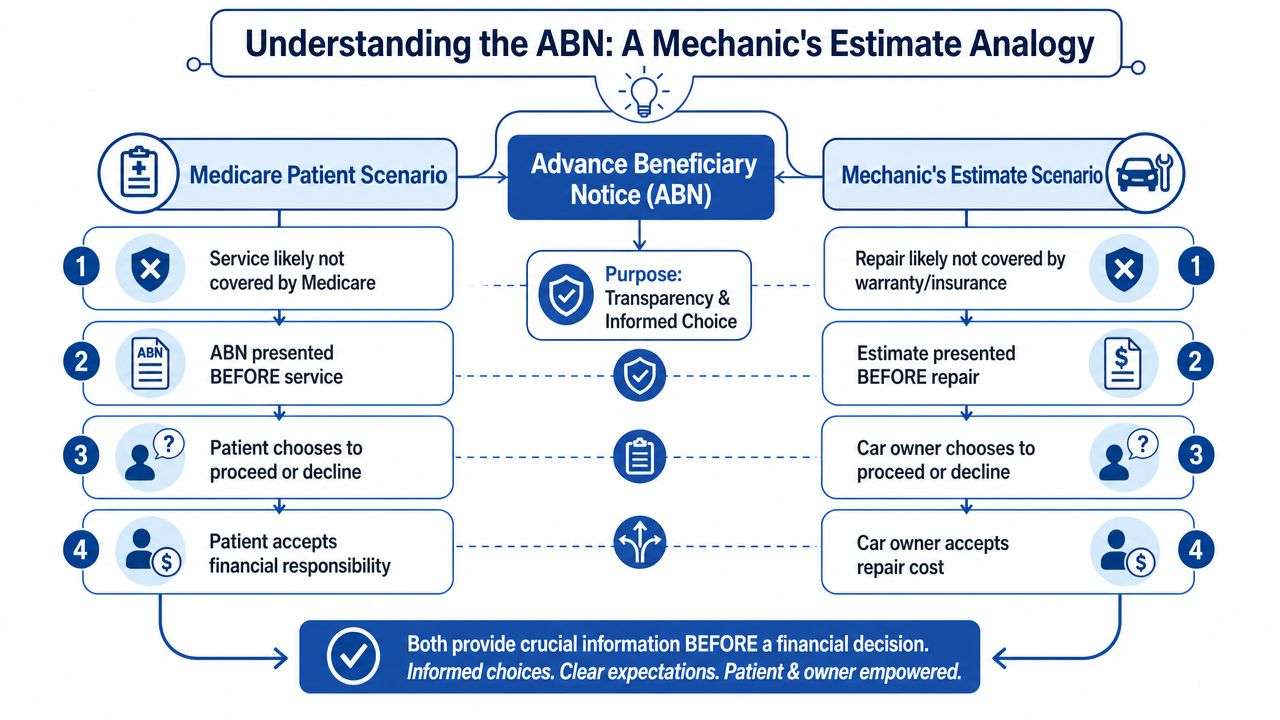
The Two Jobs The ABN Performs
First, the ABN is a patient communication tool. It tells the beneficiary, before the item or service is provided, that Medicare is expected to deny payment. That timing matters because the patient has to be able to decide in advance whether to receive the service and accept possible financial responsibility.
Second, it's a liability-transfer mechanism. If the notice is valid and issued properly, it can help shift financial responsibility to the beneficiary when Medicare denies the claim in situations where that transfer is allowed.
Those two functions are inseparable. If the patient didn't get understandable notice in advance, the form loses much of its practical and legal value.
Why Practices Get This Wrong
Many teams define the ABN too narrowly. They see it as a compliance document and forget that it also shapes the patient's experience. If a patient feels surprised later, the signed form alone won't rescue that relationship.
The stronger approach is to use the ABN as a short financial counseling script:
- What service is at issue
- Why Medicare may not pay
- What the patient's options are
- What the patient may owe if they proceed
A valid ABN isn't just signed. It's understood.
CMS also notes that the ABN is used by providers, physicians, practitioners, suppliers, independent laboratories, home health agencies, and hospices. That broad use tells you something important. This isn't a niche billing form. It's part of Medicare's core denial-management framework across multiple care settings.
The Practical Meaning For A Practice Manager
If you manage access, billing, or denials, the ABN sits at the intersection of all three. It standardizes a risky moment that otherwise gets handled inconsistently. In day-to-day operations, that means fewer avoidable write-offs, clearer patient conversations, and better support for your team when a claim denies exactly as expected.
When an ABN Is Required and When It Is Not
ABN compliance breaks down when staff use the form too broadly or not broadly enough. The key question isn't “Could Medicare deny this?” The key question is “Is this the kind of denial that calls for an ABN?”
When An ABN Is Required
CMS guidance supports use of an ABN when payment is expected to be denied for coverage-related reasons such as services not being medically reasonable and necessary or being custodial care only. Medicare guidance for home health also identifies distinct statutory coverage failure points. The same guidance explains that the cost estimate in the ABN should generally be within $100 or 25% of the actual cost, whichever is greater, according to the ABN booklet summarizing CMS guidance.
In practical terms, issue an ABN when the service is usually coverable under the program, but this patient's facts make denial likely.
Common examples include:
- Medical necessity concerns: The service may be covered in general, but the diagnosis, frequency, or clinical documentation may not support payment in this instance.
- Custodial care issues: The service falls into a category Medicare may view as noncovered for that reason.
- Home health statutory triggers: In home health, ABN decisions often arise when coverage may fail because the patient isn't homebound or doesn't meet intermittent-care requirements.
If your team struggles with identifying these triggers consistently, strengthen your eligibility and benefits verification process so coverage review happens before staff are standing in front of the patient.
Home Health Requires Extra Timing Discipline
Home health is a good example of how structured ABN rules can be. Under HH PPS, an ABN is required at three distinct trigger points: initiation, reduction, and termination of services, when coverage is expected to fail for statutory reasons, as outlined by CGS Medicare home health ABN guidance.
That tells you something broader about ABN operations. Timing isn't an administrative detail. Timing is the control point.
When The ABN Is Not The Right Tool
Practices create risk when they hand out ABNs reflexively. A blanket ABN policy for “anything Medicare might question” is poor practice. It can confuse patients, weaken staff judgment, and create sloppy documentation habits.
Avoid these patterns:
- Blanket use for all Medicare patients
- Using the ABN as a substitute for coverage research
- Issuing the form after the service is already furnished
- Leaving the estimate vague or generic
A Better Decision Framework
Use this simple operational test:
- Is the service one Medicare may cover under the right facts? If yes, keep evaluating.
- Do the patient's facts suggest denial is likely for a recognized coverage reason? If yes, an ABN may be required.
- Can you explain the risk in patient-friendly language before service? If not, slow the process down and clarify before presenting the form.
Staff should never present an ABN because they're unsure. They should present it because they can explain why noncoverage is expected.
That distinction protects both compliance and patient trust.
How to Correctly Complete and Present the ABN Form
A valid ABN depends less on paperwork volume and more on precision. The form must tell the patient exactly what is at risk, why Medicare may deny it, and what choice the patient is making. Sloppy completion is one of the fastest ways to lose the protection the notice is supposed to provide.
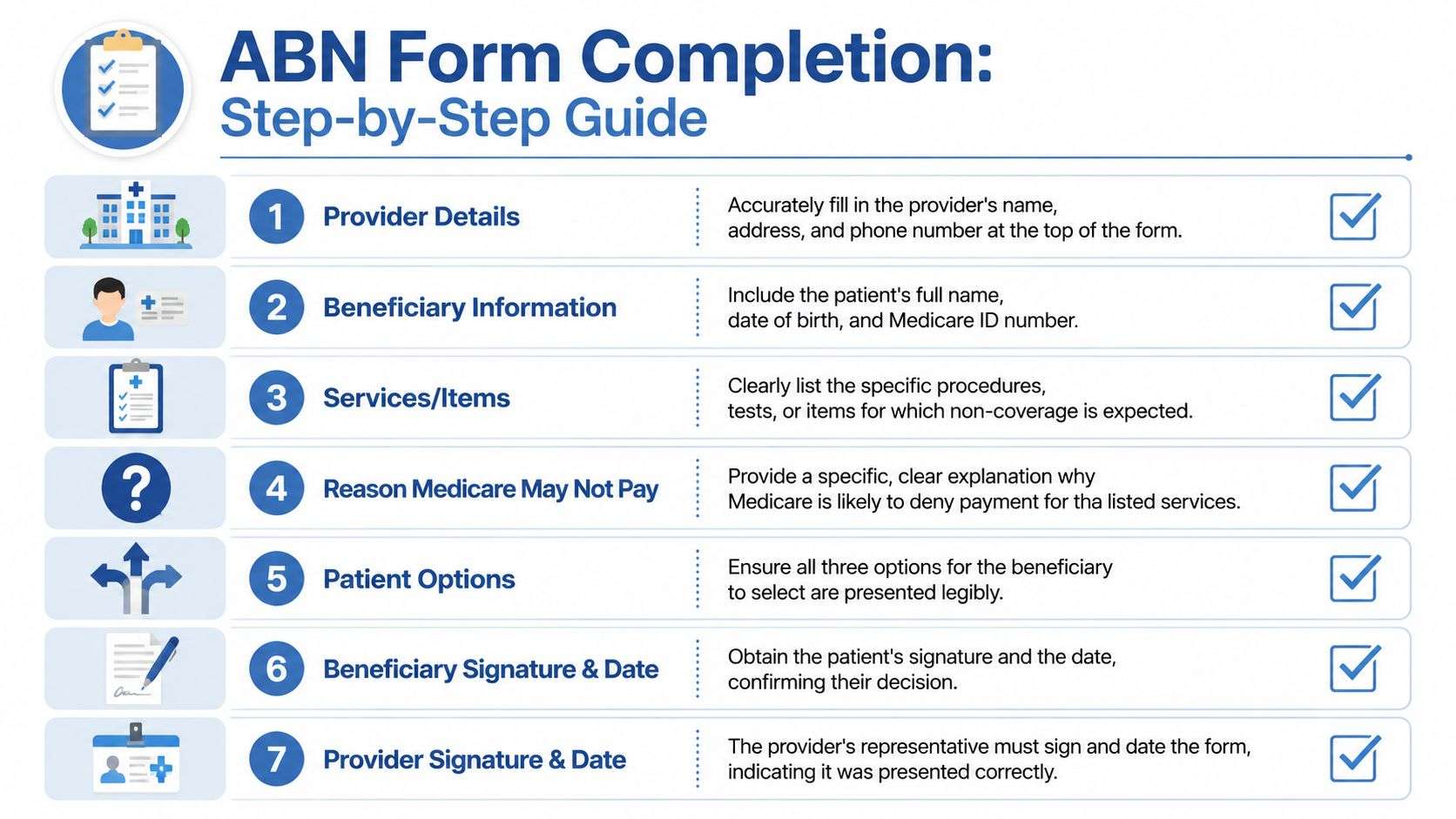
Fill Out The Form Like It Will Be Read During A Denial Review
Every field should answer a practical question.
- Provider information: Enter the practice or supplier details completely and consistently. This sounds basic, but mismatched entity information creates confusion later.
- Beneficiary identification: Use the patient's correct identifying information so the record clearly connects to the service and the person making the choice.
- Specific items or services: Be exact. “Lab work” is weak. “Vitamin D test” or the specific diagnostic service is stronger.
- Reason Medicare may not pay: Many ABNs often fall short here. Generic wording such as “may not be covered” doesn't help the patient understand the issue.
- Estimated cost: The amount should be thoughtful and supportable, not a guess scribbled in at check-in.
If your intake packets are still inconsistent across locations, it helps to standardize related patient-financial forms too, including the assignment of benefits form workflow, so staff learn one disciplined documentation habit rather than several disconnected ones.
Use Plain Language For The Reason Field
The reason field should sound like something a patient can follow. Don't paste payer jargon into the form and assume that counts as notice.
Better examples:
- Medicare may not pay for this test because the diagnosis on today's order may not meet Medicare's medical necessity rules.
- Medicare may not pay for this service because your current condition may not meet coverage requirements for this level of care.
- Medicare may deny payment because this service may be considered custodial rather than covered care.
Poor examples:
- Noncovered.
- Medical necessity.
- Frequency exceeded.
Those short phrases may make sense to coders, but they don't inform the beneficiary.
Field test: If a patient asks, “What does that mean for me?” and your staff has to reinterpret the form verbally, the wording probably wasn't clear enough.
Explain The Patient Options Carefully
The patient's choice on the ABN affects what happens next operationally. Staff should explain the options neutrally. They should not steer the patient into the option that seems easiest for the practice.
A simple way to present the choices:
- Proceed and request billing to Medicare. The patient receives the service, Medicare gets the claim, and the denial can be processed through normal channels if payment is refused.
- Proceed but don't bill Medicare. The patient still wants the service but chooses not to have a claim submitted.
- Decline the service. The patient chooses not to receive the item or service at issue.
Each option creates a different downstream billing path. That's why the person presenting the ABN should understand more than the script. They should know what the selected option means for registration notes, claim submission, and patient statements.
Presentation Rules Matter As Much As Completion
The ABN has to be presented before the item or service is provided. It also has to be presented in a way that allows real choice. Rushed delivery at the point of care can undermine that.
Train staff to do the following:
- Pause long enough to explain the issue
- Answer basic questions without coaching the patient's selection
- Confirm the patient understands they may be financially responsible
- Obtain the signature and date before service
- Store the signed form where billing can retrieve it easily
What doesn't work is dropping the ABN into a clipboard stack and saying, “Sign everything on page four.” That may collect a signature, but it doesn't create a defensible process.
Documentation Coding and Billing Implications
Once the ABN is signed, the work shifts from patient communication to claim strategy. At this stage, many practices lose the benefit of a properly executed notice. The form is in the chart, but coding doesn't reflect it, billing can't find it, or the modifier selection doesn't match the actual situation.
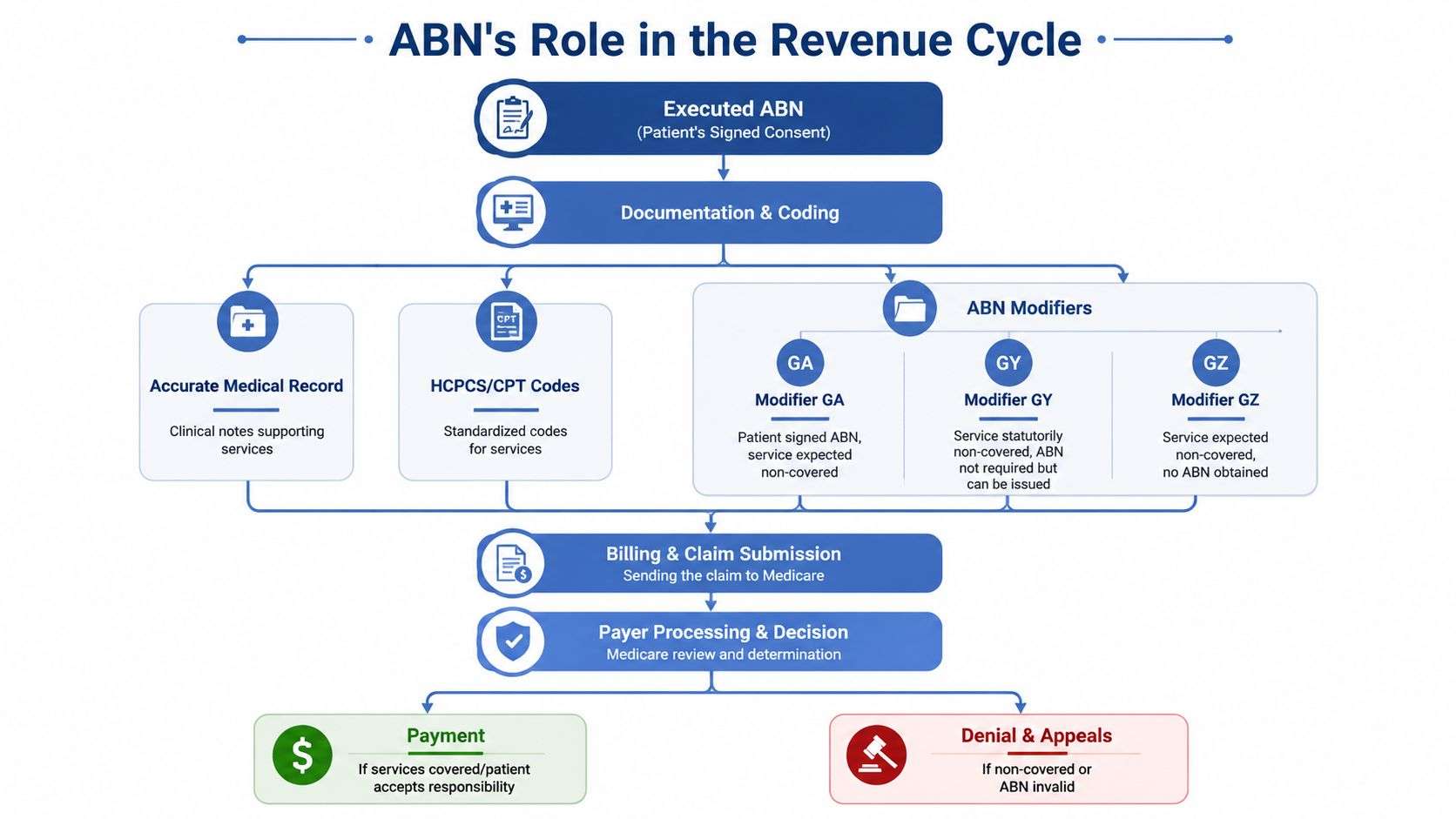
The ABN Has To Connect To The Claim
A signed form in isolation doesn't protect revenue. Billing staff need a clean handoff that answers three questions:
- Was an ABN required?
- Was it obtained correctly?
- How should the claim reflect that status?
This is why ABN management should sit inside broader documentation discipline. If the chart, order, diagnosis support, and patient financial record don't align, your claim posture weakens. Practices that are tightening this area often benefit from reviewing their broader clinical documentation improvement process.
Modifier Logic Drives Financial Consequences
In practical billing operations, the ABN status influences which modifier belongs on the claim. The common ones staff need to understand are GA, GX, GY, and GZ.
A practical breakdown:
- GA: Use this when a required ABN is on file for a service expected to deny in this case. This tells billing and audit staff that the notice process was completed.
- GX: This signals a voluntary notice scenario tied to a statutorily noncovered service.
- GY: This identifies a statutorily noncovered item or service.
- GZ: This typically reflects that the service is expected to be denied, but a valid ABN was not obtained.
You don't need every front-desk employee to memorize every modifier. You do need them to know that a missing or invalid ABN changes what billing can do later.
The billing office can't repair a front-end ABN failure with back-end coding.
Retention And Retrieval Matter
Keep the signed ABN in a place where denials staff can retrieve it. That sounds obvious, but many organizations still bury the document in scanned media without naming conventions or indexing rules.
Good retention practice includes:
- Linking the ABN to the specific date of service
- Making it visible in the patient record, not hidden in miscellaneous media
- Ensuring coders and denial staff can confirm the patient's selected option
- Preserving the complete signed version, not just a partial scan
An ABN should function like evidence. If a denial posts months later, your staff should be able to produce the notice quickly and match it to the exact service and claim. When retrieval is slow, write-offs increase because staff won't chase what they can't prove.
Avoiding Common ABN Denials and Billing Risks
Most ABN-related losses don't happen because Medicare's rules are impossible. They happen because practices treat the notice as routine and stop paying attention to the details that make it enforceable.
The Mistakes That Create Avoidable Write-Offs
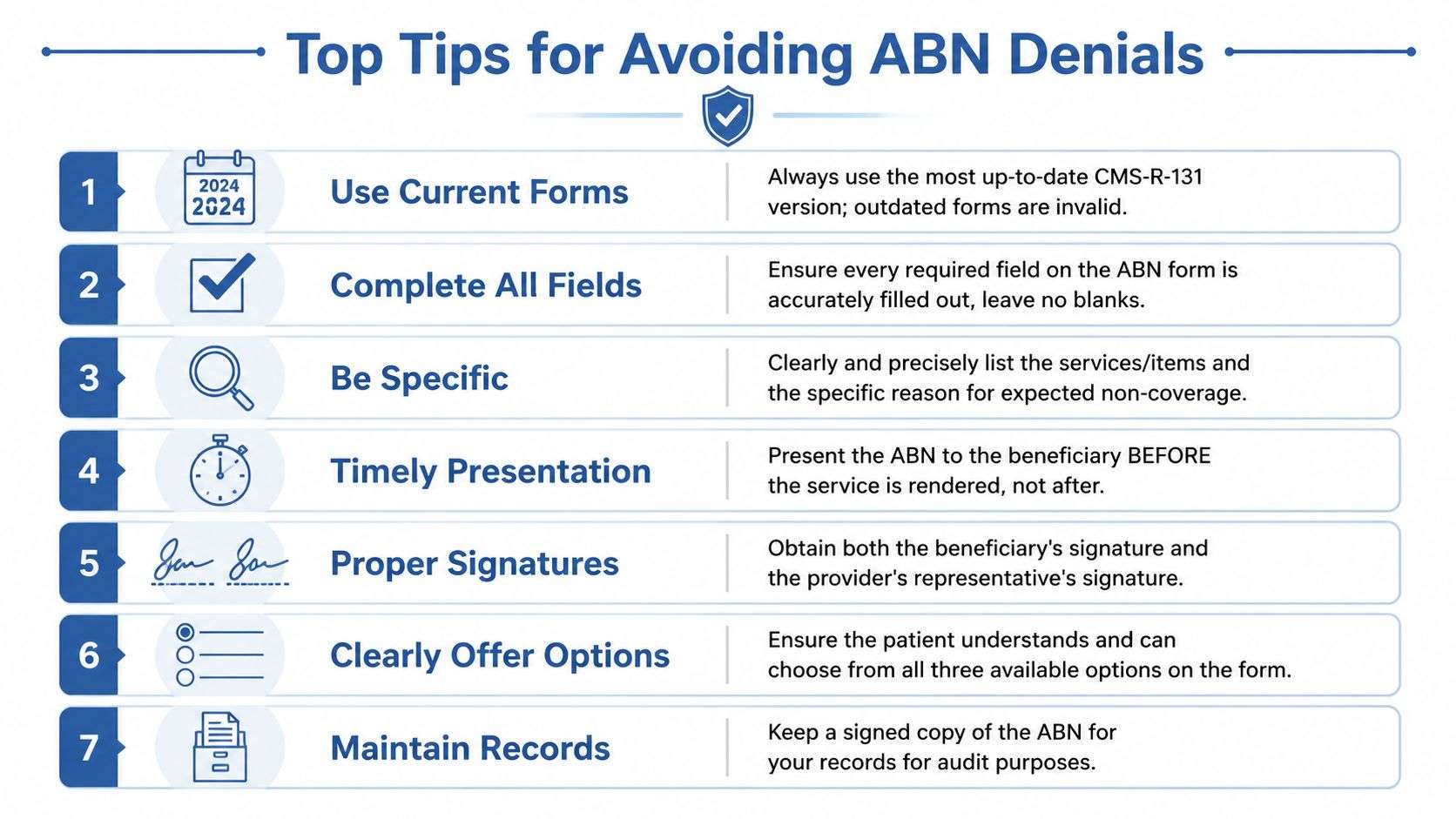
The most common errors are operational, not theoretical.
- Using the wrong version of the form: Staff print old packets, save outdated templates to desktops, or pull forms from local folders without governance.
- Writing vague reasons for likely denial: The patient sees unclear language, and your file shows weak notice.
- Presenting the ABN too late: Once the service decision is effectively made, the notice loses its purpose.
- Estimating costs carelessly: The estimate field isn't filler. It should reflect a real effort to project patient liability.
- Coaching the patient's choice: Staff may intend to help, but pushing a patient toward one option creates risk.
Best Practices That Hold Up Under Pressure
The strongest ABN programs are boring in the best way. They use standard scripts, role-based training, and audit checks.
Try this operating model:
- Create service-specific ABN language banks for common scenarios, then require staff to tailor them rather than write from scratch every time.
- Limit who can finalize the form so inexperienced staff don't improvise high-risk wording.
- Audit signatures, dates, and estimates weekly if denial volume suggests problems.
- Train staff to explain, not persuade when walking through beneficiary options.
One useful internal test is to review denied claims where patient billing failed. Pull the ABN, the registration notes, and the claim. You'll usually find the breakdown quickly. Either the notice came too late, the wording was too vague, or the documentation trail didn't support the billing action.
What Good ABN Governance Looks Like
A well-run practice doesn't rely on memory. It uses controls:
- approved forms only
- standard reason language
- defined handoff to billing
- retrievable document storage
- periodic manager review
When those controls are absent, the same avoidable disputes repeat. The patient says no one explained the charge. Billing says the form was signed. Leadership writes off the balance to close the complaint.
That cycle is preventable.
Integrating the ABN into Your RCM Workflow
The ABN belongs inside the revenue cycle, not beside it. If your organization treats it as front-desk paperwork, it will be inconsistent. If you build it into scheduling, coverage review, registration, documentation, coding, and denial follow-up, it becomes a stable control point.
Build A Cross-Team Process
The best workflow usually looks like this in practice:
- Scheduling or pre-service review flags risk
- Clinical staff confirm the service details
- Patient access presents the ABN clearly and timely
- Billing receives the selection and supporting documentation
- Denials staff can retrieve the record without hunting for it
That handoff structure matters even more in multi-site groups where each location develops its own habits. Standardization doesn't mean a robotic script. It means every site follows the same compliance rules and escalation path.
Use Systems To Reduce Human Error
ABN failures often trace back to fragmented systems, not bad intentions. Old templates live in shared drives. Scanned forms are hard to find. Staff can't tell whether the current document is the approved one. In those environments, strong infrastructure matters. Practices reviewing their technical stack may also want to look at managed IT services for DFW medical practices as a practical resource for improving document control, security, and workflow reliability.
You can also strengthen consistency through revenue cycle management automation. Automated task routing, document prompts, and work queues won't replace staff judgment, but they can reduce missed notices, incomplete forms, and poor handoffs.
The larger point is simple. The Advance Beneficiary Notice of Noncoverage is not just a Medicare form. It's a structured way to protect revenue, support compliant billing, and give patients a fair explanation before they face a financial decision. Practices that operationalize it well usually see fewer disputes, cleaner denial handling, and more confidence across the front and back end.
If your team is dealing with Medicare denials, inconsistent ABN workflows, or patient billing disputes tied to noncovered services, One For All Medical Billing can help you tighten the process. Their team supports practices with revenue cycle management, denial prevention, documentation alignment, and billing operations that turn compliance requirements into practical financial controls.

