

table of contents
Your bank deposit looks fine. Your production report looks fine. But your A/R aging, patient balances, and payer follow-up list are all telling different stories.
That usually means payment posting isn't being treated as a control point. It's being treated as clerical cleanup.
In real operations, medical billing payment posting is where a practice finds out whether it was paid correctly, whether the payer applied the contract correctly, whether the patient balance is real, and whether a denial needs action today or will age into avoidable write-off territory. If this step is loose, every report after it becomes less trustworthy.
Why Payment Posting Is More Than Just Data Entry
A new practice manager often sees payment posting as the point where the team records money and closes the loop on a claim. That definition is incomplete. The posting team is also validating what happened to the claim after adjudication and deciding what happens next.
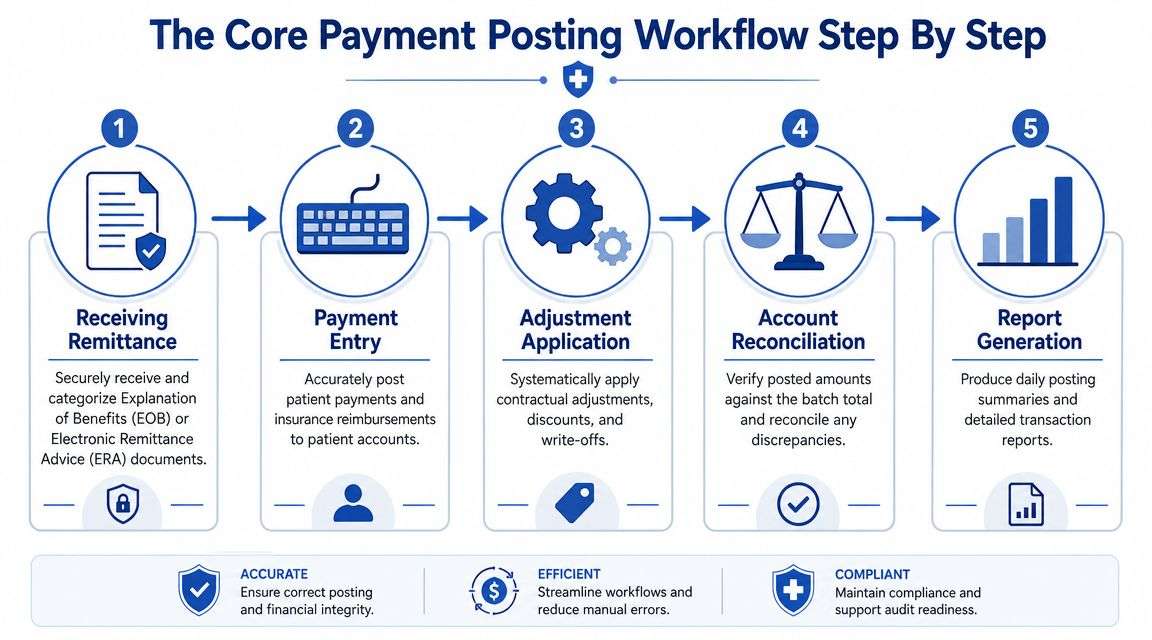
A basic industry definition is still useful. Payment posting is the revenue cycle step where payer and patient remittances are matched to claims, then recorded with associated contractual adjustments, denials, partial payments, and secondary insurance balances; the operational sequence is to receive ERA/EOB, verify payment details, post to the correct account, and then reconcile discrepancies so balances can be transferred, appealed, or billed to the patient according to this overview of payment posting fundamentals.
That sequence sounds administrative. In practice, it's one of the most important financial checkpoints in the revenue cycle.
Where Posting Changes The Financial Picture
When payments are posted accurately, the practice can trust its patient balances, identify claims that need appeal, and keep leadership reports grounded in actual account activity. When posting is sloppy, three problems show up fast:
- False patient balances: Staff bill patients for amounts that should have been adjusted, transferred, or sent to secondary coverage.
- Hidden payer issues: Short pays blend in with normal account activity and never make it to follow-up.
- Distorted reporting: Collections, A/R, refunds, and outstanding liability stop reflecting reality.
Practical rule: If posting is wrong, every downstream number is suspect.
This is why many groups that want better cash control don't start with dashboards. They start by tightening the posting workflow and reconciliation habits, then they build reporting on top of cleaner data. For practices reviewing outside support options, that's also where services like healthcare RCM solutions fit. The value isn't just getting transactions entered. It's getting the account disposition right.
What Good Managers Watch For
A strong manager doesn't ask only, “Was the payment posted?” The better questions are:
- Was the payment posted to the correct claim and service line?
- Was the adjustment appropriate under the payer contract?
- Was the remaining balance routed correctly?
- Was a denial or discrepancy pushed to a team that can act on it?
That's the difference between bookkeeping and revenue integrity. One records activity. The other protects reimbursement.
The Core Payment Posting Workflow Step By Step
Most posting errors happen because teams move too quickly from remittance receipt to account closure. The safer approach is to treat posting as a controlled sequence with clear checkpoints.
Start With The Remittance, Not The Assumption
Every clean posting cycle begins when the team receives the payer remittance. That may arrive as an ERA or as a paper EOB. Patient payments arrive through separate channels such as front-desk collection, portal payment, check, or merchant batch.
Before anyone touches the account, verify the remittance source, payment date, payer identity, patient name, claim reference, and whether the payment belongs to one claim or multiple claims. Many miscues often begin at this point. A batch can look complete while still containing a line-level discrepancy that changes patient responsibility.
For teams trying to reduce manual handoffs across billing systems, concepts from modern data pipeline architecture are useful. The lesson isn't technical for its own sake. It's operational. Payment data moves across systems, files, and queues, so accuracy depends on reliable intake, mapping, and validation.
Post The Claim Line By Line
Take a common example. A payer adjudicates an office visit claim and sends an ERA with allowed amounts, payer payment, adjustment information, and patient responsibility. The poster shouldn't enter only the total check amount and move on. They need to apply the remittance to the specific claim and, where required by the system, to the correct service lines.
That means checking:
- Claim match: Confirm the remittance belongs to the right patient account and date of service.
- Payment application: Apply the payer payment to the billed services exactly as adjudicated.
- Adjustment entry: Record contractual adjustments and any other adjudication results correctly.
- Balance routing: Move remaining liability to secondary insurance or patient responsibility when appropriate.
- Exception flagging: Hold anything that doesn't reconcile cleanly.
If your team works heavily with electronic remits, understanding the role of the ERA in medical billing helps standardize this step and reduce avoidable interpretation errors.
Reconcile Before You Close The Batch
Posting isn't finished when the amounts are in the practice management system. It's finished when the batch reconciles. The poster should compare posted totals against the remittance and internal batch controls, then confirm that exceptions were separated for follow-up rather than buried in notes.
A balanced batch with unresolved discrepancies is not actually balanced.
Mature teams outperform busy teams in this aspect. Busy teams post faster. Mature teams make sure every unmatched amount, denial, transfer, and unusual adjustment has a next owner.
Don't Blend Patient And Payer Logic
Patient payments need their own controls. A copay taken at check-in, an online balance payment, and a payer remittance may touch the same account, but they shouldn't be handled with the same assumptions. Staff need to know whether the patient payment should remain applied, be reallocated, or trigger a refund review once insurance adjudication is final.
That's why effective posting workflows separate transaction entry from account resolution. Entering money is easy. Resolving what the account now means is the skill.
Navigating Adjustments Denials And Write Offs
The easy accounts aren't what hurt a practice. The difficult ones do. Posting gets complicated when the payer doesn't pay as expected and close the claim.

Know Which Adjustments Are Routine And Which Are Not
Some adjustments are expected. If the payer processed the claim under the contract and the difference between billed charges and allowed amount is contractual, that entry is routine. It reduces the account according to the payer agreement.
Other adjustments deserve scrutiny. If the payer applies a code or explanation that doesn't fit the contract terms, the poster shouldn't treat it as ordinary cleanup. They should route it as a variance for review.
A useful way to train staff is to sort adjustments into three buckets:
- Expected contractual activity: Standard allowed-amount difference under contract terms.
- Administrative exception: Something is missing, mismatched, or unclear and needs validation.
- Potential underpayment: The payer's application appears inconsistent with the contract or claim facts.
That distinction matters because once a questionable adjustment is posted as final and no one reviews it, it often disappears into the ledger.
Denials Need Routing, Not Just Entry
A denial found during posting is not the end of the claim. It's the point where the claim should move into the right work queue.
The posting team should identify the denial, enter it correctly, and assign the next action. A coding issue belongs with coding review. A coverage issue may require eligibility validation. A medical necessity or authorization problem may need appeal review. A claim that sits in posted status with a denial note attached is effectively abandoned.
If your office is refining those handoffs, a focused denial process matters as much as the posting itself. This overview of medical billing denial management is relevant because denial work starts the moment posting identifies the issue.
Manager check: If your denials are visible only in aging reports and not in posting exception queues, follow-up is already late.
Write Offs And Refunds Require Discipline
Write-offs cause confusion because teams use the term loosely. A contractual write-off is not the same as bad debt, and neither should be used as a shortcut to clear a stubborn balance. The posting function should only record the type of write-off that policy and account facts support.
Credit balances need the same discipline. Once posting reveals that the account is overpaid, staff must determine whether the excess belongs to the patient, the payer, or should be reallocated elsewhere on the account. Delayed credit review creates refund risk and patient service problems.
For managers who want a broader operational frame for these interactions, MakeAutomation's RCM guide is a useful primer because it places posting, denials, and follow-up in the same revenue cycle context.
What Does Not Work
These habits usually create repeat problems:
- Using generic adjustment codes: They make reporting vague and hide payer patterns.
- Writing off small balances without root-cause review: This masks process defects.
- Leaving denied claims on posted accounts with no owner: The denial ages while staff assume someone else has it.
- Ignoring small credit balances: Small credits accumulate into avoidable refund exposure.
The safest posture is simple. Every unusual posting result needs a classification, an owner, and a next action.
Turning Posting Data Into Payer Performance Insights
At this juncture, payment posting stops being a back-office transaction function and becomes a management tool.
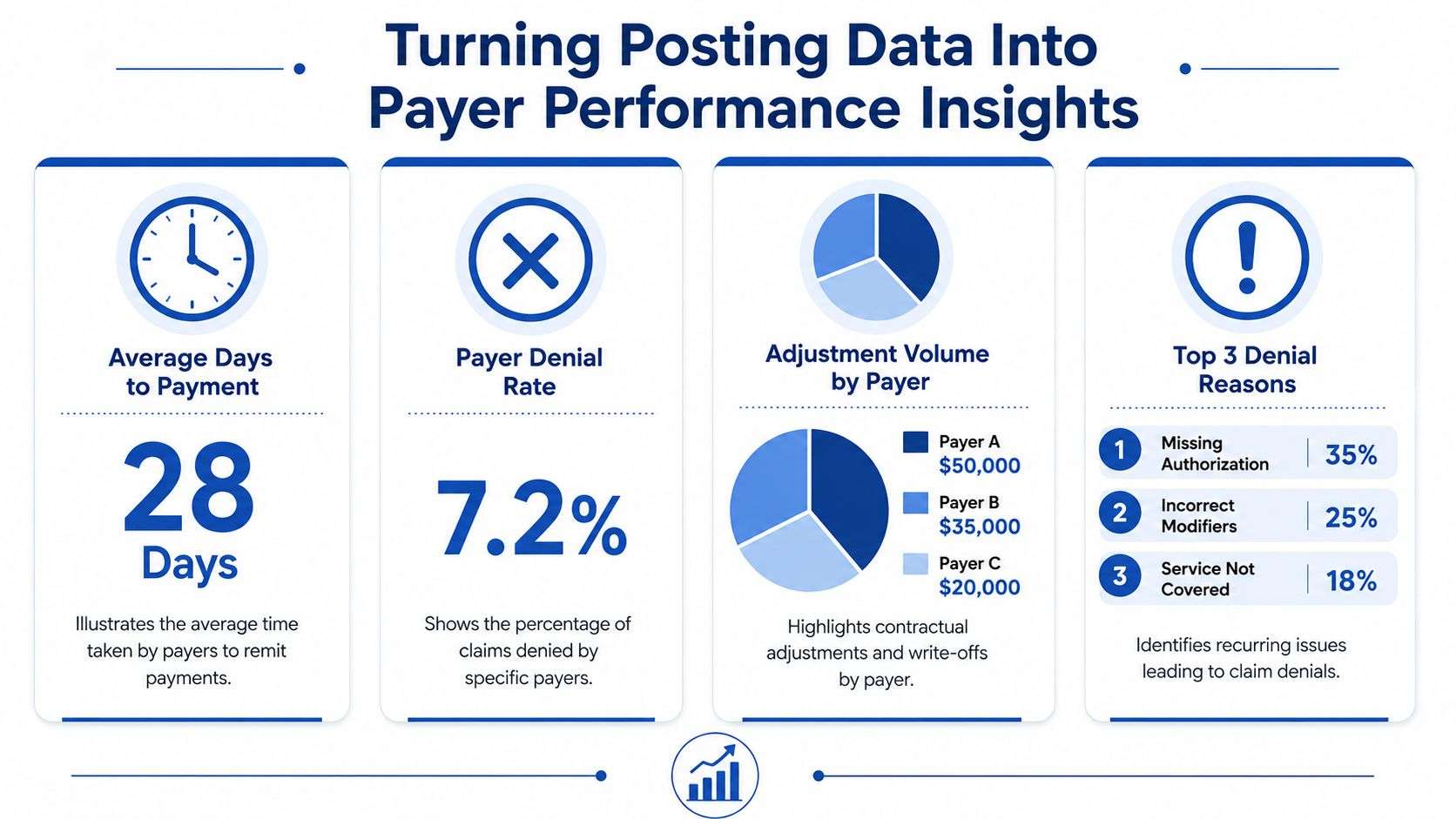
One of the most overlooked realities in medical billing payment posting is that it can serve as a contract-compliance and underpayment detection function, not just a bookkeeping task. Industry guidance notes that analyzing adjustment codes can reveal systematic underpayments, that daily reconciliation can catch errors sooner, and that the real value is revenue integrity rather than data entry speed, with direct effects on patient balances, refund obligations, and leadership reporting accuracy, as described in this discussion of payment posting strategies and revenue integrity.
Build A Simple Payer Review Framework
A practice manager doesn't need a massive analytics program to start using posting data well. Start with a disciplined review of what the posting team already sees every day.
Review payer activity through four lenses:
- Adjustment behavior: Are the same non-routine adjustments appearing over and over from the same payer?
- Denial pattern: Are certain denial categories surfacing repeatedly after posting?
- Balance transfer accuracy: Are patient balances increasing because payers are applying responsibility differently than expected?
- Underpayment signals: Are posted payments repeatedly landing below contracted expectations on similar claims?
The point isn't to chase every variance. The point is to identify repeatable behavior that affects cash and reporting.
What To Pull From Posting Reports
Good posting reports can tell you more than many dashboards if you know what to look for. I usually want managers to review exceptions before totals.
Look for:
- Recurring adjustment codes by payer
- Claims posted with residual balances that don't fit normal patient liability
- Denied claims discovered at posting and their assigned next step
- Accounts with credits created immediately after insurance adjudication
- Line items that repeatedly require manual correction
Those patterns tell you whether the problem is contract interpretation, front-end registration, coding, payer behavior, or staff posting inconsistency.
The most valuable posting report in many practices isn't the one that shows money posted. It's the one that shows what could not be posted cleanly.
Use Posting Data In Contract Conversations
Payer meetings often stay too general. Staff say reimbursements feel inconsistent, but they can't show where the inconsistencies occur. Posting data changes that conversation.
When your team tracks payer-specific adjustment behavior and isolates likely underpayments, you have a practical basis for escalation. You can bring examples of recurring adjudication patterns, identify categories that require repeated correction, and show where balances are being pushed downstream in ways that create patient confusion or extra internal work.
That's also why operations leaders are putting more attention on analytics that tie directly to workflow outcomes. Resources on how to unlock real-time ROI with data are useful here because they reinforce a simple operational truth: data matters most when it changes decisions and accountability.
For practices that need a more formal reporting layer, revenue cycle management analytics can help structure payer review, exception monitoring, and financial reporting around the posting data already being generated.
What Managers Should Escalate First
Start with issues that repeat and distort cash visibility:
- Frequent questionable adjustments from one payer
- Posted denials with the same root cause across locations
- Patient balances that appear inflated after adjudication
- Credit balances that emerge from the same remittance pattern
- Claims that require repeated manual correction before closure
That's strategic payment posting. Not faster entry. Better control.
Common Posting Errors And The Role Of Automation
Manual posting doesn't fail only because people are careless. It fails because the work is repetitive, detail-heavy, and full of exceptions. That's exactly the kind of process where teams need controls, not just effort.
The Errors That Create The Most Rework
Some posting mistakes are obvious right away. Others sit in the system until a patient calls or finance notices the numbers don't tie out.
Common failures include:
- Wrong account application: A payment lands on the wrong patient or wrong date of service, then staff spend days tracing the misapplication.
- Incorrect adjustment selection: The poster uses a broad or inaccurate adjustment category, which muddies reporting and can hide payer issues.
- Duplicate posting: A payment gets entered twice because the remittance and the batch review weren't aligned.
- Bad patient responsibility transfer: Insurance should have remained primary or secondary should have been billed, but the balance goes to the patient instead.
- Unresolved exception closure: The account looks complete even though a variance still needs action.
These errors create recognizable symptoms. You'll see unexplained credits, inconsistent patient statements, denial follow-up gaps, and reports that don't match operational reality.
Fix The Process Before You Blame The Staff
A lot of managers respond by telling the team to be more careful. That rarely solves the root issue.
Better fixes are procedural:
- Standardize posting rules so staff know when to post, hold, transfer, or escalate.
- Separate clean claims from exception claims instead of forcing all accounts through the same queue.
- Require batch reconciliation before close with unresolved items documented for follow-up.
- Audit adjustment usage to catch vague or inconsistent coding habits.
- Create ownership rules for denials, credits, and possible underpayments.
Automation helps most after the workflow rules are clear. If the rules are muddy, the system just repeats the confusion faster.
Where Automation Actually Helps
The strongest use case for automation is straightforward ERA posting on clean remittances. When the remittance format is consistent and the mapping rules are sound, auto-posting reduces manual keying and frees staff to work exceptions, denials, and contract variances.
Automation also helps with queue management, reconciliation prompts, exception routing, and visibility across multi-site operations. But it doesn't remove the need for oversight. Someone still needs to review what didn't post cleanly and verify that the system logic matches payer reality.
Many practices make the wrong trade-off. They push for high auto-posting volume before they've cleaned up payer mappings, adjustment rules, and exception handling. That saves time on paper but creates messy follow-up work later.
Integration Matters More Than Feature Lists
If your EHR, PM system, clearinghouse feeds, and payment workflows don't connect reliably, the posting team becomes the integration layer. Staff end up reconciling system gaps by hand.
That's why automation decisions should focus less on flashy features and more on whether the workflow supports accurate posting, traceable exceptions, and reliable reconciliation. One operational option practices evaluate is revenue cycle management automation, especially when they need tighter handling of ERA posting, reconciliation, and downstream follow-up across multiple locations. One For All Medical Billing is one example of a partner that includes payment posting and reconciliation within broader RCM operations.
The right target isn't zero human review. It's fewer manual touches on clean payments and more staff attention on the accounts that need judgment.
Your Payment Posting Best Practices Checklist
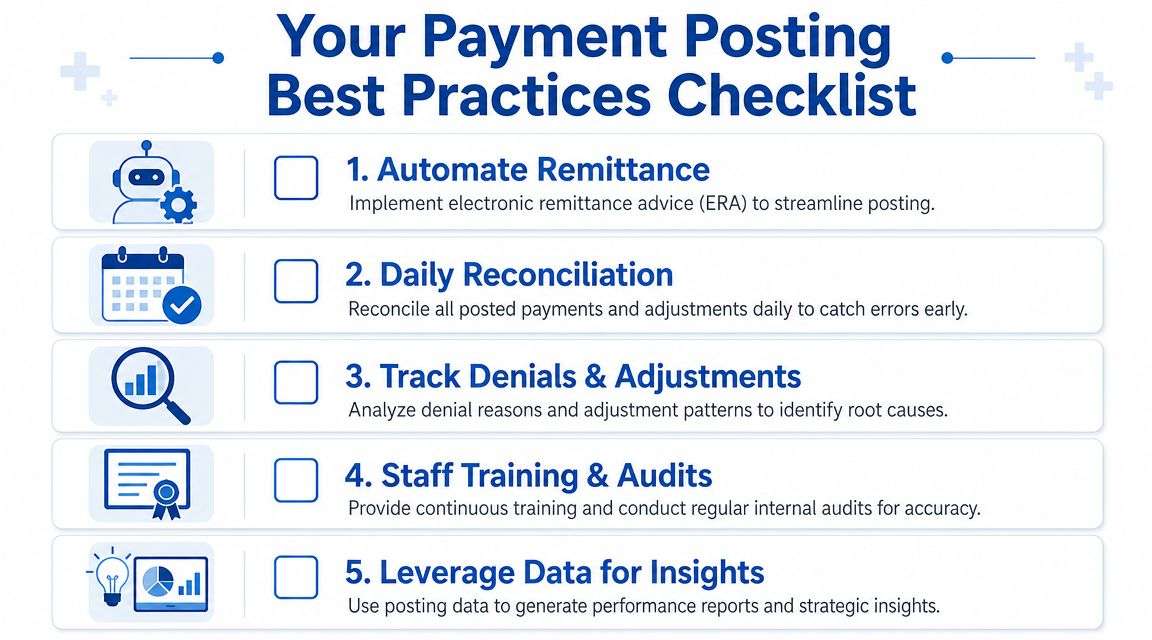
Teams don't usually struggle because they lack effort. They struggle because posting standards live in people's heads instead of in a repeatable operating routine.
Use This Checklist With Your Billing Team
- Reconcile Daily: Match posted activity to remittance and batch controls every day so discrepancies surface while the trail is still fresh.
- Post At The Line Level When Needed: Don't rely on claim-level shortcuts when the remittance requires service-line accuracy.
- Classify Adjustments Carefully: Separate normal contractual activity from questionable payer behavior so reporting stays meaningful.
- Route Denials Immediately: Assign every denial to the right queue or owner before the account ages.
- Review Credit Balances Promptly: Investigate overpayments before they turn into delayed refunds or patient complaints.
- Track Payer Exceptions: Maintain a practical log of repeat adjustment and underpayment issues by payer.
- Audit Patient Responsibility Transfers: Confirm that balances sent to patients are legitimate and not the result of posting or adjudication errors.
- Standardize Exception Handling: Give posters clear rules for when to post, hold, escalate, or rework an account.
- Automate Clean Remittances: Use ERA-based automation where the workflow is stable, but keep staff focused on exceptions.
- Train And Re-Train: Posting accuracy depends on payer rules, system behavior, and internal policy staying aligned.
The Short Version
If you want cleaner reporting, better patient balances, and stronger payer accountability, improve posting discipline first. Posting is where reimbursement becomes either trustworthy financial data or future cleanup work.
That's why medical billing payment posting deserves management attention. Not because it's glamorous. Because it decides whether the practice knows what it has been paid, what is still owed, and what needs action now.
If your team needs help tightening payment posting, reconciliation, denial routing, or payer variance review across one location or many, One For All Medical Billing offers payment posting and broader RCM support built around accurate account resolution and operational visibility.

