

table of contents
A 43239 claim gets denied more often than most billing teams expect. The denial usually doesn't happen because the procedure was wrong. It happens because the record didn't prove the biopsy, the diagnosis link was weak, or the modifier logic fell apart when the claim hit edits.
That creates the kind of rework billing managers know too well. Staff stop what they're doing, pull the op note, review the pathology trail, check payer policy, and build an appeal that could have been avoided upstream. For a high-volume GI code, that's not a small operational problem. It's a revenue cycle leak.
Your Guide To The 43239 CPT Code
Monday morning in a GI billing office usually looks the same. Yesterday's scopes are dropping into charge review, pathology is still pending on some cases, and a payer edit has already kicked back a 43239 claim because the diagnosis pairing or modifier logic did not hold up. That is how this code creates revenue loss. Not through rare coding errors, but through small breakdowns at multiple points in the claim lifecycle.
CPT 43239 deserves close operational control because it sits at the intersection of documentation, diagnosis selection, edit handling, and payer policy. Medicare classifies upper GI endoscopy with biopsy among the covered diagnostic endoscopy services in its endoscopy billing guidance, which is a useful starting point for teams building internal rules around this family of codes. For teams that want the broader code set context, this EGD CPT code guide helps frame where 43239 fits within upper endoscopy billing.
The practical point is simple. A clean 43239 claim depends on decisions made before the scope, during the procedure, after pathology routing, and again at final claim assembly.
Where Revenue Usually Breaks
On high-volume GI accounts, I see 43239 fail in three predictable places:
- Before the date of service: Eligibility is active, but the plan has site-of-service rules, frequency edits, or authorization requirements the team did not confirm.
- Inside the procedure record: The note shows an EGD with biopsy, but it does not clearly support the indication, biopsy site, or clinical reason tissue was obtained.
- During claim construction: The CPT code is correct, but the ICD-10 pairing is weak, the modifier choice does not support the code combination, or the claim hits NCCI and payer-specific edits.
Each failure point creates a different type of work queue. Front-end mistakes trigger avoidable holds. Documentation gaps force coding queries or post-bill appeals. Claim-build errors delay payment even when the service itself was performed and medically appropriate.
Operational rule: Manage 43239 as a revenue cycle workflow, not just a charge entry task.
What Actually Improves Payment
Teams reduce denials when they build controls around the full life of the claim. That means pre-service coverage checks, physician documentation standards that capture biopsy details clearly, coder review for diagnosis linkage, and denial tracking by payer so repeat edit patterns are corrected upstream.
Generic endoscopy habits are usually not enough here. 43239 is a code where one missing detail can convert a payable claim into rework, and repeated rework on a common GI service erodes margin fast. Billing managers who treat 43239 as a monitored process usually get better first-pass acceptance, fewer medical necessity denials, and cleaner appeal files when a payer still pushes back.
Decoding CPT 43239 And Its Clinical Purpose
CPT 43239 means “Esophagogastroduodenoscopy, flexible, transoral; with biopsy, single or multiple.” The key phrase is with biopsy. CMS guidance distinguishes it from 43235, which is the diagnostic-only EGD code used when no biopsy is performed, as outlined in CMS Local Coverage Article A57414.
In billing terms, 43235 is the scope and visual exam. 43239 is the scope, visual exam, and tissue sampling. That difference is the whole claim.
The Simplest Way To Explain It
Use this comparison when training new coders or charge entry staff:
- 43235: The provider looked.
- 43239: The provider looked and took tissue for analysis.
A practical analogy helps. 43235 is like taking a picture. 43239 is like taking a picture and bringing back a sample. If there's no tissue sample documented, don't bill 43239.
For a broader upper endoscopy code overview, this guide to the CPT code for EGD procedures is a useful reference point for teams building specialty-specific coding rules.
What The Code Includes
43239 already bundles the standard diagnostic endoscopy work that happened during the same encounter. Brushing, washing, and specimen collection tied to the diagnostic exam aren't separately billable. Trying to split those services out creates unbundling risk and invites denials.
That matters because many denials don't come from dramatic mistakes. They come from over-reporting routine components that are already included in the primary CPT.
If the biopsy is documented, bill 43239 once for the session, even when multiple biopsy samples are taken.
What Payers Want To See
The code requires more than the word “biopsy” in the note. Payers want enough detail to support that the biopsy was clinically justified and performed in a way that matches the billed service. When the note is vague about site or intent, the claim becomes vulnerable.
Common weak phrases include:
- “Biopsy taken” with no location
- “Specimens sent” with no reason
- “Upper endoscopy performed” without showing that sampling occurred
Strong coding starts with understanding that 43239 is not a more detailed version of 43235. It's a different service because tissue was obtained. If your team holds that line consistently, you eliminate one of the most common causes of avoidable denial.
Mastering Documentation For Medical Necessity
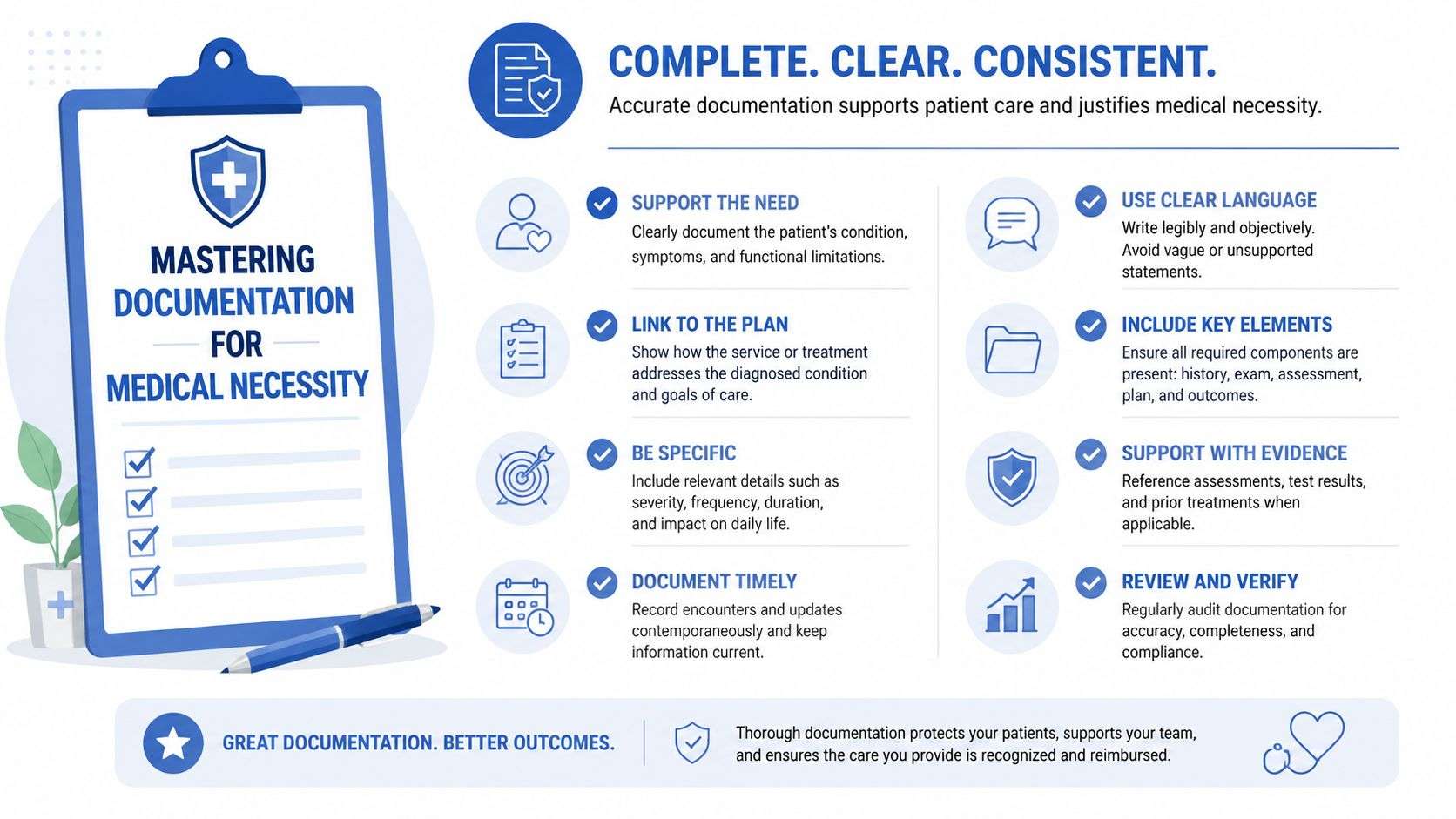
A denial for 43239 often starts long before the claim hits the payer. The physician documents "EGD with biopsy," pathology is pending, the coder has no clear indication-to-finding link, and the billing team is left trying to defend medical necessity after the fact. For a high-volume endoscopy code, that rework drains staff time and delays cash.
For 43239, the operative note has to do more than confirm that tissue was taken. It has to show why biopsy was reasonable on that date of service, at that site, for that patient. Medicare and commercial payers both look for that connection in post-payment review and prepayment edits, especially when the diagnosis submitted does not clearly support sampling.
What The Operative Report Must Say
A defensible 43239 note shows a clean chain of medical necessity. The reviewer should be able to follow the logic without filling in gaps.
Include these elements:
- The indication for the procedure: Dysphagia, melena, refractory GERD symptoms, iron deficiency anemia under evaluation, abnormal imaging, suspected celiac disease, or another documented reason for the exam.
- The endoscopic findings: Esophagitis, nodular mucosa, ulceration, erythema, erosions, suspected Barrett's mucosa, duodenal scalloping, mass, or other abnormal findings that explain why tissue sampling was performed.
- The exact biopsy site: Distal esophagus, gastric antrum, gastric body, duodenal bulb, second portion of the duodenum, or each separate anatomic location sampled.
- The clinical intent: Rule out eosinophilic esophagitis, confirm H. pylori gastritis, assess dysplasia, evaluate celiac disease, investigate neoplasia, or document another reason tied to the finding.
- Specimen submission: Confirmation that tissue was obtained and sent to pathology.
Specificity protects revenue. "Biopsies obtained" is not enough if the note never identifies what looked abnormal, where the tissue came from, or what question the biopsy was meant to answer.
What Strong Medical Necessity Documentation Looks Like
The cleanest notes answer four questions in sequence:
- Why was the EGD performed?
- What did the physician see?
- Why did those findings justify biopsy?
- Where was each specimen taken from?
That order matters because coders build the claim from the record as written, and auditors review the same record with no benefit of hallway clarification. If the indication is vague, the finding is missing, or the site is nonspecific, the diagnosis-to-procedure link weakens. That is the point in the revenue cycle where avoidable denials begin.
Teams that formalize clinical documentation improvement workflows usually get better results from short GI-specific prompts inside the template than from one-time education sessions alone. A two-line prompt for indication, finding, site, and intent prevents more denials than a generic reminder to "document better."
Documentation Gaps That Trigger Rework
Several note patterns repeatedly cause missed revenue or force appeals:
- Copy-forward history with no current rationale: Prior symptoms are pasted into the note, but nothing explains why biopsy was indicated during this encounter.
- Conflicting template language: One field says the exam was normal, another says biopsy was taken. That inconsistency invites medical necessity review.
- Missing biopsy intent: Tissue is documented, but the note never states what diagnosis the physician was evaluating.
- Anatomic ambiguity: "Stomach biopsy" is weaker than "gastric antrum biopsy." Broad wording gives the payer room to question diagnosis linkage.
- Findings documented after the plan without clear connection: The physician lists pathology goals, but the note does not tie those goals to observed mucosal abnormalities or the presenting problem.
From an RCM standpoint, this section of the chart drives more than code selection. It affects diagnosis support, modifier defensibility, appeal strength, and how quickly your team can respond if records are requested. For 43239, strong documentation at the front end is usually cheaper than fixing the claim after denial.
Correctly Applying Modifiers And ICD-10 Codes
Many otherwise valid 43239 claims either survive or fail at this critical juncture. The procedure may be documented correctly, but if the modifier logic is wrong or the diagnosis linkage is weak, reimbursement gets delayed or reduced.
Recent reimbursement guidance notes that Modifier 22 can increase payment by 20% to 50% when the added work is fully supported, and that using the correct distinct service modifier in bundled scenarios has dropped denial rates from 12% to 2% in RCM benchmarks, according to MD Clarity's CPT 43239 reimbursement review.
Modifier 59 And XS
Use these when 43239 is performed with another procedure and the record supports a distinct procedural service. The modifier isn't there to rescue weak documentation. It's there to show that the services were separate enough to pass edit logic.
Examples of when to review for distinctness:
- Same-day endoscopic services involving different sites
- Encounters where another procedure creates bundling risk
- Cases where NCCI edits would otherwise collapse the claim
If the only reason the modifier appears is “because the payer usually denies without it,” that's a red flag.
For teams that want a quick refresher on modifier decision rules, this practical explanation of CPT modifier usage helps frame when modifiers clarify a claim and when they just create exposure.
Modifier 22
Use Modifier 22 only when the procedure required work beyond the usual service. For 43239, that can apply when anatomy, visualization, or procedural difficulty materially increased the effort. The modifier must be supported by clear operative details.
Good support usually includes:
- The specific reason the work was unusually difficult
- The added physician effort or complexity
- A note that makes the extra work obvious to the reviewer
Poor support sounds like “procedure difficult” with no explanation. That won't hold up.
Modifier 53
Use Modifier 53 when the procedure started but had to be discontinued because continuing would endanger the patient. The record needs to show that the procedure had begun and why it stopped.
This is not the modifier for scheduling issues, prep problems discovered before initiation, or general inconvenience. It's for an interrupted procedure under qualifying clinical circumstances.
Don't use a modifier to patch a narrative gap. Build the narrative first, then decide if the modifier is justified.
ICD-10 Pairing Principles
Diagnosis coding has to do more than describe the patient generally. It has to support why this EGD included a biopsy. In practical terms, your ICD-10 choice should connect to the indication, findings, and pathology intent in the op note.
Common compliant diagnosis categories referenced in payer guidance include:
- GERD-related diagnoses
- Barrett's esophagus
- Gastritis
- Duodenitis
- Suspected upper GI pathology or malignancy
The verified data also references examples such as K21.9, K29.60, and K31.9 in the context of supporting documentation requirements under LCD-related guidance. Use exact diagnosis selection based on the physician's final documentation, not coding habit.
A Frequent Code Selection Mistake
One recurring error is confusing biopsy with snare polypectomy. Those are not interchangeable services. If the physician removed a lesion using a snare, that points away from 43239 and toward the more specific removal code. Misclassifying that service is a common denial trigger.
A simple internal rule helps: if the note says tissue was sampled for diagnosis, think biopsy. If it says lesion or polyp was removed with a technique such as snare, verify the code family before claim submission.
Navigating Payer Rules And Common Denials
A technically correct claim can still deny when it collides with payer edits, payer-specific diagnosis policies, or unsupported biopsy logic. That's why 43239 has to be managed as both a coding issue and a payer-behavior issue.
Recent claims data showed that payers flagged over 32% of outpatient GI endoscopies billed with CPT 43239 due to unsuitable biopsy reporting, and over 27% of 43239 denials stemmed from unsubstantiated diagnosis codes. The same review also noted that billing 43239 for a diagnostic EGD alone, when 43235 should have been used, remains a frequent audit and denial driver, according to this 43239 denial analysis.
Why Payers Reject These Claims
Payers aren't just checking whether a scope happened. They're testing whether the billed code, diagnosis support, and documentation all tell the same story.
That story breaks when:
- The op note documents an exam but not the biopsy clearly enough
- The diagnosis code is too nonspecific for the payer's coverage rules
- Bundled services are reported separately without valid distinction
- The billed CPT suggests tissue sampling, but the record reads like diagnostic-only EGD
The Denial Patterns Billing Managers Should Track
You'll get more value from denial reporting if you separate 43239 denials into distinct buckets instead of one generic “medical necessity” category.
Use categories such as:
- No biopsy support in op note
- Diagnosis not covered or not substantiated
- Bundling or edit failure
- Modifier missing or not accepted
- Procedure downcoded to diagnostic EGD
That breakdown tells you where to intervene. If most denials sit in diagnosis support, coder education may help. If they sit in biopsy proof, physician documentation is the main issue.
The payer's question is simple: “Why was this biopsy necessary for this patient on this date?” If your claim doesn't answer that cleanly, it's vulnerable.
Moving From Appeals To Prevention
A strong denial prevention program for 43239 usually includes pre-bill review for high-risk combinations, payer-specific diagnosis crosswalks, and fast feedback to physicians when notes are incomplete. Teams that want a tighter process often build those steps into a broader medical billing denial management workflow.
The key trade-off is speed versus accuracy. If your staff rush 43239 claims out the door without confirming biopsy support and diagnosis linkage, you may post charges faster but collect slower. For this code, front-end discipline usually beats back-end appeal volume.
An Example Claim Workflow To Reduce Denials
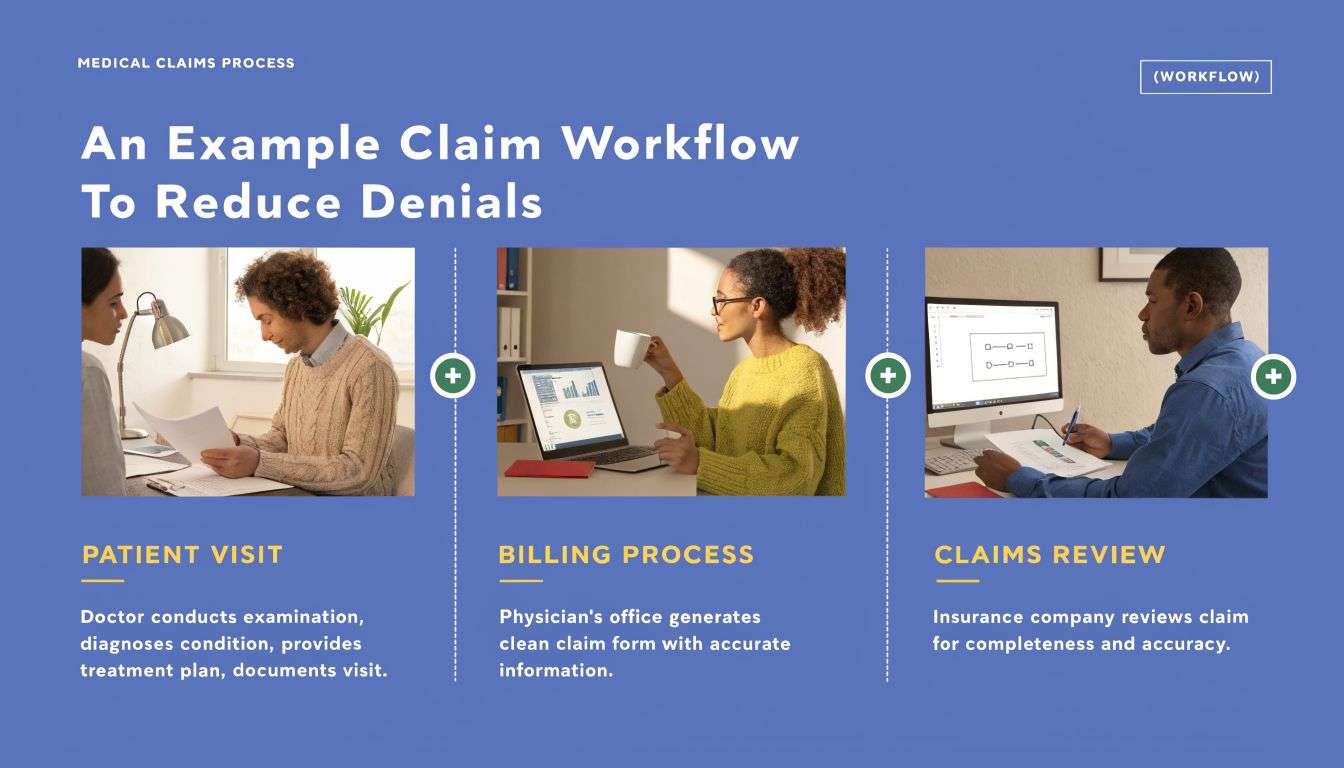
A workable 43239 process doesn't depend on one excellent coder catching everything. It depends on a repeatable handoff sequence where each team member has one clear job and the next step doesn't start with missing information.
Step One At Scheduling
The workflow starts before the encounter. Staff verify eligibility, check payer requirements, and confirm whether the plan expects authorization or other pre-service documentation for upper GI endoscopy claims. They also make sure the ordering reason is captured clearly enough to support later diagnosis review.
If the front end records only “EGD” without a clinical reason, the claim starts weak.
Step Two In The Procedure Note
The physician documents the indication, findings, biopsy location, and biopsy purpose while the encounter details are still fresh. The note should be complete before coding, not fixed later by billing staff through email chains and addenda whenever possible.
This is also the point where pathology tracking should be linked operationally, so the record supports the sampling narrative.
Step Three In Coding Review
The coder reviews the op note against the billed service. If the documentation supports biopsy, assign 43239. If it reads as diagnostic-only, stop and query before defaulting to the higher-value code.
The coder also checks for:
- Distinct service scenarios needing modifier review
- Diagnosis linkage that supports medical necessity
- Mismatch between physician wording and charge ticket selection
Step Four At Claim Scrub And Submission
Before release, the claim scrubber should flag common 43239 risk points. In many practice management systems, that includes edits for missing diagnosis linkage, questionable modifier combinations, and code pairings that can trigger bundling.
If your team outsources part of this work, one option is using a full-service RCM partner such as One For All Medical Billing's bill type and claims support resources alongside your own internal controls, especially when multi-site charge capture is inconsistent.
Step Five After Adjudication
Payment posting should do more than close the account. Staff should reconcile expected versus actual reimbursement, identify downcodes, and route denials into a code-specific work queue. That gives the billing manager a usable feedback loop.
A clean workflow for 43239 isn't complicated. It's disciplined. When eligibility, documentation, coding, edits, and reconciliation line up, denials fall because the claim tells one consistent story from start to finish.
Frequently Asked Questions About Billing 43239
Can 43239 Be Billed On The Same Day As A Colonoscopy
Yes, but don't assume same-day billing means automatic payment. Review bundling logic, confirm the procedures were separately reportable, and apply the appropriate modifier only when the documentation supports distinct services. If the record doesn't clearly separate what was done, the modifier won't save the claim.
What's The Difference Between 43239 And 43251
43239 is for EGD with biopsy. 43251 is for EGD with snare removal of a lesion or polyp. Don't code a removal procedure as a biopsy just because pathology was sent afterward. The technique documented in the operative note controls the code choice.
Does A Negative Biopsy Result Change Reimbursement
No. Reimbursement is based on the medical necessity and documentation for performing the biopsy, not on whether the pathology result was positive, negative, or inconclusive. What matters is that the record supports why tissue sampling was clinically appropriate when the procedure was performed.
How Can Billing Teams Tighten Review Without Slowing Everything Down
The most practical approach is targeted automation. Rules-based claim edits, documentation prompts, and denial pattern analysis help staff focus on the claims most likely to fail. If your team is exploring workflow automation, this overview of OpenClaw AI for healthcare is a useful example of how AI tools are being discussed in administrative healthcare operations.
If your team is dealing with recurring 43239 denials, One For All Medical Billing can support the full revenue cycle, from eligibility verification and coding review to denial follow-up and payment reconciliation, with workflows built for specialty-specific claim accuracy.

