

table of contents
A denied abdominal aortic aneurysm claim usually doesn’t fail because the patient’s condition was unclear. It fails because the chart didn’t say enough for the code that was chosen. A note says “AAA follow-up,” the ultrasound is billed, the payer asks where the aneurysm sits in relation to the renal arteries or whether rupture was ruled out, and payment stalls.
That pattern frustrates practice managers because basic abdominal aortic aneurysm icd 10 articles rarely address the part that affects cash flow. They list a code, maybe two, and stop there. In real operations, that’s where the trouble starts. Front-desk staff schedule a screening, the provider documents “aneurysm,” the coder has to decide whether it’s ectasia, unruptured AAA, ruptured AAA, or a different aortic pathology entirely, and the biller is left cleaning up preventable denials.
Your Authoritative Guide To Abdominal Aortic Aneurysm ICD 10 Coding
If your team handles vascular, primary care, urgent care, or multi-site billing, AAA coding has become a documentation problem before it becomes a coding problem. The old habit of using a broad abdominal aortic aneurysm diagnosis and hoping the rest sorts itself out doesn’t hold up when payers want specific anatomy, rupture status, and medical necessity tied cleanly to the service.
The most expensive mistakes are usually simple:
- A vague diagnosis line that says “AAA” without saying whether it’s ruptured or unruptured
- A missing location detail when the surgeon documented infrarenal or juxtarenal anatomy elsewhere in the chart
- A screening claim billed like surveillance after the patient already has a known aneurysm
- A follow-up study linked to the wrong diagnosis family
Clean AAA billing starts with a repeatable process, not coder heroics. The teams that perform best usually standardize three things first:
- Provider prompts in the note for location, rupture status, and diameter
- Coder review rules for ectasia versus aneurysm versus dissection
- Claim edits that catch diagnosis and procedure mismatches before submission
Operational rule: If the clinical note doesn’t identify rupture status and location clearly enough for someone outside the practice to understand it, it probably isn’t ready to bill.
For teams building that process, practical ICD-10 education for billing accuracy helps more than another static code list. What matters is training people to read the chart the way the payer will read it.
Understanding The Clinical Context Of AAA For Accurate Coding
A payer denies an abdominal ultrasound follow-up because the claim says only “AAA,” while the vascular note documents an infrarenal aneurysm with interval growth. That kind of miss is common, and it usually starts before the coder touches the claim. Clinical context drives diagnosis selection, medical necessity, and in many plans, whether prior authorization or post-payment review will hold up.
An abdominal aortic aneurysm is a pathologic enlargement of the abdominal aorta. In practice, the 3 cm threshold still matters because reports below that range may support ectasia or simple dilation rather than a reportable aneurysm diagnosis. If the radiology impression says “mild ectasia” and the physician does not diagnose AAA, assigning an aneurysm code creates audit risk and can trigger avoidable denials.
The reimbursement issue is not just whether an aneurysm exists. Payers increasingly expect the record to support what kind of aneurysm is being followed. Size, rupture status, and location relative to the renal arteries all affect how reviewers interpret necessity for surveillance imaging, specialist follow-up, and repair planning. Infrarenal versus juxtarenal anatomy is a frequent weak point. Practices that ignore that distinction often see denials that basic code lists never warn about.
Why The Clinical Picture Matters To Billing
AAA shows up in several billing pathways. A Medicare screening encounter follows one set of rules. Incidental findings on CT or ultrasound create a diagnostic workup path. Established aneurysms move into surveillance, and symptomatic or ruptured cases shift the urgency, place of service, and supporting documentation entirely.
Those differences should be clear in the note. A screening study should read like screening, with risk factors and eligibility documented. A surveillance study should show a known aneurysm, prior measurements when available, and the reason interval imaging is being repeated. For teams managing preventive claims, this cardiovascular disease screening ICD-10 guidance helps separate screening logic from disease-management billing.
Risk factors also matter because they support why the patient was screened or why follow-up was reasonable. Smoking history, age, sex, family history, and vascular comorbidities often appear in payer policies and utilization review criteria. If those details stay buried in the history instead of appearing clearly in the assessment and plan, the practice makes its own defense harder.
Why Accuracy Has Real Stakes
This is not a minor coding distinction. It affects authorization, diagnosis validity, and whether surveillance imaging is paid at all.
An NIH-published mortality analysis reported that U.S. age-adjusted mortality for aortic aneurysm and dissection declined from 8.89 to 3.75 per 100,000 population from 1999 to 2023 in association with better screening and treatment patterns, including endovascular care, as shown in this NIH-published mortality analysis. From a revenue-cycle standpoint, that trend matters because properly coded surveillance and intervention claims support the care pathway that prevents emergency presentations and supports timely repair.
The practical rule is simple. Code AAA only when the chart supports aneurysm, and make sure the documentation states the details a payer will ask for later. If your denials cluster around follow-up imaging or vascular referrals, review whether providers are documenting diameter, growth, and anatomy with enough specificity to support the diagnosis billed.
Core ICD 10 CM Codes For Abdominal Aortic Aneurysm
The old shorthand for abdominal aortic aneurysm coding was easy to remember and easy to misuse. Historically, I71.4 designated abdominal aortic aneurysm, without rupture. It was the foundational code for unruptured AAA and helped distinguish those cases from ruptured aneurysms and from other aortic conditions.
That legacy matters because many practices still have templates, superbills, and internal habits built around I71.4. The problem is that coding now requires more anatomical precision.

The Primary Coding Split
The first decision point is still the most important one. The chart must support whether the aneurysm is:
- Unruptured
- Ruptured
- Not documented well enough to assign either safely
If the documentation is vague on rupture status, the coder shouldn’t guess. That kind of guess can affect medical necessity, urgency, procedure authorization, and claim review.
The 2026 Specificity Shift
For the 2026 ICD-10-CM update, coders must identify the aneurysm’s location relative to the renal arteries. Unruptured infrarenal AAA is coded as I71.43, while unruptured juxtarenal AAA is I71.42, a distinction that matters for compliance and complex repair billing, according to this 2026 AAA code update overview.
That means the coder needs to pull location from the actual clinical record, not from assumption. “Abdominal AAA” is no longer enough when the op note, CTA impression, or vascular consult identifies anatomy more precisely.
The Codes Your Team Should Keep Straight
Use this practical hierarchy in daily work:
- I71.42 for juxtarenal AAA without rupture
- I71.43 for infrarenal AAA without rupture
- I71.30 for ruptured AAA, when supported by documentation
- Z13.6 for screening in an asymptomatic patient
- I77.811 when the finding is abdominal aortic ectasia, not aneurysm
A coder should never “upgrade” an ectasia finding into AAA just because the patient is under surveillance. The diagnosis has to match the documented pathology.
What Works In Practice
Practices reduce coding friction when radiology and vascular templates use the same words coders need. The most helpful note language includes the exact site, whether rupture is present, and whether the visit is for screening, active management, or surveillance.
What doesn’t work is relying on impression-only language like “stable AAA” when the rest of the chart contains the details but nobody carries them into the final assessment.
Distinguishing AAA From Aortic Ectasia And Dissection
A denial review often starts with a chart that says “aortic enlargement,” while the CTA says “ectasia” and the vascular consult says “small infrarenal aneurysm.” If the diagnosis is not reconciled before claim submission, the practice risks the wrong ICD 10 code, medical necessity edits, and avoidable payer follow-up.
AAA Versus Ectasia
For coding, the distinction is not semantic. It affects diagnosis selection, surveillance coverage, and whether the payer sees the visit as aneurysm management or follow-up of a lesser dilation.
AAA is generally documented when the abdominal aorta meets aneurysmal criteria, commonly a diameter greater than 3 cm. Ectasia describes dilation that falls short of that threshold. Coders should not decide this from imaging measurements alone if the treating physician finalizes a different diagnosis. The billed diagnosis should match the provider’s assessment, supported by the imaging record.
This is a common revenue problem. A radiology report may describe ectasia, while the assessment carries forward “AAA” from an old problem list. That mismatch triggers payer scrutiny, especially when the claim also includes surveillance imaging or vascular surgery follow-up. Practices get better results when the provider updates the assessment and impression in the same visit rather than leaving coding staff to reconcile conflicting terms after the fact.
If your physicians document aneurysm surveillance frequently, build that distinction into your clinical documentation improvement workflow. It reduces retrospective queries and helps prevent denials tied to unsupported aneurysm diagnoses.
AAA Versus Dissection
Dissection is a separate aortic condition with different coding logic and different clinical implications. AAA refers to aneurysmal dilation of the vessel. Dissection refers to a tear within the aortic wall, often documented with terms such as intimal flap, true lumen, or false lumen.
That difference matters on claims. A note centered on aneurysm size, interval growth, and repair planning points toward AAA coding. A note centered on flap, tear, lumen involvement, or acute aortic syndrome points toward dissection coding. If both conditions are present, both must be clearly documented in the final diagnostic statement. Coders should not infer one from the other.
Payers also look closely at anatomic specificity here. If the surgeon or vascular specialist identifies an infrarenal aneurysm but imaging raises concern for suprarenal extension or dissection, vague wording can derail both diagnosis coding and downstream procedure authorization. In practice, I see denials when the impression uses one term, the body of the report supports another, and no one closes the loop before billing.
A Quick Comparison For Staff Training
- Ectasia means abdominal aortic dilation below aneurysm criteria
- AAA means documented aneurysmal enlargement of the abdominal aorta
- Dissection means a tear within the aortic wall, with separate diagnosis coding
- Rupture status must be stated by the provider and should never be inferred from symptoms alone
- Location details such as infrarenal versus juxtarenal should stay consistent across imaging, assessment, and claim diagnosis selection
The safest coding rule is simple. Use the provider’s final diagnosis, confirm it against the imaging findings, and query any chart that mixes ectasia, aneurysm, and dissection terminology without a clear conclusion.
Essential Documentation To Support AAA Coding And Avoid Audits
Most AAA denials begin much earlier than claim submission. They start when the provider note leaves out a detail the coder needs but assumes someone else will infer. Auditors and payers don’t infer. They read what’s there.

The AAA Documentation Checklist
Every AAA-related encounter should support these elements in the medical record:
Exact diagnosis
State whether the patient has AAA, ectasia, dissection, or another aortic condition.Rupture status
Document unruptured or ruptured explicitly. Don’t leave the coder to interpret symptoms.Anatomic location
Record whether the aneurysm is infrarenal, juxtarenal, or otherwise defined in the clinical note.Maximum diameter
Include the measured size in centimeters when available from imaging or vascular documentation.Encounter purpose
Clarify whether the service is screening, surveillance, diagnostic workup, treatment planning, or post-procedure follow-up.Symptoms or asymptomatic status
If the patient has abdominal pain, back pain, or an incidental finding, say so. If asymptomatic, that matters too.Relevant associated findings
Note dissection, traumatic cause, syphilitic cause, or other clinically documented distinctions when applicable.
What Auditors Look For
Payers usually test whether the diagnosis billed is the diagnosis documented, and whether the service rendered fits that diagnosis. AAA claims draw extra scrutiny when imaging, screening, and surgical planning all appear in the same longitudinal chart.
A practical clinical documentation improvement workflow helps when teams struggle with carry-forward problem lists and inconsistent vascular terminology.
What Actually Improves The Record
The best fix is usually a short EHR prompt, not a long education memo. Add required fields in the vascular or follow-up template:
- Location relative to renal arteries
- Largest documented diameter
- Rupture status
- Reason for visit
Audit insight: If your note can support a prior authorization but not a post-payment review, it still isn’t complete enough.
That small change gives coders what they need and gives billers cleaner support when a payer requests records.
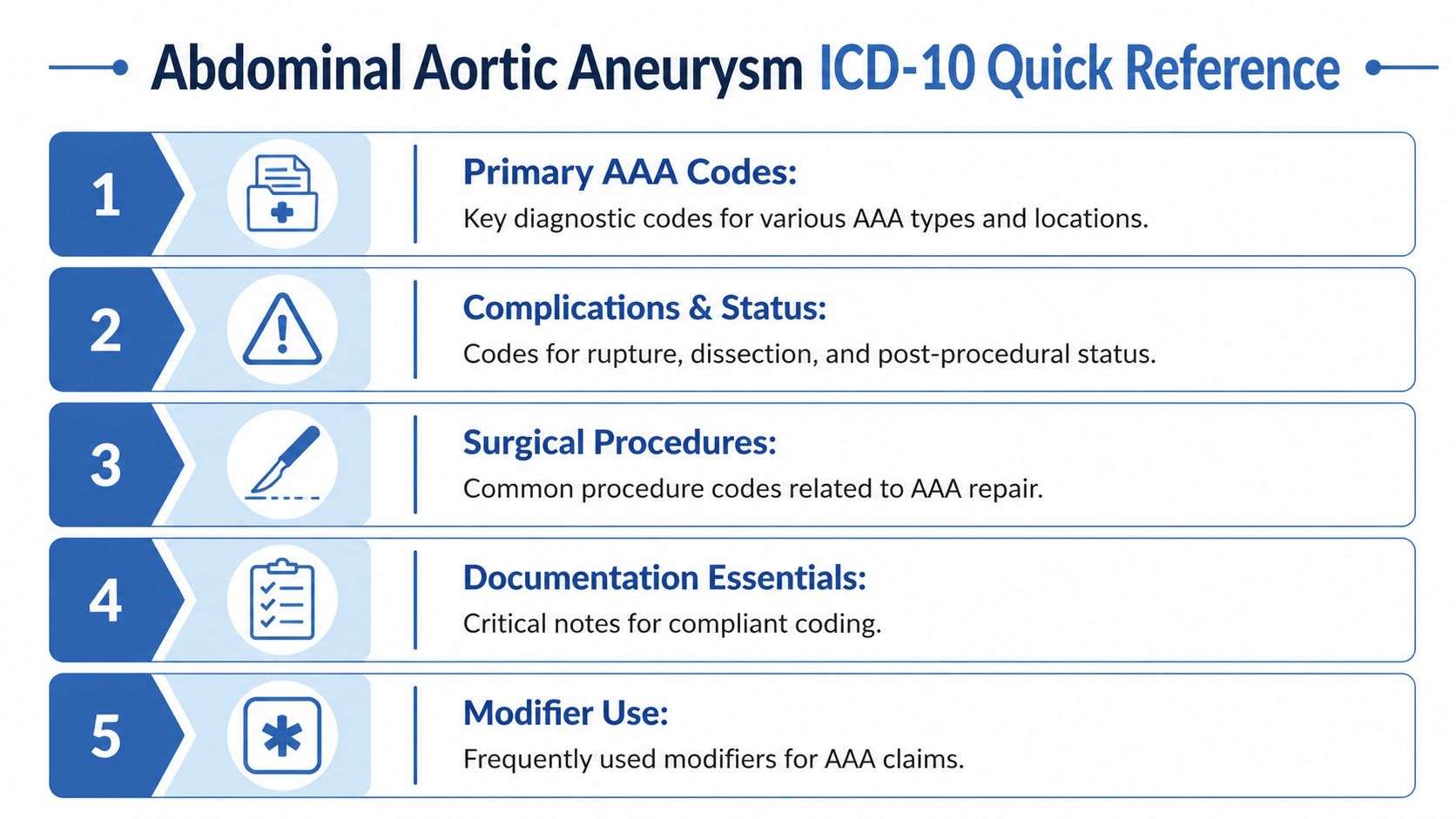
Abdominal Aortic Aneurysm ICD 10 Quick Reference Guide
Busy teams need a workstation version of the rules. This is the short list worth keeping in daily view.
Key Diagnosis Codes
I71.42
Unruptured juxtarenal abdominal aortic aneurysmI71.43
Unruptured infrarenal abdominal aortic aneurysmI71.30
Ruptured abdominal aortic aneurysmI77.811
Abdominal aortic ectasiaZ13.6
Screening for cardiovascular disorders, used for asymptomatic AAA screening situations
Quick Use Rules
- Use a screening code only when the patient is being screened and doesn’t already have a diagnosed AAA.
- Use an aneurysm code only when the documentation supports aneurysm rather than ectasia.
- Don’t treat pain alone as proof of rupture.
- If the surgeon or imaging report identifies juxtarenal or infrarenal anatomy, carry that specificity into code selection.
Keep These Pairings Straight
- Screening ultrasound should align with screening intent
- Surveillance imaging should align with a known diagnosis
- Post-repair visits need clear status documentation, not just the old diagnosis copied forward
This quick reference works best when paired with a claim edit that stops broad abdominal aortic aneurysm icd 10 selections if the chart contains more specific anatomic language.
Practical Coding Scenarios From Screening To Follow Up
Rules stick better when they’re applied. These are the situations that create the most confusion in real billing workflows.
Scenario One Medicare Screening Visit
A beneficiary comes in for a one-time AAA screening ultrasound based on Medicare eligibility criteria. The patient has no prior AAA diagnosis and no symptoms suggesting known aneurysm management.
For this encounter, code it as screening, not disease surveillance. The diagnosis should reflect screening status. The verified guidance allows Z13.6 for asymptomatic screening, and Medicare AAA screening uses CPT 76706 in the documented screening context described in the AAA code background.
The usual mistake is assigning an aneurysm diagnosis before an aneurysm has been established.
Scenario Two Known AAA Surveillance
A patient with a previously diagnosed unruptured aneurysm returns for interval imaging. The report confirms the known condition and the provider documents continued monitoring.
This is no longer a screening claim. It’s disease surveillance tied to the diagnosed aneurysm. If the note identifies infrarenal or juxtarenal anatomy, use the corresponding diagnosis code rather than a broad legacy habit.
What works here is matching the diagnosis to the current documented anatomy and linking the imaging to surveillance of a known condition.
Scenario Three Urgent Presentation With Suspected Rupture
An urgent care or emergency setting receives a patient with severe symptoms, imaging is obtained, and the final documented diagnosis supports ruptured AAA.
The coding point is simple but critical. Don’t code rupture from symptom severity alone. Wait for the provider’s confirmed diagnosis. Back pain may appear in many conditions. The diagnosis must come from the documented clinical conclusion.
Scenario Four Post EVAR Follow Up
A patient returns after endovascular aneurysm repair. The follow-up note reviews recovery, imaging status, and graft-related planning.
Teams often keep billing the original aneurysm diagnosis without clarifying the visit’s purpose. Post-procedure follow-up coding depends heavily on how the provider frames the encounter. If the reason for the visit is surveillance after repair, the chart must say so clearly.
For practices that need help choosing abdominal imaging codes tied to these encounters, CT abdomen CPT coding guidance can help billing staff avoid diagnosis-to-procedure mismatches.
The cleanest claims come from notes that answer one question plainly: why is the patient here today, and what exact aortic condition is being managed?
A Brief On Procedure Coding For AAA Repair With ICD 10 PCS
Diagnosis coding tells the payer what condition exists. ICD-10-PCS tells the inpatient side what procedure was performed. For hospital claims involving AAA repair, the PCS side becomes just as important as the diagnosis side.
Open Repair And Endovascular Repair Aren’t The Same
Open AAA repair and endovascular aneurysm repair are profoundly different procedures, and the PCS code set reflects that difference. In practical terms, coding staff need to know whether the surgeon replaced a segment through an open approach or placed an endovascular device through the vessel.
That distinction affects root operation selection, body part value, device value, and approach. It also affects how the inpatient record supports the severity and resource intensity of the admission.
What Billers Should Watch In The Operative Record
Even if a practice manager isn’t assigning PCS codes personally, these details matter:
- Open versus endovascular approach
- Standard EVAR versus more complex fenestrated or branched work
- Exact aortic segment treated
- Any additional vessel work performed during the case
The diagnosis code and the procedure record have to tell the same story. If the diagnosis supports a juxtarenal aneurysm but the procedure documentation reflects a more complex endovascular repair than the coding team expected, that record deserves closer review before final billing.
The Practical Revenue Cycle Point
PCS accuracy protects more than claim submission. It affects inpatient reimbursement integrity, utilization review alignment, and audit readiness. Teams that separate diagnosis coding from operative coding too aggressively often miss inconsistencies that a payer or auditor will spot quickly.
For surgical AAA episodes, the strongest workflow is a cross-check between the vascular note, imaging, final diagnosis, and operative report before claim release.
Common AAA Claim Denials And How To Fix Them
A vascular follow-up claim goes out with a broad AAA diagnosis, the CTA report documents infrarenal disease, and the payer asks for records. Two weeks later, the claim is denied for lack of specificity. That sequence is common, and it is usually preventable.
AAA denials tend to cluster around the same operational failures. Providers document the aneurysm, but not the details the payer uses to validate medical necessity. Coders rely on legacy habits. Claim edits miss anatomy, rupture status, or screening history that should have been caught before submission.

An AAPC cardiology coding alert discussing AAA coding denials highlights a pattern many practices already see in their own remits. Payers scrutinize claims more closely when the record does not clearly state rupture status, aneurysm size, or location, especially when imaging supports a more specific description than the billed diagnosis reflects, as explained in this AAPC cardiology coding alert on keeping AAA coding in fine form.
Denial Pattern One. Rupture Status Is Missing
A note that says only “AAA” creates an avoidable problem. The payer is left to ask whether the aneurysm is ruptured, nonruptured, repaired, or historical.
How to fix it: Require the assessment to state rupture status in plain language. If the physician intends a nonruptured diagnosis, the record should say so directly. Coders should not infer it from a stable office visit, normal vitals, or the absence of emergency treatment.
Denial Pattern Two. Anatomy Is Documented In Imaging But Not Carried Into Coding
This is one of the highest-yield edits I recommend for vascular claims. The radiology report may say infrarenal or juxtarenal, but the claim goes out with a broad AAA diagnosis because no one reconciled the final note against the imaging.
That gap matters for reimbursement and denials. Several payers apply stricter review when aneurysm location and size are missing, particularly on surveillance imaging, pre-op workups, and cases that may later support repair.
How to fix it: Add a pre-bill comparison step between the CTA or ultrasound impression, the vascular surgeon’s assessment, and the diagnosis code selection. If the imaging gives location detail, the provider should either adopt that language or clarify why it should not be used.
Denial Pattern Three. Screening And Surveillance Get Mixed Together
A one-time screening benefit does not function like follow-up care for a known aneurysm. Front-desk staff and schedulers often collapse these into one workflow, and that creates downstream denials.
How to fix it: Separate intake questions for screening versus known AAA follow-up. If the patient already carries an AAA diagnosis, the visit should be built as surveillance or management, not preventive screening. A disciplined medical billing denial management process helps teams trace which payers are denying these claims and where registration errors begin.
Denial Pattern Four. Diagnosis And Procedure Do Not Tell The Same Story
A repair claim supported by detailed operative language will draw attention if the diagnosis side is vague, outdated, or inconsistent with the treated segment. I see this most often after complex reviews, where the surgeon documents more specificity than the diagnosis list reflects.
How to fix it: Hold repair-related claims for senior review when the procedure appears more complex than the diagnosis coding suggests. The diagnosis, imaging, and operative documentation need to align before submission. For practices tightening billing controls across service lines, vendors such as RiverAxe LLC are often evaluated alongside internal edit rules and coder review workflows.
A cleaner appeal letter does not repair a record that never documented the aneurysm clearly in the first place.
Denial Pattern Five. Copy-Forward Keeps Old AAA Diagnoses Active
Problem-list carryover causes quiet but expensive errors. A repaired aneurysm may remain active for years. Aortic ectasia may continue to appear as AAA. Historical vascular disease may be pulled into a current encounter without physician review.
How to fix it: Make diagnosis reconciliation part of follow-up visits for patients with vascular history. The provider should confirm whether the aneurysm is current, repaired, excluded, monitored, or no longer the focus of care. That one habit reduces denials, appeal volume, and audit exposure.
Optimizing Revenue With Accurate AAA Billing And HCC Coding
AAA coding isn’t only about getting one claim paid. It affects risk capture, reimbursement accuracy, and how a multi-site organization represents patient complexity across its revenue cycle.
Recent coding changes have made that more visible. Recent ICD-10 updates affect HCC risk adjustment for AAA claims, over-reliance on the base I71.4 code can cut reimbursement by up to 18% in multi-site systems, and AI-powered coding tools have improved accuracy by 35% by identifying more complex cases such as thoracoabdominal aneurysms, according to this analysis of ICD-10-CM I71.4 and related coding implications.
Where Revenue Is Won Or Lost
The revenue problem usually isn’t that staff don’t know AAA exists. It’s that the workflow allows broad diagnosis capture when the record supports something more precise. That undercuts reimbursement in fee-for-service settings and weakens documentation quality in risk-adjusted environments.
AI tools can help flag missed specificity, but they don’t replace coder judgment. They’re strongest when they surface likely anatomy, missing rupture status, or possible misclassification for human review.
A Practical Strategy For Practice Managers
Use a layered approach:
- Template discipline so providers document location and status consistently
- Coder review rules for ectasia, dissection, and thoracoabdominal crossover cases
- Analytics by payer and site to catch where denials cluster
- Technology support for chart scanning and code suggestion, with human validation
Some billing leaders also review broader system design ideas from vendors and consultants outside healthcare operations teams. For example, this overview of a medical billing system from RiverAxe LLC is useful as a general reference point when evaluating workflow automation, claim visibility, and operational controls.
Better AAA billing comes from combining precise documentation, disciplined coding review, and denial trend analysis. No single software prompt fixes all three.
Practices that treat abdominal aortic aneurysm icd 10 coding as a small diagnosis issue usually leave money on the table. Practices that treat it as a workflow issue usually perform better.
Frequently Asked Questions About AAA ICD 10 Coding
How Do You Code AAA Screening Versus Surveillance
Use a screening diagnosis only when the patient is asymptomatic and does not already have a confirmed AAA diagnosis. If the patient has a known aneurysm and returns for monitoring, that’s surveillance of an existing condition, not preventive screening.
What If Imaging Finds Aneurysm Incidentally
Code the documented condition that the provider adopts as an active diagnosis for the encounter. Don’t assume every incidental mention becomes a billable managed diagnosis. The provider’s final assessment should show whether the finding is clinically addressed, deferred, or referred.
Can You Code AAA If The Report Says Ectasia
Not unless the provider documents aneurysm and the record supports it. Ectasia and aneurysm are related but not interchangeable. If the report describes ectasia, the coder should stay with the ectasia pathway unless the physician clarifies otherwise.
What Diagnosis Supports A One Time Medicare AAA Screening Ultrasound
Use the screening diagnosis when the patient meets screening criteria and does not have a known AAA. The service must be documented as screening, not follow-up of existing disease.
How Should You Handle A Repaired AAA At Follow Up
Don’t automatically keep billing the original active aneurysm diagnosis as if nothing changed. Read the note carefully. The visit may be follow-up after repair, continued surveillance, or management of a related complication. The chart has to support the current status.
When Should A Coder Query The Provider
Query when the chart leaves a genuine coding gap, especially around rupture status, anatomic location, or whether the finding is ectasia versus aneurysm versus dissection. AAA coding is too sensitive to guesswork.
If your team wants cleaner vascular claims, fewer denials, and stronger coding support across screening, surveillance, and post-procedure follow-up, One For All Medical Billing can help build the documentation and billing workflows that make AAA reimbursement more predictable.

