

table of contents
You can't fix a problem you don't understand. Before you start tweaking your healthcare revenue cycle, you have to know exactly where the money is getting stuck. This means digging into your data to find the leaks and establish a clear baseline. Without it, you're just guessing—and your practice's financial health is too important for guesswork.
Establishing Your RCM Baseline And Defining Success

Starting a healthcare revenue cycle optimization project without a baseline is like trying to drive to a new destination without a map. You might feel like you're moving, but you have no idea if you're actually getting closer to your goal or just driving in circles.
A baseline assessment is a health check for your entire revenue cycle. It swaps gut feelings and office rumors for cold, hard data. This is how you find out precisely where your revenue is leaking, whether it's an issue at the front desk or a bottleneck in your appeals process.
Pinpointing Your Critical Key Performance Indicators
First things first, you need to track the right metrics. While you could track dozens of Key Performance Indicators (KPIs), focusing on a handful of critical ones will give you the most insight without causing "analysis paralysis." These numbers tell the real story of your practice's financial health.
A few of the most important RCM KPIs we always start with are:
- Clean Claim Rate (CCR): What percentage of your claims get accepted and paid on the first try? A high CCR, ideally 95% or higher, means your front-end and billing workflows are running smoothly. If it’s low, you have a problem with data entry, coding, or eligibility checks.
- Days in Accounts Receivable (A/R): How long does it take, on average, to get paid? The lower, the better. Most high-performing practices aim for fewer than 40 days. A high number here points to a sluggish collections or follow-up process.
- Denial Rate: What percentage of your claims are getting denied? A 0% rate isn't realistic, but getting it below 5-10% is a very achievable goal. Anything higher than that needs immediate attention.
- Cost to Collect: How much are you spending to collect each dollar owed to you? This includes everything from staff salaries to billing software fees. A low cost to collect is a sign of an efficient RCM machine.
By consistently tracking these core metrics, you create a data-driven foundation for all future optimization efforts. These numbers are not just statistics; they are direct indicators of process failures and opportunities for improvement.
Interpreting The Data To Reveal The Truth
Just collecting the data isn't enough—you have to figure out what it's telling you. For instance, a high denial rate isn’t just a number; it’s a symptom. When you dig into the reasons, you might find that 70% of your denials are due to simple eligibility issues. That’s not a billing problem; it's a front-desk workflow problem.
Likewise, if your Days in A/R are creeping up, don't automatically assume your collections team is slacking. The real culprit could be a new, complex prior authorization rule from a major payer that's delaying claim submissions and making your A/R look older than it really is. Learning more about benchmarking in healthcare can help you set realistic standards for your practice's financial performance.
This is where raw data becomes actionable intelligence. It helps you shift from a vague goal like "improve RCM" to a specific, measurable target like, "Reduce eligibility-related denials by 50% in the next quarter." Getting this clarity is the first, and most critical, step to a successful optimization strategy.
Fortifying Front-End Processes To Prevent Denials

Think of your front desk as more than just a welcome center. It's your first line of defense in the battle for healthcare revenue cycle optimization. A shocking number of claim denials can be traced right back to simple, preventable errors made during patient registration and scheduling.
Building a financial fortress at your practice's front door isn't just a good idea—it's essential for stopping revenue leakage before it even starts. When front-end processes are weak, the entire revenue cycle feels the pain. Inaccurate demographic info, outdated insurance details, or a missed prior authorization create a mountain of costly rework for your billing team. These aren't just administrative hiccups; they're direct hits to your cash flow.
Perfecting Patient Registration And Eligibility Verification
The goal for every single patient interaction should be to capture flawless data right from the get-go. This means having standardized, repeatable workflows that leave no room for error, whether a patient schedules online, calls the office, or walks in.
Think of it as a pre-flight checklist for every appointment. Your team needs a clear process they can follow every single time. Key steps should always include:
- Verifying Patient Demographics: Confirm the patient’s full name, date of birth, and address against a government-issued ID. A single typo is all it takes to trigger a denial.
- Scanning Insurance Cards: Get a clear copy of the front and back of the insurance card at every visit. Yes, even for your regulars. Payer details and plan coverage can change overnight.
- Conducting Real-Time Eligibility Checks: Use your practice management system to run an electronic eligibility check before the patient is seen. This confirms active coverage and gives you a clear picture of their co-pay, deductible, and co-insurance responsibilities.
So many practices make the critical mistake of assuming an established patient's information is still current. Verifying data at every single touchpoint is the single most effective way I've seen to slash registration-related denials.
This relentless focus on accuracy is what separates a denied claim from a paid one. For a deeper look, check out our guide on what constitutes a clean claim in medical billing.
Mastering Proactive Prior Authorization Management
Prior authorizations are a universal headache, with 60% of revenue cycle leaders calling the process overwhelmingly labor-intensive. Simply waiting for a service to be denied because of a missing authorization is a reactive—and expensive—mistake. A proactive authorization strategy is non-negotiable in today's healthcare environment.
I once worked with a multi-location pain management group drowning in authorization-related denials for their interventional procedures. We helped them implement a small, centralized authorization team responsible for tracking payer rules and securing approvals before appointments were even finalized. The results were incredible. That dedicated team cut their authorization denials by over 40% in just six months, completely transforming their cash flow.
This kind of proactive approach reflects a much larger industry trend. Fragmented systems are giving way to integrated platforms that unify the entire revenue cycle. Research even shows that formally bringing clinicians into the financial clearance process streamlines prior authorizations, with some forward-thinking organizations reporting 20-30% improvements in throughput.
By shoring up your front-end workflows, you stop problems before they can start. This doesn't just boost your clean claim rate; it frees up your entire team from chasing down preventable errors, allowing them to focus on high-value tasks and delivering excellent patient care.
Mastering Claims And Proactive Denial Management

Submitting a claim is easy. Getting it paid on the first pass? That's a different story. This is the heart of your billing process, where all your hard work either turns into cash or gets stuck in administrative limbo.
Success here isn’t about luck. It’s the direct result of solid clinical documentation and a smart, proactive strategy for stopping denials before they happen.
The gold standard for any practice serious about healthcare revenue cycle optimization is a clean claim rate of 95% or higher. Think of this as more than just a number—it’s a direct reflection of your financial health and how efficiently your practice runs. When you hit that mark, it means every part of your process, from the front desk to the final submission, is working together seamlessly.
The Unbreakable Link Between Documentation And Coding
Here's something many practices get wrong: clean claims don't start with your billers. They start with your providers. This is where Clinical Documentation Improvement (CDI) becomes so crucial. It’s all about making sure physician notes are clear, complete, and specific enough for your coders to assign the right ICD-10 and CPT codes that prove medical necessity.
Vague or incomplete documentation is a one-way ticket to a denial. If a provider's notes don't fully justify the services billed, payers have every reason to push back. This often forces you to downcode—using a less complex and lower-paying code—or face an outright rejection.
We see it all the time. A cardiologist provides a complex evaluation, but the chart simply reads "patient follow-up." A coder can't justify a higher-level E/M code from that, so they’re forced to bill for a simpler visit. That’s real money left on the table. A good CDI program would coach that provider to capture the full scope of their work, ensuring proper payment.
A claim is a story, and the clinical documentation is its evidence. Without strong evidence, the story falls apart, and your payment is denied. Investing in provider education on documentation best practices pays dividends in reduced denials and accurate reimbursement.
Stop Chasing Denials And Start Preventing Them
Having a team dedicated to appealing denials is purely reactive. It’s a necessary function, but it’s not a strategy for growth. True optimization comes from preventing those denials in the first place. This requires a fundamental shift in mindset from chasing payments to fixing the root causes of your problems.
In the high-stakes game of revenue cycle management, claim denials have become the single biggest threat to your bottom line. The data is sobering: 41% of providers now report that 10% or more of their claims are denied. Those denials stretch out your accounts receivable and eat away at your margins, especially when the cost-to-collect is already high.
A proactive approach starts with a deep dive into your own denial data. By sorting denials by payer, reason code, provider, and service line, you’ll start to see patterns. Maybe one insurance company consistently denies a specific procedure for "lack of medical necessity." That isn't just a one-off problem; it's a systemic issue that needs a targeted fix.
Building Your Denial Prevention Framework
Once you’ve uncovered the why behind your denials, you can build corrective actions that actually stick. This framework is all about continuous monitoring and creating feedback loops that drive improvement.
- Payer Rule Management: Dedicate a person or team to tracking and sharing updates to payer policies. A new prior authorization rule or a change in bundling can cause chaos if your team isn't ready.
- Provider Feedback: Don't just tell providers they have denials—show them the data. Share trends related to their documentation or coding choices in a non-punitive way. This helps them connect their charting habits to the practice's financial health.
- Front-End Process Audits: Small mistakes at check-in cause huge headaches on the back end. Regularly audit your registration and eligibility verification processes to ensure staff are capturing accurate information every single time.
- Claim Scrubbing Technology: Before a claim goes out the door, run it through automated software that "scrubs" it for common errors. This can catch everything from formatting mistakes to coding conflicts and payer-specific rule violations.
As you work to master claims and proactive denial management, it's worth exploring how new technologies can help. Tools using dedicated AI in insurance claims processing are becoming essential for boosting efficiency and accuracy.
By adopting this proactive stance, you’ll transform your billing department from a reactive fire-fighting unit into a strategic, revenue-generating engine. If you're ready to dive deeper into this topic, we've put together a dedicated guide on medical billing denial management.
Using Technology And Automation To Master Your Revenue Cycle
In healthcare RCM, relying on manual processes is like running a marathon in flip-flops—you might eventually finish, but it’s going to be slow, painful, and inefficient. The most direct path to a healthier bottom line runs straight through smart technology and automation.
This isn’t about replacing your team; it's about empowering them. By automating the repetitive, low-value tasks that bog them down, you free up your skilled staff to focus on complex challenges that actually need a human touch, like negotiating with payers or helping a patient navigate a confusing bill.
The right tech turns your RCM from a reactive cost center into a proactive, data-driven engine for growth. The journey often follows a clear path, starting with your existing systems and building up to more advanced tools.
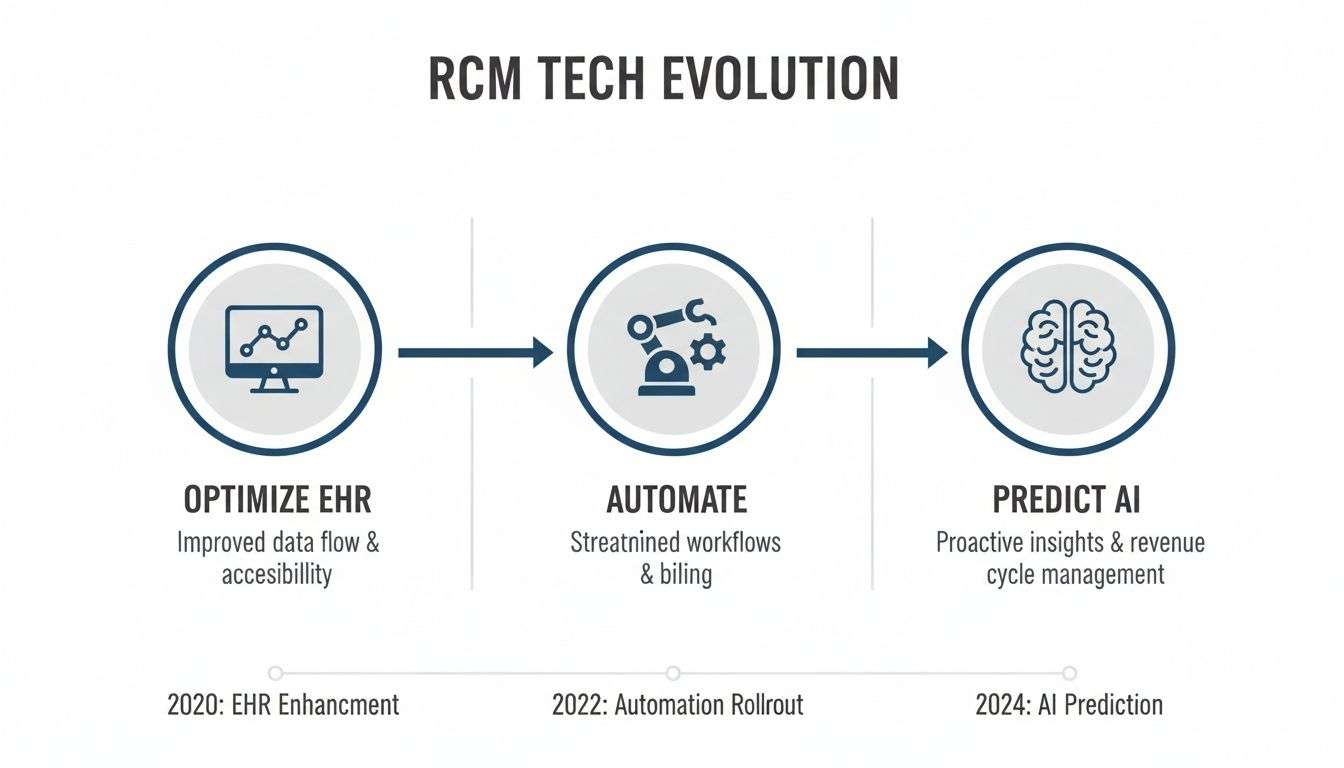
As you can see, excellence is a journey. It starts with getting the most out of what you already own, then moves to automating workflows, and finally uses AI to predict and solve problems before they even hit your revenue stream.
Start By Unlocking Your Existing EHR And PM System
Before you rush out to buy shiny new software, your first move should be to fully optimize the tools you already have. I've seen countless practices underuse the powerful features already built into their Electronic Health Record (EHR) and Practice Management (PM) systems.
It's time for a deep dive. Many systems have functions that can automate key RCM steps without costing you an extra dime.
- Automated Eligibility Checks: Set up your system to run batch eligibility verification for all appointments 24-48 hours in advance. This flags coverage problems early, giving your team a window to fix them before the patient even walks in the door.
- Custom Claim Scrubbing: Don't just stick with the default settings. Build custom rules based on your practice's common denial trends. If a certain payer always denies a procedure without a specific modifier, create a rule that automatically flags any claim missing it.
- Automated Payment Posting: Make sure you're using electronic remittance advice (ERA) files. Automating payment posting with ERAs eliminates hours of manual data entry and drastically cuts down on posting errors. You can find more detail in our guide on electronic remittance advice.
A common mistake I see is practices assuming they need brand-new technology to see improvements. Often, the biggest and fastest gains come from mastering the software you're already paying for. Call your vendor and schedule a training session—you'll be surprised what you uncover.
Adding Robotic Process Automation For Tedious Work
Once your core systems are running smoothly, the next layer of efficiency comes from Robotic Process Automation (RPA). Think of RPA "bots" as digital team members who can handle the repetitive, mind-numbing tasks that eat up your staff's day.
RPA is perfect for jobs like:
- Logging into payer portals to check claim status.
- Submitting prior authorization requests.
- Pulling data from external sources to update patient accounts.
For instance, instead of a biller spending their morning logging into five different insurance portals to check on unpaid claims, an RPA bot can do it overnight. It can then compile a neat report and drop it into a work queue for your A/R team to tackle first thing. That simple automation can free up hours of manual work every single day.
To get a clearer picture of where technology fits, here’s a breakdown of the most impactful tools.
Key RCM Technology And Its Impact
- EHR/PM System: This is the core platform for patient data, scheduling, and basic billing functions. Its integration is key to efficiency and it serves as the foundation for all RCM activities.
- Automated Eligibility: This tool verifies patient insurance coverage in real-time or in batches. It can reduce front-end denials by up to 90% and significantly improve your clean claim rate.
- Claim Scrubbing: This software analyzes claims for errors against payer rules before submission, which lowers first-pass denial rates and accelerates payment velocity.
- RPA (Bots): These digital workers automate repetitive, rule-based tasks like status checks and data entry. This can free up staff time by 20-30% and reduce human error on tedious jobs.
- AI/Predictive Analytics: This advanced technology analyzes historical data to predict outcomes and guide strategy. It can improve collections by 15-25% by forecasting denials and prioritizing A/R efforts.
Each layer of technology builds on the last, creating a more resilient and efficient revenue cycle.
The Power Of AI In Predictive Analytics
Artificial Intelligence (AI) and machine learning are at the top of the RCM tech pyramid. While RPA is great for doing tasks, AI is about thinking and providing insights to guide your strategy. It sifts through massive amounts of your historical data to spot patterns and forecast what's coming next.
This is becoming a must-have as healthcare margins get tighter. In fact, 72% of healthcare executives are prioritizing investments in automation and predictive tech. They know that AI-powered billing can find new revenue by accurately coding complex services or capturing payment for telehealth, potentially boosting collections by 15-25% in certain specialties.
AI's impact stretches across the entire revenue cycle. It can predict which claims are most likely to be denied before you submit them, giving your team a chance to intervene. It can also analyze your A/R to prioritize follow-up, ensuring your staff spends their time on the accounts most likely to pay. For practices ready to take the next step, advanced tools like an AI CRM for healthcare clinics can integrate clinical and financial workflows to capture every dollar earned.
Your Implementation Roadmap And Timeline
Turning all the strategies we’ve discussed into a high-performing system is a major project. It won’t happen overnight, but with a structured plan and clear communication, you can move from assessment to lasting success without causing chaos.
Think of this as your playbook for making steady, deliberate progress toward your financial goals. Each step builds on the last, creating momentum that your entire team can feel.
Phase 1: The First 30 Days – Foundation And Quick Wins
The first month is all about getting your bearings and scoring some early victories. The goal here is to build momentum and show your team that these changes are valuable. Don't try to fix everything at once; focus on foundational work and a few high-impact changes.
Here’s where to start:
- Conduct a Comprehensive RCM Assessment: Pull at least three months of data and establish your baselines using the KPIs we covered earlier. Your mission is to find your top 1-2 denial reasons and the single biggest bottleneck in your current workflow.
- Assemble Your RCM Task Force: This isn't a committee that meets once a quarter. Designate a small, cross-functional team with leaders from the front desk, your clinical team, and the billing office. This group will own the project and keep communication flowing between departments.
- Optimize Front-End Workflows: Your first quick win is here. Implement real-time eligibility checks for every single patient, every single time. Start scanning insurance cards at every visit, no exceptions. This alone can slash your front-end denials.
You cannot manage what you do not measure. This initial 30-day period is critical for gathering the data that will guide every subsequent decision. It's the diagnostic phase that ensures you're solving the right problems.
Phase 2: The Next 60 Days – Process And Training
With your baseline set, the next two months are for refining processes and training your team. This is where you hardwire new habits and build the operational muscle needed for long-term performance. It’s all about change management.
Focus on these initiatives:
- Develop a Denial Prevention Plan: Based on what you found in your assessment, create a specific action plan to tackle your #1 denial reason. If prior authorizations are the culprit, for example, centralize the process or implement a dedicated tracking system so nothing falls through the cracks.
- Provide Targeted Team Training: A memo won't cut it. Hold hands-on training sessions for front-desk staff on the new registration protocols. Do the same for your billers on navigating new payer rules. Show them exactly how to succeed in the new workflow.
- Launch a Clinical Documentation Improvement (CDI) Pilot: Start small. Pick one or two providers who are open to feedback. Review their documentation for specificity and connect the dots for them—show how clearer notes directly lead to more accurate coding and fewer headaches for everyone.
Successfully managing this phase means getting buy-in. You have to explain the "why" behind every change—how it protects the practice's financial health, reduces administrative burnout, and ultimately supports better patient care.
Phase 3: The Next 90 Days – Technology And Outsourcing Decisions
Now that your manual processes are tighter, it's time to see how technology can help you scale that success. This is also the point where you need to be honest about your team's bandwidth and decide if bringing in an expert partner makes sense.
Ask yourself these key questions:
- Are we fully using the automation features already built into our EHR/PM system?
- Could RPA bots for tasks like claim status checks free up significant staff time for higher-value work?
- Do we have the in-house expertise to manage complex payer negotiations and appeals, or is our team stretched too thin?
This is often when practices realize they need more firepower. If your denial rate is still stubbornly high or your A/R continues to age despite your best efforts, it may be time to get help. You can explore the benefits of healthcare revenue cycle outsourcing to see if it aligns with your goals. A good partner brings immediate expertise and advanced technology to the table without the steep learning curve.
Finally, measure your return on investment (ROI). You must track your core KPIs—Clean Claim Rate, Days in A/R, Denial Rate, and Cost to Collect—against the baseline you set in Phase 1. The goal is to prove that your strategic changes are delivering real, measurable value.
Frequently Asked Questions About RCM Optimization
When practice leaders start digging into revenue cycle optimization, the same few questions always pop up. It's a complex area, so it's natural to want clear, straightforward answers.
We've gathered some of the most common inquiries we get from practice leaders and provided the kind of direct advice you need to make smart, confident decisions.
What Is The First Step In Healthcare Revenue Cycle Optimization?
Everyone wants to know where to begin. The answer is always the same: a deep, honest look at your current performance. Before you can fix anything, you have to know what's broken. This means going far beyond a gut feeling or surface-level glance.
A proper baseline assessment involves digging into your data. You need to analyze your clean claim rate, days in A/R, and denial rates. This is how you pinpoint the exact stages—whether it's the front desk, coding, or A/R follow-up—where revenue is leaking. Without this initial diagnosis, any "improvements" are just shots in the dark.
The initial assessment is your roadmap. It tells you not only where you are, but precisely where to focus your efforts for the greatest impact. It turns a vague goal of "improving RCM" into a specific, actionable plan.
How Long Does It Take To See Results From RCM Improvements?
The timeline really depends on the scale of the changes you're making. Some fixes can produce results almost immediately, while bigger strategic shifts need more time to pay off.
- Quick Wins (30-60 Days): You can see a fast impact by shoring up your front-end processes. For example, implementing real-time eligibility verification can slash registration-related denials within the first month or two.
- Strategic Shifts (90-180 Days): Bigger projects, like overhauling your entire denial management workflow, launching a clinical documentation improvement (CDI) program, or rolling out new tech, usually take three to six months to show a measurable lift in your KPIs.
The key here is consistency. Real RCM optimization isn’t a one-and-done project. It’s a continuous cycle of monitoring, tweaking, and improving.
When Should My Practice Consider Outsourcing Its RCM?
This is a major strategic decision, and it usually comes down to whether you're facing persistent problems you can't seem to solve on your own. If your internal team is overwhelmed or lacks the specific expertise needed, it’s time to seriously consider a partner.
Pay attention to these red flags:
- A stubborn denial rate that stays above 10%
- An aging A/R with a large chunk of claims sitting over 90 days
- High staff turnover in your billing and collections department
- A constant struggle to keep up with complex and ever-changing payer rules
Bringing in a specialized RCM partner gives you immediate access to certified experts and powerful technology. For many practices, this delivers a much faster and more significant return on investment than trying to build out those capabilities from scratch.
Can Small Practices Benefit From Advanced RCM Technology?
Absolutely. There's a common misconception that high-end RCM tools are only for huge hospital systems, but that's just not true anymore. The game has completely changed.
Modern RCM technology is now incredibly scalable and affordable. Thanks to cloud-based platforms and specialized service partners, independent clinics can access the same powerful tools as their larger counterparts. This includes software for things like automated eligibility checks, AI-powered claim scrubbing, and sophisticated analytics. This tech helps level the playing field, empowering smaller practices to run just as efficiently as the big players.
Ready to stop guessing and start optimizing? The certified, US-based experts at One For All Medical Billing can help you diagnose your RCM challenges and implement a plan that boosts your clean claim rate and accelerates your cash flow. Schedule your free consultation today.

