
table of contents
A HIPAA compliance audit is more than just a formality—it’s an official investigation into how your practice handles protected health information (PHI). These inspections are carried out by the U.S. Department of Health and Human Services (HHS) Office for Civil Rights (OCR) to make sure you’re truly protecting sensitive patient data.
What Is A HIPAA Compliance Audit And Why It Matters Now

Think of a HIPAA audit as a high-stakes exam for your data security practices. It’s a formal, deep dive into whether your organization is meeting the strict standards of the HIPAA Privacy, Security, and Breach Notification Rules. This isn’t about just checking boxes; it’s a thorough review of your daily operations to confirm your policies are actively safeguarding patient information.
During an audit, investigators will look at everything from your written procedures and staff training logs to your technical safeguards. They want to see real proof that you’ve identified risks to PHI and have concrete measures in place to manage them. Failing this review can bring serious consequences, including steep financial penalties, mandatory corrective action plans, and lasting damage to your practice’s reputation.
The New Era Of Heightened Enforcement
If you’ve viewed HIPAA audits as a distant threat in the past, it’s time to reconsider. The enforcement climate has changed dramatically, turning proactive readiness from a best practice into an essential survival strategy. The OCR isn’t just reacting to major breaches anymore—it's actively hunting for non-compliance.
The numbers tell a clear story. As of January 2026, the Office for Civil Rights has already settled or imposed penalties in more than 50 HIPAA violation cases specifically targeting risk analysis and patient access initiatives. This is a massive jump from previous years. For comparison, the OCR only initiated 16 penalties in 2024, while 2025 saw over 21. That’s a year-over-year increase of roughly 31% in enforcement actions, a trend that shows no signs of slowing down.
Why Proactive Readiness Is Non-Negotiable
This shift in enforcement means that every healthcare organization, no matter its size, is on the OCR’s radar. Waiting for an audit notification letter to show up in your mailbox is a dangerously outdated approach. Instead, you need to treat audit readiness as a continuous, year-round function.
A proactive approach to HIPAA compliance isn’t just about dodging fines; it’s about building a culture of security that protects your patients, your reputation, and your financial stability. It transforms compliance from a reactive burden into a strategic asset.
This involves conducting your own internal risk assessments, consistently training your team, and making sure all your security protocols are up-to-date and working correctly. Understanding what auditors look for is the first step toward building a strong defense, and you might be interested in learning more about how to ensure compliance and data security within your practice. Adopting this forward-thinking mindset is your best shield against the intense scrutiny of a HIPAA audit.
The Different Types Of HIPAA Audits Explained
When it comes to HIPAA compliance, not every audit follows the same script. The Office for Civil Rights (OCR) has a few different ways it investigates potential violations, and knowing the difference is crucial for preparing effectively.
It really boils down to two main types. The first and most common is a reactive investigation, which happens in response to a specific event. The second is a proactive audit, where the OCR is essentially spot-checking the industry.
Reactive Investigations: Complaint-Driven Audits
The vast majority of HIPAA audits are reactive. These aren’t random checks; they are direct responses to a specific trigger. If a patient files a formal complaint claiming their privacy rights were violated, you can bet the OCR will look into it.
The same goes for self-reporting a data breach that affects 500 or more individuals. An investigation is almost guaranteed.
Because these audits are triggered by a specific incident, they are laser-focused. If the complaint is about improper PHI disclosure, auditors will dig into your policies, access logs, and procedures directly related to that event. Their goal is to see if a violation actually happened and figure out how bad it was.
Proactive Audits: Desk Vs. Onsite
Proactive audits are part of the OCR’s broader enforcement program to get a pulse on industry-wide compliance. These come in two flavors, each with a very different feel.
Desk Audits: Think of a desk audit as a remote, open-book test. The OCR will send a formal request for specific documents—like your Security Risk Analysis, notice of privacy practices, and proof of workforce training. You’ll have a deadline to upload this evidence for them to review from afar. While less intense than an onsite visit, your documentation has to be perfect.
Onsite Audits: A comprehensive onsite audit is more like a hands-on inspection. Auditors physically come to your facility for several days to see your operations in action. They’ll interview staff, check your physical security measures, and review systems in real-time. This is a much deeper dive into how your HIPAA policies are actually being followed day-to-day.
The bottom line is this: whether an audit is remote or in-person, the expectation is the same. You must have clear, organized documentation to back up your compliance efforts. Nothing raises a red flag faster than a "shoebox" full of disorganized papers or missing policies.
Understanding the difference between a desk audit and an onsite review helps you prepare for the level of scrutiny you might face. To ensure your team is ready for either scenario, you need to be confident in their roles and responsibilities. You can learn more about how to determine if your team is HIPAA compliant in our detailed guide.
Ultimately, a strong, well-documented compliance program is your best defense, no matter what kind of audit comes your way.
Understanding Common HIPAA Audit Triggers
A HIPAA audit from the Office for Civil Rights (OCR) is almost never a random event. Think of the OCR as firefighters—they don’t just show up at your door for fun. They arrive because they saw smoke, and that smoke is almost always a specific red flag signaling a potential compliance fire.
Knowing what these triggers are is the first step in building a proactive defense. It allows you to focus your time and resources on the areas that are most likely to land you in hot water.
Patient Complaints About Privacy Violations
The single most common trigger for a HIPAA audit is a patient complaint. When a patient feels their privacy has been violated—whether their records were improperly shared, someone snooped in their chart, or they were denied access to their own files—they can file a complaint directly with the OCR.
Every credible complaint gets a look. If that initial review suggests a violation might have actually happened, the OCR will kick off a formal investigation to get the full story. This is exactly why solid patient communication and clear internal policies for handling privacy issues are so non-negotiable.
Self-Reported Data Breaches
Another major cause for an audit is when you report a data breach yourself. Under the HIPAA Breach Notification Rule, you’re legally required to notify the OCR (and the people affected) of any breach involving unsecured protected health information (PHI).
If that breach impacts 500 or more individuals, it’s an automatic trigger for a formal OCR investigation. But don't get too comfortable with smaller incidents. A pattern of seemingly minor breaches can also attract scrutiny, as it suggests a systemic weakness in your security that the OCR may want to investigate further. A consistent focus on improving clinical documentation can go a long way in preventing the kinds of errors that lead to these small but troublesome breaches.
Media Coverage And Whistleblower Reports
Sometimes, the call comes from outside the house. Negative news stories about a data security incident at your practice can put you directly on the OCR’s radar. Public reports of a breach often spur an official investigation to figure out just how bad the compliance failure really was.
A less public but equally powerful trigger comes from whistleblowers. A disgruntled former employee or even a concerned current staff member who reports significant compliance gaps can launch an OCR investigation. This really highlights how vital it is to build a culture where staff feel safe raising compliance concerns internally first.
To put these risks into perspective, here's a look at the most common events that get the OCR's attention.
Common HIPAA Audit Triggers And Their Frequency
- Patient Complaint: An individual files a formal complaint with the OCR alleging a violation of their privacy rights. This has a high likelihood of investigation, as all credible complaints are reviewed.
- Large Data Breach: You self-report a breach affecting 500 or more individuals, as required by law. This has a very high likelihood of investigation and automatically triggers one.
- Pattern of Small Breaches: You repeatedly self-report smaller data breaches, signaling systemic security issues. The likelihood of investigation is medium to high.
- Whistleblower Report: A current or former employee reports significant, willful non-compliance to the OCR. This has a high likelihood of investigation.
- Negative Media Coverage: Public news reports about a data security incident at your organization. The likelihood of investigation is medium to high.
Understanding these triggers isn't about creating fear; it's about being prepared. By knowing where the OCR is most likely to look, you can direct your compliance efforts far more effectively.
The frequency of healthcare data breaches has reached alarming levels, making proactive defense more critical than ever. In just five months between September 2025 and January 2026, an average of 47 data breaches were reported each month.
This trend is only getting more intense. The rate of reported breaches affecting 500 or more records had nearly doubled by 2022 compared to 2018, climbing to about two major incidents per day. You can dive into the full analysis of healthcare data breach statistics on HIPAAJournal.com.
By recognizing these common triggers, you can stop seeing audits as a random threat and start treating them as a predictable risk—one you can actively manage and defend against.
Navigating The HIPAA Audit Process Step By Step
Getting that letter from the Office for Civil Rights (OCR) is enough to make any practice owner’s heart sink. But a HIPAA audit isn’t a surprise ambush—it’s a structured process. Knowing the roadmap ahead of time is the key to turning panic into a clear, manageable plan.
Think of it as four distinct stages: the first contact, the request for your paperwork, a possible on-site review, and the final verdict. How you handle the first step directly impacts how smoothly the rest will go. The ultimate goal is simple: show you’ve made a good-faith effort to protect patient data all along.
Phase 1: The Initial Audit Notification
It all starts with an official letter. The OCR will reach out via certified mail or a secure email to let you know your organization has been selected for a HIPAA compliance audit. This isn't a vague warning; it's the official starting gun.
The notification spells out exactly what auditors want to see. It will clarify if they’re doing a comprehensive review or zeroing in on a specific incident, like a patient complaint or a recent data breach. Most importantly, it gives you a deadline to respond, and you won’t have much time—often as little as 10 business days.
Phase 2: Document Request And Submission
Next, you'll receive a detailed list of documents the OCR wants to review. This is what's known as a "desk audit," where auditors assess your compliance from afar based on the proof you provide. This is your chance to show them your HIPAA program isn't just an idea, but a well-documented reality.
This isn't a suggestion box; it's a specific set of demands for hard evidence. You’ll be asked to hand over critical documentation that almost always includes:
- Your latest Security Risk Analysis (SRA)—the absolute foundation of your HIPAA security efforts.
- Your complete set of HIPAA Privacy and Security Policies and Procedures.
- Proof of workforce training, like sign-in sheets or digital logs showing who was trained and when.
- A copy of your Notice of Privacy Practices and proof of how you provide it to patients.
- A complete list of your Business Associates along with their signed Business Associate Agreements (BAAs).
You'll upload everything through a secure online portal the OCR provides. Hitting that deadline is non-negotiable. It’s the first test of your cooperation and shows you’re taking the process seriously. This is often where practices realize how a single event can spiral into a full-blown investigation.
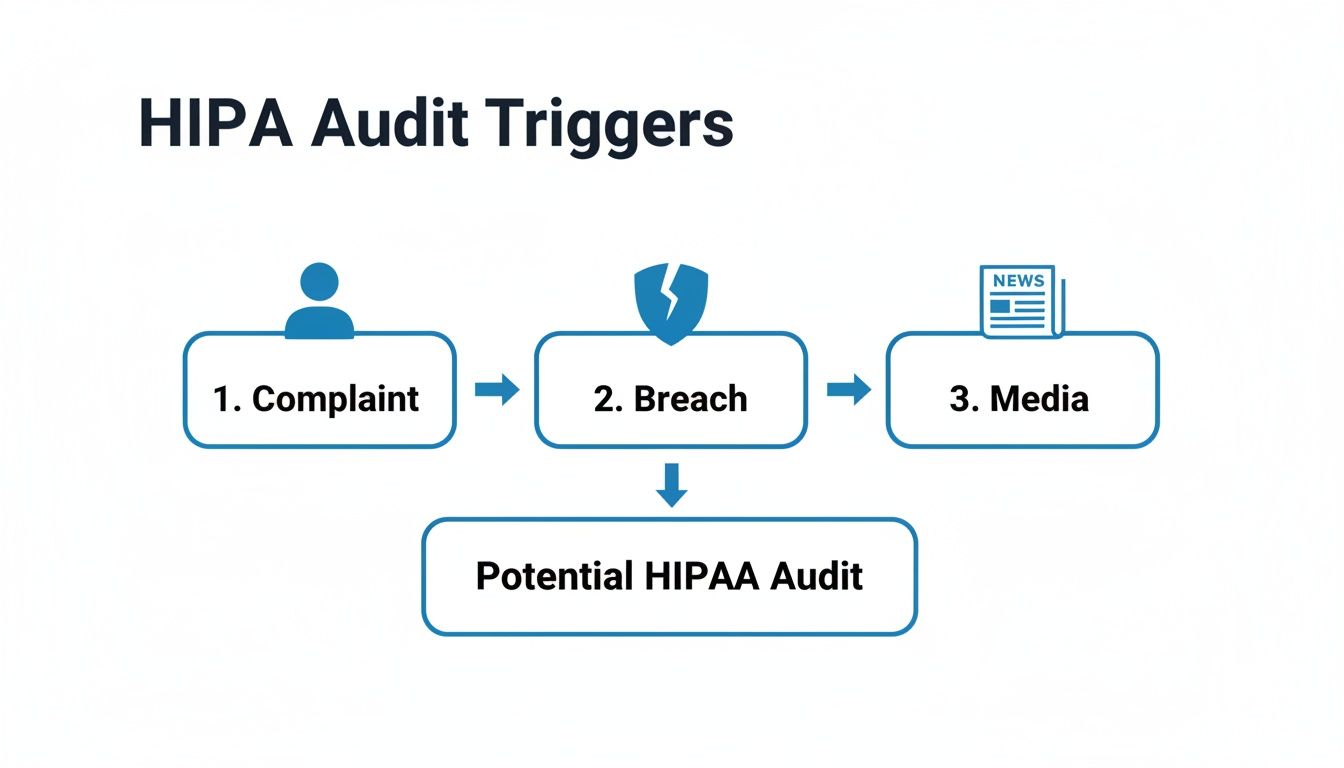
As you can see, something as simple as one patient complaint or a small breach reported in the news can be the spark that ignites a formal audit.
Phase 3: The Onsite Visit And Interviews
If your submitted documents raise red flags or if the audit is particularly serious, the OCR might decide to pay you a visit. This is where things get more intense. Auditors will come to your office for a few days to see with their own eyes how your compliance program works in the real world.
During an onsite visit, they’re confirming that your policies are more than just words on a page. They might ask your front desk staff how they handle a patient requesting their records, or they could watch your IT team manage user access to the EHR. The auditors are looking for consistency—what your team says and does should match your written policies perfectly.
An onsite HIPAA audit is the ultimate test of your compliance culture. It reveals the difference between having policies on a shelf and having a team that lives and breathes them every day.
Phase 4: The Final Report And Determination
Once the OCR has gathered all the information from your documents, interviews, and any site visits, they’ll put together their findings. The first thing you'll get is a draft report. This is your opportunity to review their conclusions and submit comments or extra evidence to clear up any misunderstandings.
After reviewing your feedback, the OCR issues its final audit report. This document will lay out any areas where you were found to be non-compliant and what you need to do next. If everything looks good, the report will simply close the audit. But if they find violations, it could lead to a formal Resolution Agreement, which often includes a mandatory corrective action plan and, in some cases, steep financial penalties.
Your Essential HIPAA Audit Readiness Checklist

The thought of a HIPAA audit can send a shiver down any practice manager's spine, but it doesn't have to. The best defense is a good offense. Instead of scrambling when an auditor’s notification letter arrives, you can get ahead of the game by conducting your own internal review.
This checklist breaks down the key areas auditors zero in on, organized by the three pillars of HIPAA compliance. Use it to run a meaningful self-assessment, patch any gaps you find, and face a potential audit with confidence, not panic.
The HIPAA Privacy Rule Checklist
The Privacy Rule is all about how you use and share Protected Health Information (PHI). Auditors need to see that you not only respect patient rights but have clear, documented proof of it.
Notice of Privacy Practices (NPP): Your NPP is your promise to patients about how their health information is handled. Auditors will check that it's current, easy for patients to find (posted in your office and on your website), and that you have a signed acknowledgment from every single patient.
Patient Right to Access: This is a huge enforcement priority for the OCR. You must have a crystal-clear process for patients to request and receive their health records. Auditors will review your request logs to ensure you meet the 30-day time limit without fail.
Business Associate Agreements (BAAs): You're on the hook for every vendor you share PHI with, from your billing service to your cloud storage provider. Auditors will demand a complete list of your business associates and copies of the signed BAAs for each one. No exceptions.
The HIPAA Security Rule Checklist
The Security Rule focuses entirely on protecting electronic PHI (ePHI). Here, auditors will dig deep into your administrative, physical, and technical safeguards to make sure you’re actively defending data against all threats.
Your Security Risk Analysis (SRA) is the absolute linchpin of your entire security program.
An incomplete or nonexistent Security Risk Analysis is one of the fastest ways to fail a HIPAA audit. The OCR considers the SRA the foundational element of any HIPAA security program, and its absence is a major red flag indicating systemic non-compliance.
These are the must-have security items to get in order:
Current Security Risk Analysis (SRA): Have you conducted a thorough, organization-wide SRA in the last year? Be ready to hand over this document and the risk management plan that shows how you're fixing the vulnerabilities you found.
Access Controls and Logs: You must prove that ePHI access is limited to the “minimum necessary” for an employee’s role. Auditors will want to see your user access policies, review how you assign credentials, and inspect the audit logs that track who accessed what data and when.
Workforce Training and Security Policies: Auditors need documented proof that your team receives security training annually. This means having training logs, signed employee acknowledgments, and written policies covering everything from password management and mobile devices to incident response.
The Breach Notification Rule Checklist
Finally, the Breach Notification Rule requires a documented game plan for responding to a data breach. Auditors want to see that you can identify, assess, and report incidents according to HIPAA’s strict timelines.
Breach Response Policy and Procedures: Your practice needs a written policy that details the exact steps your team will take if a breach occurs. It must cover who to notify internally, how to perform a risk assessment to determine if it's a reportable breach, and the official process for notifying patients and the OCR.
Incident Logs and Documentation: Keep a detailed log of all security incidents, even minor ones that don't escalate into a full-blown breach. This shows auditors that you are actively monitoring for threats and have a formal process for evaluating them.
To help you get organized, here’s a quick-reference summary of the key documents and processes you’ll want to have ready.
HIPAA Readiness Checklist By Rule
- Privacy Rule: Verify you have signed Notice of Privacy Practices (NPP) acknowledgments from all patients. This proves you informed them of their rights and your data-use policies.
- Privacy Rule: Keep a complete list of Business Associate Agreements (BAAs) with signed copies for each. This demonstrates you’ve established HIPAA compliance with all third-party vendors.
- Security Rule: Maintain an up-to-date Security Risk Analysis (SRA) performed within the last 12 months. This is non-negotiable; it’s the foundation of your entire security program.
- Security Rule: Have clear User access control policies and audit logs for ePHI systems. This shows you enforce the "minimum necessary" standard for data access.
- Security Rule: Keep Workforce training records, including dates, topics, and signed acknowledgments. This confirms your staff has been educated on their security responsibilities.
- Breach Notification Rule: Have a written Breach Response Policy and incident log. This proves you have a documented, repeatable plan for handling data incidents.
Taking the time to review this checklist regularly shifts you from a reactive to a proactive compliance mindset. This self-audit process not only gets you ready for an official audit but also strengthens your overall data protection strategy—a vital part of effective revenue cycle management. To learn more, check out our guide on 10 Revenue Cycle Management Best Practices.
How A Compliant Partner Strengthens Your Audit Defense
Facing a HIPAA compliance audit can feel overwhelming, especially when you're already juggling patient care and the financial health of your practice. But your compliance responsibility doesn’t stop at your own front door. It extends to every single vendor you share Protected Health Information (PHI) with—and that absolutely includes your billing company.
This is where choosing the right partner becomes a crucial part of your audit defense. When you work with an outside vendor, their security measures become an extension of yours. If your billing partner has flimsy security controls, it creates a massive vulnerability that auditors are trained to spot.
A data breach that starts with a third-party vendor is just as damaging as one that happens in your own office. In the eyes of the Office for Civil Rights (OCR), you are still on the hook.
Sharing The Burden Of Compliance
Partnering with a fully compliant medical billing expert is like adding a specialized security detail to your team. Instead of shouldering the entire weight of data protection yourself, you’re handing off a huge piece of that responsibility to a partner whose entire business is built on secure processes. This immediately strengthens your practice’s overall risk profile.
A truly compliant partner doesn’t just sign a Business Associate Agreement (BAA) and call it a day. They proactively build and maintain robust security measures designed to shield the sensitive data they manage for you. That's a key difference auditors look for.
For example, a compliant billing service will ensure:
- All data transmissions containing PHI are encrypted end-to-end.
- Access to patient data is strictly limited to authorized personnel based on the principle of minimum necessary access.
- All team members are U.S.-based, fully certified, and go through continuous HIPAA training.
- Their systems and infrastructure are constantly updated and monitored for potential threats.
How A Secure Partner Reduces Audit Risk
Working with a secure partner gives you a powerful, confident answer when auditors start asking about your vendor management program. You can show that you’ve done your due diligence by choosing a partner that makes security a priority, which effectively lowers your risk from third-party threats.
Choosing a compliant partner isn't just about outsourcing a task; it's about importing expertise and security infrastructure that fortifies your own compliance efforts. This strategic decision shows auditors you take your responsibility to protect PHI seriously across your entire operation.
When your billing operations are managed by a dedicated, HIPAA-compliant team, the PHI we handle is protected by layers of administrative, technical, and physical safeguards. This not only reinforces your practice's compliance but also frees you up to focus on what matters most—your patients. This partnership model is a core component of successful revenue cycle management. To learn more, explore our complete guide on healthcare revenue cycle outsourcing.
By entrusting your billing to an expert, you’re not just improving your collections and shrinking your denial rate. You are building a far more resilient defense against the intense scrutiny of a HIPAA compliance audit, giving you invaluable peace of mind.
Frequently Asked Questions About HIPAA Audits
When it comes to HIPAA audits, providers and practice managers often have a lot of practical questions. We get it. To help you feel more prepared, we’ve put together clear, straightforward answers to some of the most common concerns we hear.
How Long Does A Typical HIPAA Audit Take?
The timeline for a HIPAA audit really depends on the type. A remote desk audit, which is mostly a review of documents you submit, can take anywhere from a few weeks to several months as auditors communicate back and forth with your team.
An in-person, comprehensive onsite audit is a whole different ballgame. The auditors might only be physically at your practice for a few days, but the entire process—from the day you get the notice to the final report—can easily stretch on for many months.
What Is The Most Common Reason For Failing A HIPAA Audit?
By far, the most common reason practices fail a HIPAA audit is the failure to perform a complete and accurate organization-wide Security Risk Analysis (SRA). The Office for Civil Rights (OCR) considers the SRA the absolute bedrock of your entire HIPAA security program.
The absence of a current and comprehensive Security Risk Analysis is a critical red flag for auditors. It signals that an organization lacks a fundamental understanding of its vulnerabilities and is not proactively protecting patient information, which almost always leads to a finding of willful neglect.
If you don't have a recent SRA, or if the one you have is incomplete, it tells auditors you aren't actively trying to identify or manage the risks to your electronic protected health information (ePHI).
Can A Small Practice Really Get Audited?
Yes, absolutely. The OCR audits covered entities of all sizes, from major hospital systems down to solo practitioners. A single patient complaint or a data breach involving just one person’s information is more than enough to trigger an investigation, no matter how small your practice is.
No one who handles PHI is too small to be on the OCR’s radar.
What Happens If I Receive An Audit Notification?
First, don't panic—but definitely don't ignore it. The very first thing you need to do is read the notification letter carefully. Pay close attention to the scope of the audit and, most importantly, the deadline for your response. These deadlines are often tight, sometimes as short as 10 business days.
Start gathering all the requested documentation immediately. This is also the time to consider calling a compliance expert or legal counsel who can help guide you through the process and ensure your response is complete, on time, and accurate.
A robust compliance program is your best defense. One For All Medical Billing strengthens your practice by managing billing and coding with HIPAA-compliant processes at every step, reducing your risk and giving you peace of mind. Learn how our secure, U.S.-based team can support your practice by visiting us at https://oneforallmed.com.

