

table of contents
When you're billing for a new patient visit that's more involved than a simple check-up but not a full-blown crisis, CPT code 99204 is often the right choice. It's designed for office visits of moderate complexity, covering encounters where you spend 45-59 minutes or make medical decisions that require significant thought.
Essentially, this code tells payers that you put in serious cognitive work for a new patient.
Decoding The 99204 CPT Code
In the language of medical billing, CPT codes are the shorthand we use to describe what happened during a visit. The 99204 CPT code holds a key spot in this system, specifically for new patients in an office or outpatient clinic. It signals a visit that falls squarely in the middle—not minor, but not critically severe either.
This code is a workhorse for many practices because it captures the value of those common but intricate patient scenarios. We've all been there: the appointments where you have to dig deep, untangle multiple health issues, review a stack of outside records, or prescribe a medication that comes with real risks.
Before the big Evaluation and Management (E/M) guideline changes in 2021, coding felt like a frustrating game of counting bullet points for history and exam elements. It was tedious and often missed the point.
The Shift To Cognitive Effort
Thankfully, the updated guidelines simplified everything. The focus shifted away from clerical box-checking and onto the two things that truly define a visit's value: the total time you spent or the complexity of your Medical Decision-Making (MDM).
This change put CPT code 99204 front and center. It finally allows providers to get paid fairly for their mental labor and the dedicated time a new patient requires on the day of their visit.
The core idea behind the modern 99204 is to capture the intensity of the provider's work, not just the procedural motions of the visit.
Getting this code right is vital for your practice's financial health and compliance. It's a go-to for encounters that demand a thoughtful, measured approach. You'll likely find yourself using it in situations like these:
- Managing a new patient with one or more poorly controlled chronic illnesses.
- Working up a new problem with an uncertain prognosis that needs more investigation.
- Deciding to prescribe medication that requires careful risk management and patient education.
- Sifting through extensive outside records or getting history from multiple people to piece together a diagnosis.
Mastering the criteria for 99204 ensures you aren't leaving money on the table by under-coding or creating audit risks by over-coding. It strikes a balance, much like its counterpart for established patients. If you're looking for more details on that, you can learn more about CPT code 99214 in our related guide.
Ultimately, getting 99204 right is about getting credit for the moderate-level complexity you handle every single day.
Choosing Your Path: Time vs. Medical Decision-Making
When you're looking at justifying a 99204 CPT code, think of it as having two different roads to the same destination. You can choose your level of service based on either the total time you spent on the encounter or the complexity of your Medical Decision-Making (MDM). You don't have to meet both—just one.
This flexibility is a direct result of the big E/M guideline updates from 2021, which were designed to cut down on administrative fluff and better reflect the actual cognitive work we do. And the shift was huge. One study showed that before the changes, level 4 visits like 99204 made up just 7.8% of new patient encounters. By 2021, that number had jumped to an incredible 50.5%, showing just how quickly providers embraced these more intuitive rules.
This flowchart gives you a great visual for the two paths you can take to bill a 99204.
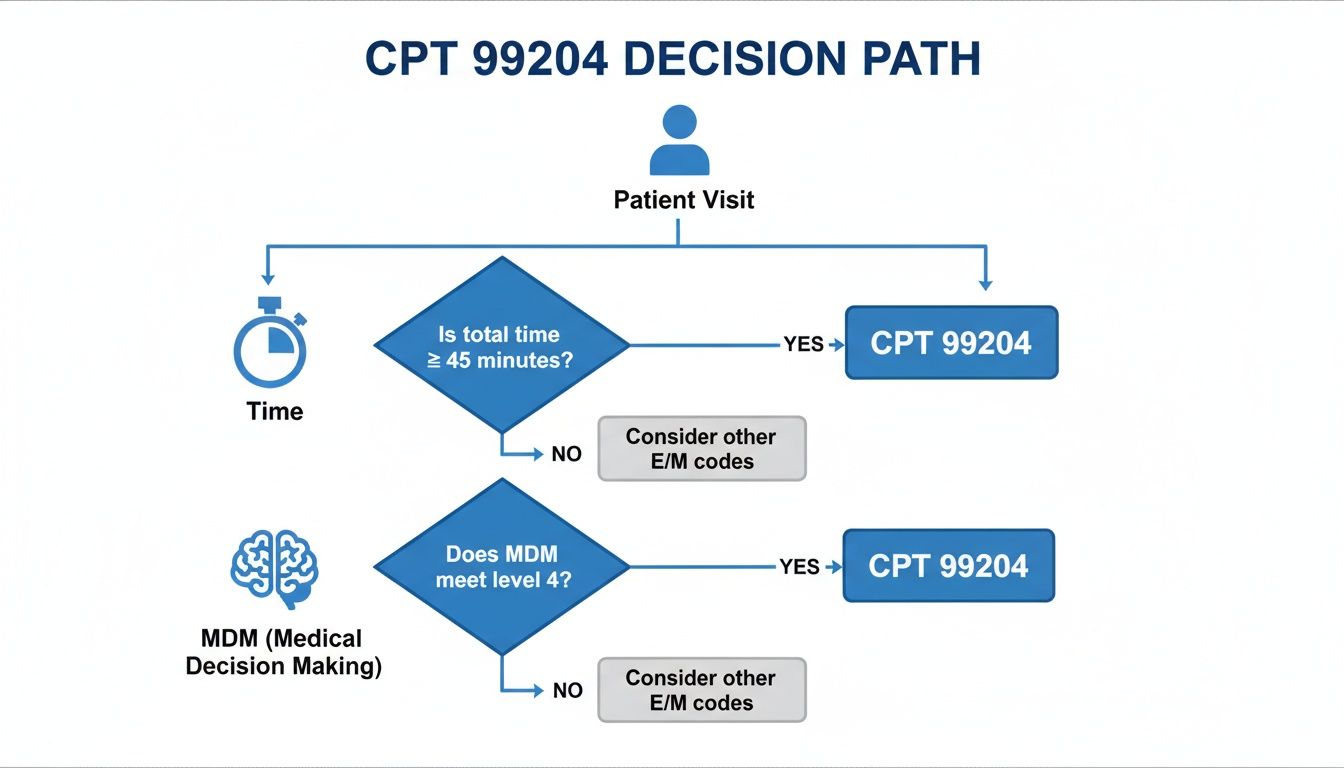
As you can see, once you start a new patient visit, you’re at a fork in the road. You can document based on the clock (Time) or your clinical brainpower (MDM).
To make it even clearer, here’s a quick look at the two billing pathways. This should help you decide which method fits a particular encounter best.
Comparing Time vs. MDM Billing For CPT 99204
Time-Based Billing:
- Primary Justification: Total time spent on the encounter date.
- Required Threshold: 45-59 minutes.
- What Counts: Face-to-face, charting, record review, care coordination.
- Best For: Encounters with extensive counseling, record review, or care coordination.
- Documentation Focus: A clear statement of total time and a summary of activities.
MDM-Based Billing:
- Primary Justification: Complexity of thought process.
- Required Threshold: Moderate complexity MDM.
- What Counts: Problems, data review, risk of management.
- Best For: Encounters with complex diagnoses, multiple data points, or risky treatments.
- Documentation Focus: Detailing the problems, data reviewed, and risk factors considered.
Ultimately, choosing between time and MDM isn't about which is "better," but which one most accurately reflects the work you did for that specific patient.
The Time-Based Pathway
Billing based on time is usually the more straightforward of the two options. It’s simple: to qualify for CPT code 99204, you need to spend a total of 45 to 59 minutes on patient-related activities on the day of the encounter.
It’s crucial to remember this isn’t just face-to-face time. The clock is running for a wide range of tasks you perform for that patient on that specific day.
Activities that count toward your total time include:
- Prepping for the visit: Reviewing prior records, lab results, or imaging before you even walk in the room.
- Direct patient time: Talking to the patient, getting a history, doing an exam, and counseling them or their family.
- Ordering services: The time it takes to order medications, tests, or procedures.
- Coordinating care: Talking to other healthcare professionals (as long as you're not billing for it separately).
- Documentation: Charting the visit in the EHR on the day of the encounter absolutely counts.
Key Takeaway: When using time, your note needs a clear statement of the total time and a quick summary of what you did. For example: "Total time spent today was 50 minutes, which included reviewing outside records, examining the patient, counseling on treatment options, and documenting in the EHR."
The Medical Decision-Making Pathway
The other road focuses on the complexity of your thought process, or Medical Decision-Making (MDM). This is where the "art" of medicine really comes into play—it's how you put all the pieces together to come up with a diagnosis and treatment plan. To bill 99204 using MDM, the encounter needs to hit moderate complexity.
So, what does moderate MDM look like? You have to meet the criteria for two out of these three pillars:
- Number and Complexity of Problems Addressed: This could be one or more chronic illnesses that are flaring up, two or more stable chronic illnesses, or a new problem where the outlook is a bit fuzzy.
- Amount and/or Complexity of Data Reviewed: This is where you get credit for digging deeper. It could mean reviewing notes from other doctors, deciding to order tests, or looking at images or lab reports yourself.
- Risk of Complications and/or Morbidity from Patient Management: This pillar is met by decisions like prescribing medication, deciding on a minor surgery, or even referring a patient for a major elective surgery.
For instance, a new patient who comes in with uncontrolled hypertension and diabetes, requiring a new prescription and a review of their past specialist notes, would almost certainly meet the bar for moderate MDM. Getting these details into your note is what makes for an audit-proof claim. This is where strong clinical documentation improvement strategies become so valuable—they help you capture this complexity accurately every time.
See 99204 In Action With Clinical Scenarios
Understanding the rules for CPT code 99204 is one thing, but seeing how they apply in the real world makes all the difference. Abstract concepts like "moderate MDM" or "total time" become crystal clear when you connect them to the patients you see every day.
This section will walk you through practical, detailed clinical scenarios to show precisely how and why a visit qualifies for 99204. Think of these examples as a blueprint, translating theory into the documentation you create daily. By examining these cases, you can build confidence in your coding decisions, whether you choose to bill based on time or Medical Decision-Making (MDM).

Primary Care New Patient With Chronic Conditions
Let’s start with a classic primary care scenario that perfectly illustrates billing CPT code 99204 based on MDM.
A 58-year-old new patient establishes care to manage their hypertension and type 2 diabetes. The patient brings in recent lab work from another state and reports their home blood pressure readings have been consistently high. They are currently taking two medications but aren't sure if they're working effectively.
Justification for 99204 (MDM): This visit easily meets the criteria for moderate MDM. The provider must address two stable chronic illnesses, review external lab results, and make a decision to adjust a prescription drug regimen. This combination hits two out of the three required MDM elements for moderate complexity.
Sample Documentation Snippet:
- Problems Addressed:
- Hypertension, uncontrolled. Patient reports elevated home readings despite current therapy.
- Type 2 Diabetes Mellitus, stable on current oral medication.
- Data Reviewed:
- Reviewed outside lab work from 3 months prior.
- Reviewed patient's log of home blood pressure readings.
- Risk:
- Moderate risk due to prescription drug management. Will increase dose of lisinopril and continue metformin. Counseled patient on lifestyle modifications and signs of hypoglycemia.
This documentation clearly outlines the thought process and supports the moderate MDM level required for the 99204 CPT code.
Urgent Care Visit For Abdominal Pain
Now, let's look at an urgent care case where billing based on time becomes the most straightforward and accurate reflection of the service provided.
A 35-year-old new patient presents to an urgent care clinic with a two-day history of sharp, intermittent right upper quadrant abdominal pain. The patient is anxious and has many questions about potential causes, from gallbladder issues to liver problems. The provider spends considerable time taking a detailed history, performing a thorough exam, and counseling the patient on the differential diagnosis and the plan for further workup.
Justification for 99204 (Time): The direct patient care, extensive counseling, record review, and documentation can easily accumulate. The cognitive effort is high, but the total time spent provides a more direct path for billing.
Sample Documentation Snippet:
- Time Statement: Total time spent today was 50 minutes. This time was spent on reviewing the patient’s intake form, obtaining a detailed history, performing a physical exam, discussing potential diagnoses and the workup plan, ordering labs and an abdominal ultrasound, and documenting the encounter in the EHR.
By including this clear and concise time statement, the provider fully supports using CPT code 99204. There's no need to dissect the MDM elements because the 45-59 minute requirement has been met and documented.
Rheumatology Consult For Joint Swelling
Finally, here’s a specialty-specific example that could be justified by either MDM or time, but we’ll focus on the MDM path. It also shows how a visit can lead to another procedure, which might require a specific modifier.
A 42-year-old patient is referred for a new consultation due to painful swelling in their right knee and left wrist, with no prior diagnosis. The provider must consider a wide range of possibilities, from inflammatory arthritis like rheumatoid arthritis to an infectious process. This requires a comprehensive history, review of the referring physician's notes, and a decision to order specific, complex lab tests. The provider also performs a joint injection during the visit.
This encounter highlights a situation where another service is performed. You might be interested in our guide on how to properly use CPT Modifier 25 when an E/M service and a procedure occur on the same day.
Justification for 99204 (MDM): The MDM here is clearly moderate. The provider is addressing a new problem with an uncertain prognosis. They are analyzing data from another professional and will be ordering and interpreting specific rheumatology labs. Finally, the decision to order prescription medication and perform a minor procedure (the injection) qualifies as moderate risk.
Sample Documentation Snippet:
- Problems Addressed: New problem with uncertain prognosis: polyarticular joint swelling and pain. Differential includes inflammatory arthritis vs. crystalline arthropathy.
- Data Reviewed: Reviewed referral note from PCP. Independent interpretation of X-rays is not required at this time.
- Risk: Moderate risk based on the decision to begin prescription NSAID therapy and perform a diagnostic/therapeutic arthrocentesis of the right knee.
These scenarios demonstrate the practical application of 99204 coding guidelines, helping to bridge the gap between abstract rules and your day-to-day clinical work.
How To Avoid Common 99204 Denials
Successfully coding a 99204 visit is only half the battle. The real goal is getting paid for your work, and that means navigating the tricky world of insurance payers. Denials and downcodes are frustrating, for sure, but they’re often preventable if you have the right strategy in place.
Think of a denied claim as a test paper handed back with a failing grade. The payer is essentially saying your documentation didn't adequately show why the service was necessary or why it met the standards for moderate complexity. By getting ahead of the common reasons for these rejections, you can build a stronger, more defensible claims process from the start.

The popularity of this code is a bit of a double-edged sword. In 2022, CPT code 99204 was the single most frequently billed code for new patient office visits under Medicare Part B, with over 12.3 million allowed claims. But with that high volume comes intense scrutiny. In fact, documentation errors for office visits like 99204 contributed to a 12.9% error rate in internal medicine and a 13.8% error rate in family practice.
Mismatch Between Documentation And Code
This is, without a doubt, the number one reason for a 99204 denial. The story your documentation tells just doesn't line up with the code you've billed. This usually happens in one of two ways.
If you’re billing based on Medical Decision-Making (MDM), your note must clearly paint a picture of moderate complexity. A reviewer needs to see that you managed multiple chronic conditions, wrestled with a new problem with an uncertain outlook, or made key decisions about prescription drugs. A vague note that glosses over your thought process is just asking for a downcode to 99203.
On the other hand, if you're billing based on time, your documentation needs a precise, unambiguous statement. Simply writing "spent a long time with the patient" won't cut it. You have to explicitly document the total time you spent on the date of the encounter—for example, "Total time spent today was 50 minutes"—to meet the 45-59 minute requirement for 99204.
Lack Of Medical Necessity
The other major hurdle is failing to prove medical necessity. This is the critical link between what you did (the CPT code) and why you did it (the ICD-10 diagnosis code). The patient’s diagnosis has to justify a moderate level of service.
For instance, billing a 99204 for a new patient with a simple, uncomplicated cold is a huge red flag for payers. But that same code is perfectly appropriate for a new patient presenting with uncontrolled hypertension and diabetes, since those conditions inherently demand a more complex evaluation and management plan.
Your documentation needs to tell a coherent story. The patient's diagnoses (ICD-10) should logically lead to the level of service you provided (CPT 99204). This creates an unbreakable link that satisfies payer requirements.
To really fortify your claims, make sure you’re using the most specific ICD-10 codes available. The more detail you provide about the patient's condition, the stronger your case for medical necessity becomes. Building a solid process for this is a core part of effective medical billing denial management.
Proactive Strategies To Reduce Denials
To protect your revenue and cut down on administrative headaches, it pays to be proactive. Here are a few strategies to put in place:
- Create Audit-Proof Notes: Whether you use MDM or time, be explicit. For MDM, consider using subheadings like "Problems Addressed," "Data Reviewed," and "Risk" to structure your thoughts. For time-based billing, include a clear statement of the total time spent.
- Link Diagnoses to Services: Before you submit a claim, do a quick check to ensure the primary diagnosis logically supports a moderate complexity visit. If a patient comes in with multiple issues, list the most complex and resource-intensive condition first.
- Conduct Internal Audits: Every so often, pull a small sample of your 99204 claims for review. This simple practice helps you spot documentation weaknesses or recurring coding errors before they turn into a major problem with payers.
- Educate Your Clinical Team: Your providers are your first line of defense. Make sure they understand what constitutes moderate MDM and exactly what documentation is needed to back up their coding choices. Simple EHR templates or smart phrases can make this process a whole lot easier.
The Real Financial Impact Of Accurate Coding
Getting paid what you’re worth starts with getting your coding right. Properly using the 99204 CPT code isn’t just an administrative chore—it’s a core driver of your practice’s financial health. The code you choose creates a direct line between the clinical work you do and the revenue you earn. Understanding this connection is the key to making sure you're fairly compensated for the complex care you provide to new patients.
At the center of this financial picture are Relative Value Units (RVUs). Think of RVUs as a universal point system that Medicare and most other payers use to decide what a service is worth. A more complex or time-intensive service, like a 99204 visit, gets a higher RVU value than a simpler one, like a 99203.
How RVUs Turn Into Revenue
It’s pretty simple: a higher RVU score means higher reimbursement. The total RVU for any code is multiplied by a "conversion factor"—a specific dollar amount—to determine the final payment. Since 99204 has a higher RVU value than lower-level codes, billing it accurately when the work justifies it translates to a significant bump in revenue for that encounter.
One of the most common and costly mistakes we see is habitual under-coding. Maybe you bill a 99203 when the visit really met the criteria for a 99204. It might feel "safer" and less likely to attract scrutiny, but it means you are consistently leaving money on the table. Every time you default to a lower code, you're undervaluing your time and clinical expertise, which adds up to substantial revenue loss over the year.
The Cost Of Coding Inaccurately
The financial implications here are clear. Mastering CPT code 99204 billing is especially critical for specialties where new patient evaluations are often complex, like rheumatology or mental health. Reimbursement trends for Medicare show consistent value, with rates averaging $167.10 in 2025 and projected to climb to $177.36 in 2026, though this can vary by scenario. For many practices, hitting a 90% clean claim rate depends entirely on precise coding and diligent follow-up.
But this isn't about trying to maximize billing at all costs. Over-coding—billing a 99204 without the documentation to back it up—carries its own set of serious risks. This can trigger payer audits, which are incredibly time-consuming and can lead to repayment demands, fines, or even getting kicked out of insurance networks.
The key to financial health is not just coding higher, but coding smarter. A balanced, compliant approach ensures you are compensated appropriately for your work without exposing your practice to unnecessary audit risk.
This balanced approach has a direct effect on your revenue cycle performance. When coding is done right the first time, you shorten the time it takes to get paid—a critical metric for any practice. For a deeper dive, check out our guide on how to improve your accounts receivable days calculation. Ultimately, accurate coding is a direct reflection of the value you provide, and it’s what gives you the financial stability to keep delivering excellent patient care.
Building A Workflow For Perfect 99204 Claims
Mastering the 99204 CPT code isn't about memorizing rules; it's about building them into your daily habits. A smart, intentional workflow can transform accurate coding from a stressful chore into a seamless part of your practice’s DNA. This proactive approach makes every claim defensible, accurate, and ready for a first-pass payment.
The idea is to create a system where clinicians, managers, and billers are all on the same page. It all starts at the point of care, with documentation that captures the true complexity of the visit without burying providers in administrative work.
Optimizing The Clinical Encounter
For clinicians, every minute counts. The right tools inside your Electronic Health Record (EHR) can make documenting for 99204 surprisingly simple. Instead of typing out long-winded justifications from scratch, the trick is to use pre-built (but customizable) shortcuts.
- EHR Templates: Build out specific templates for new patient visits that prompt you for the key 99204 elements. These should have dedicated spots for your time attestation and the three pillars of Medical Decision-Making (MDM).
- Smart Phrases: Create short "dot phrases" that expand into full sentences. For example, typing
.time50could instantly populate the note with: "Total time spent today was 50 minutes, which included reviewing outside records, examining the patient, counseling on treatment options, and documenting in the EHR."
These tools aren't just about saving time—they build consistency. They ensure every note contains the specific language payers look for to justify the moderate complexity of a 99204 service. A few seconds of work on the front end can prevent hours of headaches later.
A Pre-Submission Checklist For Billers
Before a single claim leaves your system, a quick quality check can catch over 90% of common errors. This simple pre-submission checklist is the final safety net for practice managers and billers. Think of it as a fast, methodical spot-check to stop denials before they happen.
A proactive checklist is your best defense against payer scrutiny. It shifts your team from a reactive, denial-fighting mindset to a proactive, revenue-protecting one.
Your checklist for every 99204 claim should verify these four things:
- Justification is Clear: Does the note have a clean time statement (45-59 minutes) OR clear documentation backing up at least two of the three moderate MDM elements?
- Medical Necessity is Proven: Do the ICD-10 codes logically support a moderate-complexity encounter? Is the story consistent?
- Documentation is Signed: Is the provider's note finalized and signed? An unsigned note is an automatic denial.
- Patient Status is Correct: Is this truly a new patient to the practice, or should an established patient code be used instead?
By weaving these simple steps into your process, your entire team helps build a stronger, more resilient revenue cycle. You'll ensure you get paid fairly and promptly for the essential work you do every day.
Common Questions About CPT Code 99204
Even for seasoned providers, navigating the specifics of CPT code 99204 can feel a bit tricky. Let's clear up some of the most common questions that pop up, so you can code these encounters with confidence.
What's The Real Difference Between 99203 And 99204?
The main distinction between these two new patient codes is the level of complexity and the time spent. Think of it like a staircase—each code represents a step up.
CPT 99203 is your go-to for a new patient visit with a low level of Medical Decision-Making (MDM). If you're billing by time, this code covers encounters lasting 30-44 minutes.
CPT 99204, on the other hand, is a significant step up. It’s meant for new patient visits that demand moderate-level MDM or take a total of 45-59 minutes. This is where you're managing a new problem with an uncertain prognosis or juggling a few chronic illnesses that need attention.
Can I Bill 99204 If My Visit Was Under 45 Minutes?
Yes, you absolutely can, but there’s a catch. You can only bill 99204 for a visit shorter than 45 minutes if you're justifying the code based on the complexity of your Medical Decision-Making.
If the patient’s condition, the data you had to sift through, and the risk involved in your treatment plan all add up to "moderate" complexity, then the clock doesn't dictate the code. The MDM does.
It's critical to remember that you have to pick one path: time or MDM. You can't mix and match. If you decide to bill based on time, that 45-minute minimum is a hard-and-fast rule that needs to be clearly documented.
Your choice between time and MDM gives you flexibility. Go with the one that best tells the story of the work you performed during the visit.
When Should I Use Modifier 25 With A 99204 Code?
Modifier 25 is your best friend when you perform a significant, separately identifiable E/M service on the same day as another procedure. Attaching Modifier 25 to the 99204 code is like raising a flag for the payer that says, "Hey, this E/M service was distinct and went above and beyond the normal pre-work for the procedure."
Here’s a classic example: a new patient comes in for a moderately complex workup of multiple joint pains, which clearly qualifies for a 99204 service. During that same appointment, you also perform a joint injection.
In this scenario, you’d add Modifier 25 to your 99204 code. This ensures you get paid for both the comprehensive evaluation and the injection. Without it, the payer will almost certainly bundle the E/M service into the procedure payment, and you’ll lose out on earned revenue.
At One For All Medical Billing, we live and breathe the nuances of codes like 99204. We help practices just like yours build stronger, more profitable revenue cycles. Our team of certified, U.S.-based experts makes sure your claims are accurate, compliant, and optimized to get paid on the first pass. Stop leaving money on the table—let us handle the billing headaches so you can focus on patient care. Schedule your free consultation today!

