

table of contents
You didn't go into medicine to become a billing expert. You did it to help people. But let's be honest—the financial health of your practice is what makes that patient-first mission possible. Effective medical billing for small practices isn't just a back-office chore; it's the engine that keeps your doors open and allows you to provide the best care.
The Financial Backbone Of Your Small Practice
Think of your practice's revenue cycle as its circulatory system. When everything flows smoothly, cash comes in consistently, nourishing every part of your operation from payroll to new equipment. But even a single blockage—like a simple coding error, an unexpected insurance denial, or a missed filing deadline—can disrupt the entire system.
For a small practice, these little blockages can quickly turn into big problems. In fact, some reports show that preventable billing errors can cost practices 15-20% of their potential revenue. That's a staggering amount of money left on the table.
This guide is designed to help you find and clear those blockages. We'll walk through practical, step-by-step advice to help you build the financial stability your practice needs to thrive, not just survive.
Reframing Your Billing Process
The real key to success is a shift in perspective. Instead of seeing billing as a checklist of separate tasks, you need to view it as one interconnected process from start to finish.
This holistic approach is what we call Revenue Cycle Management (RCM). A strong RCM strategy ensures that every step, from the moment a patient schedules an appointment to the day their final payment is posted, is handled with precision. You can dive deeper into the fundamentals in our detailed guide to revenue cycle management.
A healthy revenue cycle means you spend less time chasing down payments and more time focusing on what actually matters—your patients. It transforms billing from a source of stress into a predictable, reliable engine for your practice's growth.
By understanding how each piece of this system connects, you can proactively spot weak points, prevent common mistakes before they happen, and build a truly resilient financial foundation. That's exactly what this guide will help you do, ensuring every claim you submit works for you, not against you.
Decoding The Medical Billing Workflow From Start To Finish
Medical billing isn't just about sending an invoice. It's a meticulous, multi-step journey that kicks off the second a patient books an appointment and doesn't truly end until your practice has been paid in full. Each step is a link in a chain—if one link breaks early on, it can cause serious payment logjams down the road.
Getting a handle on this workflow is the first real step toward mastering the financial health of your practice. Think of it less like paperwork and more like an assembly line. Every station has to do its job perfectly for the final product—a paid claim—to roll off the line successfully. This flow is the absolute core of effective medical billing for small practices.
Step 1: Patient Registration And Eligibility Verification
This is where it all begins. When a patient schedules their visit, your front desk team gathers their demographic info (name, address, date of birth) and, critically, their insurance details. But just photocopying the insurance card isn't nearly enough.
The real work here is eligibility and benefits verification. This means proactively checking with the insurance company to confirm the patient's policy is active and actually covers the services they're about to receive. Skipping this step is one of the fastest ways to get an instant claim denial, wasting everyone's time. Confirming eligibility upfront protects both the patient from surprise bills and your practice from non-payment.
Step 2: Medical Coding And Charge Capture
Once the doctor has seen the patient, their detailed notes need to be translated into the universal language of insurance payers. This translation process is called medical coding. Every diagnosis, procedure, and service gets a specific code from standardized sets like ICD-10 (for diagnoses) and CPT (for procedures).
Accurate coding is non-negotiable; it’s how you tell the insurance company the complete story of the visit. At the same time, charge capture ensures that every single billable service provided during the encounter is accounted for. A missed code or an unrecorded procedure is revenue that's simply lost forever.
Step 3: Claim Submission And Payer Adjudication
With all charges captured and coded, the information is compiled into a formal request for payment, known as a claim. This claim is then sent electronically to the payer. Precision is everything here. A simple typo in a patient's name or a transposed digit in their policy number can get the entire claim rejected right out of the gate.
After submission, the claim enters the adjudication phase. This is the insurance company's review process. They scrutinize the claim against the patient's plan, checking for coding accuracy, medical necessity, and proper formatting before deciding whether to pay it, deny it, or ask for more information.
This infographic shows how each stage of the billing process acts like a circulatory system for your practice's financial health, connecting the entire revenue cycle directly to your cash flow.
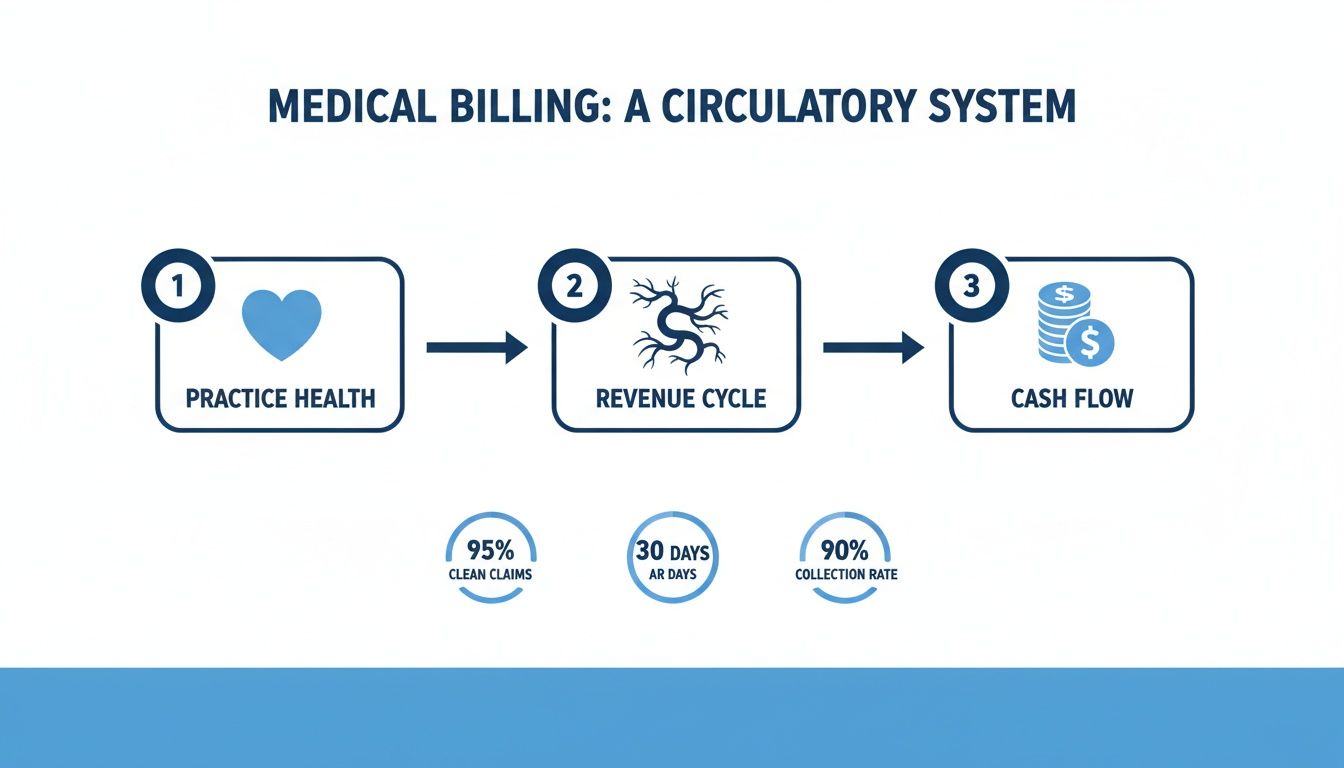
As you can see, a healthy practice depends on a smooth, continuous revenue cycle to maintain positive cash flow, much like a heart relies on clear arteries to keep blood pumping.
Step 4: Payment Posting And Reconciliation
When a claim is approved, the payer sends a payment to your practice, usually via an Electronic Funds Transfer (EFT). Along with that payment comes an Explanation of Benefits (EOB) or Electronic Remittance Advice (ERA), which breaks down exactly how the claim was processed and paid.
Payment posting is the act of recording this payment in your system and matching it to the right patient account. This isn't just data entry; it's a critical accounting step that confirms which claims are closed, flags any underpayments from the insurer, and clarifies the exact balance that is now the patient's responsibility.
Effective payment posting isn't just data entry; it's a financial reconciliation process that gives you a clear, real-time picture of your revenue. It closes the loop on successful claims and flags any discrepancies that need immediate attention.
Step 5: Patient Billing And Follow-Up
Finally, whatever balance remains after the insurance company has paid its portion is billed to the patient. This involves sending out a clear, easy-to-understand statement. Prompt, professional, and friendly patient billing is the final push needed to collect the last piece of your revenue.
The list below summarizes these key stages, offering a quick reference for mastering each part of the billing lifecycle.
Key Stages Of The Medical Billing Lifecycle
- Patient Registration & Verification: The core purpose is to collect accurate patient data and confirm active insurance coverage upfront. A pro-tip for small practices is to use a real-time eligibility tool. A 2-minute check here can save you weeks of rework later.
- Medical Coding & Charge Capture: The core purpose is to translate clinical services into standardized codes that justify reimbursement. A pro-tip is to create a "superbill" or charge sheet for your most common services to prevent missed charges.
- Claim Submission & Adjudication: The core purpose is to submit a clean, error-free claim to the payer for review and approval. A pro-tip is to scrub every claim with clearinghouse software before submission to catch typos and formatting errors.
- Payment Posting & Reconciliation: The core purpose is to accurately record payments, identify payer issues, and update patient accounts. A pro-tip is not just to post the payment but to reconcile the ERA/EOB against your contracted rates to spot underpayments.
- Patient Billing & Follow-Up: The core purpose is to collect the remaining balance from the patient in a timely and professional manner. A pro-tip is to offer online payment options. The easier you make it for patients to pay, the faster you'll collect.
This end-to-end workflow demands precision at every turn. You can discover the benefits of automating your medical billing workflow to help reduce manual errors and get paid faster. By mastering these five steps, your small practice can build the strong, predictable revenue stream it needs to thrive.
Solving Common Billing Pain Points
Every small practice owner knows the sting of a denied claim or a simple coding error. These aren’t just minor administrative hiccups; they're leaks in your revenue pipeline that, over time, can seriously threaten the financial health of your entire operation.
The good news? These common pain points are almost always solvable with the right systems and a proactive mindset.

The key is to reframe these challenges. Instead of seeing a denial as a dead end, think of it as a signal—an opportunity to find a weak spot in your process and fix it for good. By tackling these issues head-on, you can turn a reactive, stressful process into a predictable and efficient one.
Identifying And Fixing Common Errors
Most billing headaches boil down to a handful of recurring, preventable mistakes. The first step is learning to spot them. By building simple checks and balances into your workflow, you can catch these issues long before they ever leave your office.
Here are the most frequent culprits and how to stop them in their tracks:
- Incorrect Patient Data: A simple typo in a patient's name, birthdate, or policy number is one of the top reasons for an instant rejection. The fix: Implement a strict front-desk protocol to verify demographic and insurance info at every single visit, not just the first one.
- Coding Mistakes: Using an outdated, incorrect, or nonspecific code can trigger a denial for lack of medical necessity. The fix: Make sure your team has access to the latest coding manuals and gets regular training on updates. A simple "cheat sheet" for your practice's most common codes can also cut down on errors.
- Missed Filing Deadlines: Every insurance payer has a "timely filing" limit. Miss it, and you forfeit that revenue completely. The fix: Use your practice management software to set up alerts for claims approaching their filing deadlines so nothing falls through the cracks.
For small medical practices, this level of accuracy is directly tied to financial survival. Research shows just how costly these small errors can be, finding that poor billing practices cause U.S. physicians to lose an estimated $125 billion every year. A huge chunk of that loss comes from avoidable issues like the ones listed above.
Transforming Denial Management From A Chore To A Strategy
A claim denial can feel like a final judgment, but it’s really just the start of a conversation with the payer. A shocking percentage of denied claims are never appealed, meaning practices are voluntarily walking away from revenue they rightfully earned. An effective denial management process is a core part of successful medical billing for small practices.
A claim denial isn't a lost cause; it's a request for more information or a correction. A systematic approach to managing denials can recover a significant amount of revenue that would otherwise be written off.
Instead of tackling denials as they pop up, create a structured workflow. The goal is to understand the "why" behind each denial so you can prevent similar ones from ever happening again.
Building A Simple And Effective Appeals Process
When a claim gets denied, don't just resubmit it and hope for the best. Follow a clear, organized process to maximize your chances of getting paid.
- Analyze The Denial Reason: First things first, carefully read the Explanation of Benefits (EOB) or Electronic Remittance Advice (ERA). The payer will provide a reason code that explains exactly why the claim was denied (e.g., service not covered, requires prior authorization, duplicate claim).
- Gather Necessary Documentation: Depending on the reason, you may need to collect more information. This could include the patient's medical records, physician's notes to prove medical necessity, or proof of a prior authorization.
- Correct And Resubmit Or Appeal: For simple mistakes like a coding typo, you can often just correct the claim and resubmit it. For more complex issues, like a dispute over medical necessity, you'll need to file a formal appeal according to the payer's specific guidelines.
By creating this systematic approach, you turn chaos into order. For a more detailed walkthrough, you can explore our comprehensive guide on improving your medical billing denial management. This proactive strategy empowers your practice to take control of its revenue cycle and stop leaving money on the table.
Of all the hurdles a small practice faces, two of the most fundamental are credentialing and compliance. Before you can even think about submitting a claim, you have to clear these two steps. They aren't just administrative boxes to check; they're the non-negotiable requirements that give you the legal and contractual right to get paid for your work.
Think of it this way: Compliance, especially with regulations like HIPAA, is your license to operate in the healthcare world. It proves you can be trusted with highly sensitive patient data. Credentialing, on the other hand, is your official invitation to the party—it’s the process that gets you “in-network” with insurance companies, allowing you to bill them directly for your services.
Understanding The Credentialing Gateway
So, what exactly is provider credentialing? It’s the process insurance companies use to meticulously verify your qualifications, licenses, and professional history before they’ll agree to let you join their network. For a small practice, being out-of-network with the major local payers is a huge roadblock, making it tough to attract and keep patients.
Getting credentialed is your direct path to reimbursement from these key players.
Credentialing isn't just a mountain of paperwork; it's the formal process of building trust with payers. It confirms your legitimacy and is the first and most critical step in establishing a financial relationship with any insurance company.
While the process can feel painfully slow—often taking 90-120 days—it’s an essential investment of your time. If you fail to get credentialed or, just as bad, let your credentials lapse, any claims you submit will be automatically denied. That means your revenue stream from that payer shuts off completely.
Core Components Of The Credentialing Process
The journey to becoming an in-network provider involves a few key stages. The secret to getting through it without unnecessary delays? Staying organized.
- Gathering Your Documents: You'll need everything from your medical license and DEA certificate to proof of malpractice insurance and a detailed CV.
- Completing Payer Applications: Every insurance company has its own unique, and often lengthy, application. Accuracy here is everything. Even a small mistake can send you right back to the beginning.
- Verification and Approval: The payer will then independently verify all the information you provided. This is called primary source verification, and it happens before they make their final decision.
- Ongoing Maintenance: Don’t assume you’re done for good. Credentialing is not a one-time event. Re-credentialing is required every few years to make sure your information is still current.
Maintaining Strict Compliance With Healthcare Regulations
Beyond just getting paid, your practice has a serious legal duty to protect patient information. The Health Insurance Portability and Accountability Act (HIPAA) is the big one here, setting strict federal standards for how patient data is handled, stored, and shared.
For a small practice, a HIPAA violation can be absolutely devastating, leading to massive fines and irreparable damage to your reputation. Being compliant means having clear policies for everything, from which employees can access patient records to the security of your billing software.
The sheer complexity of regulations has made medical billing disproportionately challenging for small practices, and it’s only getting tougher. One recent survey found that nearly 10% of medical claims are rejected on the first submission, forcing providers into a time-consuming rework cycle. You can learn more about the top medical billing challenges that practices face. Taking compliance seriously isn't just good practice—it's your best defense.
Outsourcing Your Medical Billing: A Strategic Choice
Deciding how to handle your practice’s billing is one of the biggest financial choices you'll make. Many small practices default to keeping it in-house, assuming it's cheaper and offers more control. But that assumption often ignores the true, hidden costs of running a complex billing operation.
Don't frame the choice as simply "in-house vs. outsourced." Think of it as a strategic business decision. What is the most efficient, profitable, and sustainable way to manage the financial heart of your practice? For more and more clinics, the answer is partnering with a dedicated billing service.
The Real Cost Of In-House Billing
Managing medical billing for small practices internally is so much more than just an employee's salary. When you add everything up, the numbers often tell a surprising story. The true cost includes not just direct expenses but also major indirect and opportunity costs.
Think about the full investment required:
- Salaries and Benefits: This isn't just a competitive wage. It includes health insurance, retirement contributions, and payroll taxes for your billing staff.
- Training and Education: Medical coding and payer rules change constantly. You have to invest in ongoing training to keep your staff current and avoid expensive mistakes.
- Software and Technology: You're on the hook for buying, maintaining, and upgrading billing software, clearinghouse access, and all the secure IT that goes with it.
- Hidden Operational Costs: What happens when your biller takes a vacation, calls in sick, or quits? The billing process grinds to a halt, cash flow dries up, and you’re left scrambling to hire someone new.
The biggest hidden cost of in-house billing is often the burden it puts on you, the provider. Every hour you spend fighting with payers, managing staff, or worrying about cash flow is an hour you aren’t spending on patient care or growing your practice.
The Strategic Advantages Of Outsourcing
Partnering with a professional revenue cycle management (RCM) service is about more than just handing off tasks; it’s about gaining a dedicated financial partner. These specialized teams bring an economy of scale a small practice can rarely match, giving you access to expertise and technology that directly boosts your bottom line.
The economics have shifted, making outsourcing a powerful cost-control strategy. Research shows that outsourcing can save a practice $30,000–$50,000 per year just by avoiding the salary and benefits of one full-time in-house biller. On top of that, administrative costs tied to billing can be cut by 30–40% because specialized services use standardized, efficient workflows.
Questions To Ask A Potential Billing Partner
Choosing the right partner is everything. When you're evaluating potential services, you need to look for transparency, deep expertise, and a genuine commitment to your practice's unique needs.
To help you find the right fit, here’s a checklist of essential questions to ask.
- What is your experience with my specific specialty? A cardiologist’s billing challenges are completely different from a pediatrician’s. A partner with proven experience in your field will be far more effective from day one.
- How do you measure and report on performance? Look for a company that gives you clear, regular reports on key metrics like your Clean Claim Rate, Days in A/R, and Net Collection Rate. You need total visibility.
- What is your process for managing denials and AR follow-up? A great partner doesn’t just submit claims and hope for the best. They should have a proactive, systematic process for appealing every denial and chasing down every unpaid claim.
- How do you ensure compliance with HIPAA and other regulations? Your partner must have rock-solid security and a deep understanding of healthcare compliance. This protects you, your practice, and your patients.
Asking these critical questions helps you move beyond a simple price comparison to find a true strategic ally. To explore this topic further, read our guide on how outsourcing medical billing can save your practice time and money.
Measuring Success With Key Billing KPIs
You can't improve what you don't measure. In the world of medical billing for small practices, that isn’t just a saying—it’s a fundamental truth. Simply pushing claims out the door and hoping for the best is a recipe for financial uncertainty. If you really want to take control of your practice's revenue, you need to track your performance using Key Performance Indicators, or KPIs.

Think of KPIs as the vital signs of your practice's financial health. They're much more than just numbers on a spreadsheet; they tell you what’s working, what’s broken, and where you have opportunities to grow. Monitoring these metrics transforms billing from a reactive chore into a proactive, data-driven strategy.
The Most Important KPIs For Small Practices
While you could track dozens of metrics, a few core KPIs give you the clearest picture of your revenue cycle performance. Focusing on these essentials will deliver the most valuable insights without overwhelming your team.
Clean Claim Rate (CCR)
Think of this as your "first-pass success rate." The Clean Claim Rate measures the percentage of claims accepted by a payer on the very first submission, with no errors or rejections. A high CCR is a powerful sign that your front-end processes—like eligibility checks and accurate coding—are firing on all cylinders.
- What It Reveals: The overall accuracy and efficiency of your pre-submission workflow.
- Ideal Benchmark: A healthy practice should aim for a CCR of 95% or higher.
Days In Accounts Receivable (A/R)
This KPI tracks the average number of days it takes for your practice to collect payments. A high Days in A/R number is a major red flag. It means cash is tied up in unpaid claims and your follow-up process might be lagging. The goal here is simple: keep this number as low as possible.
- What It Reveals: The speed and effectiveness of your collections process.
- Ideal Benchmark: A strong target for small practices is under 40 days.
Monitoring your Days in A/R isn't just an accounting task; it's a direct measure of your practice's cash flow efficiency. Every day you shave off this number puts money back into your practice faster, where it can be used for patient care and growth.
Net Collection Rate (NCR)
This is the ultimate measure of your practice's ability to collect the money it's rightfully owed. The Net Collection Rate calculates the percentage of the allowed reimbursement that you actually collect from both payers and patients. It shows how much potential revenue is slipping through the cracks due to things like uncollectible debt, billing errors, or missed filing deadlines.
- What It Reveals: The overall effectiveness of your entire revenue cycle, from submission to final payment.
- Ideal Benchmark: Top-performing practices typically achieve an NCR of 96% or higher.
Essential Medical Billing KPIs And Industry Benchmarks
To help you get started, here's a quick-reference guide to the key metrics every small practice should track to monitor its financial health.
- Clean Claim Rate (CCR): This KPI measures the percentage of claims accepted on the first submission. The ideal benchmark for a healthy practice is 95% or higher.
- Days in Accounts Receivable (A/R): This KPI measures the average number of days it takes to collect payments. The ideal benchmark is under 40 days.
- Net Collection Rate (NCR): This KPI measures the percentage of allowed reimbursement your practice actually collects. The ideal benchmark is 96% or higher.
- Denial Rate: This KPI measures the percentage of claims denied by payers. The ideal benchmark is under 5%.
By consistently tracking these core KPIs, you can move from guessing to knowing. You’ll have the data-driven insights needed to spot problems early, make smarter decisions, and actively steer your revenue cycle toward long-term profitability.
Frequently Asked Questions About Medical Billing
Getting into the weeds of medical billing always brings up a few practical questions. We hear these all the time from small practice owners, so we've put together some straightforward answers to give you clarity and confidence as you fine-tune your practice's financial health.
How Does Billing Software Integrate With An EHR?
Think of your billing software and your Electronic Health Record (EHR) as two sides of the same coin—they need to talk to each other. Most modern billing software is built to connect directly with your EHR or Practice Management (PM) system, creating a seamless bridge between your clinical and financial operations.
This connection is what stops you from having to manually re-enter patient information, appointment details, or superbills. Instead, everything from demographics to encounter notes flows automatically. It pulls the diagnosis (ICD-10) and procedure (CPT) codes right from the clinical documentation and tees them up for a claim. This not only saves a massive amount of time but also cuts down on the kind of data entry mistakes that lead to instant denials.
What Is The Typical Cost For A Billing Service?
When you outsource your billing, the pricing usually falls into one of two buckets. The most common model is a percentage-based fee, where the billing service takes a cut of your total monthly collections. This typically ranges from 4% to 10%. The beauty of this model is that your billing partner’s success is tied directly to yours—they get paid when you get paid.
The other option is a flat fee per claim. This can work well for practices with a very predictable, steady stream of claims. For most small practices, however, the percentage model is a better fit. It offers more predictable costs and gives your billing partner a real incentive to fight for every dollar you've earned. If you want to see how we structure our pricing, you can read more about our billing services for small practices or solo providers.
What Should I Expect During Onboarding?
Switching to a new billing partner should feel like a well-orchestrated handoff, not a chaotic scramble. The process usually kicks off with a discovery phase. This is where the billing team gets to know your practice inside and out—your specialty, your common procedures, your payer mix, and the software you're currently using.
After that, they'll work with you to set up a secure, HIPAA-compliant connection to your EHR/PM system.
A smooth onboarding process is a key indicator of a professional billing partner. It should feel like a partnership from day one, with clear communication, defined timelines, and a dedicated point of contact to guide you through each step.
Finally, they’ll get their systems configured with all your practice's information, from provider credentials to your specific payer contracts. A good partner handles all the heavy lifting during this period, which usually takes a few weeks, while keeping you in the loop every step of the way.
Ready to stop worrying about billing and start focusing on your patients? One For All Medical Billing combines specialty-specific expertise with dedicated support to help your practice get paid faster and with less hassle. Schedule your free consultation today.

