

table of contents
Revenue Cycle Management (RCM) is the entire financial journey a patient's account takes through your practice. It kicks off the second a patient books an appointment and doesn't end until their balance is fully paid.
Think of it as the financial circulatory system of your medical practice. It’s what keeps the lights on.
Understanding Revenue Cycle Management In Healthcare
Imagine your practice's finances like a complex circulatory system. Just as blood carries essential oxygen and nutrients to every part of the body, your revenue cycle delivers the cash flow needed to keep your operations healthy and thriving.
Any blockage or slowdown can cause serious problems, affecting everything from making payroll to delivering quality patient care. This is exactly what Revenue Cycle Management oversees. It’s far more than just sending out bills; it's a strategic, end-to-end process that protects your financial vitality.
The Financial Lifeline Of Your Practice
Effective RCM is the true financial backbone of any modern healthcare practice. It’s the bridge connecting the clinical side of your practice (providing care) with the administrative side (getting paid).
When that bridge is strong, your practice runs on predictable cash flow with fewer administrative headaches. But when it’s weak? You’ll start seeing the symptoms: rising claim denials, aging accounts receivable, and a frustrated, overworked staff.
The whole system breaks down into three core areas:
- Front-End Processes: This is your first impression. It includes patient registration, insurance eligibility verification, and handling prior authorizations.
- Mid-Cycle Processes: This is where care meets coding. It covers clinical documentation, charge capture, and making sure every service is coded accurately.
- Back-End Processes: This is the follow-through. It involves claims submission, payment posting, denial management, and final patient collections.
Each stage is directly linked to the next, meaning a tiny error during registration can snowball into a costly denial weeks down the line. You can dive deeper into these stages and other key topics in our medical billing articles.
Revenue Cycle Management is the art and science of ensuring that the care you provide is properly documented, coded, billed, and reimbursed, safeguarding the financial health of your practice so you can focus on patient health.
Why A Solid RCM Strategy Matters Now
Getting RCM right has never been more critical. Healthcare is getting more complex, and payer rules are getting tighter, making it a real challenge to maintain financial stability.
The numbers tell the story. The global RCM market is projected to skyrocket from USD 169.69 billion in 2025 to USD 451.29 billion by 2034, according to recent revenue cycle management market research. This explosive growth is driven by one simple need: greater efficiency.
The trend is crystal clear: practices that invest in optimizing their revenue cycle are the ones best positioned for long-term success.
A Step-By-Step Breakdown Of The RCM Process
The revenue cycle isn’t a single action—it’s a carefully choreographed sequence of events. Think of it less like a sprint and more like a relay race, where a smooth handoff between each stage is critical. A small fumble at the beginning can cause major disruptions weeks or even months down the line, turning a straightforward claim into a financial headache.
To really get a feel for how revenue moves through your practice, we need to trace its path from start to finish. The journey is generally broken down into three core phases: the front-end, the mid-cycle, and the back-end. Each phase has its own job to do, building on the last to form a chain where every single link matters.
This visual shows the high-level flow of revenue between the patient, your practice, and the payer.
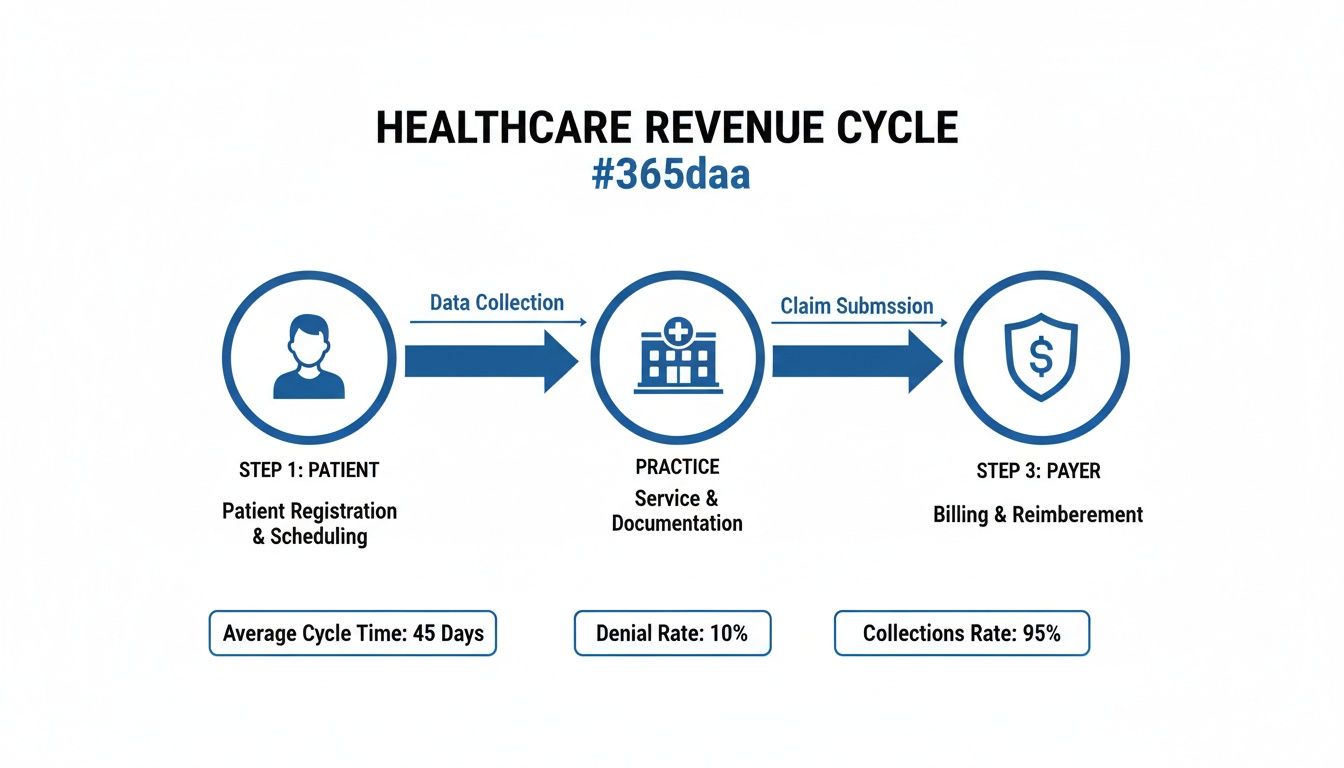
As you can see, it's designed to be a smooth, linear process. When it works well, your practice stays financially healthy. When it doesn't, a bottleneck in one area can bring everything to a halt.
Front-End RCM: The Foundation Of Your Revenue
The front-end is where your revenue cycle officially kicks off. It covers all the administrative tasks that happen before or right at the time of a patient’s visit. Honestly, this is arguably the most important stage for preventing problems later. Getting these steps right sets the stage for a clean claim and quick payment.
Think of the front-end like pouring the concrete foundation for a house. If that foundation is weak, cracked, or uneven, the entire structure you build on top of it will be unstable. The same is true for your RCM process—errors here will absolutely compromise everything that follows.
The main front-end jobs include:
- Patient Registration and Scheduling: This is where your team collects accurate demographic and insurance information. Even a simple typo in a name or a policy number can trigger an instant claim denial.
- Insurance Eligibility and Benefits Verification: Before the patient even walks in the door, your team needs to confirm that their insurance is active and actually covers the planned services. Studies show that a staggering 75% of claim denials are tied to issues that could have been caught right here, like inactive coverage or registration errors.
- Prior Authorization: Many payers require pre-approval for certain procedures, tests, or medications. Failing to secure a necessary prior authorization is one of the most common—and most expensive—reasons for denials, leaving your practice with revenue you can't collect.
A proactive front-end process is the single best defense against claim denials. Verifying patient information and securing authorizations upfront prevents the vast majority of common billing headaches.
These initial steps are non-negotiable. Clean data collected here ensures that when a claim is created later, it has the highest possible chance of getting accepted and paid on the first try.
Mid-Cycle RCM: Translating Care Into Cash
Once the patient has been seen, the focus shifts to the mid-cycle. This part of the process is all about documentation and translation—taking the clinical services your team provided and converting them into the standardized codes that insurance payers need to see.
This is where the clinical world officially meets the financial world. Accuracy is everything. The codes assigned here will determine the exact reimbursement your practice receives for its services.
Key mid-cycle functions are:
- Clinical Documentation: The physician has to create a detailed, accurate record of the patient encounter, including diagnoses, treatments, and any procedures performed. This documentation is the source of truth for all billing activities that follow.
- Charge Capture: This is simply the process of logging all billable services. A missed charge means lost revenue, plain and simple. An incorrect charge can lead to compliance issues or claim rejections.
- Medical Coding: Certified coders review the clinical documentation and assign the right ICD-10 codes (for diagnoses) and CPT/HCPCS codes (for procedures and services). This takes real expertise, as coding rules are complex and seem to change constantly.
Proper coding is both a science and an art. It demands precision to stay compliant while also making sure you’re being reimbursed for all legitimate work. To keep up with the frequent changes, you can learn more by reading our complete guide on the latest ICD-10 coding updates.
Back-End RCM: Securing And Finalizing Payment
The back-end is the final leg of the journey, where the claim is finalized, submitted, and managed until the account is fully paid. If the front-end and mid-cycle stages were handled correctly, the back-end should be relatively smooth. But this is also where any earlier mistakes finally surface as claim denials or payment delays.
This last phase is all about persistence and follow-through. It’s not enough to just send a claim out into the world and hope for the best. The back-end team has to actively manage it until every dollar owed is collected.
The critical back-end processes include:
- Claims Submission: The coded claim is "scrubbed" for errors one last time and then transmitted electronically to the insurance payer. The goal is always to submit a clean claim—one that’s totally error-free and can be processed without a single hiccup.
- Payment Posting: As payments come in from payers, they must be posted accurately to the corresponding patient accounts. This step reconciles what was billed with what was paid, flagging any discrepancies or underpayments.
- Denial Management: When a claim gets denied, the back-end team has to investigate why, fix any errors, and resubmit the claim or file a formal appeal. An effective denial management strategy is crucial for recovering revenue that would otherwise be lost for good.
- Patient Collections: Finally, any remaining balance after insurance has paid its share (like deductibles or copayments) is billed to the patient. This involves sending clear statements and offering easy payment options to close out the account.
Each of these three phases—front-end, mid-cycle, and back-end—must work in perfect harmony. A breakdown in one stage immediately creates a mess for the next, showing exactly why a holistic view of the revenue cycle is so vital for a practice's financial well-being.
The True Impact Of A Healthy Revenue Cycle
It’s one thing to understand the individual steps of the revenue cycle, but it’s another to see the powerful ripple effect of a well-oiled system. When your practice stops just processing claims and starts strategically managing revenue, the impact is felt far beyond the billing department.
A healthy revenue cycle isn’t just about the numbers; it’s about building a more stable, efficient, and patient-focused practice. The benefits compound over time, creating a positive feedback loop. Faster payments improve cash flow, which reduces operational stress and frees up capital to invest in better patient care. That, in turn, boosts patient satisfaction and retention, further securing your practice’s future.
Boosting Your Bottom Line Directly
Let's start with the most obvious benefit: a stronger financial position. When every stage of the cycle works in harmony—from clean patient registration to aggressive denial follow-up—your practice sees real, tangible results. It directly strengthens the key financial metrics that determine your profitability and long-term survival.
A healthy RCM process accomplishes several financial goals at once:
- Accelerated Cash Flow: By submitting clean claims the first time around, you drastically shorten the time it takes to get paid. This closes the gap between providing a service and receiving payment, ensuring a steady, predictable stream of income.
- Lower Days in Accounts Receivable (A/R): This KPI is a direct measure of how long your money is tied up in unpaid claims. Efficient RCM systematically drives this number down, putting money back into your practice where it belongs.
- Increased Net Collection Rate: An optimized process ensures you collect every dollar you’re contractually owed. This involves catching underpayments and successfully fighting denials, directly adding to your net revenue.
A streamlined revenue cycle transforms your billing from a reactive, administrative chore into a proactive, strategic asset. The goal is simple: get paid fully and promptly for every single service you provide.
The scale of administrative waste in healthcare is staggering. One of the most eye-opening statistics is that RCM activities alone cost U.S. hospitals over $160 billion annually. This figure, which makes up more than 40% of total hospital spending, screams inefficiency. It’s exactly why providers nationwide turn to specialized partners for denial reduction and faster collections. You can learn more about these U.S. healthcare RCM market insights and see the bigger picture.
It's About More Than Money—It’s About Your People
While financial health is the primary goal, the operational benefits of a smooth revenue cycle are just as important. A chaotic billing process creates constant stress, frustration, and administrative fires that your staff are forced to put out. This leads directly to burnout, high turnover, and a distracted work environment.
When your RCM is dialed in, it frees your team from tedious, repetitive tasks. Instead of chasing down missing information or fighting with payers over avoidable denials, they can focus on higher-value work that actually improves the patient experience. This shift creates a calmer, more productive workplace where employees feel more effective and engaged.
Safeguarding Your Practice’s Future
Finally, a robust RCM process is non-negotiable for compliance and risk management. Payer rules and healthcare regulations are a moving target, and failing to keep up can lead to costly penalties, audits, or even legal trouble.
A well-designed revenue cycle has built-in checks and balances to ensure every claim is accurate and compliant before it ever leaves your system. This protects your practice from financial risk and maintains your good standing with both government and commercial payers. By making compliance a priority at every step, you aren't just collecting revenue today—you're safeguarding your practice’s operational and financial stability for years to come.
Essential RCM Metrics Your Practice Must Track
You can't manage what you don't measure. When it comes to your revenue cycle, relying on gut feelings is a recipe for disaster. You need hard data, and that’s where Key Performance Indicators (KPIs) come in.
Think of KPIs as the diagnostic dashboard for your practice's financial health. They translate all the complex, day-to-day RCM activities into clear, actionable numbers, showing you exactly where things are running smoothly and where they’re breaking down. Monitoring these metrics is the difference between just processing claims and strategically managing your revenue.

What Your Numbers Are Telling You
To get a complete picture, you need to track metrics across the entire revenue cycle—from the front desk all the way to final payment. This gives you a holistic view, helping you spot small issues before they snowball into major cash flow problems. A sudden dip in one area often signals a problem that needs immediate attention.
So, where should you start? Let's break down the most important metrics into a simple framework.
A solid set of KPIs acts as your financial early-warning system. Here are the core metrics every practice should be watching, broken down by what they measure and what "good" looks like.
Essential RCM Key Performance Indicators (KPIs)
Clean Claim Rate (CCR)
- What It Measures: The percentage of claims accepted by a payer on the first submission without any errors. This is a direct reflection of your front-end accuracy.
- Industry Benchmark: Aim for 95% or higher. Anything below 90% is a red flag.
Denial Rate
- What It Measures: The percentage of claims denied by payers. A high rate points directly to revenue leakage and administrative rework.
- Industry Benchmark: Keep this under 5%. Rates between 5-10% are average but need improvement.
Days in A/R
- What It Measures: The average number of days it takes to collect payment after a service is provided. This is a critical indicator of cash flow health.
- Industry Benchmark: Excellent: <30 days. **Concerning:** >50 days.
Net Collection Rate
- What It Measures: The percentage of the total allowed reimbursement you actually collect. This tells you how effective you are at collecting every dollar you're owed.
- Industry Benchmark: A healthy rate is 95-99%.
Tracking these numbers is non-negotiable for building a resilient revenue cycle. They tell a story about your practice's operational efficiency and financial stability. Without them, you’re flying blind.
Tying It All Together
Let's put this into perspective. Your Clean Claim Rate (CCR) is your best measure of front-end performance. A high CCR—ideally 95% or more—means your team is nailing patient registration and eligibility checks, setting every claim up for success from the start.
On the other end, your Denial Rate reveals how well your back-end team manages claims after submission. The industry average hovers between 5% and 10%, but top-performing practices keep this number under 5%. Remember, it’s not just about tracking the rate; it’s about digging into the reasons for denials to fix the root cause.
Understanding why claims are denied is more important than knowing that they are denied. This insight allows you to fix the core problem instead of just treating the symptom, creating a more resilient revenue cycle over time.
Finally, Days in Accounts Receivable (A/R) gives you that high-level view of your entire RCM engine's efficiency. This KPI shows the average time it takes to get paid. A lower number means faster cash flow, which is the lifeblood of any practice.
Here are the A/R benchmarks to aim for:
- Excellent: Fewer than 30 days
- Good: 30 to 40 days
- Average: 40 to 50 days
- Concerning: Over 50 days
Consistently monitoring these metrics allows you to make data-driven decisions that protect your bottom line. It's fundamental to what revenue cycle management is all about. For more on how we ensure data transparency, you can find details in our FAQs about whether you will receive regular performance reports.
The Future Of Revenue Cycle Management
The world of Revenue Cycle Management isn't standing still. If you think the old-school, paper-heavy processes are going to cut it tomorrow, think again. The entire financial journey in healthcare is getting an upgrade—becoming smarter, more automated, and far more focused on the patient.

We're seeing a fundamental shift in what's possible. RCM is moving from a reactive, administrative headache to a proactive, strategic advantage. For practices ready to embrace what’s next, these trends offer a clear path to better financial health and smoother operations.
Automation And Artificial Intelligence
Leading the charge are Artificial Intelligence (AI) and automation. These aren't just buzzwords; they're powerful tools taking over the repetitive, time-sucking tasks that have bogged down billing teams for years. This frees up your people to focus on high-value work, like digging into denial trends or having meaningful financial conversations with patients.
The impact is already huge. AI-driven tools are poised to generate up to $360 billion in annual U.S. savings by making billing smarter, catching errors before they happen, and even predicting denials.
Here’s what these intelligent systems are already doing:
- Predictive Denial Management: Imagine knowing a claim is likely to be denied before you send it. AI analyzes your historical data to flag high-risk claims, giving your team a chance to fix issues upfront.
- Automated Coding Suggestions: Using Natural Language Processing (NLP), these tools can scan a provider's clinical notes and suggest the most accurate medical codes. This reduces human error and ensures you’re coding to the highest level of specificity.
- Intelligent Claim Scrubbing: Think of it as an expert spell-checker for your claims. The system automatically runs each claim against thousands of constantly updated, payer-specific rules to boost clean claim rates.
To get a better handle on this, check out our guide on how AI is changing medical billing.
Emphasis On The Patient Financial Experience
The other massive shift is the laser focus on the patient financial experience. With high-deductible health plans becoming the norm, patients are now major stakeholders in their healthcare costs. They expect the same clarity and convenience from their doctor’s bill that they get from any other consumer service.
The future of RCM understands that a positive patient financial journey is just as crucial as a positive clinical one. Clear communication and simple payment options are no longer nice-to-haves—they're essential for both patient satisfaction and your practice's bottom line.
This means giving patients tools that empower them, not confuse them. We’re talking about things like:
- Accurate, easy-to-understand cost estimates before a service is performed.
- Clean, consolidated billing statements that make sense at a glance.
- Multiple digital ways to pay, from online portals to mobile payment apps.
When you improve price transparency and make it simple for patients to settle their bills, you’ll see patient collections speed up dramatically. You’ll also spend less time and money chasing down bad debt. This patient-first mindset is truly the cornerstone of any modern RCM strategy.
Actionable Steps To Improve Your RCM Strategy
Understanding your revenue cycle is the first step. Taking action is what actually drives financial growth. The good news is that improving your RCM performance doesn’t mean you have to overhaul everything overnight. It all starts with a few deliberate, practical steps that build momentum and deliver real results.
This roadmap will give you a clear path forward, whether you handle billing in-house or you’re thinking about bringing in a partner. The goal is simple: get paid faster, shrink your denial rate, and lift the administrative weight off your team’s shoulders so you can get back to what matters—patient care.
Conduct A Thorough Internal Audit
Before you can fix a problem, you have to find it. A comprehensive internal audit is the non-negotiable starting point for any meaningful RCM improvement. This isn't just a quick glance at the numbers; it's a deep dive into every workflow, from the front desk to the back office, to pinpoint exactly where revenue is leaking out.
Start with your key metrics. Is your denial rate slowly climbing? Are your Days in A/R creeping up month after month? Those numbers are your breadcrumbs—they tell you where to look first. The idea is to uncover the root causes of your biggest headaches, not just the symptoms.
Key areas to investigate during your audit include:
- Front-End Accuracy: Take a hard look at your patient registration and insurance verification. Are you consistently capturing the right demographic and policy information? A single typo here can derail an entire claim.
- Coding and Documentation: Pull a sample of recent claims. Does the clinical documentation truly support the codes being billed? This is a common source of both denials and compliance risk.
- Denial Trends: Don't just look at the denial rate; categorize your denials by reason and by payer. Are you constantly getting hit with the same prior authorization or medical necessity issues from a specific insurer?
Evaluate Your Team And Technology
Once you have a clear picture of your performance gaps, it's time to assess your resources. Does your team have the right training and tools to actually win this fight? The rules of medical billing are in constant flux, and ongoing education is the only way to keep your staff’s skills sharp.
Your technology stack is just as critical. An outdated Practice Management (PM) system can create bottlenecks and inefficiencies that handcuff even the best team. For example, exploring the benefits of automating your medical billing workflow can be an eye-opener, showing how modern tools slash manual errors and get cash in the door faster.
The most effective RCM strategies are built on a foundation of well-trained people and modern, efficient technology. Investing in both is a direct investment in your practice's financial health.
When you're evaluating your capabilities, be honest. Can your current setup truly handle the complexities of modern RCM? This assessment often makes it painfully clear whether it’s time to seek outside help. Partnering with an external expert isn’t admitting defeat; it’s a strategic decision to access specialized knowledge and advanced technology without a massive upfront investment, securing a much healthier financial future for your practice.
Common Questions About RCM
Even with a full breakdown, it's natural to have a few lingering questions. Let's tackle some of the most common ones we hear from practice leaders trying to get a handle on their revenue cycle.
What’s The Difference Between RCM And Medical Billing?
This is a great question, and the answer is all about scope.
Think of medical billing as a critical part of the RCM process. It’s the backend work—creating the claim, sending it to the payer, and posting the payment when it comes in. It’s absolutely essential, but it’s a specific set of tasks.
Revenue Cycle Management, on the other hand, is the entire financial journey of a patient visit. RCM starts the moment a patient schedules an appointment (with registration and insurance verification) and doesn't end until the final balance is paid. It covers everything from the front desk to the back office, including coding, claims, denials, and patient collections.
In short, medical billing is a key function, but RCM is the whole financial ecosystem.
How Long Does A Typical Revenue Cycle Take?
This varies a lot depending on your specialty, your payers, and how efficient your internal processes are. A healthy, well-oiled RCM machine should aim to get claims paid within 30 to 45 days of the service date.
But if things get messy—with constant denials, slow A/R follow-up, or sloppy front-end data collection—that cycle can easily stretch to 60, 90, or even 120 days. A primary goal of smart RCM is to shrink that timeline and keep cash flowing predictably.
What Are The First Steps To Outsourcing RCM?
Thinking about bringing in a partner is a big move, but getting started is simpler than you might think.
- Take a Quick Internal Snapshot: Before you do anything else, look at your numbers. What’s your denial rate? How old is your A/R? Knowing your biggest pain points gives you a clear starting line.
- Set Your Goals: What does success look like for you? Are you trying to slash denials, get cash in the door faster, or just give your staff some breathing room? Be specific.
- Talk to an Expert: The best next step is a simple conversation. A consultation with an RCM specialist can help you diagnose your practice's specific issues and map out a clear path to better financial health.
Ready to see how a dedicated partner can transform your practice’s financial health? One For All Medical Billing combines decades of expertise with a commitment to getting you paid faster and with less stress. Schedule your free consultation today.

